
The field of electronic entertainment, our self-selected area of exploration, is vast. On one end you have visceral creations that we don’t even bother with, games that are mostly about pointing at people in a virtual world and shooting them. On the other, we have esoteric creations of pure mathematics like Conway’s Game of Life.
How well-known would you consider Conway’s Life to be? By one measure it’s incredibly obscure, in that if you ask a random person on the street if they know about it they’ll probably at best think you’re talking about Hasbro’s Game of Life, a simple board game where players pilot colored pegs riding in a tiny plastic car down a winding road from birth to retirement, a buffet of unexamined assumptions with a long history which itself may be worthy of exploration here itself some day.
But by another yardstick, few games are more well-known than Conway’s Life. It was created 55 years ago, in 1970, by British mathematician John Horton Conway, meaning it’s Older than Pong. It’s not technically just a computer game, but its explorations have grown so huge that practically everyone who cares simulates it on a computer.
When I say it’s a creation of pure mathematics, please don’t be scared off, because it’s really simple to understand. It was a popular subject of Martin Gardner’s Mathematical Recreations columns in Scientific American.
Imagine an infinite grid, a pocket universe that’s like an Excel spreadsheet that goes on forever. Each cell can contain a counter, which is considered “alive,” or nothing, which is considered “dead,” or just empty. From there, you use a simple process to simulate this universe.
You don’t have to worry about physics or gravity or free will. Instead, every counter on the grid with less than two neighbors dies (is removed) due to loneliness; every counter with more than three dies due to overcrowding; and on every empty space with exactly three neighbors is birthed a new counter. By “neighbors,” I mean on one of the eight spaces around it. By “birthed,” I note that reproduction in the world of Life is genderless and trinary.
So that’s how to do it. But why would you? It’s because despite its simplicity, Life patterns grow by unexpected and interesting processes. It’s a case of emergent complexity; like how DNA molecules ultimately produce living creatures in our world, simple origins create hugely complex results. That similarity of complexity to our universe is why it’s called a “game of life.”
A better introduction can be found at this page at Cornell University. It’s a type of cellular automation, a wider field with many game design implications. You could consider classical roguelikes to be a type of cellular automation, although not nearly as simple, or as elegant. Within the world of Conway’s Life there are Gliders, Oscillators, Wicks, Puffers, Guns, Methuselahs, Spaceships and more. While there aren’t physics as we consider them, there is a “speed of light.”
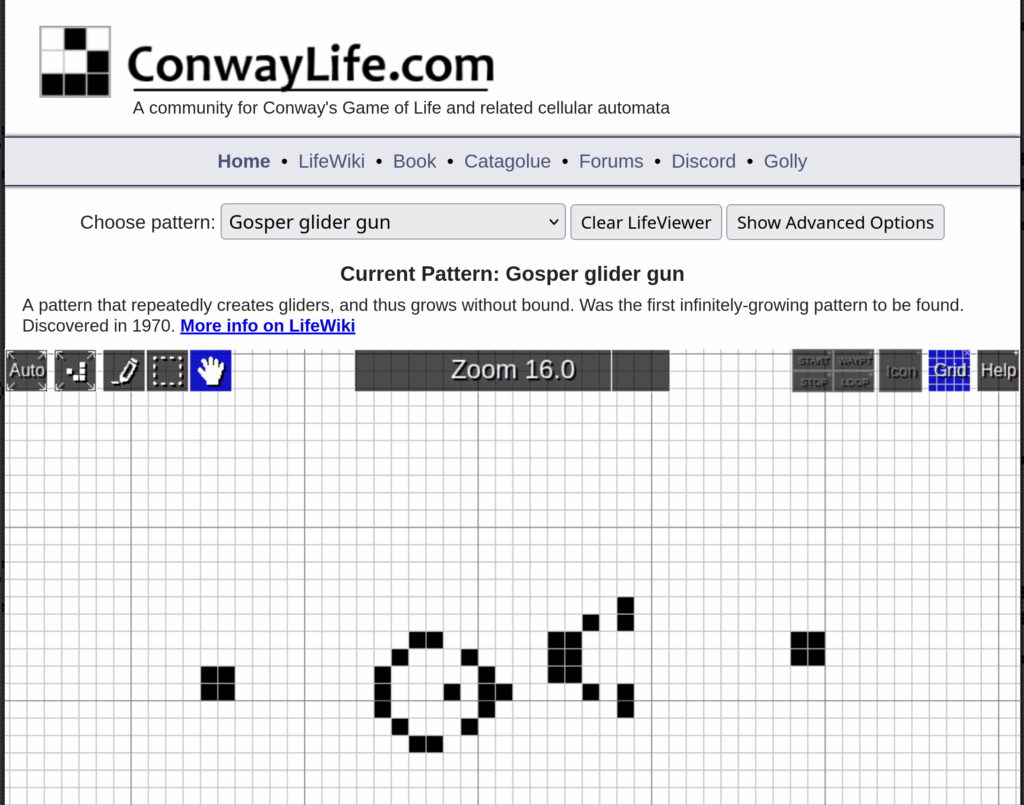
The website ConwayLife.com, created probably some time in 2009, is one of those many websites out there that invisibly hosts active communities that big media sites routinely ignore, the kind of thing that Set Side B carries both a banner and a deep affection for. There was a time where sites like this were a major focus of the World Wide Web, and it still is, even if the wider world fails to notice it. ConwayLife.com hosts a simulator on its homepage, a wiki of concepts, an active forum, a well-populated list of links, and even a Discord.
Please, those of you who read this, try to move your interest in the direction of exploring this strange but fascinating phenomena. Maybe it’ll bounce off of you, but maybe it won’t.
