
The Miracle of C64 Salamander

The Commodore 64 has many great games, but it tends to be best suited for computer-style games. When you compare it to the NES, for instance, it’s usually for Japanese-made action games. In Japan, hundreds of programmers had the Famicom boom to get better at the platform, and the system itself has an entire off-screen area of the screen to use as a scroll buffer. The C64 only had eight pixels of scroll buffer. There were scrolling games on the C64, even fast ones (I point to Andrew Braybrook’s Uridium and Paradroid that show the Commodore at its scrolling best), but it’s just a fact that the Famicom/NES was just better at it, and it was a time when there were lots of scrolling games coming in out of arcades.

I would like to highlight a particular case where the C64 acquits itself fairly well: its version of Konami’s Salamander, a.k.a. Life Force in some territories.

There’s a ton of scrolling C64 games that don’t hold up well. Take Strider, for instance. It tries to be a lot more like the arcade game than the NES version, I’ll give it that, but at the cost of all of its bosses, most of its speed, and it doesn’t even end very well, it just stops, feeding the player a line about having passed a test. Urk! If you want to see what I mean, have a look (11 minutes), but frankly why would you want to?

Here’s C64 Strider, but if you’re played the arcade version it’ll only make you sad.

There are good arcade, and arcade-style, games on the platform, and when they’re done well they can make the platform, quite literally, sing–the C64 has a terrific sound synthesizer chip. Ghosts & Goblins is often held aloft as a good example of a good C64 conversion, but although it has an iconic song, it only has one song, it’s not the classic tune from the arcade game, and it’s only got four levels. It plays a lot more smoothly than the NES version (7 minutes), but c’mon, Micronics made that one.

It runs at a good frame rate, has a great and spooky tune, and it manages to load four levels into the C64’s RAM at once, but it’s missing the last two levels and its two major bosses. And yet, it’s still a technical feat on the C64. BTW, there’s a 2015 port of GnG to the Commie (download) that’s better than the NES version in just about every way.

The C64 version of Life Force also only has four levels, but they’re very remarkable levels, impressively like the arcade game. It has a different tune for each stage! They actually sound like the arcade game! And one of the levels is the “Prominence Stage,” the most eye-catching part of the arcade and NES games, and it holds up (11 minutes), the flaming solar surfaces are animated, and the solar flares are just as deadly as in the other versions. It even exceeds the NES version in a couple of ways: your ship tops out at three Options instead of the NES’s two, and the Ripple and Laser beams are impressively flicker-free, since they’re drawn with background tiles, a feat the NES has trouble duplicating due to its background tile drawing limitations.

Is it equal to the NES version? Well… I can’t say that it is. And the Famicom version lets you have three Options, so the C64 version loses ground there too. But look at it! For the levels it has, the C64 really does its best to match the arcade. (If you’re surprised that the second level is different, the Famicom/NES puts the vertical mountain level there; the C64 sticks more closely to the arcade game, where the second stage is an asteroid belt.)

So even though the C64 port is about as good as you can expect from a 1983 computer with only eight hardware sprites, the Famicom/NES port is also great. Oh well, C64 users can content themselves to having a much better version of M.U.L.E., the NES version stinks.

From Destructoid: Gex Recriminations

The Suck Fairy is a mischievous spirit who visits the beloved properties of our youths so that when we return to them they’re much worse than they were when we first found them. That is surely the explanation; it’s not that we’re much more knowledgeable and mature readers/viewers/players now than back then. It can’t be that our horizons have expanded. It can’t be that the thing we liked back then was never really as good as we thought it was.

The Suck Fairy as a concept has been with us for a while now. I think it was introduced to the world in a September 2010 article on Tor.com by Jo Walton. There’s lots of weird concepts like that that litter internet culture (my favorite is the “Crazification Factor,” from a post on Kung Fu Monkey in 2005, long enough ago that its mention of Obama’s election refers to his Senate run), and sometimes we don’t even know the first time it arose.

Gek is maybe an odd choice for a visit from the Suck Fairy; surely, all of its suck was predispensed? But it was still beloved by some, many of them purchasers of the failed 3DO system on which it originated, one of those consoles with few games, and even fewer that could be called good. (The best, probably? Star Control II.)

The writer of this Destructoid article, still liked it for itself, but finds that it’s one of those games where context given by its manual kind of ruins the game’s premise by giving it an adverse context.

If you just play the game, Gex is a fairly shallow game about a lizard mascot character, in sunglasses no less, romping through a series of worlds based on media properties, uttering trite digitized quotes at various times.

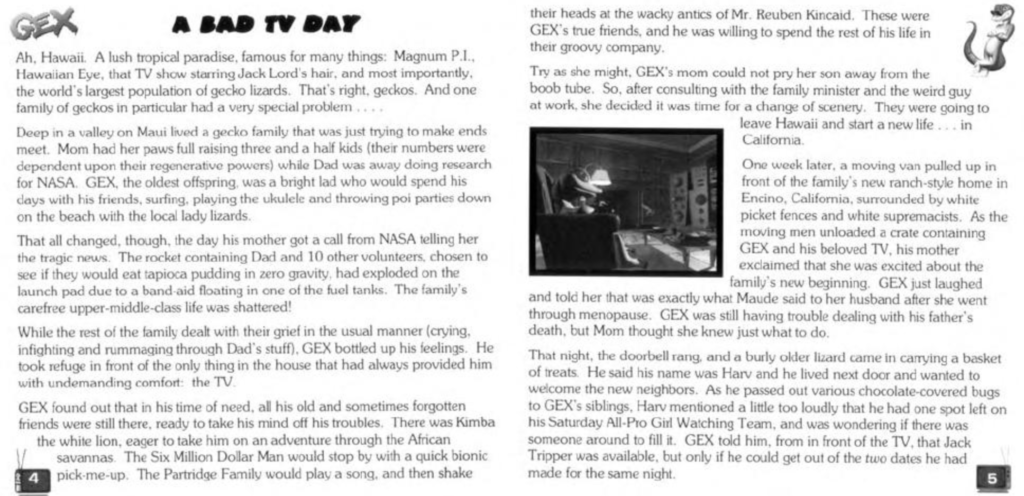
If you read the manual, you find out that Gex is wallowing in sorrow! His dad was an astrogecko working for NASA! He lost his life in a terrible accident! Gex, unable to face the world, retreated into television! It’s the only way he can handle living! And, although Gex thwarts the villain’s plot to use him as a mascot character (a thing he already is really), nothing at the end of the game indicates that his mental state has changed.

The first of six manual pages that lays out the reason for Gex’s media obsession.

I think the writer may be overthinking things a bit. Often manual stories were written as an afterthought by people who had nothing to do with the making of the game. Have you ever seen the manual for the NES release of Konami’s Life Force? It claims that the evil gigantic space creature Zelos, huge enough to devour planets, was the proud offspring of alien beings named “Ma and Pa Deltoid.” The manual for NES Metal Gear claims that the villain wasn’t Big Boss but instead “Colonel Vermon CaTaffy.”

Gex got off pretty lightly, by comparison.

I’ve wildly misunderstood Gex (Destructoid, by Timothy Monbleau)