
(Edit: changed stylization of the name of the system so it’s not all-caps.)
I was sure I had posted about this before, I mean I had to have. It’s such a cool bit of gaming history, never less than a bit obscure, but still, incredibly, has multiple websites devoted to it today. While waiting to binge on Kirby Air Riders, I figured I’d work off some of my indie KARma (heh) with this post about something that could not possibly be more different.
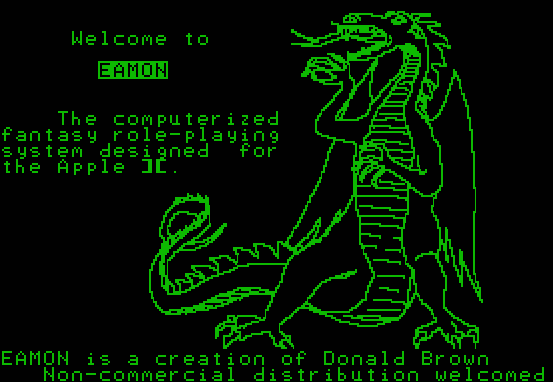
I’m talking about Eamon, an Apple II text adventure/RPG system with ports to other platforms (there was a not much used C64 version, and a PC/MS-DOS version with a bit more uptake), but was biggest on Apple II.
Eamon itself isn’t a single game, but is more like a family of games, each created to a certain specification. The closest thing that Eamon has to being at its center is the Master Disk, which is a character creation tool and a starter adventure. The idea is, you create and customize a character using the Master Disk, which saves your character and allows you to take them into other adventures, written by others.
If you remember me talking about Dungeon (from Loadstar issue #74 and others), it’s the same kind of idea, but from far earlier, and a lot more freeform. Dungeon had creation tools and a game engine. Eamon adventures were BASIC programs written from scratch, that modified the character file. Your in-game surrogate was really at the mercy of whatever horrors the adventure writers had in mind. If you feel a mild chill of existential horror at the idea, that’s because you live after decades of internet culture has trained you to recoil in fear that a software author could do just anything. It requires a degree of trust on the part of the user. Of course, Eamon adventures varied in quality and fairness. You have to expect that even your best characters could get pasted by a level 1,000 Tarrasque right as an adventure begins. Of course, smart people made backups of their character disk; in a chaotic realm like this, it’s a lot less cheating than basic prudence.
I promised links to websites. Here they are.
There’s Eamon Remastered, which is a web-based recreation with many recreations of classic games. With it, you can create a character which is saved to the website, then put it through the options on the Master Disk, and then can send them through the adventures, without having to get an emulator working or anything. If you just want to try it, that’s probably the best.
There’s a full Eamon Wiki, the Eamon Adventures’ Guild Online, the Adventurer’s Guide to Eamon, and the blog Renga in Blue’s description. Given that it’s an obscure text adventure system written in BASIC and created in 1979, it’s frankly astounding that there’s so much information on it on the Living Web.
I’m surprised that Eamon isn’t more widely remembered now, as there were hundreds of adventures (at least 280) made for it. The Digital Antiquarian wrote about the history and play of Eamon: Part One, Part Two, a liveblogged exploration, A Journey Into the Wonderful World of Eamon, and some expressed frustration on coming up with a definite history of Eamon.
Gaming Jay plays Eamon (33 minutes):
So, how do you play this?
First off, you should probably try the Eamon Remastered web-base recreation, which has a fair number of adventures to play. Here is its manual.
After you create your character (if you’re playing the Apple II original, make sure to follow directions in town, as the game is positively gleeful about killing newly-made characters), you’ll want to buy a weapon and some armor. Advancement in Eamon is not of the level-based D&D style, instead characters advance by doing. When you attack with a weapon, you might improve in your ability to use it. When you’re struck by an attack, you might improve in your use of armor. It lacks the “dopamine hit” (I hate that term) of gaining a level, but I think this is quite a more realisticm, and dare I say, better, method of character advancement. It’s more like the Runequest/Call of Cthulhu/Basic Role-Playing system, where most of a character’s ability is encoded within a number of individual skills. Though it’s a lot more gradual, it also means that characters are a lot more individual.
When you play it, you’ll find that it works basically like Infocom adventures did. Since each Eamon game is a program to itself, things could work very differently between them, but I think most of them tried to adhere to some shared conventions.
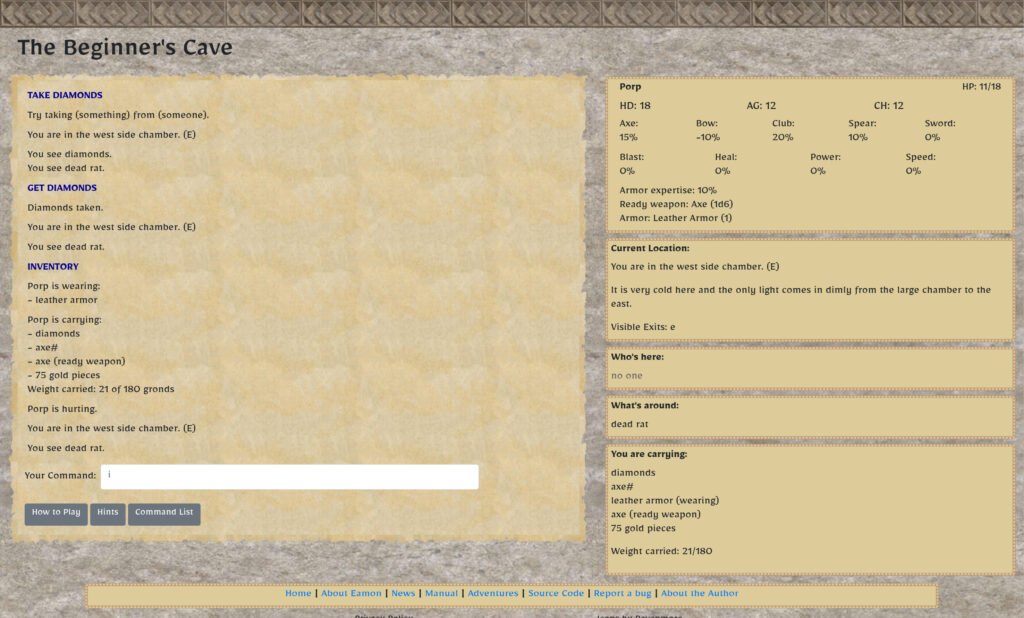
The “Beginners Cave” adventure is the intended first experience with EAMON. It provides you with some basic treasure, opponents and advancement. It is quite possible for a new character to die there, so treat this adventure with care. I found that there’s some quirks. “take [item]” tends not to work; “get [item],” however, does. “attack [monster]” can be used to attack in melee. There is a button, by the input box, that you can click for a list of available commands.
I don’t know if this is true of every adventure, but to get away from a battle you’re currently in, it won’t do to move out of it, if you don’t want to fight you should use the “flee” command, although monsters can follow you anyway if they choose. Flee sends you to the previous room you were in. If the monster that was menacing you chooses to follow, then I don’t know what else to do than just keep attacking and hope for the best.
I don’t have a lot of experience with Eamon myself, so I must leave you to your own devices for furthering your adventuring career. Good luck!
