The CRPG Addict Plays The Original MUD

MUDs, and their sibling games MUCKs and MOOs, now almost forgotten except among a rapidly-aging userbase, used to be the biggest gaming draw on the internet. When MMORPGs became big, it was largely by using the lessons of MUDs and applying them to a 3D graphical world with action gameplay. Everquest (admit it, you haven’t heard that name for a while) and World of Warcraft would never have become big if it hadn’t been able to stand on the shoulder of MUDs. And now, with WoW’s memory receding in the minds of many users, I think it’s well time to go back and find out what the originals were all about.

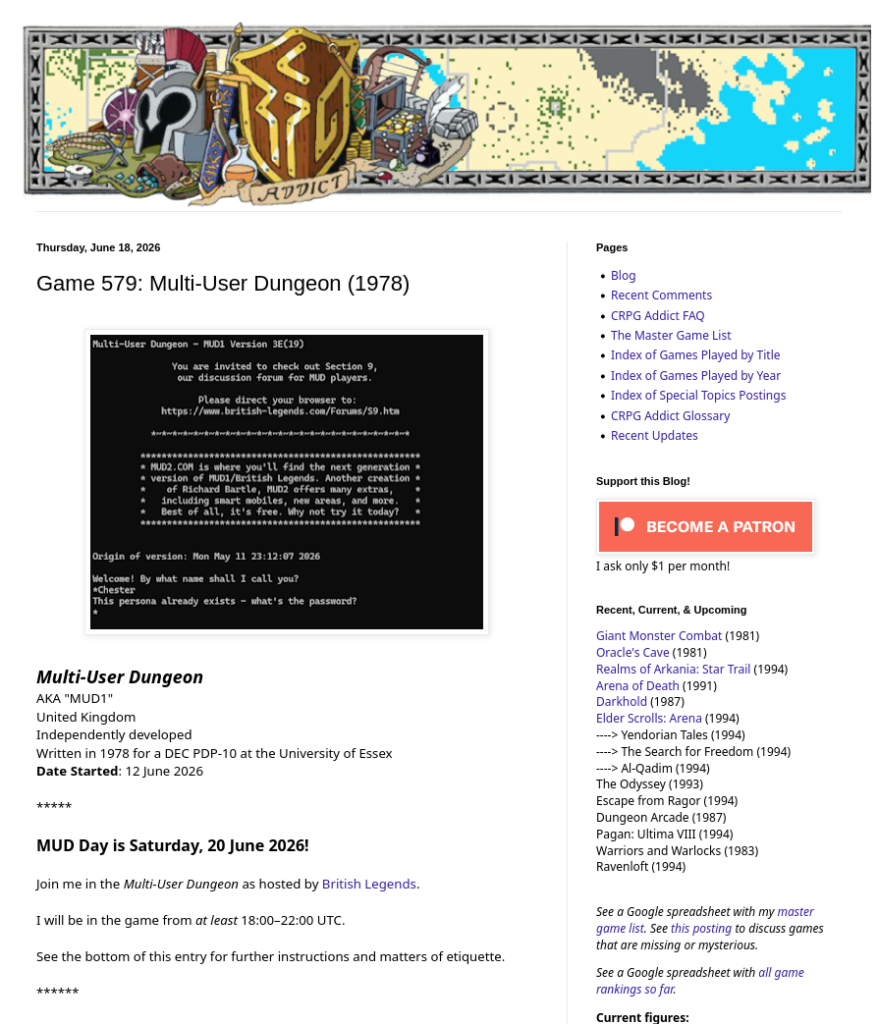
The CRPG Addict has come around to reviewing the original Multi-User Dungeon, the first of many. Because PLATO predated so many networked computer games it wasn’t the first online multiplayer game, but it was one of the first that could be played by many people. The Addict links to an extensive Digital Antiquarian article from 2017 explaining MUD’s history.

That Antiquarian article is pretty amazing. In the original MUD, if you got enough experience points you could become a wizard, basically a moderator yourself. If you killed another player they had to start over from scratch, and you got 1/24th of their experience points. Other ways to gain points was to find treasure and drop it into the swamp. Once treasure was swamped it was gone until the next server reset, which only happened when nearly all the treasure was so disposed. While you could find and use weapons, there was a limited number of most of those in the game so most players had to be satisfied with basic stick weapons.

But despite these limitations, players managed. Wizards could crash the game easily (there was a command specifically for doing so!), so mostly they didn’t. Customs were decided on; it was improper to kill a player more than two levels below yours. The game continued, and players largely came up with their own solutions to social problems.

The CRPG Addict explains that the original MUD is still in operation at british-legends.com, and that you can even join him there to play today! Times are in his post.

RenoProject.org: Documenting Habitat and its descendants

Long, long ago, three full ages before Zuckerberg’s doomed Metaverse, there was Lucasarts, formerly Lucasfilm Games, and Maniac Mansion, and the SCUMM engine.

Lucasarts went on to have a long legacy of adventure games, and while it’s gone now and most of its progeny is owned by some mouse creature, it survives in a number of forms, like the upcoming Monkey Island re-revival.

Another legacy of Lucasarts and SCUMM is what is possibly the first graphical MUD, called Habitat.

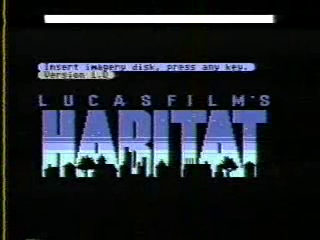
Even though it’s blurry, it deserves the head spot on a blog post, just one more time.

What? You don’t know what a MUD is, or a MOO or a MUCK? A lot of knowledge is in danger of being lost, but we don’t have time to remind you of rudiments here.

Habitat was an early experiment in online communities, a server-based virtual world whose clients were Commodore 64s. In appearance it looks a whole lot like a multiplayer version of Maniac Mansion.

It never went public, but did eventually become a paid feature, in modified form. on the C64 online service QuantumLink under the name Club Caribe. Then, with the wane of the Commodore 64 as a viable platform, QuantumLink closed their servers and rebranded as America On-Line, a.k.a. AOL. And that is not only history at this point, but ancient history. Read more about it here.

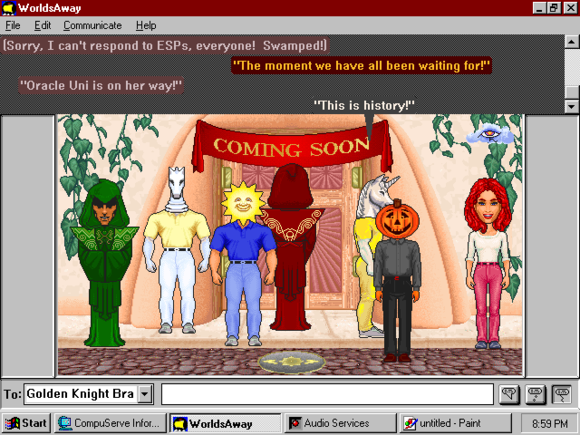
While there was still competition in the dial-up online service space, two creators of Habitat, Randy Farmer and Chip Morningstar, partnered with Fujitsu to have another go at a Habitat-style service, this time called WorldsAway. They partnered with AOL competitor CompuServe, and didn’t do badly for a while.

There’s all kinds of things to talk about here, and I have rather more knowledge than most because I was involved with this, I was volunteer staff at the flagship WorldsAway world, called Dreamscape. I was a participant in the CompuServe forum before the main service even opened, I spend an entire night on the phone as a teen, our old 486DX running Windows 3.11 downloading the client software.

WorldsAway was basically my life for a few years. It could be incredibly addicting, and spirits were high in the early days. There was a feeling of being at the forefront of something. The Internet was just starting to become really big. Who knew what it would become?

What happened to WorldsAway is a story, one that I’m probably not qualified to tell. I know there were problems with business management even from the start. The world staff was constantly said to be fighting with higher-ups, who wanted to cheapen or diminish the project. In size, certainly, the initial world Dreamscape never got anywhere as large as what we hoped for. Even compared to the size of its Commodore 64 predecessor Club Caribe, it was pretty small.

It’s said that they were a west coast operation, and many of their staffers were queer. One of the eventual spinoff worlds that WorldsAway would spawn was explicitly queer-friendly. Given the successes and continued struggles of queer-friendly media on the internet today, I feel like WA’s acceptance of alternate lifestyles should probably be better known.

I still have a couple of friends from those days. Others I’ve sadly lost touch with. A few friends from that time, notably Tiggles, Esme, and Rosaleah, have departed our physical world as well. Maybe some comfort could be had in the idea that maybe they’re users in some higher-order reality, who may have logged-off of our world, but are still out there in a more profound form. If they’re out there and somehow seeing this: please spare a thought for me. I’ll be back out there some day.

The Reno Project is a website devoted to preserving as much of those early projects, those ancient times, as possible. You could immerse yourself in the screenshots there, and dream of a past era that barely was. One of its competitors at the time, which is a bit better known today, is The Palace. One other service that still exists that competed with it is There, although good luck making an account (I tried). And Second Life of course continues to chug along. All of these things seem to me like more worthy projects than Zuckerberg’s latest progeny.