Never let it be said that I’m not alert to the benefits of reusing work.
I was just watching the beginning of Video Games 101’s first video, of four, of Final Fantasy IV née II, which was such a substantial jump over the first Final Fantasy that it instantly gained a bunch of admirers back then, including myself. It came out early in the SNES’ lifespan too, and I’d say it was instrumental to getting players interested in the system. Of course, it only seemed like such a great jump because Japanese Final Fantasy games II and III never made it to the US, and back then were barely even heard of at the time.
Around the 19 minute mark in the video (which I’m not embedding because it’s not actually the subject of this post), Professor Brigands mentioned how much better it was that FFIV, unlike the first game, didn’t adhere to a convention of earlier C/JRPGs: if a character tries to attack a monster that an earlier character to act has targeted and defeated, then that character’s turn is wasted. In FFIV and most games to follow, the character will instead pick another random opponent. FFIV marked a change in behavior for CRPGs in this, and it’s rare that you’ll find a later game where characters will waste turns like this.
I happen to know the justification behind those wasted turns, and in fact I think the change was for the worse, and being of an argumentative mood I made a comment on the video explaining it. That is what follows (edited slightly) below.
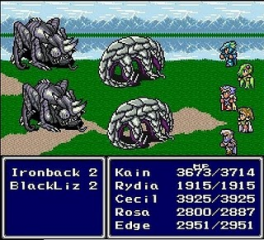
Brigands called this ridiculous, and most people would agree with him, but I don’t. RPGs have, for a long time, decreased the function of actual strategy over time. This isn’t true just of turn-based games or JRPGs, but in general. They keep getting easier and simpler.
Losing a turn is, against most opponents, a really minor penalty anyway. It’s an incentive to spread out your attacks against weak foes, allowing the player to conserve a small amount of HP (from potential attacks from other monsters) through the use of good tactics, and it means you can’t just completely turn off your brain even against groups of the weakest foes. If you just pound the A button, you risk giving the other monsters free hits against you. It increases player engagement, not by a huge amount, granted, but by a smidge.
Before FFIV, most games applied this turn-wasting concept. So, why did so many games do this?
In some of the earliest days of RPGs, those of 1st Dungeons & Dragons*, a combat round was intended to be a full minute of time. This was explained in that attacks were intended to actually a sequence of combat moves: thrusts, slashes, feints, dodges and the like, that were elided in play in terms of just getting to the numerical effect of those actions.
That’s why fighters in those games could gain extra attacks per round: it wasn’t that they got more swings, but that they were more efficient in their actions, and could get in more telling blows. This is also why Armor Class doesn’t reduce damage, but instead decreases the enemy chance to hit. Damage came from the accumulation of telling blows.
And HP loss itself was also an abstraction, not entirely being directly hurt, but more like scratches, welts, getting worn out, the results of pressing your luck a bit too far, and then actual wounds. If staging an attack against a monster takes a full minute, it makes more sense that one character killing it would cause a following attack that turn to be wasted. In 1E D&D, players had to declare their actions at the start of a round before anyone acted, and the DM was also expected to record each monster’s plans at the start of the round and follow through with them when their turn came.
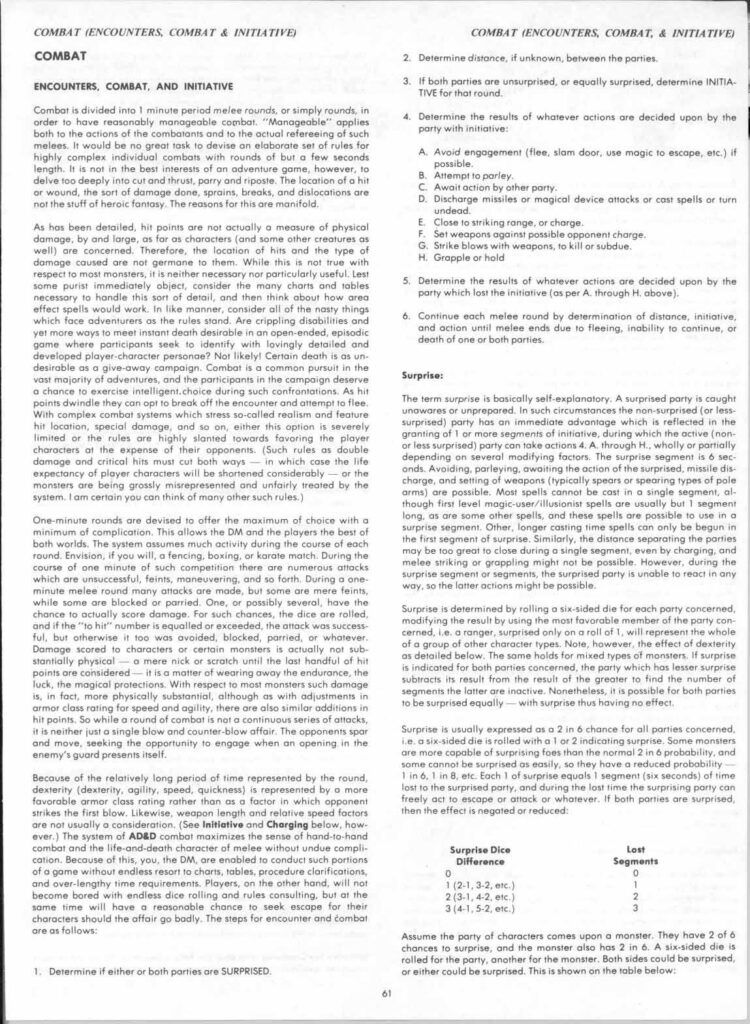
The justification for all of this can be found on page 61 of the 1st edition Dungeons & Dragons DM’s Guide. Now I mention this not to say if it’s good or bad. It’s obvious that current-day D&D doesn’t adhere to this mental model of combat, probably because most players themselves didn’t understand Gary Gygax’s theory of play, but also because it made the game more complicated if everyone had to plan their actions ahead, at the start of each round.
But it does mean that video games from that era did tend to adopt those concepts. The original Final Fantasy is known to have copied many things from D&D, including many of its monsters, and other ideas too, and this seems to have been one of them. I mention all of this just to shed some light on why the original FF did this, and also that, in this one area, it makes the game slightly less thoughtful.
* This wasn’t actually true of the very earliest days of Original D&D, or OD&D, for it didn’t actually have a set combat system at all! Players were intended to use Chainmail, a previous system of medieval combat, to simulate battle. The system that we would recognize as the root of current-day D&D’s combat began in Greyhawk, OD&D’s first supplement.