
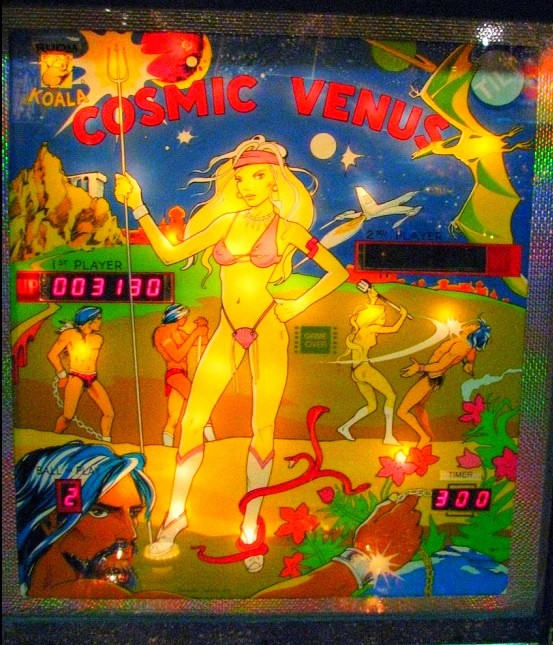
Last night at our weekly movie watch group we saw Tilt (1979), one of those fad exploitation movies that Hollywood used to make, about pinball hustling, and with a surprisingly sweet ending, which felt earned because the first half of the movie is pretty sleezy, with an aspiring musician getting the money to make a demo tape by exploiting the pinball talents of a young girl, played by Brooke Shields, who’s got a crush on him. Tilt, BTW, has a prop pinball machine called Cosmic Venus as the centerpiece of the last third of the film, which judging by its art is set on a planet mostly dedicated to stripping.
Anyway, that got me thinking about something to show after it, something from the world of real pinball. And I happened upon a promo tape that Bally made to promote the then-upcoming release of The Addams Family, which would go on to become the best-selling pinball machine of all time, with over 20,000 thousand tables sold. Meaning, if you’re going to learn to play any pinball table, Addams Family is still the one you’re the most likely to find out in the wild (although newer machines like Godzilla or Batman ’66 are also good bets).
Here is that tape (10 minutes):
When that was made, they didn’t know that, after designer Pat Lawlor’s earlier hits Earthshaker, Whirlwind and Funhouse, that his next game would become the greatest of all time.
Addams Family is a little simple compared to the games that would follow it, and especially the games released now by companies like Stern and Jersey Jack, but I think that adds to its appeal. It’s the perfect middle ground between the games that came before it, which were mostly about trying to achieve multiball as many times as possible, and current tables that devalue multiball, and push players towards very long games and wizard modes to get good scores.
AF has a wizard mode, Tour The Mansion, which you get by earning all 12 mansion rooms, but it also has a very lucrative multiball, and it’s the player’s choice if they want to focus on one, the other, or a combination of both. The Youtube channel of tournament organization PAPA has an excellent tutorial and demonstration of high level strategy and gameplay. (21 minutes)
But if a third of an hour is too much time to learn the rules of an excellent pinball machine, Quick Ass Pinball will teach you the basics in 4½ minutes:
