
CRPG Combat & What a Combat Round Means

Never let it be said that I’m not alert to the benefits of reusing work.

I was just watching the beginning of Video Games 101’s first video, of four, of Final Fantasy IV née II, which was such a substantial jump over the first Final Fantasy that it instantly gained a bunch of admirers back then, including myself. It came out early in the SNES’ lifespan too, and I’d say it was instrumental to getting players interested in the system. Of course, it only seemed like such a great jump because Japanese Final Fantasy games II and III never made it to the US, and back then were barely even heard of at the time.

Around the 19 minute mark in the video (which I’m not embedding because it’s not actually the subject of this post), Professor Brigands mentioned how much better it was that FFIV, unlike the first game, didn’t adhere to a convention of earlier C/JRPGs: if a character tries to attack a monster that an earlier character to act has targeted and defeated, then that character’s turn is wasted. In FFIV and most games to follow, the character will instead pick another random opponent. FFIV marked a change in behavior for CRPGs in this, and it’s rare that you’ll find a later game where characters will waste turns like this.

I happen to know the justification behind those wasted turns, and in fact I think the change was for the worse, and being of an argumentative mood I made a comment on the video explaining it. That is what follows (edited slightly) below.
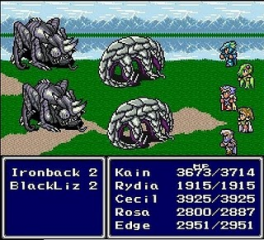
Combat in FFIV. Image from retroachievements.

Brigands called this ridiculous, and most people would agree with him, but I don’t. RPGs have, for a long time, decreased the function of actual strategy over time. This isn’t true just of turn-based games or JRPGs, but in general. They keep getting easier and simpler.

Losing a turn is, against most opponents, a really minor penalty anyway. It’s an incentive to spread out your attacks against weak foes, allowing the player to conserve a small amount of HP (from potential attacks from other monsters) through the use of good tactics, and it means you can’t just completely turn off your brain even against groups of the weakest foes. If you just pound the A button, you risk giving the other monsters free hits against you. It increases player engagement, not by a huge amount, granted, but by a smidge.

Before FFIV, most games applied this turn-wasting concept. So, why did so many games do this?

In some of the earliest days of RPGs, those of 1st Dungeons & Dragons*, a combat round was intended to be a full minute of time. This was explained in that attacks were intended to actually a sequence of combat moves: thrusts, slashes, feints, dodges and the like, that were elided in play in terms of just getting to the numerical effect of those actions.

That’s why fighters in those games could gain extra attacks per round: it wasn’t that they got more swings, but that they were more efficient in their actions, and could get in more telling blows. This is also why Armor Class doesn’t reduce damage, but instead decreases the enemy chance to hit. Damage came from the accumulation of telling blows.

And HP loss itself was also an abstraction, not entirely being directly hurt, but more like scratches, welts, getting worn out, the results of pressing your luck a bit too far, and then actual wounds. If staging an attack against a monster takes a full minute, it makes more sense that one character killing it would cause a following attack that turn to be wasted. In 1E D&D, players had to declare their actions at the start of a round before anyone acted, and the DM was also expected to record each monster’s plans at the start of the round and follow through with them when their turn came.
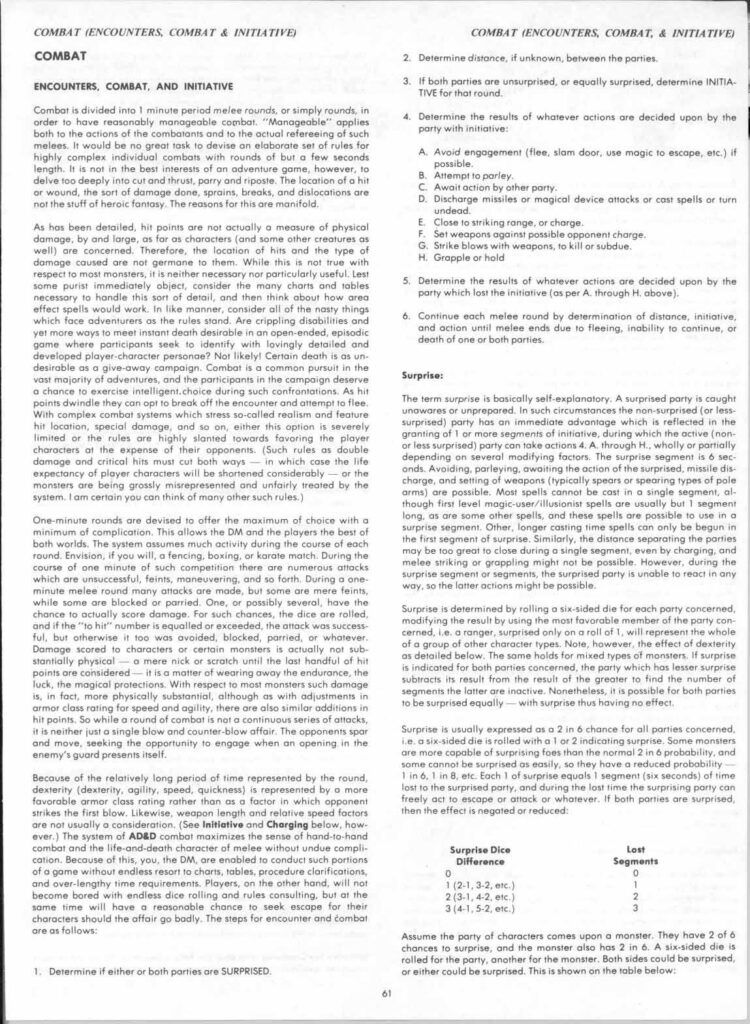
The page in question

The justification for all of this can be found on page 61 of the 1st edition Dungeons & Dragons DM’s Guide. Now I mention this not to say if it’s good or bad. It’s obvious that current-day D&D doesn’t adhere to this mental model of combat, probably because most players themselves didn’t understand Gary Gygax’s theory of play, but also because it made the game more complicated if everyone had to plan their actions ahead, at the start of each round.

But it does mean that video games from that era did tend to adopt those concepts. The original Final Fantasy is known to have copied many things from D&D, including many of its monsters, and other ideas too, and this seems to have been one of them. I mention all of this just to shed some light on why the original FF did this, and also that, in this one area, it makes the game slightly less thoughtful.

* This wasn’t actually true of the very earliest days of Original D&D, or OD&D, for it didn’t actually have a set combat system at all! Players were intended to use Chainmail, a previous system of medieval combat, to simulate battle. The system that we would recognize as the root of current-day D&D’s combat began in Greyhawk, OD&D’s first supplement.

Video Games 101 Tackles Ocarina of Time

The Legend of Zelda: Ocarina of Time has a reputation of being one of the “best” games ever made. Professor Brigands of VG101 recently spent around twelve hours making a video walkthrough of the whole thing, even finding every Heart Piece, and even every Gold Skulltula, despite the fact, as they say frequently, that the reward is in no way worth it. Each video is approximately three hours long; maybe you can have it playing in the background while doing other things.

First video (beginning to the end of the second dungeon + extras):

Second video (Jabu-Jabu’s Belly through to the end of the Forest Temple):

Third video (the Fire Temple, the Water Temple and the fetch quest to get Biggoron’s Sword):

Fourth video (The Shadow and Spirit Temples and the end):

Is that not enough? Rival channel U Can Beat Video Games has been churning through all of Final Fantasy VI (a.k.a. III, it’s complicated), having done five videos so far with one left to go, with videos ranging in length between 3⅓ to 4 hours: Part OnePart TwoPart ThreePart FourPart Five.

Halloween 2025: Castlevaniastravaganza

From “Kin no Tori,” or “The Golden Bird,” an anime movie. This alchemist witch character and her cat-bat minions are so much fun!

It’s Halloween today! Boo! I don’t mean that in a bad way, I mean it enthusiastically! Boo, I say!

Growing up I was never a big fan of Halloween, other than the opportunity to get candy. I never wore a costume out. This has changed a bit in recent years, I still don’t dress up but I do try to observe the season. Today I’m running a video marathon of various things over on cytu.be. If you know me, you might know where to look to find it, if you’re interested in such things, but this isn’t really the place for it.

While waiting for trick or treaters, here’s a few vids to help you pass the time.

MrMatthews reviews all the Gameboy Castlevania titles (29m), a collection that rates from pretty good to abysmal. But that’s not what he says, he pretty much likes them all, even Adventure and Legends.

U Can Beat Video game’s walkthrough of NES Castlevania (35m), and Video Games 101’s walkthrough of the same game (26m). There’s UCBVG’s run of Castlevania Bloodlines (2h14m). My favorite though is UCBVG’s run of Castlevania III, a 2 hour, 22 minute epic that covers all characters and routes, which is what I’m embedding here. Note, though, that it doesn’t go through the more difficult second loop….

If your tastes run a bit more academic, Jeremy Parish has some dives into the Castlevania games: the original (16m) II: Simon’s Quest (15½m), Super IV (17m) and Circle of the Moon (23m). He hasn’t done III yet it seems. His old design discussions of the NES Castlevania games at anatomyofgames.com are still up, marred a bit by the fact that the site’s been hacked to host links to casino sites. Earlier this month Jeremy appeared on the Still Loading podcast to talk about the ‘Vainia, which you can listen to on the site, or on Youtube (1h33m). The embeds below are of the original and the podcast:

To finish off, an early Sundry item, TerminalMontage’s “Something About Castlevania” animation (4m). This is basically Simon Belmont’s whole personality: violence.

Video Games 101 with Professor Brigands

I’ll admit, I’ve sat on this one for months. After posting about U Can Beat Video Games, I started to worry that this blog might get a bit repetitive if I kept posting about video game walkthrough series, and they take a long time to construct because there’s so many links, but it’s been a while since then, and VG101 has been around for years now.

Video Games 101, a side channel of a Let’s Play channel, covers much the same ground as U Can Beat Video Games. Some of the specific games are different. VG101 is a bit more about entertainment than the specifics of beating games and the strategy involved. Professor Brigands has three “TA” characters that assist him: Scary Gary (covering bosses), Blaze (a surfer who goes over the available items in each game) and Fluff the cat puppet, the most fun of the group, who explains game trivia and history.

I’m just putting it off still further at this point. Here is the intro video to the channel, followed by the list of every walkthrough VG101 has posted to date.

NES

Nintendo

Donkey Kong(10m)
Donkey Kong Jr.(11m)
Super Mario Bros.(39m)
Super Mario 3 (Full Walkthrough)(2h58m)
Super Mario Bros 3 (with warps)(21m)

The Legend of Zelda
First Quest(1h28m)
Second Quest(2h2m)

Zelda II(2h13m)
Kirby’s Adventure(2h2m)
Metroid(1h32m)
Kid Icarus(1h27m)
Punch-Out!! NES(47m)
StarTropics(2h8m)
Tetris (Strategy Guide)(23m)
Yoshi’s Cookie (Strategy Guide)(18m)
Dr. Mario (Strategy Guide)(20m)
Yoshi(14m)
Baseball(26m)
Tennis(29m)
Golf(14m)
Pro Wrestling(34m)
Ice Hockey(14m)
Volleyball(23m)
Excitebike(12m)
Pinball(26m)
RC Pro-Am(28m)
Rad Racer(31m)

Capcom

Ghosts ‘n Goblins(39m)
Mega Man(43m)
Mega Man II(1h2m)
Mega Man III(1h4m)
Mega Man IV(1h10m)
Ducktales(30m)
Duck Tales 2(34m)
Darkwing Duck(43m)
Chip ‘n’ Dale Rescue Rangers 2(44m)
Legendary Wings(38m)

Konami

Gradius(21m)
Castlevania(26m)
Castlevania II(1h3m)
Castlevania III(1h39m)
Contra(21m)
Super C(26m)
Teenage Mutant Ninja Turtles NES(47m)
Teenage Mutant Ninja Turtles II: The Arcade Game( 1h4m)
Teenage Mutant Ninja Turtles III(1h3m)
Metal Gear(1h29m)
Track and Field (all World Records)(15m)
The Goonies II(43m)
Top Gun(38m)
Tiny Toon Adventures(30m)
The Adventures of Bayou Billy(42m)
Blades of Steel(25m)
Sid Meier’s Pirates! NES(1h22m)

ICOM

Shadowgate(42m)
Deja Vu(47m)
Uninvited(35m)

Tecmo

Ninja Gaiden II(52m)
Ninja Gaiden III(51m)
Rygar(43m)

Sunsoft

Batman NES(30m)
Batman: Return of the Joker(25m)
Blaster Master(1h45m)

LJN

Friday the 13th(24m)
A Nightmare on Elm Street(42m)
Jaws(22m)
T&C Suft Design (18m)

RPGs and Related

Faxanadu(1h36m)
Legacy of the Wizard (Dragon Slayer IV NES)(1h16m)
Dragon Warrior (Dragon Quest NES)(1h51m)
Final Fantasy(4h)
Crystalis(2h2m)

Brawlers

Double Dragon(24m)
Double Dragon II(23m)
Double Dragon III(29m)
River City Ransom(47m)

The Guardian Legend(1h54m)
Adventures of Lolo(42m)
Adventures of Lolo 2(47m)
A Boy and His Blob(21m)
The Battle of Olympus(1h9m)
Adventure Island(1h7m)
Bubble Bobble(1h2m)
Maniac Mansion(1h1m)
Low-G-Man(41m)
Robocop(25m)
Battletoads(57m)
8 Eyes(49m)
Paperboy(18m)
Jackie Chan’s Action Kung Fu(37m)
Gremlins 2(25m)
Shatterhand(54m)
Beetlejuice(31m)
Dr. Jekyll and Mr. Hyde(56m)
Rockin’ Kats(50m)
Magician(1h19m)
Vice: Project Doom(43m)
The Three Stooges(26m)
Super Dodge Ball(21m)
King’s Quest V(1h10m)
Kick Master(39m)
Puss ‘n Boots(15m)
Home Alone 2(25m)
Burgertime (Strategy Guide)(11m)
Dr. Chaos(1h7m)
Werewolf: The Last Warrior(1h39m)
Star Trek: 25th Anniversary(1h15m)
Bart vs The Space Mutants(48m)
Bugs Bunny Birthday Blowout(50m)
Bad Dudes(24m)
The Flintstones(36m)
Total Recall(25m)
Robin Hood: Prince of Thieves(1h7m)
Ghostbusters(24m)
Back to the Future(23m)
Who Framed Roger Rabbit?(56m)
M.U.S.C.L.E.(15m)
Ninja Kid(19m)
The Legend of Dino Riki(24m)
Narc(25m)

GENESIS/MEGA DRIVE

Home Alone(56m)

SNES

Super Mario World
Part 1(44m)
Part 2(41m)
Part 3(45m)
Part 4(52m)
Ghoul School(34m)
Illusion of Gaia(7h4m)
Super Metroid(2h46m)

Super Mario RPG
Part 1(3h2m)
Part 2(3h2m)
Part 3(2h42m)
Part 4(2h41m)

Secret of Mana
Part 1(2h29m)
Part 2(1h59m)
Part 3(1h59m)
Part 4(1h48m)

The Legend of Zelda: A Link to the Past(3h57m)
Super Punch-Out!! SNES(34m)
Mega Man X(1h25m)
Mega Man X2(1h29m)
Final Fight(43m)
Sunset Riders(34m)

NINTENDO 64

Star Fox 64
Easy Route(47m)
Medium Route(43m)
Hard Route(51m)

Super Mario 64
Part 1(1h13m)
Part 2(59m)
Part 3(1h7m)
Part 4(51m)

Goldeneye 007(1h52m)

MISCELLANEOUS

Oregon Trail(26m)
Quest for Glory(1h4m)
Myst(1h29m)
Alley Cat(17m)

Video Games 101

We’ve linked the Youtube channel U Can Beat Video Games a number of times here previously. Their posting rate has fallen off a bit lately, likely because they’ve been tackling longer fare. It isn’t a simple matter to construct comprehensive video strategy guides and walkthroughs to lengthy JRPGs like Final Fantasy IV or Dragon Quest II.

While we wait for their next effort-intensive guide, we can watch episodes off Video Games 101, courtesy of Brigands and his other channel Let’s Play With Brigands. It’s been going for a couple of years now, and has tackled some formidable games, including The Adventures of Bayou Billy, Castlevania III and the infamous Battletoads. A particular one to check out is the bizarre Dr. Chaos (1h,7m), a game that’s half janky platforming, half haunted house exploration.

VG101 has a very different vibe from UCBVG. It doesn’t try to be nearly as comprehensive, mostly showing a typical playthough. It doesn’t provide maps or many secrets. But it does have some strategy callouts, mostly provided by their whimsical “TAs,” three side characters who wear silly costumes. The best of these is undoubtedly Fluff, a fairly realistic cat puppet, who lives in a lavish study and smokes a bubble pipe, and who provides interesting trivia about the games being played. It’s worth checking into if you have the time and inclination!

Fluff could hold down a channel all by themself!