Rings of Saturn

The Rings of Saturn logo, from the site itself

This post isn’t about any game specifically, but rather about an awesome Substack blog, Rings of Saturn, that examines the code of games from what they call the “32-bit era,” around the time of the Saturn to the Playstation 2, which includes the original Playstation, Dreamcast, and Gamecube, with a handful for the Nintendo 64, 3DO, Xbox and even the PSP along the way. They load them up in like Ghidra and search for unpublished codes, they look through demos and prototypes for ways to unlock features (sometimes ones that aren’t present in the finished game) and they make hacks to make unreleased features usable. All are very worthy activities that should be of interest for the kinds of people who would visit Set Side B. (You know who you are.)

A few selected items: a mod for Burning Rangers to play it two-player co-op, playing as Sonic in Christmas NiGHTS Into Dreams, enabling a secret English translation in Kingdom Grandprix, a debug mode in Grandia II, a patch to unlock the entire first Clockwork Knight game in Clockwork Knight 2, a code to unlock some extra cartoon artwork in Cotton Boomerang, extra options in Radiant Silvergun, a cheat code for Parappa the Rapper, and much more!

Really, if you’re a fan of games from this era, you’re almost bound to find something on this site of interest to you. Have a look!

Developer’s Menu in Arcade Mortal Kombat Games

The news about this broke some time ago, but Set Side B is only a few months old at the moment and we weren’t around then. It’s still worth mentioning though!

Ed Boon put secret codes in a number of his games to allow him to check on individual machines while out in the public. He revealed his code for Mortal Kombat II some time back, which is listed on The Cutting Room Floor. The code is entered entirely with the 1P and 2P Block buttons: P1 Block 5 times, P2 Block 10 times, P1 Block 2 times, P2 Block 8 times, and P1 Block 2 times. The timing is tight, so keep trying.

All image credits for this post: The Cutting Room Floor

One way to remember part of the code is in the menu’s name, the EJB Menu. The E and B of that stand for Ed Boon. E is the 5th letter of the alphabet, J is the 10th, and B is the second, and those are the number of button pressed needed for the first three parts of the code.. The whole code would thus be EJBHB. Using initials as part of a code seems to have been part of the culture at Bally and Williams at the time. A number of pinball games have hidden displays that can be called up from attract mode if you press buttons as if you were entering a developer’s initials in the high score screen.

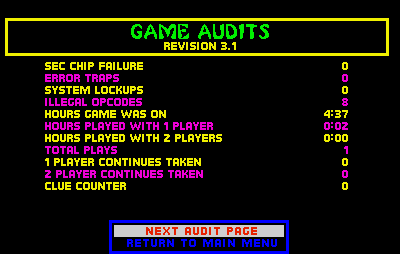
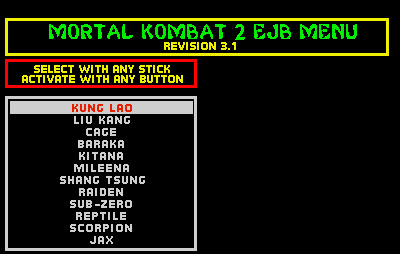
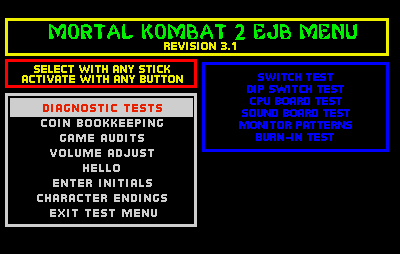
The EJB menu offers a lot of information on how a machine has been performing on location! It’s much like the operator’s menu, but with even more options! You can even call up the ending for any character, would certainly would have made any kid who knew that code back then the star of the arcade.

Of particular note is, a couple of the items in the menus are red herrings. The developers loved taunting kids by putting fake hidden features in the operator menus. “Shawn Attacks” is one of them (there is no character called Shawn in the game); “Kano Transformations” is another (Kano is not playable in MKII).

Other EJB menu codes:

Mortal Kombat 1, it’s 1PB x 5, 2PB x`10, 1PB x 2, 2PB once, 1PB x 2, 2 PB x 3, then 1 PB x 4. The page notes that, converted to letters, this code would be EJBABCD.

In Mortal Kombat 3, it’s 1PB x 5, 2PB x 10, 1PB x 3 (it’s EJC this time!), then 2PB once, 1PB x 2, 2PB x 2, 1PB x 3, and 2PB x 3. EJCABBCC. This code also works in Mortal Kombat 3 Ultimate.

The Cutting Room Floor does not list a EJB code for Mortal Kombat 4. Smash T.V. does have a code for a developer’s menu.