
Yep, what’s in the title apparently can be done.
COBOL stands for Common Business-Oriented Language, and is an extremely verbose language designed purposely to be understandable to managers. Everything in COBOL reads like it does, which makes it hard to work with. A fair portion of the financial world still runs on COBOL, in some cases using programs nearing their 60th year of existence. And someone wrote a way to use it write code for Vulkan.
Here’s the Github repository. The About blurb says it’s the shader language you didn’t know you needed. With due respect, that’s because no one ever needed it, but it’s still a fun thing that exists.
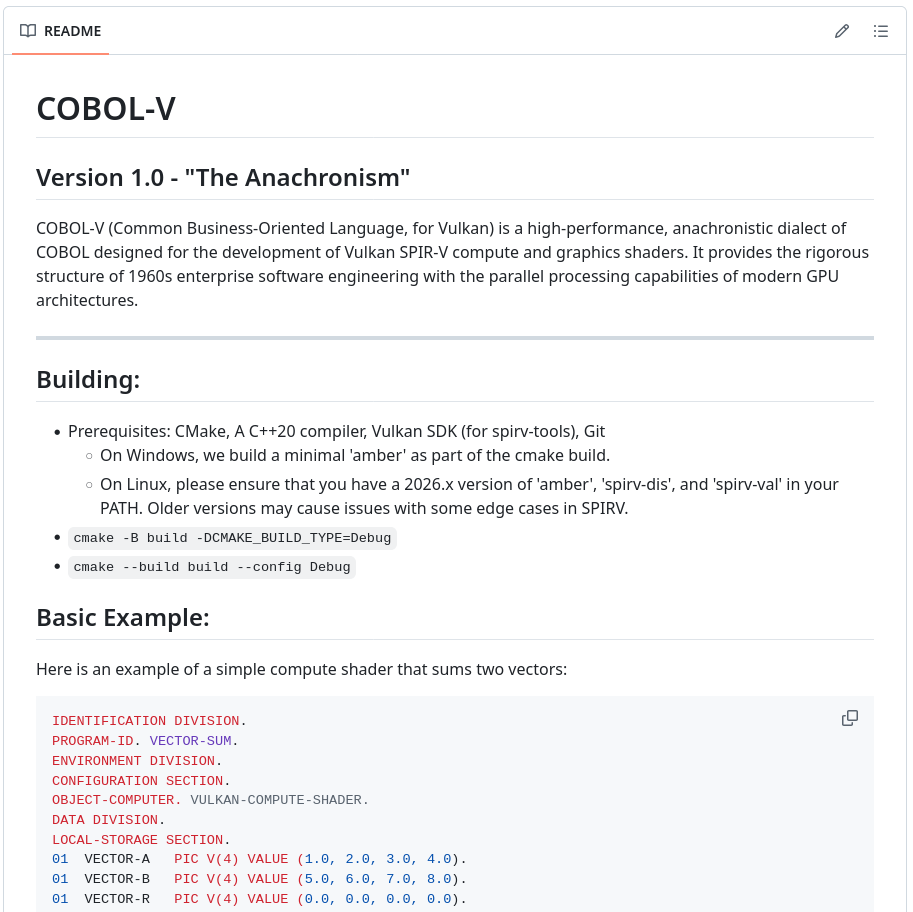
There appear to be no examples of output online. I had a look at building it myself, but my distro doesn’t seem to have the necessary programs to do that. Would any of you care to give it a try?

>Yep, what’s in the title apparently can be done.
Isn’t that an inevitable corollary of Turing completeness?
Well no. Turing completeness only tells us what can theoretically be computed in principle, it says nothing about hardware interfaces or suitability of data. COBOL is such a weird language, it uses fixed-point math for instance. it was made for human-readable code in the domain of financial applications. I had a college course in it once, although that was many years ago now. It’d be scarcely less likely to work out than writing a shader in Inform 7, a language specific to the domain of writing text adventure games.