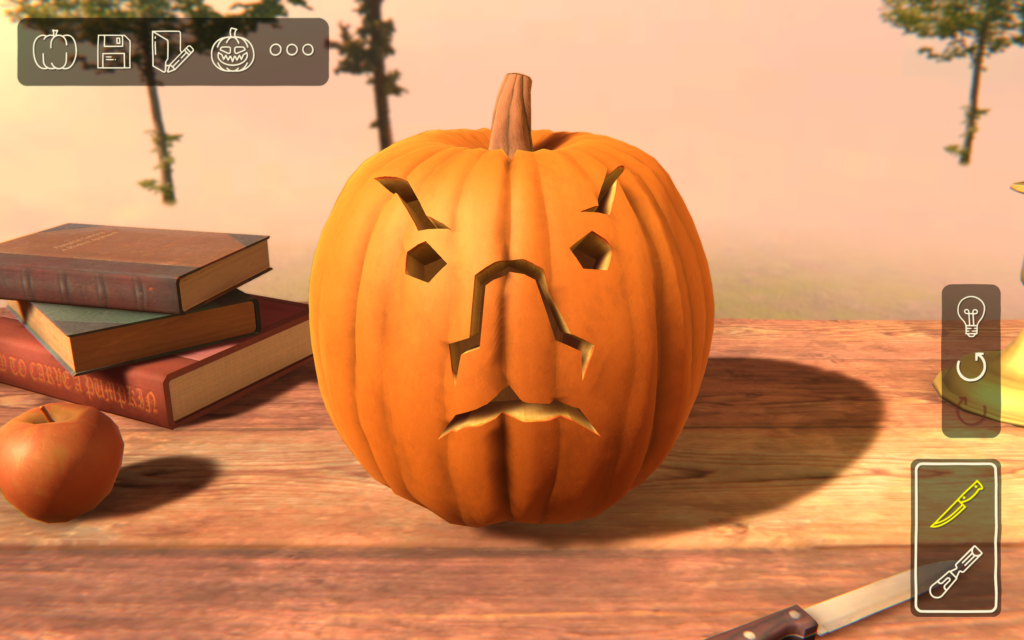
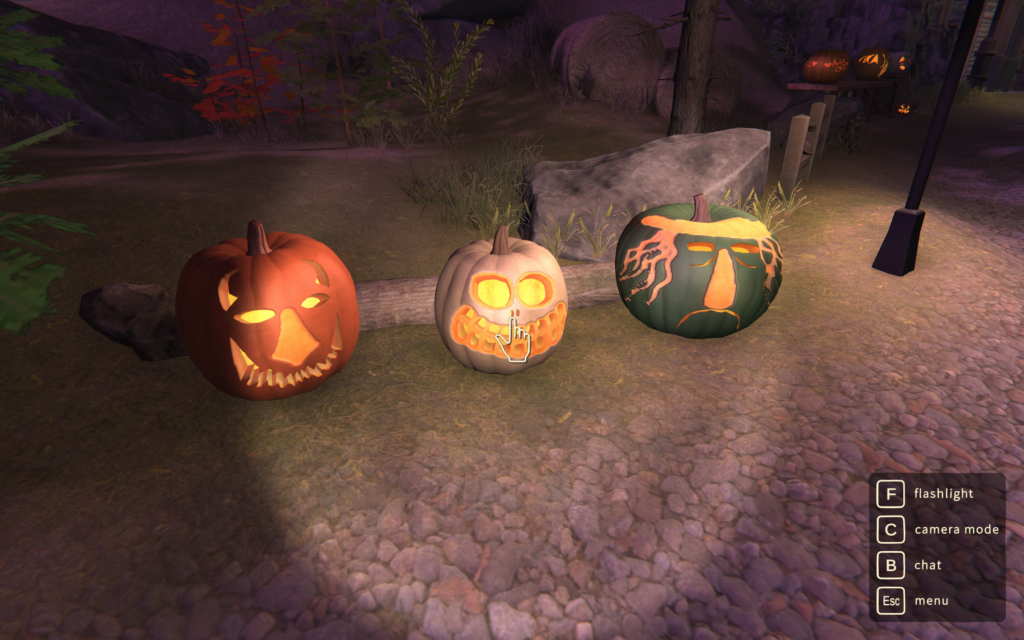
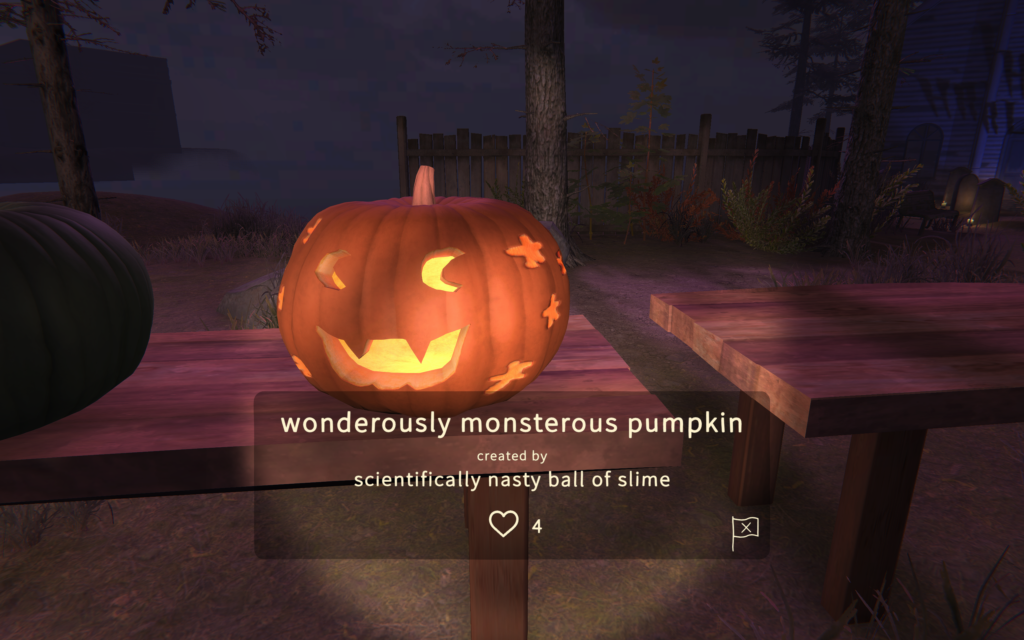
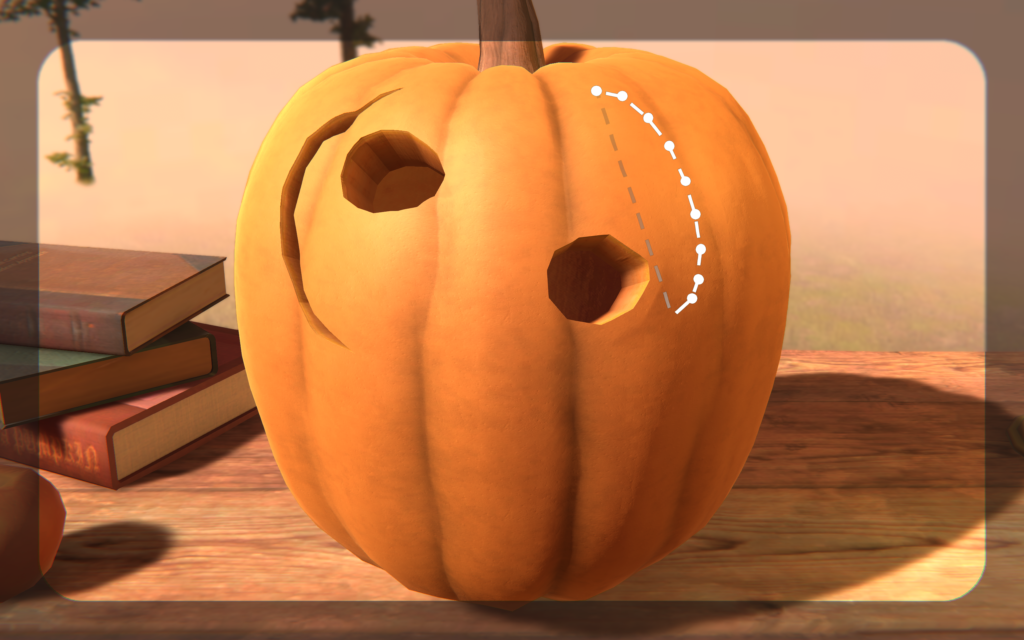
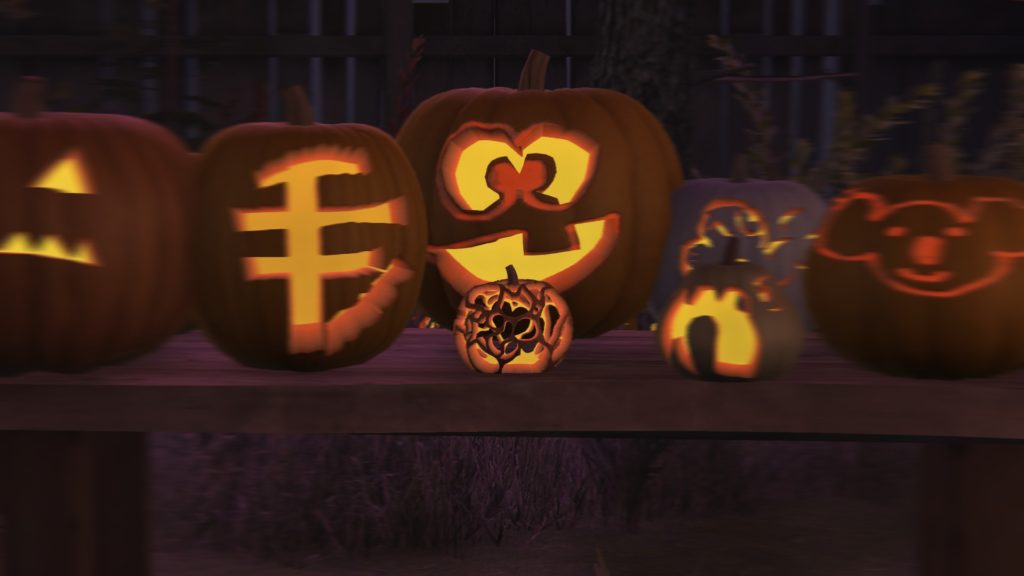
Ghosttown Pumpkin Festival, a free itch.io game that we reported on last year, has returned! Install it, apply the easy-to-use tools to carve a randomly-generated pumpkin, then upload it to the servers for everyone to look at and vote on! The servers stay up until mid-November, so you have lots of time to construct and show your work. While it’s free, you can spend $2 for a version that will let your ghost avatar wear a hat of their choice.
While you can upload pumpkins whenever, if the festival display fills up you might end up having your pumpkin shunted into an alternate town shard, so if you want more people to behold your work (and despair?), you’ll want to complete your Jack-O-Project soon.
To place your pumps, enter the festival, press Escape to choose the “dimension” you want for it, then explore for a bit with the WASD keys. When you’ve found a good spot for it press Escape again and click the pumpkin icon to select which of your saved creations to place. The spots where your orange gourdfriends can reside show up as gray dots.
Create something cool, and tell us about it here, if you feel like it!
We love it when we find weird and unique indie games to tell you all about! Our alien friends to the left herald these occasions.
It’s another of those games that’s remade in Pico8, and in the process becomes subtly different, not necessarily better, but not worse either. It’s Make-Ten, and it’s free on itch.io.
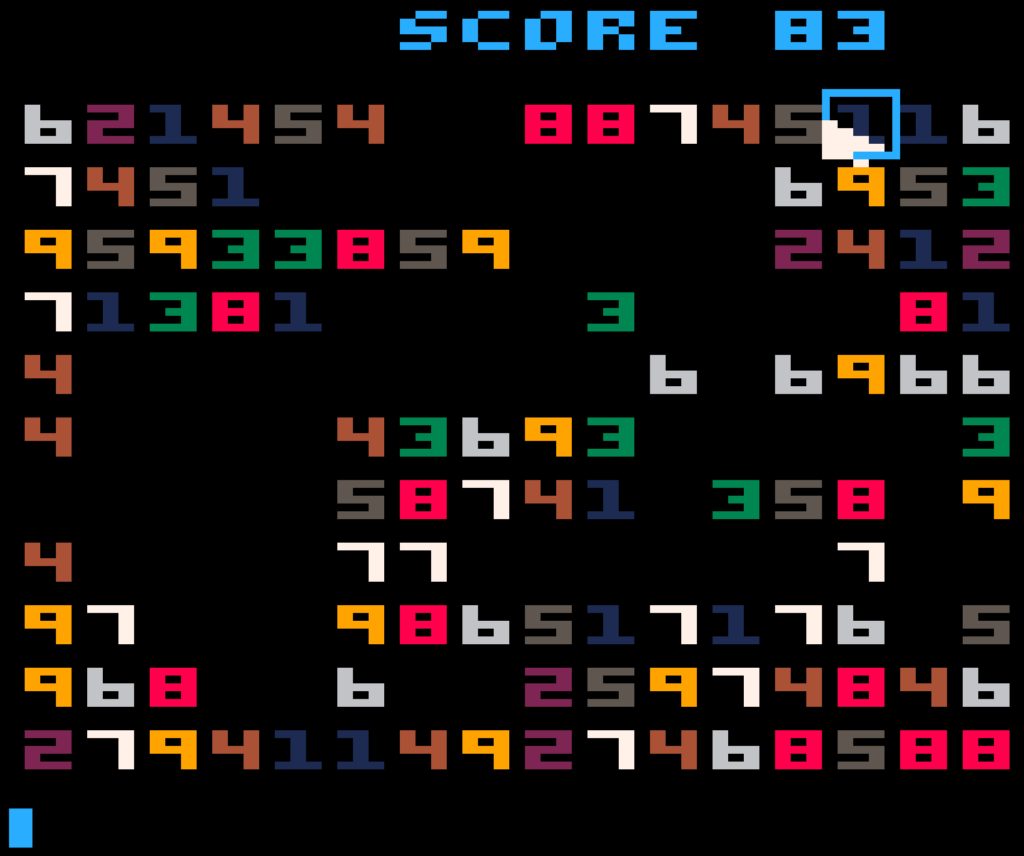
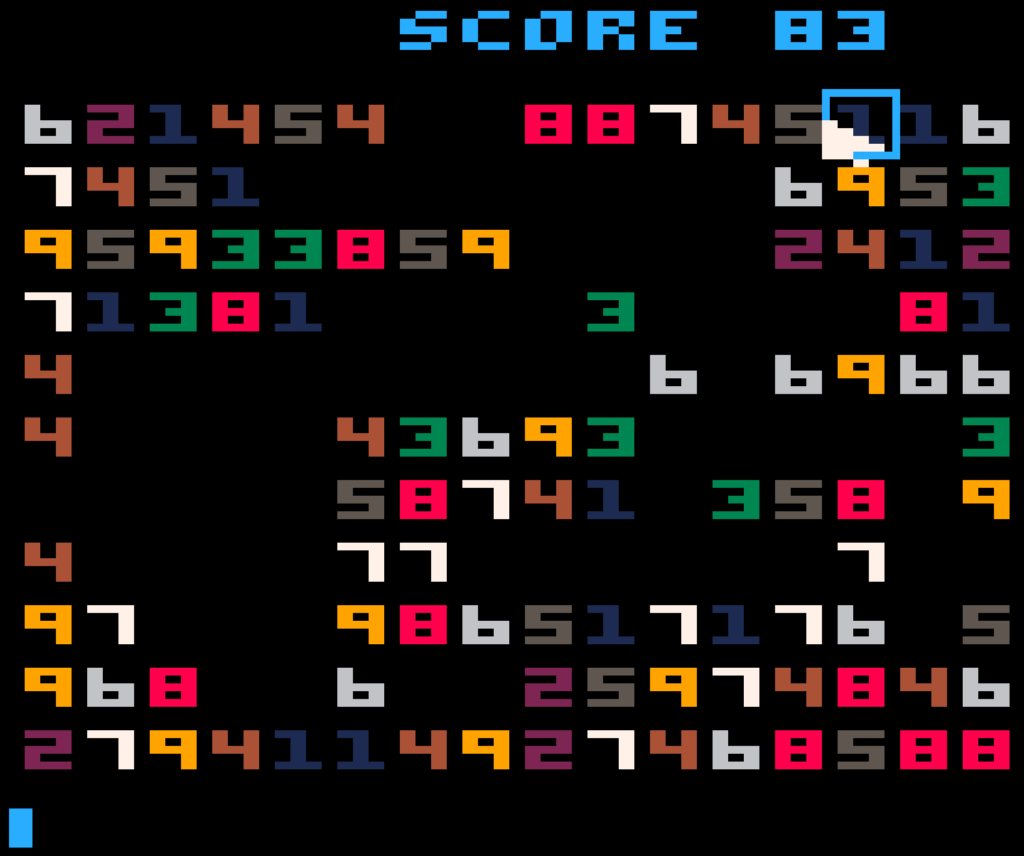
This time it’s not an arcade game. The remake is of a mobile and web game called Fruit Box. I’ve only tried the web version and, in this case, I think the Pico8 version is better. The UI is a lot easier to use for its only action, drawing boxes around numbers. The original uses a generic rectangular box, while the Pico8 version snaps the lines to the number grid, which works much better for me. Also the numbers are colored according to value, which helps readability a lot.
I’m sorry, I should explain what I’m talking about!
It’s one of those simple yet addicting games. You’re given a random field of digits from 1 to 9. You’re given a couple of minutes to draw rectangles around sets of numbers that up to 10. When you do, you get one point per digit you remove (which is a difference from the original), and those digits disappear from the board.
Obviously, pairs of numbers that add up to 10 are relatively easy to find. Any pair of 5s, for instance, can be immediately cleared. Each game usually starts with clearing away any quick pairs. Removed pairs make space to connect further digits. Empty spaces have no number value, and make it easier to clear more than two numbers at once. Some examples of common larger sets to surround (of course they can be in any order): 4-3-3, 1-2-3-4, 7-1-2, 5-3-2, 6-2-2 and 4-4-2. The tricky part is connecting two numbers in the corners of a box, when other digits get in the way, adding unwanted values to the sum.
The most valuable digit is 1, since they fit into the most possible combinations.
While Make-Ten is not a game for perfectionists, as it’s probable that most fields cannot be fully cleared, the game does let you keep playing after time concludes, which is an advantage it has over Fruit Box. It doesn’t count points after the time bar runs out, but it can be interesting to see how much of the board you can complete.
Make-Ten is really simple and has very little fuss about it. It plays quickly, and then it’s over. It’s a nice game for quick sessions. It was written in 500 characters of code, and doesn’t offer any progression or metagame. After two minutes, which begin the moment the game starts, there isn’t even a prompt to play again. To have another go, press Enter and choose to Reset Cart, or just close the window if you’re done.
Hempuli is the brilliant creator of the rule-breaking-and-making puzzle game Baba Is You. That is not the subject of this post, but I couldn’t recommend it more highly.
No, the post’s subject is a series of things they’ve made since. Yes, I said things. I said it and I meant it!
They’re all: (free|wonderful|insane|playable in browser|available on itch.io). There’s twenty-three of them, and they’re all ludicrous ruminations on the idea of Sokoban. We’ve posted about Hempuli’s improbable series of Sokolikes before, but they keep making them, and so now there’s 23.
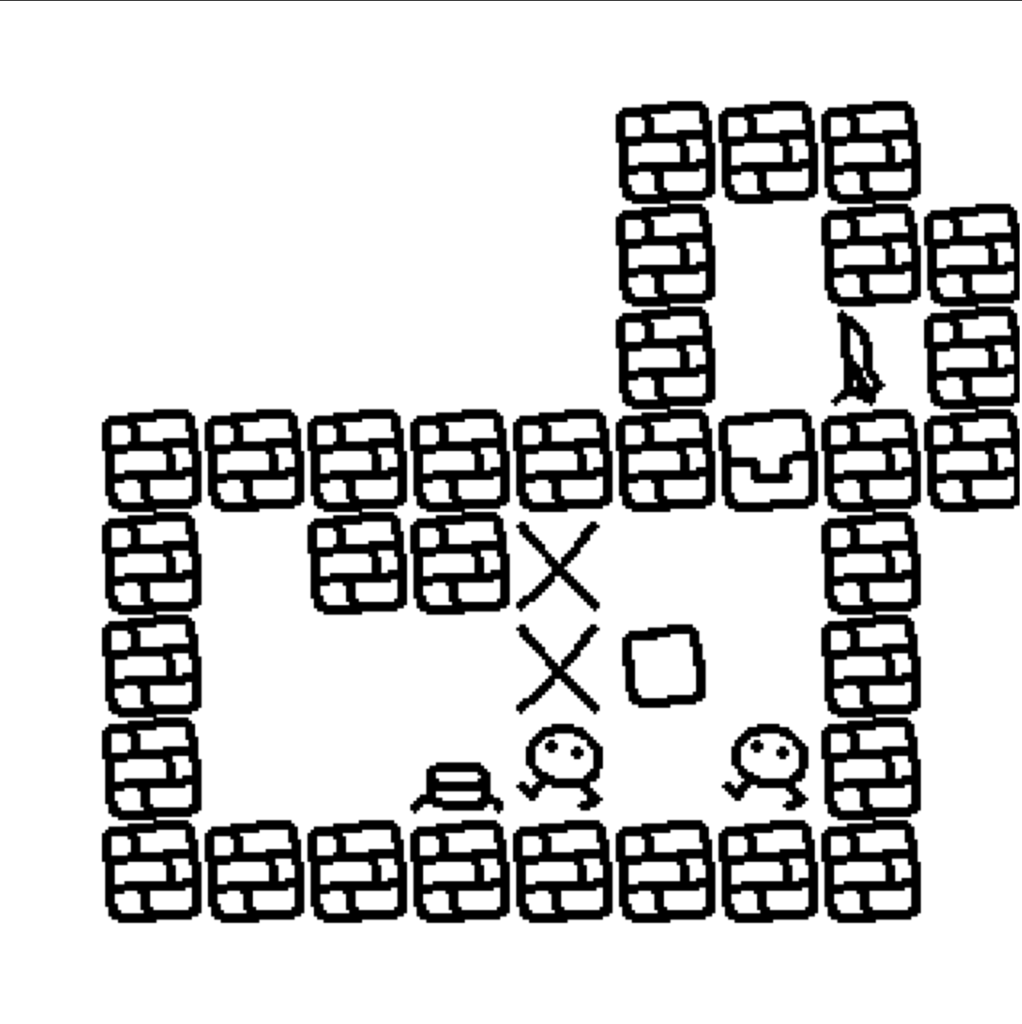
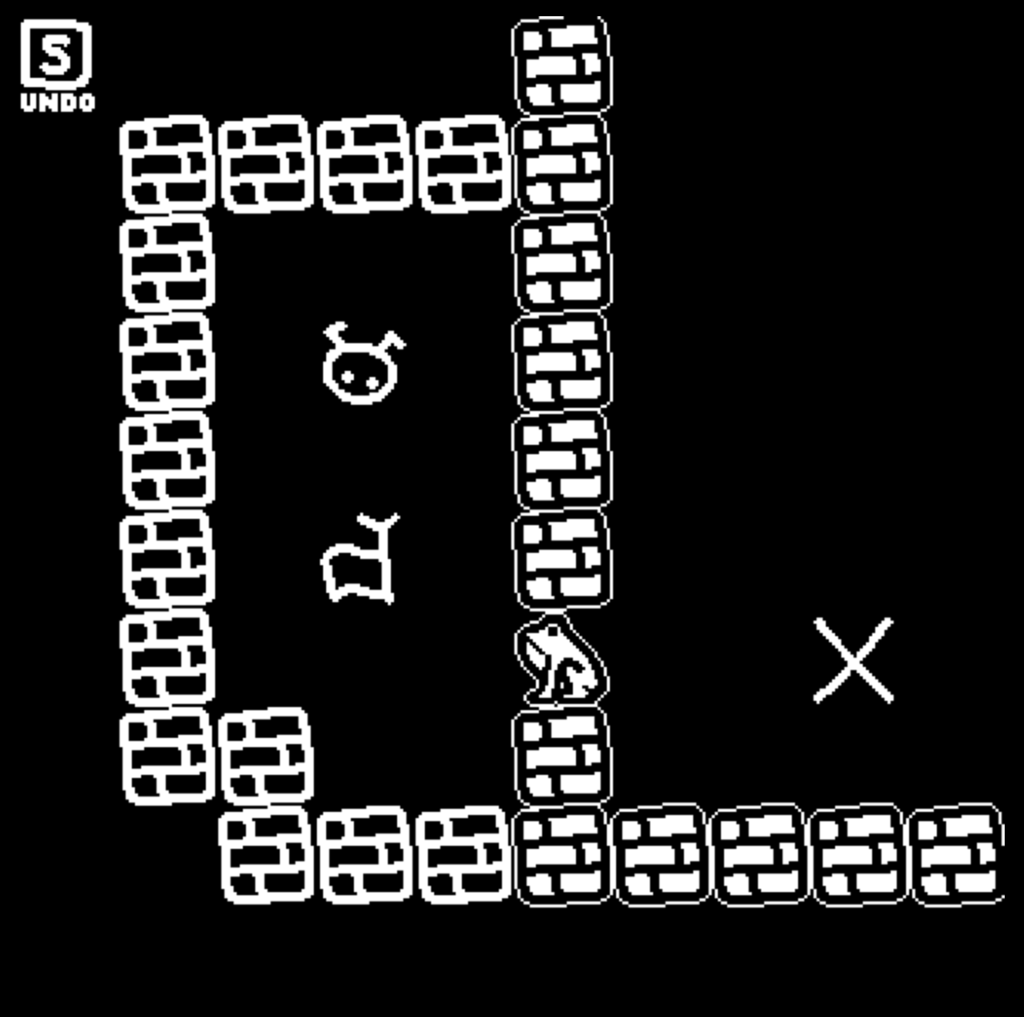
The basic rules are: there are blocks, and you can push them. If all the Xs on the level have blocks on them at the same time, the flag activates, but it stays active only while every X is occupied. If the flag is active, you can step on it to complete the puzzle.
But there are also buttons. If all the buttons of a given color have boxes (or players) on them at the same time, then certain gates in the puzzle open. Some puzzles have water. Don’t step in that. Boxes will usually float on top of water though.
In (nearly) all the puzzles, the arrow keys move your little Sokoperson, the R key resets the current puzzle, and the Z key reverses your last move. Keep pressing Z to keep going back, until you reach the puzzle’s start state.
Those are the basic rules, but don’t be surprised if they’re upturned in some of these games. Hempuli is diabolical, and sometimes the basics don’t apply, or are turned on their head in unexpected ways.
From Mountris. The character is about to make a surprising mistake.
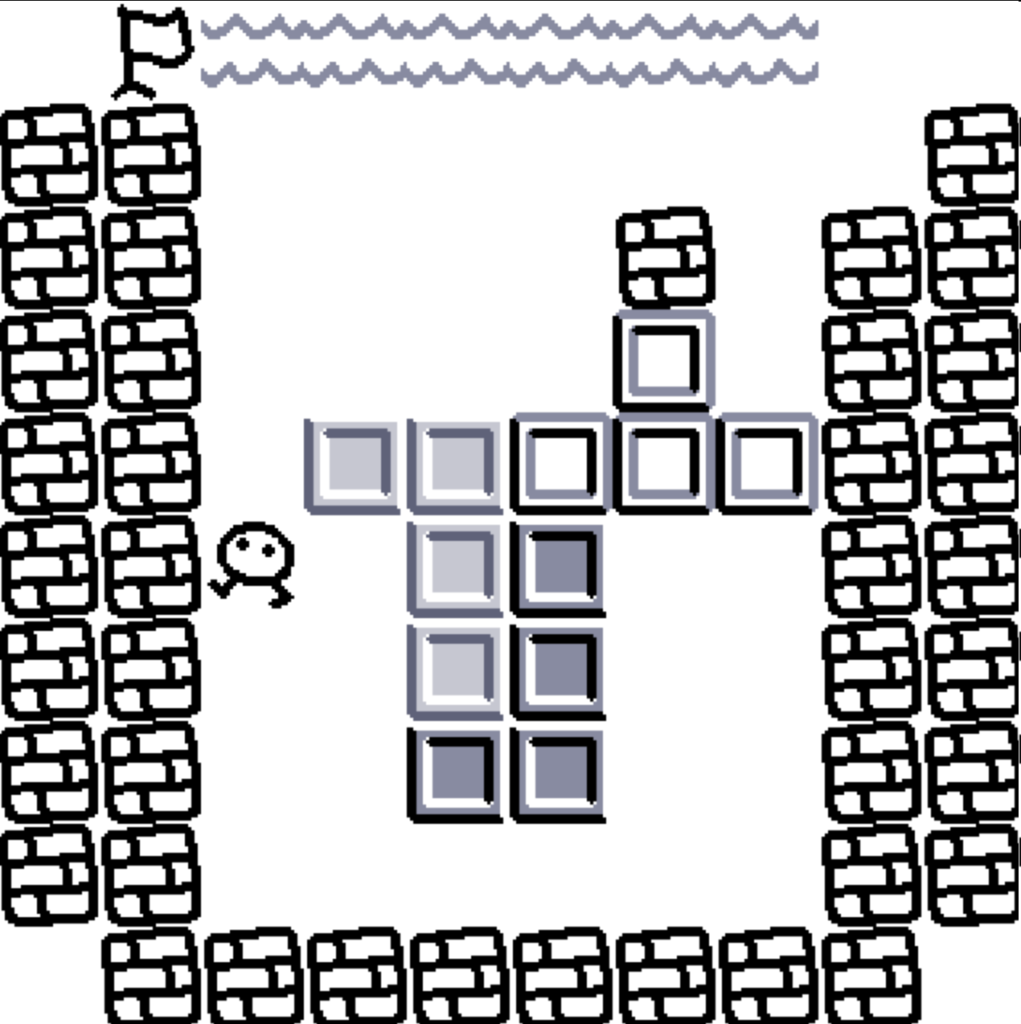
In Mountris, some of the blocks you push are Tetris shapes, that move as a single unit. Think carefully about the implications of that.
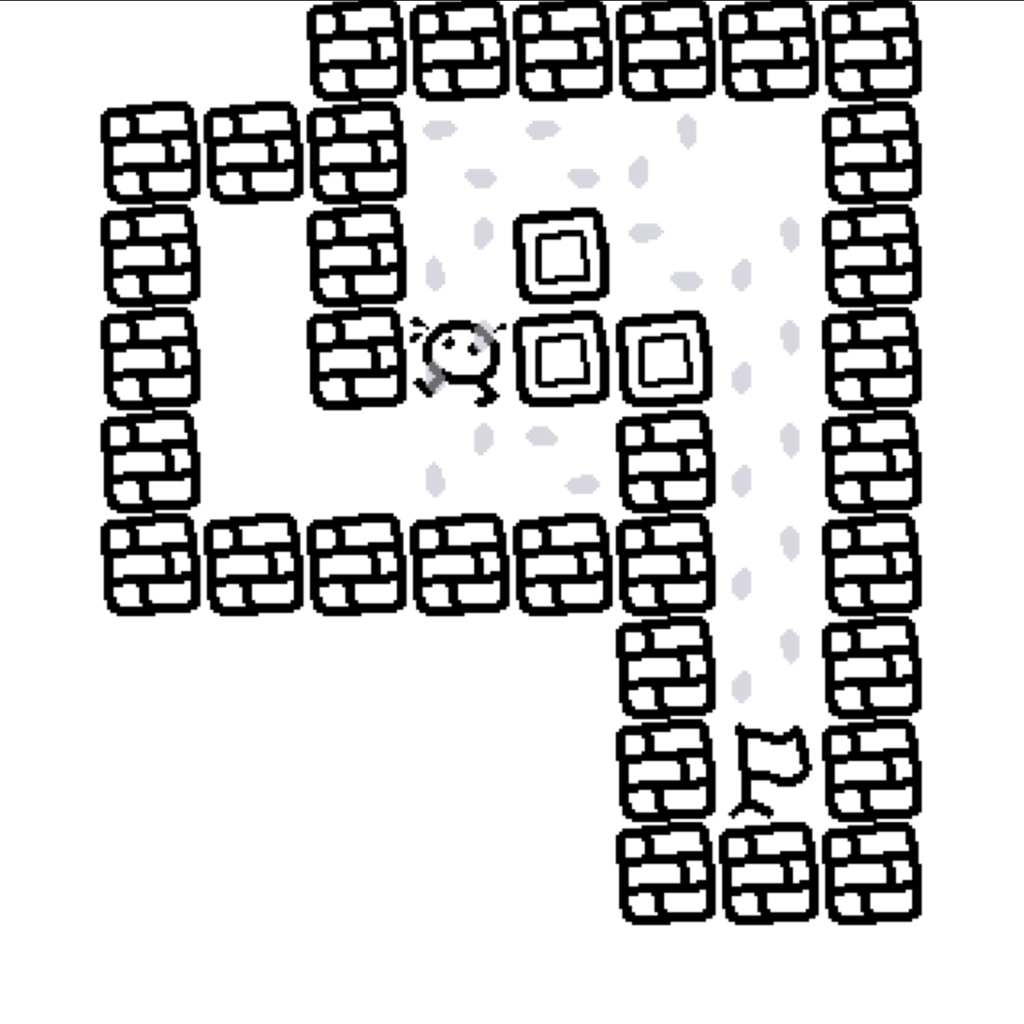
Upon seeing this early puzzle in Permaban, my mouth said, unprompted, “What fresh hell is this?”
One interesting thing about these games generally is how they often break one of the central rules of Sokoban, that you can’t push two or more blocks at a time. In many of Hempuli’s variants you can, but in some of them you can only do it in certain circumstances.
Hell, continued: From the aptly-named (?!) Nabogorf. Notice, this one has a different Undo key. Why do you suppose that is?
As I review these games in order, I’m struck by how they keep getting stranger. Evidently the process of making Baba Is You disconnected some important limiter in Hempuli’s brain, and so now they’ve become a portal, spewing forth constant matter from the Elemental Plane of Puzzles. Weep for them… but also, enjoy the results of that, both now and almost certainly in the future.
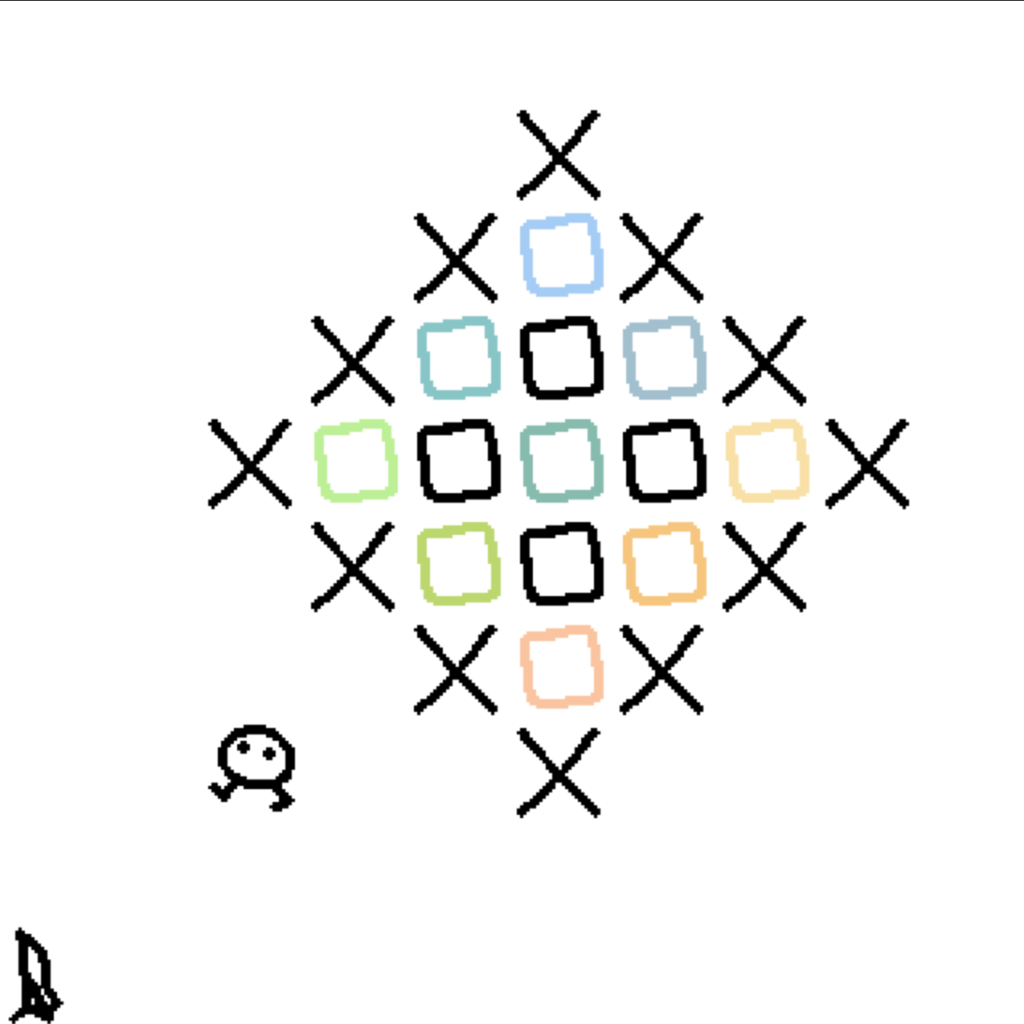
From Mayban: Oh, there’s color now. What does that mean? What’s about to happen? Why am I shaking in my seat?Automount turns the game on its head. But they all do, so that statement is meaningless. This one turns it extra on its head. With cherries on top.
We love it when we find weird and unique indie games to tell you all about! Our alien friends to the left herald these occasions.
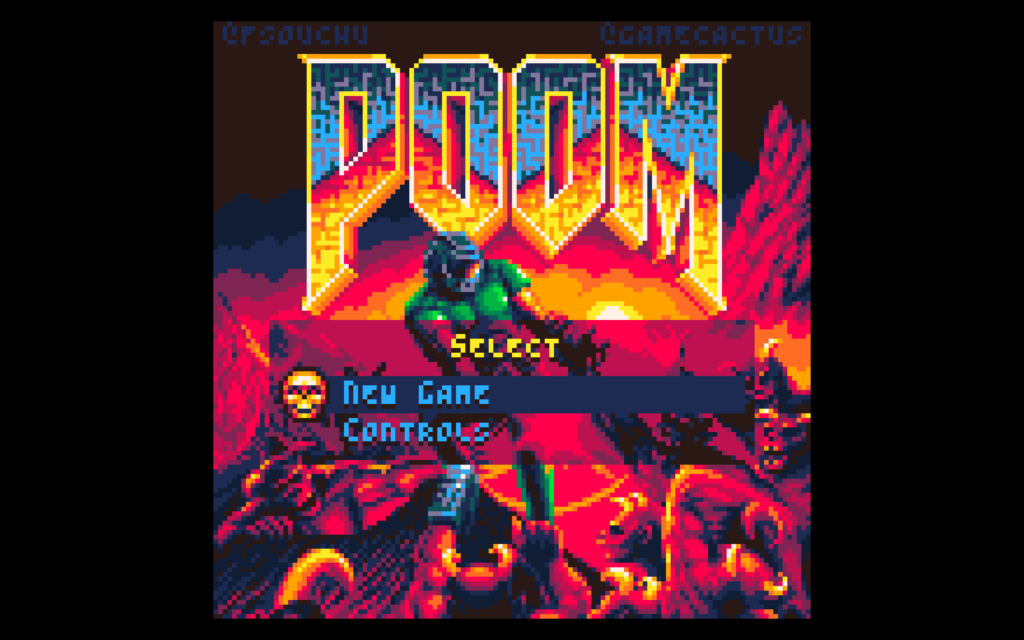
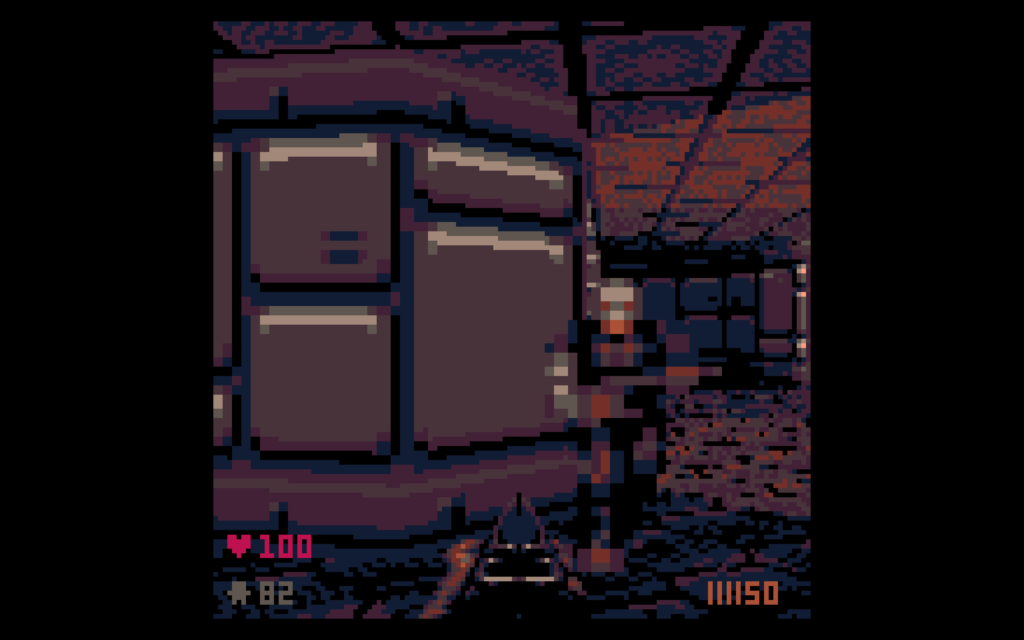
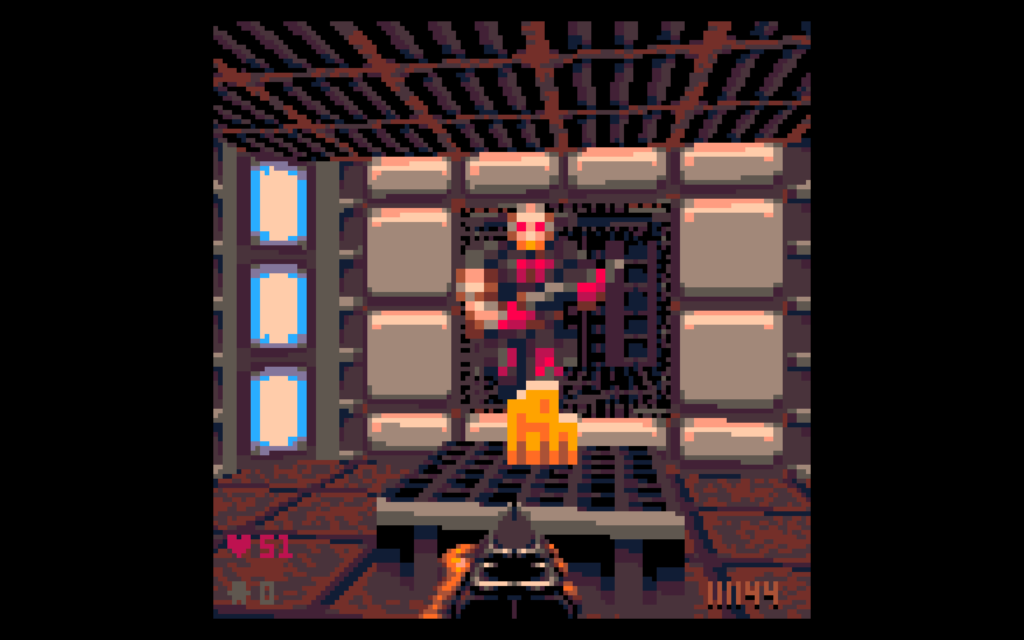
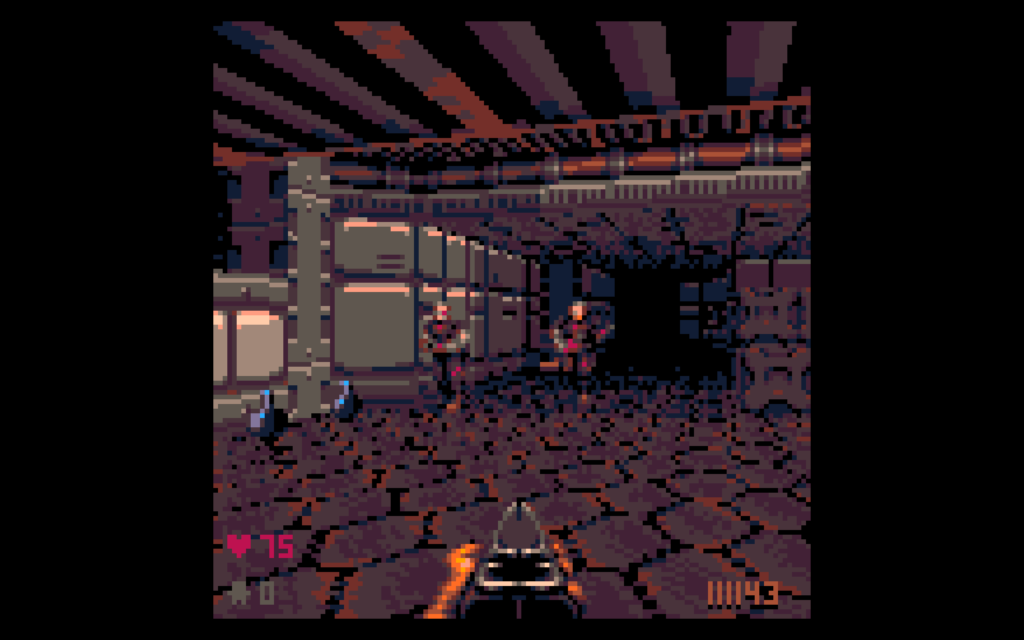
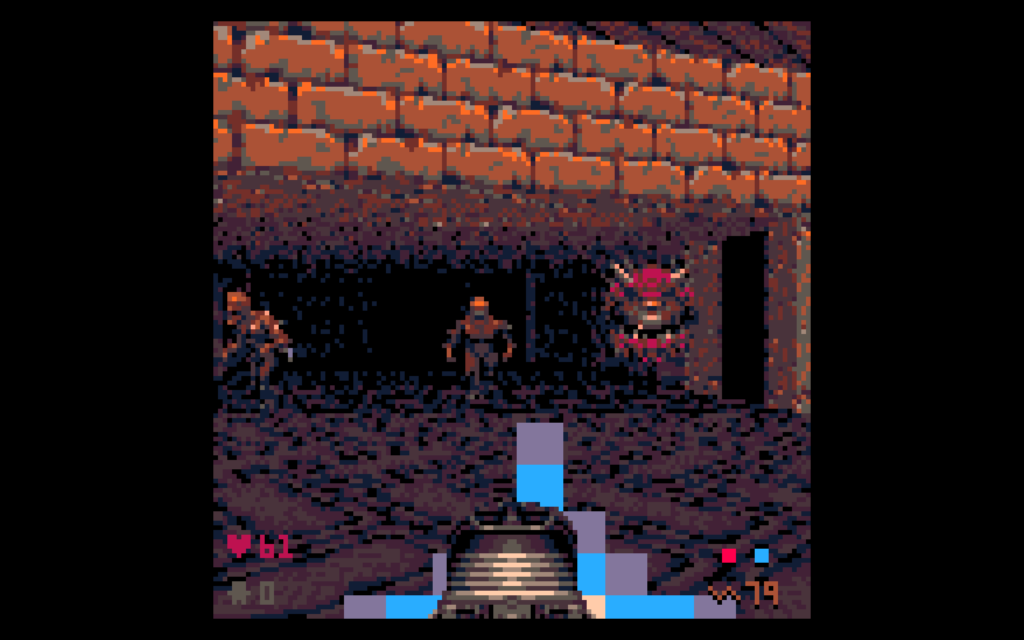
Found by Varyag on kitsunes.club, this may be the ultimate version of the Pico-8 version of other game phenomenon, not a remake of a classic arcade game but of id Software’s DOOM itself. And it has a great name: POOM. It’s made by freds72 on itch.io, and it’s free to download and play. Its levels are not ports of the original room, unless my memory is faulty, but smaller versions, but the general sense is still there. It even has a good remix of the first level music.
We love it when we find weird and unique indie games to tell you all about! Our alien friends to the left herald these occasions.
It’s one of those games that was made to fulfill the promise of a pun in the title, but turns out to be fairly interesting in its own right.
That’s not to say it’s perfect. Randomness plays way too much of a role in your success, although that could also be said of No Man’s Sky, honestly.
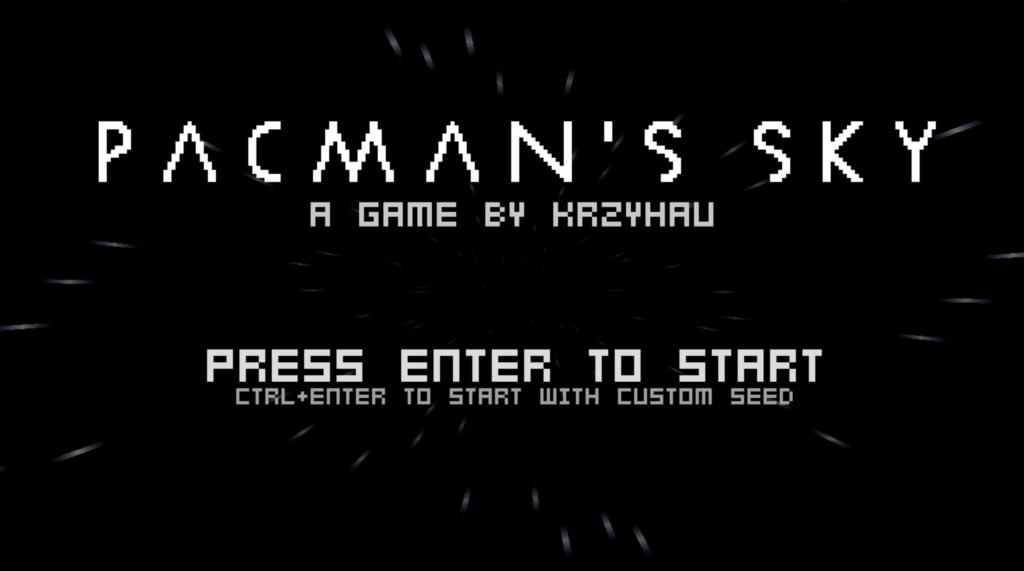
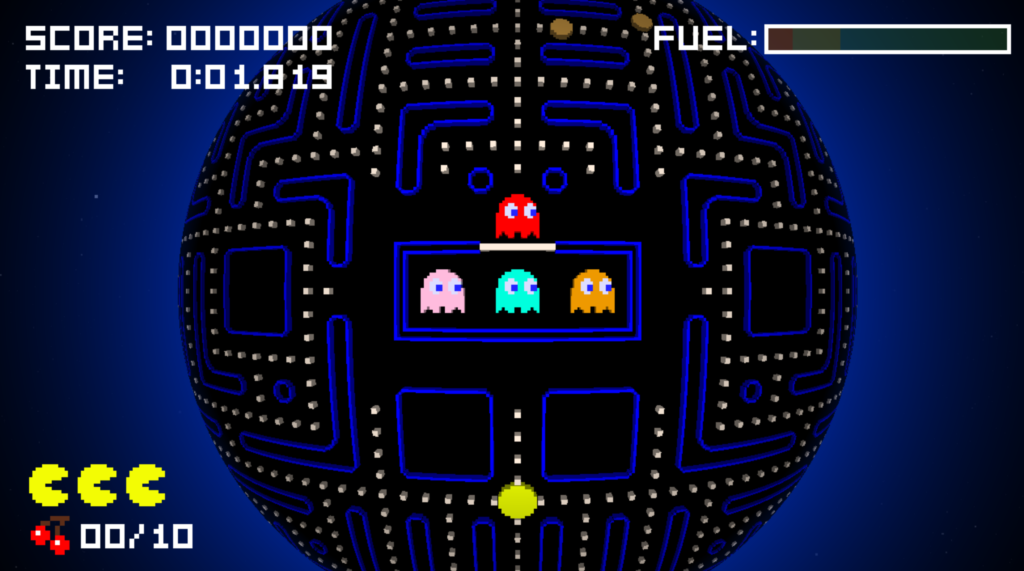
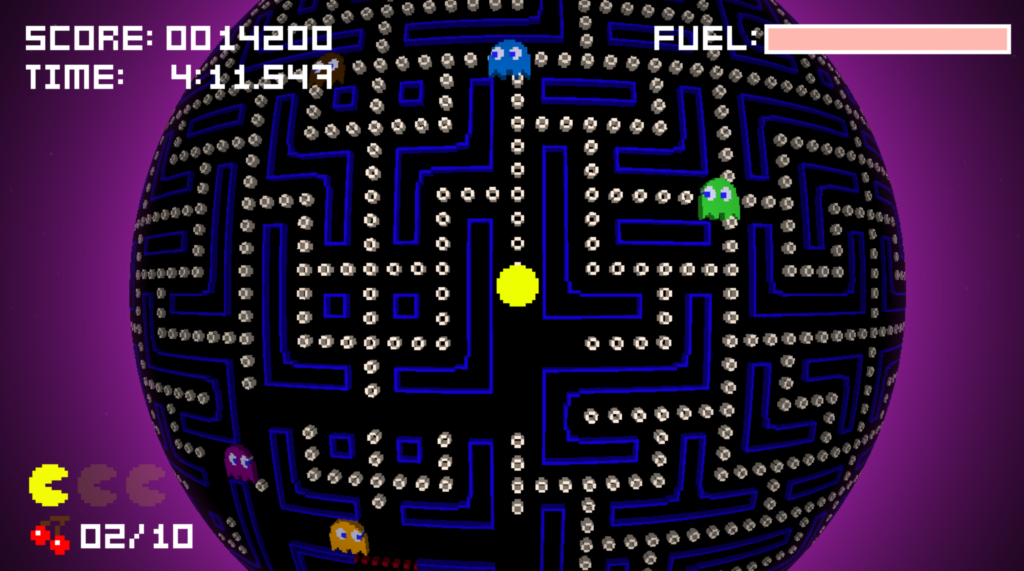
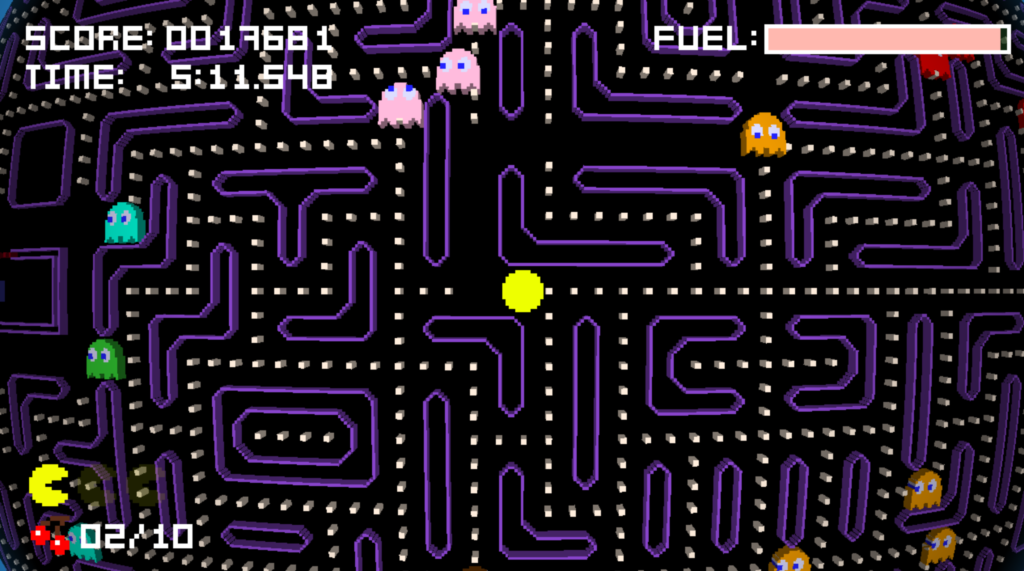
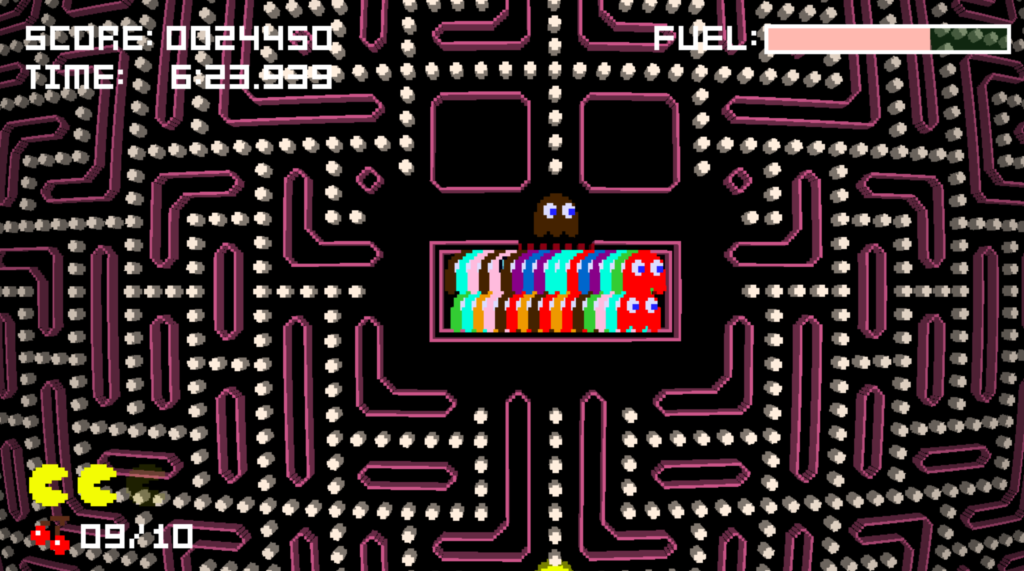
Pac-Man is stranded on a maze-like planet. The maze wraps around vertically and horizontally, but there are no helpful tunnels here to slow down the ghost pursuit, for the screen is always centered on Paccy. There is an escape rocket in the monster house, and the way inside opens up when you’ve eaten a sufficient number of dots. I wouldn’t bug out immediately though; as you eat dots, and also ghosts made vulnerable by the consumption of randomly-placed Energizers, you fill up a fuel meter in the upper-right corner of the screen. You want it to be as full as possible, especially in this first maze, where the game is still fairly easy.
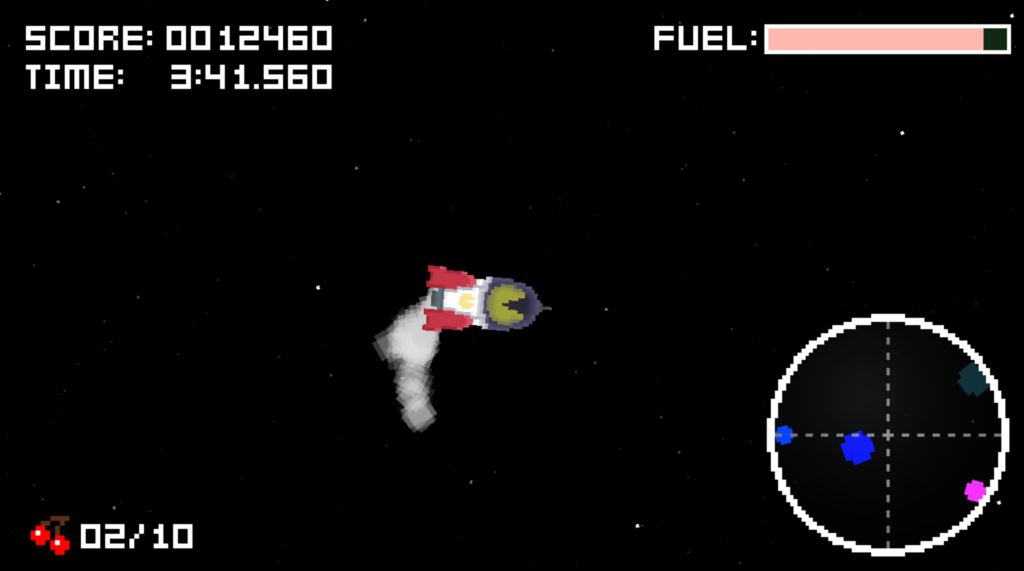
For you see, when you enter the rocket, you blast off into a 2D universe of other planets, and you need fuel to travel between them. (A bit of advice: the rocket’s thrust is always to the right! Press up-arrow to go forward, and up and down to steer.) Use the map in the lower-right to pick the next planet to crash onto, and explore a new maze. You don’t want to run out of fuel! Although you have a total of four Pac-Lives, if you run out of fuel in space, you lose regardless!
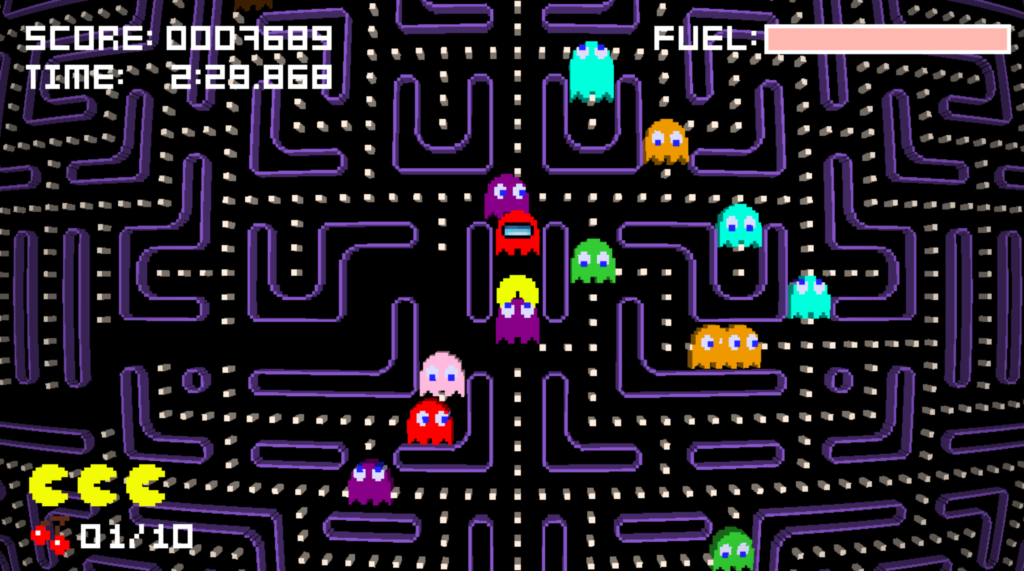
You’ll soon find that most planets are much larger than your starting world, and the game sends in a number of ghosts proportionate to its size! You could end up fleeing from nearly two-dozen ghosts! Fortunately, there are new colors of ghosts in the mix, and none of them are as avid a pursuer as the classic hues, although their meanderings will often block escape routes.
Your goal is to collect Cherries, which are sporadically scattered throughout the planets. You want to eat at least 10, then launch with a full fuel tank, and then press the Space Bar to warp out of the universe, and the game.
As I mentioned up top, randomness plays a huge role in your success. Cherries are placed completely randomly: you might find Cherries in the starting maze, you might find a planet with four Cherries on it and all you have to do is find them, but many planets will be Cherry-less. The best strategy is to scout each planet you visit for Cherries as quickly as possible, snarf up the ones you find while refilling your fuel tank with dots, then quickly evacuate and move on to the next planet.
Some tips:
If you return to a planet you’ve already been on, it’ll be in the state that you left it! This usually makes it harder to refill your tank since there’s fewer dots, so get what you can and launch again.
To help you avoid revisiting planets, I suggest targeting particular planet colors first.
Energizers are placed randomly, and like Cherries, some planets don’t have any.
Ghost vulnerability times are roughly on a par with those of the first maze of the original game, but with so much more terrain to travel through it’s usually highly difficult to make a clean sweep of all the ghosts, even if there’s only the normal four.
The class ghosts have largely the same personalities as in the arcade games: Red chases you directly, Pink looks in the direction you’re facing and tries to get in front of you, Blue seeks to be on the other side of you from one of the Red ghosts, and Orange sometimes loses interest in attacking you when you get close.
The new colors have ghosts that try to lurk behind you, ghosts that try to travel in straight lines regardless of what else is happening, ghosts that just bumble around, and even ghosts that just try to get away from everyone else, Pac or ghost.
Like arcade Pac-Man, the ghosts periodically enter “Scatter Mode,” and give up the chase for a few precious seconds. Unlike the arcade game, the ghosts don’t reverse direction when either entering or leaving Scatter Mode. Your only clue to the behavior change is them turning away, or turning back towards you. That makes them a little less predictable.
Beware! Once in a while you’ll find a ghost that, instead of the usual blue eyes, has an Among Us visor. These ghosts will be one of the other colors, and the same personality as that color, but when you eat an Energizer, not only do they not become vulnerable, they also speed up greatly! If it’s one of the more vicious colors (Red or Pink), this makes eating an Energizer extremely dangerous!
Ghosts become dangerous again the moment they reform from their eyes in the home. If you’re venturing in to get to the rocket, and a pair of eyes rushes in behind you, you can easily lose a Pac without having much control over it. This happened to me several times, it’s worth being wary of.
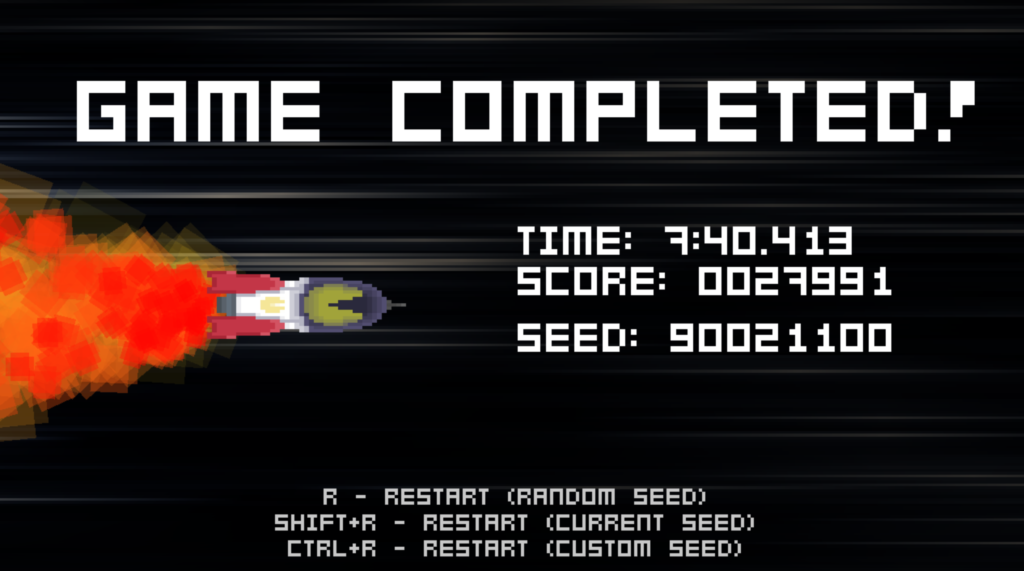
If you want to play in the universe of this victorious game, you can enter this seed at the title screen. It had one planet with four Cherries!
We love it when we find weird and unique indie games to tell you all about! Our alien friends to the left herald these occasions.
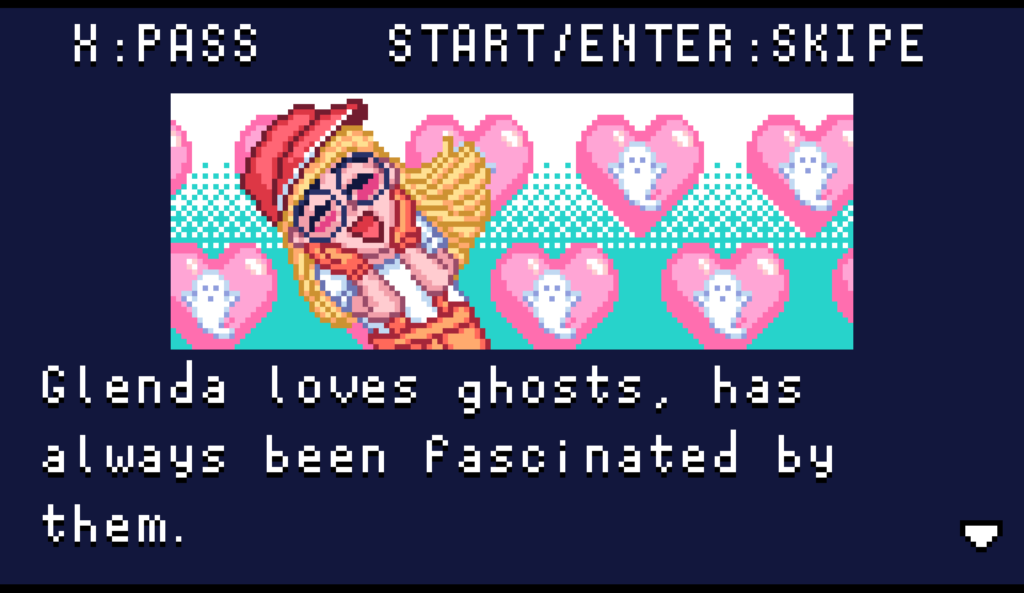
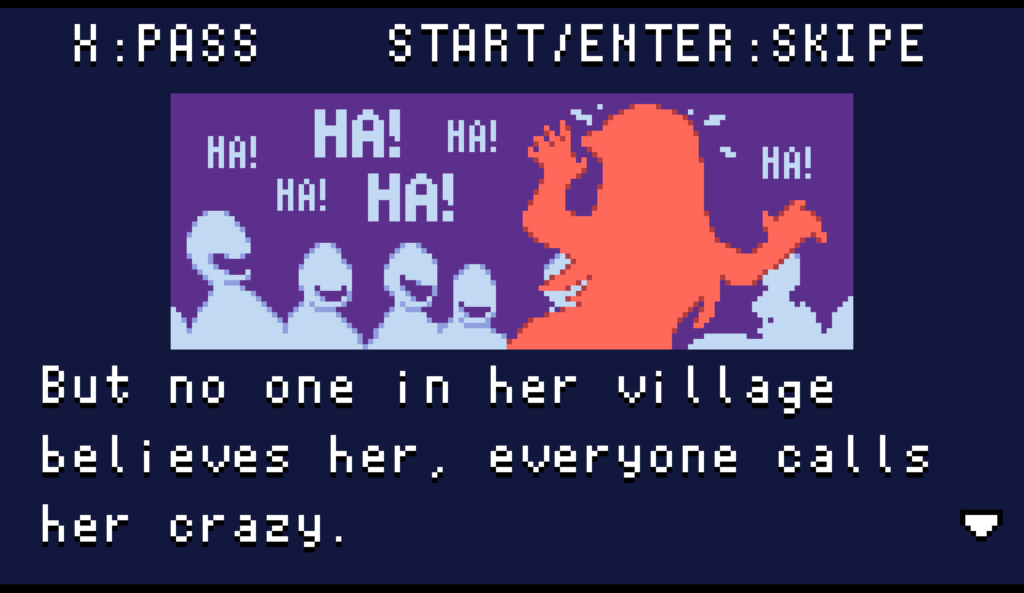
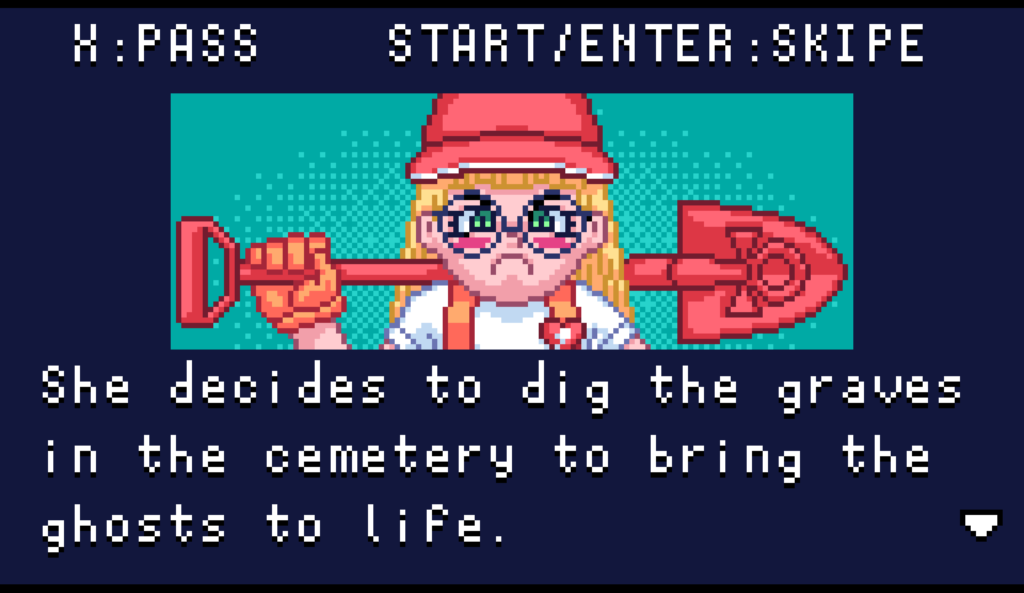
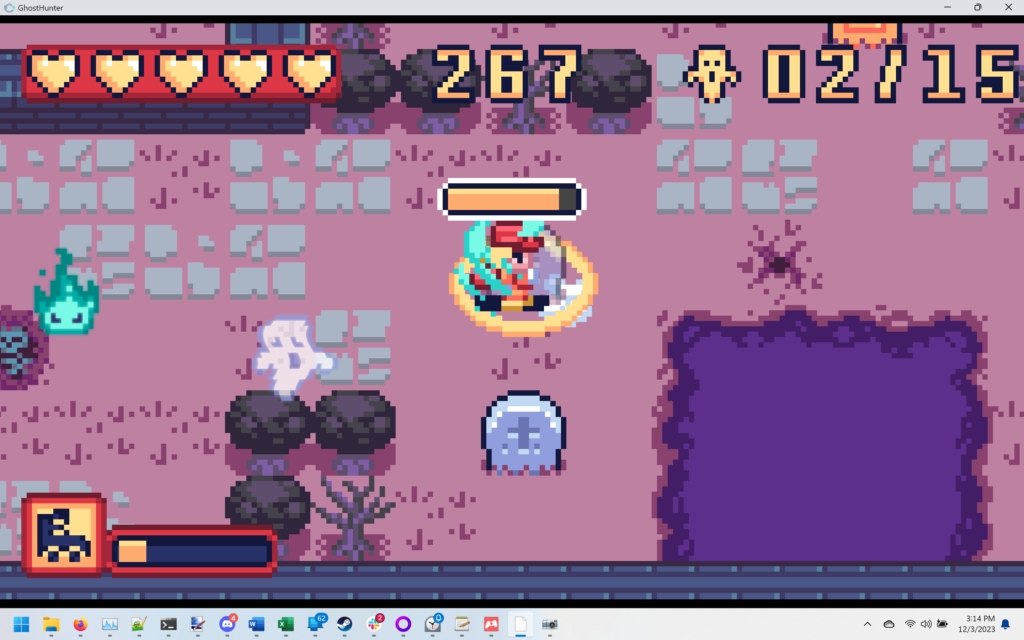
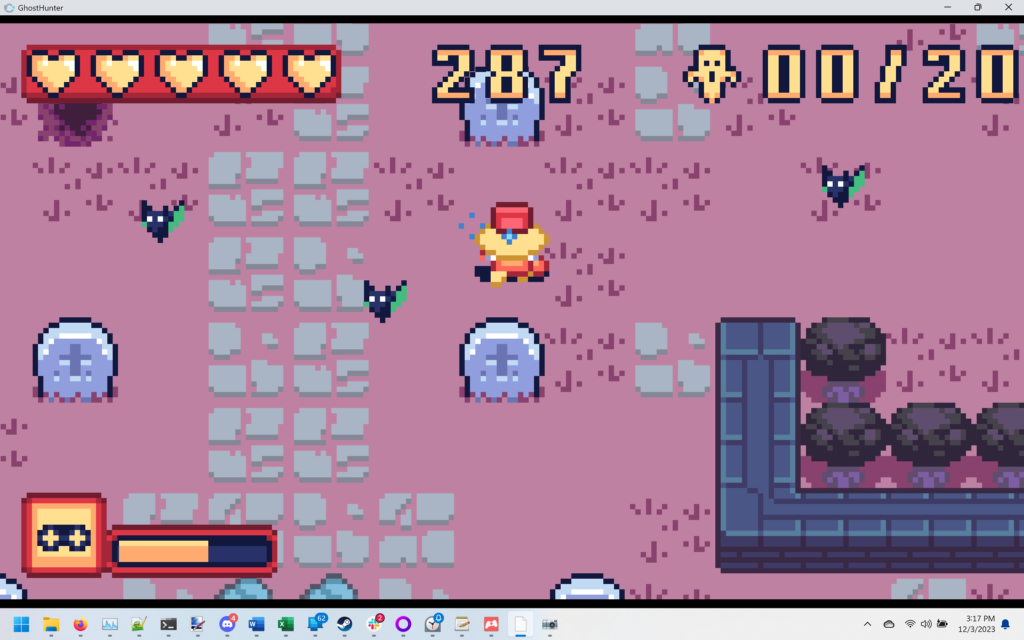
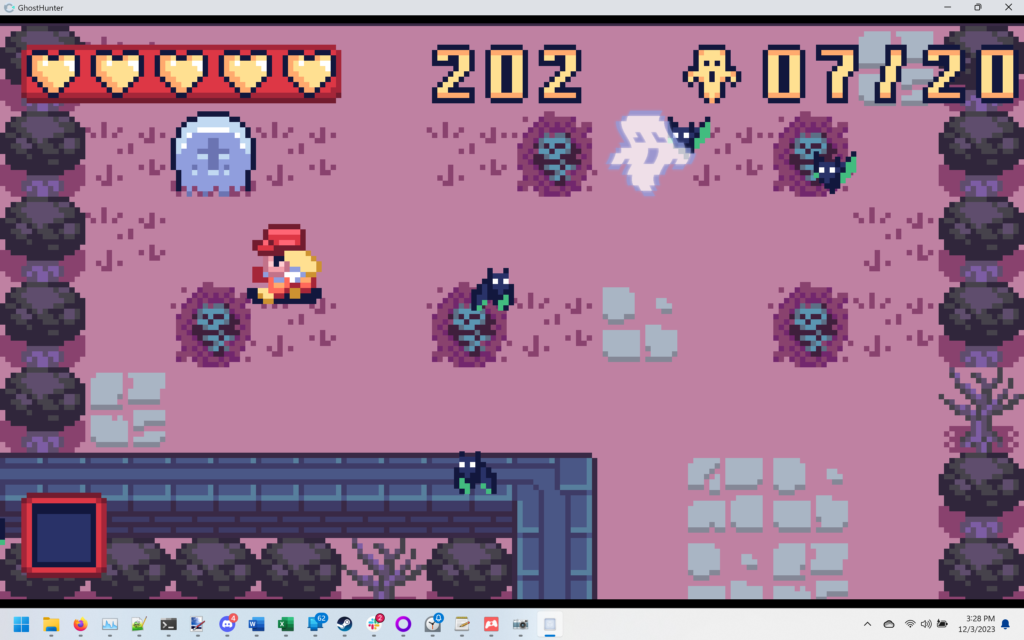
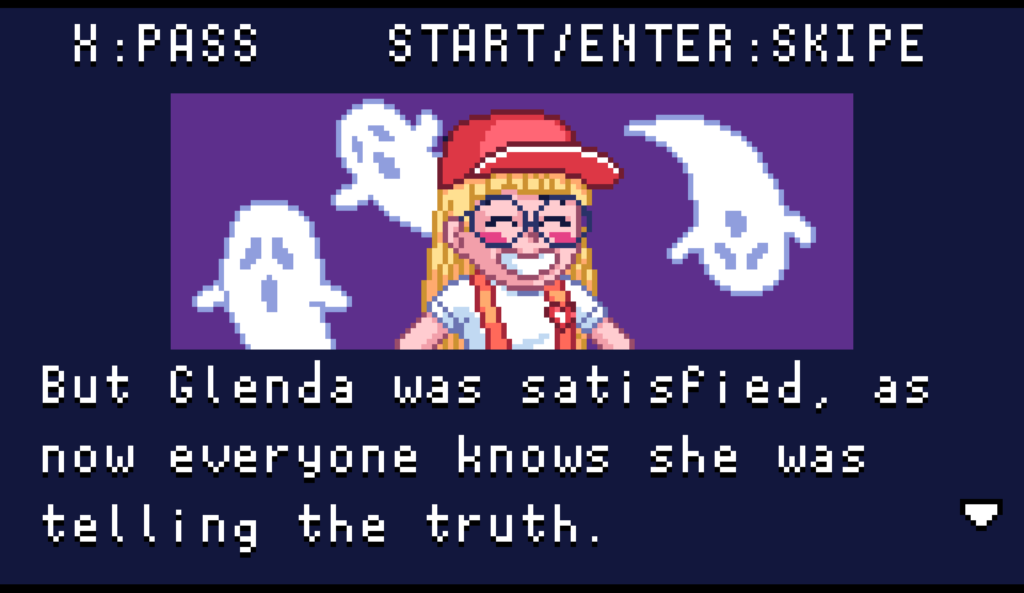
Another game jam entry, Róger Goulart’s Ghost Hunter is a short and silly game about a young lady who loves ghosts, maybe a bit more than she should.
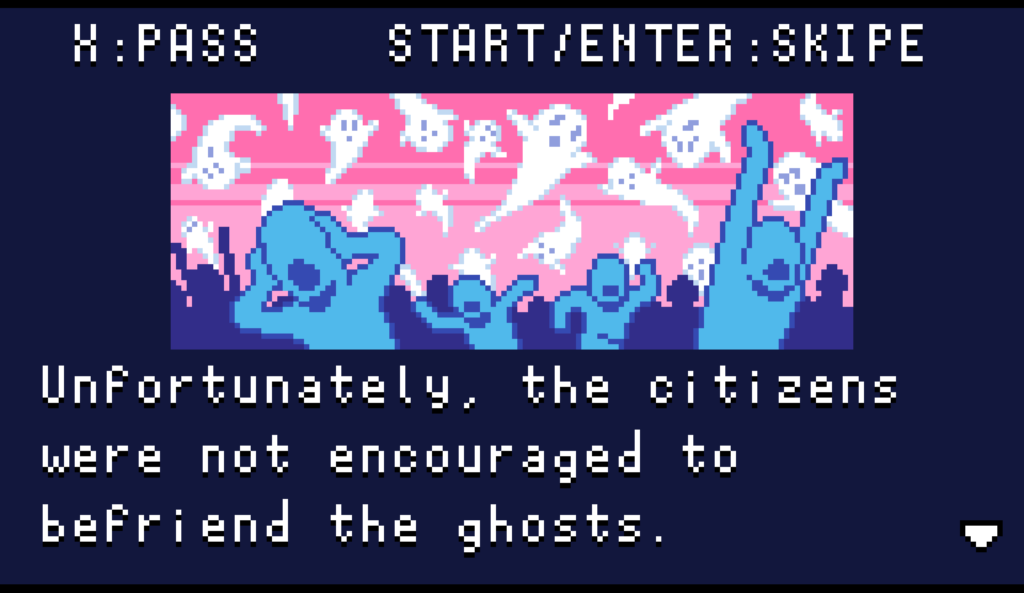
Here are some opening screens:
Take a moment to enjoy this screen.They may have a point.And a new unholy quest begins.
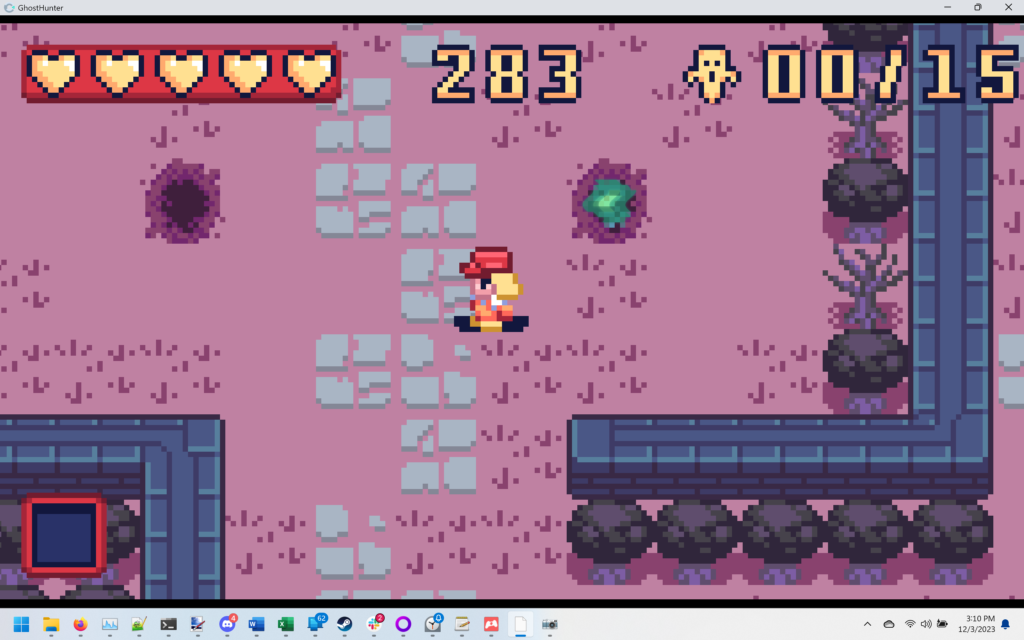
Most of it is a kind of guessing game. Each of three cemeteries has tombstones arranged around it. You go to each one and dig it up with your Shovel of Resurrection. If it’s a friendly ghost, then it emerges and you get one credit towards your quota. If it’s a cursed tomb however, an angry ghost comes out and chases you for a bit. If it catches you, you take a point of damage.
How do you tell the difference? Well, usually you can’t. But there are these orange tombstones placed around each level, and when you dig one of those up you get a random powerup for a short time. (Usually: once in a while you’ll find an angry ghost in one instead, but that’s rare.) One of the powerups shows you whether a tomb has a friendly or angry spirit in store. Other powerups slow angry ghosts, disguise you so they don’t chase you, refill your health or make you walk fast for a short time.
Level 2 has periodically appearing sludge ghosts that must be destroyed by digging up waterspouts to block them. Level 3 has annoying bat enemies that must be avoided, and a higher quota than the other levels.
My tips:
When you stop digging up a grave in the middle of the process, the digging you did before isn’t forgotten. You can sneak in a little extra digging when running from angry ghosts this way.
You tend to lose a whole letter grade at the end of a level from taking damage, so be safe.
The best powerup is the one that reveals the cursed graves. When you get one, I suggest just wandering around for a bit, looking for the mean ghosts, and remembering where they are so you can dig up friends in piece.
Spoilers for the ending are after the download link!
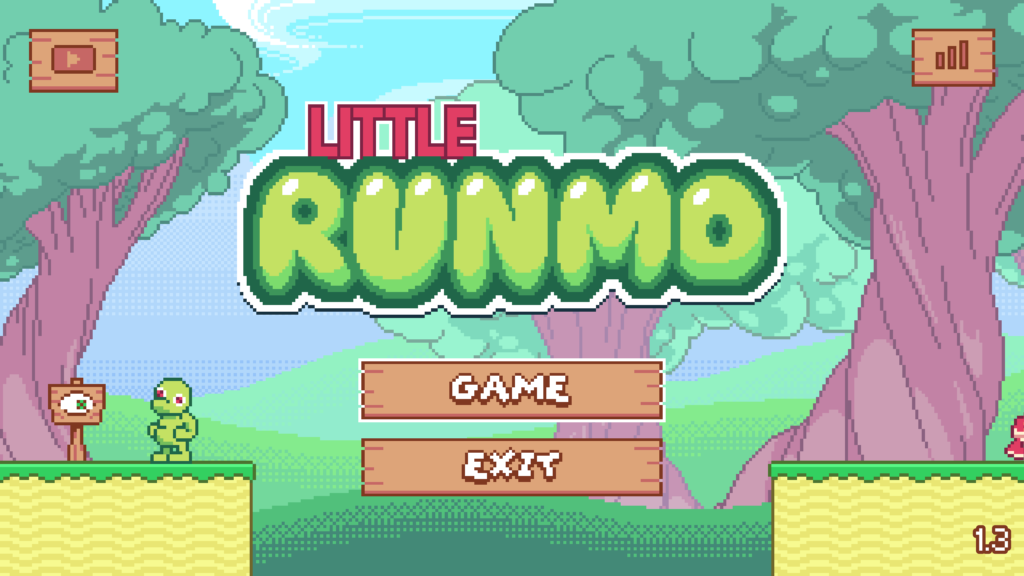
Last year for Sundry Sunday we linked to Gooseworx’s video game-inspired cartoon Little Runmo. In summary: a platforming character discovers that the peril-filled world he’s tasked with traversing is part of a system designed to support the life of a grotesque ruler. They turn it off, but other circumstances happen, and in the end things don’t go too well. Here’s the video, again (16 minutes).
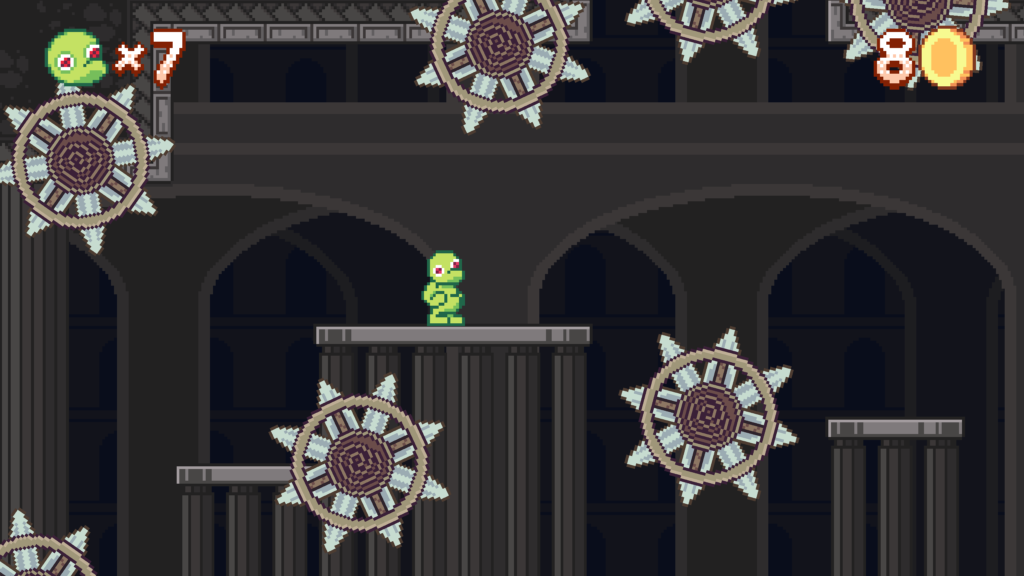
A little green person off on a dangerous journey.
Little Runmo was made four years ago and has amassed 30 million views. Much more recently, a month ago Gooseworx made a pilot for a show to be called The Amazing Digital Circus, which in that short time has gotten an incredible 147 million views. Presumably it’ll get a series, but who really can tell these days? We have one major media company that thinks it’s worthwhile to make complete expensive productions then purposely kill them before release for a tax writeoff, but these are not the pages to discuss that.
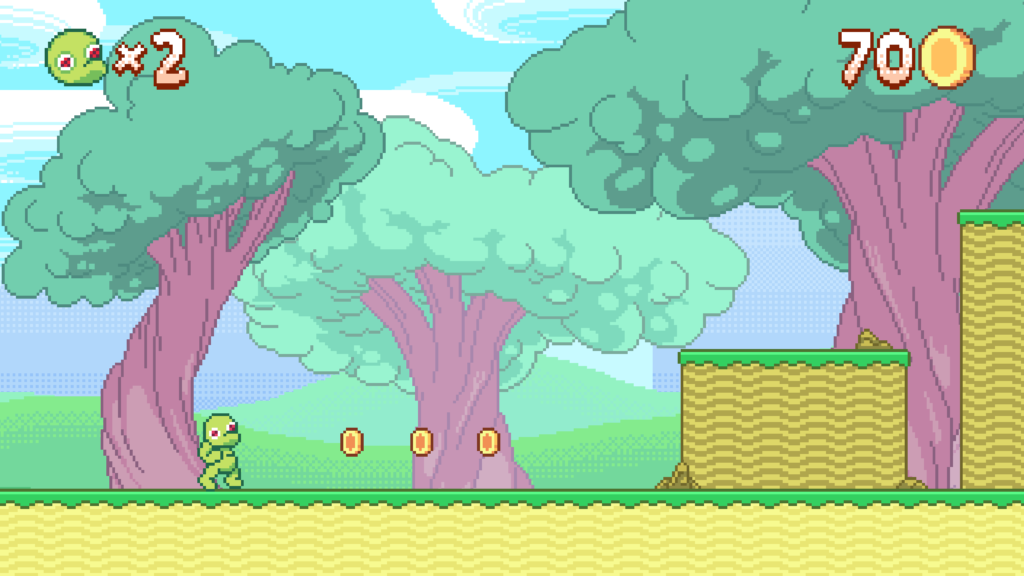
You might think it’d be a simple recreation, in game form, of the original, but it’s got its own things going on! Its platforming is pretty sharp. In addition to basic running and jumping, pressing an action button in the air gives Runmo a forward dive that gives a slight bit of extra height and some forward distance. On the ground while ducking, this move turns into a forward dash that can get through low ceiling passages.
Even with all the thematic deconstruction happening in Little Runmo, we never find out why Runmo has to traverse dangerous worlds. Presumably the evil king their deaths supports has set up some social pressure to convince his people to traverse spiky obstacle courses. Maybe the local rulers are in cahoots with him. BTW, it’s fun to say “cahoots.” Cahoots!
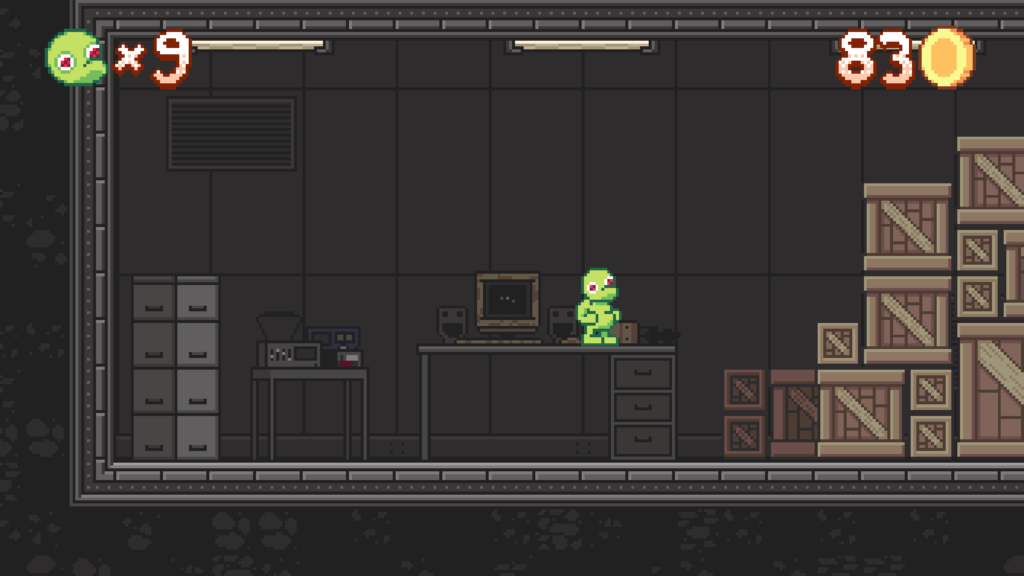
The game is divided into levels, but they aren’t clearly announced, and to a limited extent you can explore the areas as you wish, in a different order than as presented in the cartoon. The game world isn’t exactly as the cartoon presents it either, with the areas much larger, and containing a decent number of secrets to find! It’s usually worth it to poke around out of the way places if you can figure out how to get to them.
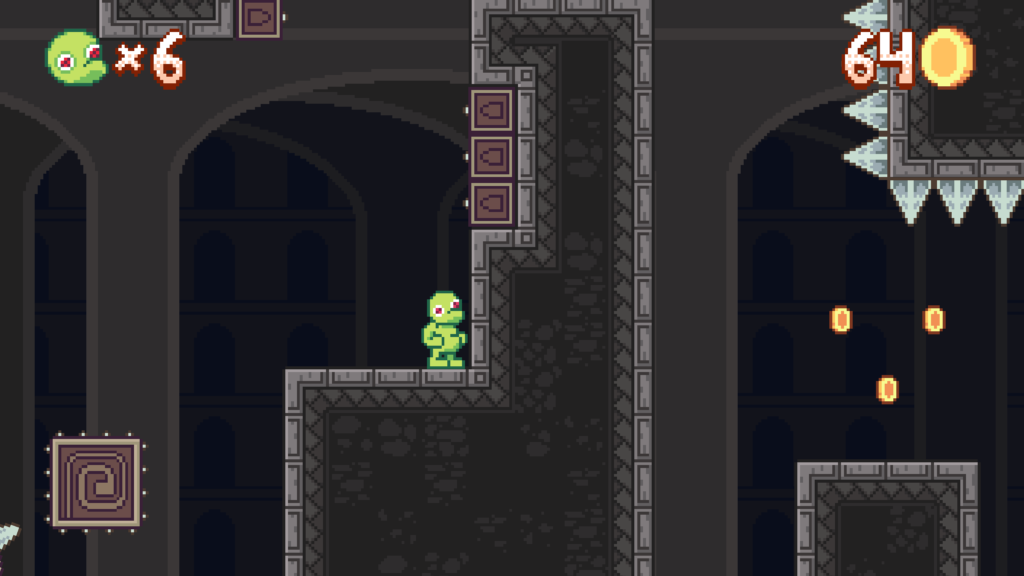
There’s a section with Mario-style timed alternating blocks, although here, if you’re inside a block when it appears, you just die.
The game starts out fairly chill, but gets pretty difficult. It doesn’t seem like an unfair level of difficulty, although it may take you a few plays to build up the skills to conquer it. Here is some advice to playing it:
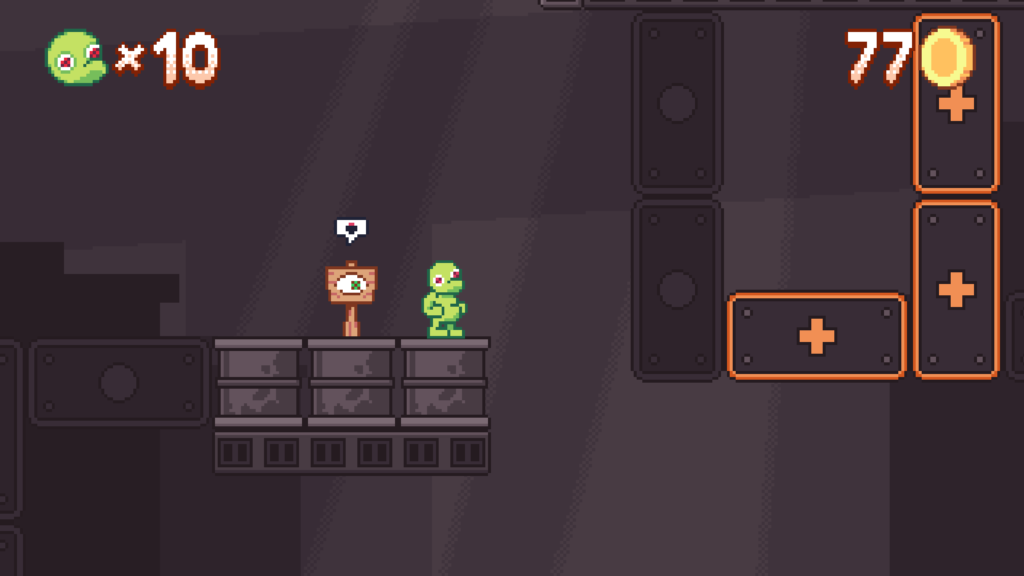
If you haven’t seen the cartoon, you should know that the above ground area is only a small part of the game. The wide pit, the first one with the alternative spike wall over it, is the entrance to the rest of the game. Pikit’s message hints that that’s the way to go (press up to listen to it).
Unlike as seen in the original cartoon, you have to use the midair dive move to get past the pit, it’s too wide to cross with wall jumps alone.
Get used to hugging walls on the way down, to slow your descent. This can be used to scout out pits for secrets, to see if the scrolling continues.
If you press towards most walls but keep jumping, you can climb them easily. Get used to doing this all the time.
If a ceiling has a one block overhang, you can get around it with a jump off the wall and a dive back towards it.
Watch the cartoon, and think about ways to explore regions that the animated Runmo doesn’t go to.
There is at least one place where there are extra lives hidden off the top of the screen.
While running out of lives doesn’t erase your metaprogress, it just sends you back to level 1, the game does not save its state when you exit it. If you quit out and reload, you’ll be at the very beginning.
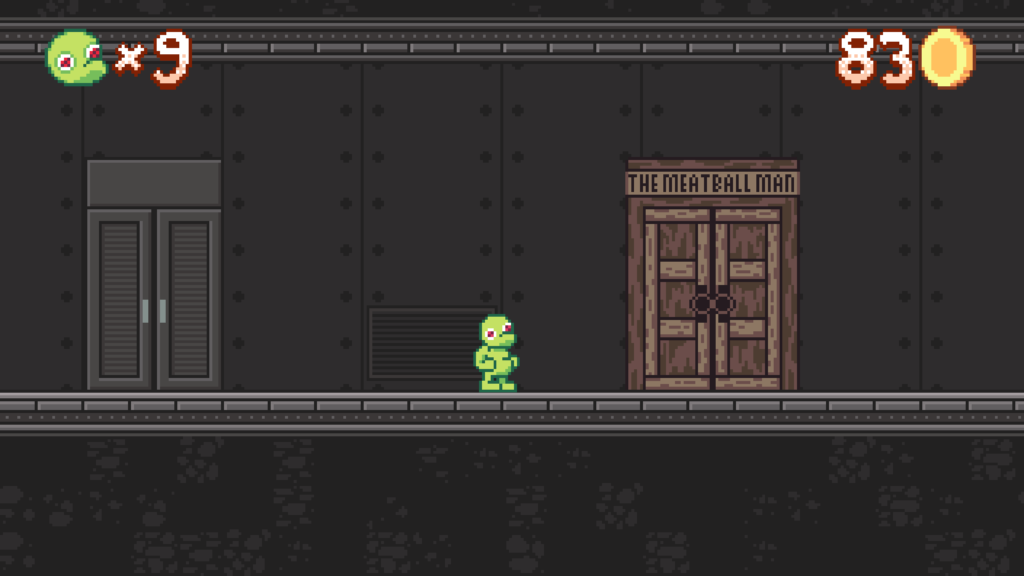
The Meatball Man is one of the funniest parts of the cartoon. It is possible to complete his room, but it’s optional in any case.
If you don’t care to see the game yourself, this 100% completion speedrun shows off the locations, although of course it doesn’t waste time talking to Pikit or exploring unnecessary places. There don’t seem to be any unnarrated longplays around yet, so, best to sharpen those skills if you want to experience it all.
The history of computers is filled with great transformative ideas that never took off, or sometimes, were even actively sabotaged.
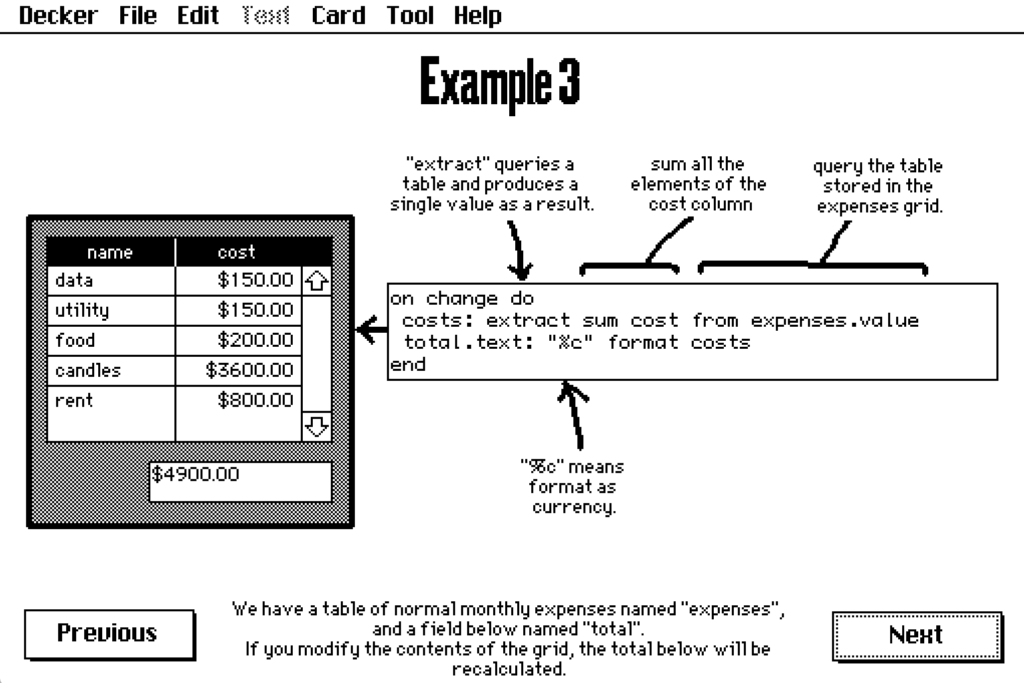
One of those ideas was Hypercard, a “multimedia authoring system” for Mac OS Classic. One way to describe it is like an individual website, contained within a file on your computer, that you could click around and explore. Unlike websites, instead of learning a special language to create documents in it, it has its own creation system that allowed users to wield the Macintosh’s powerful UI to make things.
Hypercard was an early version of several different things. Of course its concept of linking between different “cards” of information was influential to the design of the World Wide Web. Its method of placing controls onto cards and attaching code to them is reminiscent of RAD development environments like Delphi and Visual Basic. And its multimedia capabilities allowed for the creation of full games, the most prominent example of which, of course, is Cyan’s Myst. Hypercard also could be seen as the inspiration, with varying degrees of directness, of a swath of creations ranging from TWINE to alienmelon’s Electric Zine Maker.
But wait! Don’t we live in something rich people call the “free market?” Aren’t superior products supposed to make their creators (and, of course, investors) billions of dollars? Why aren’t we all making Hypercard stacks now, on our Macintosh System 29 computers? Of course: it’s because good things are not necessarily profitable, that corporate politics matter much more than the intrinsic worth of a technology, marketing is grotesquely powerful yet also somehow overvalued, and finally, the World Wide Web came out and essentially did it one better.
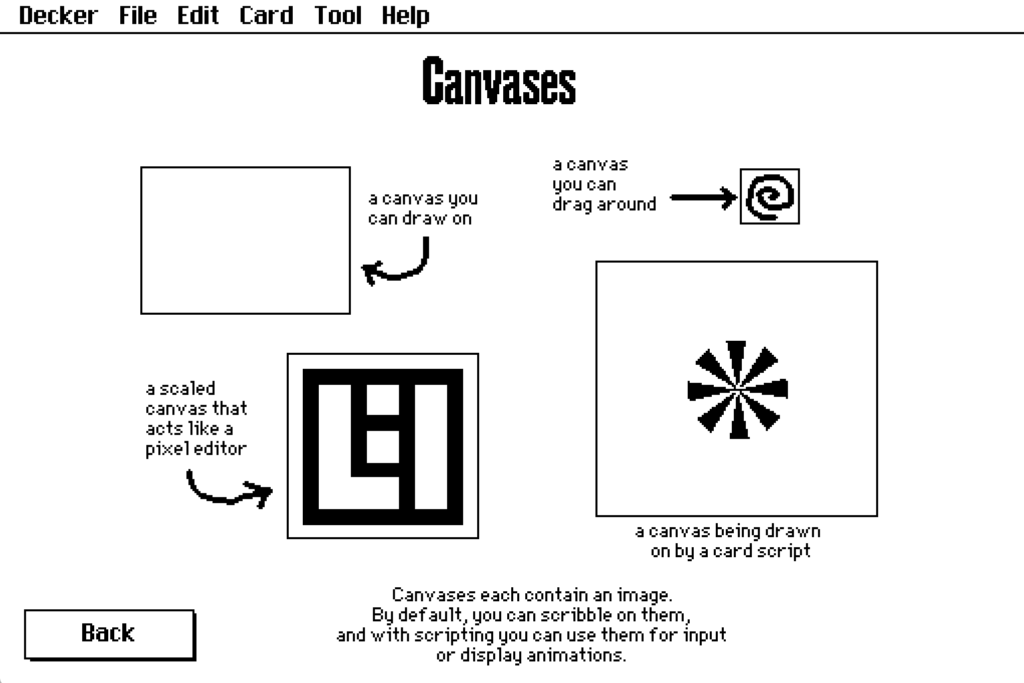
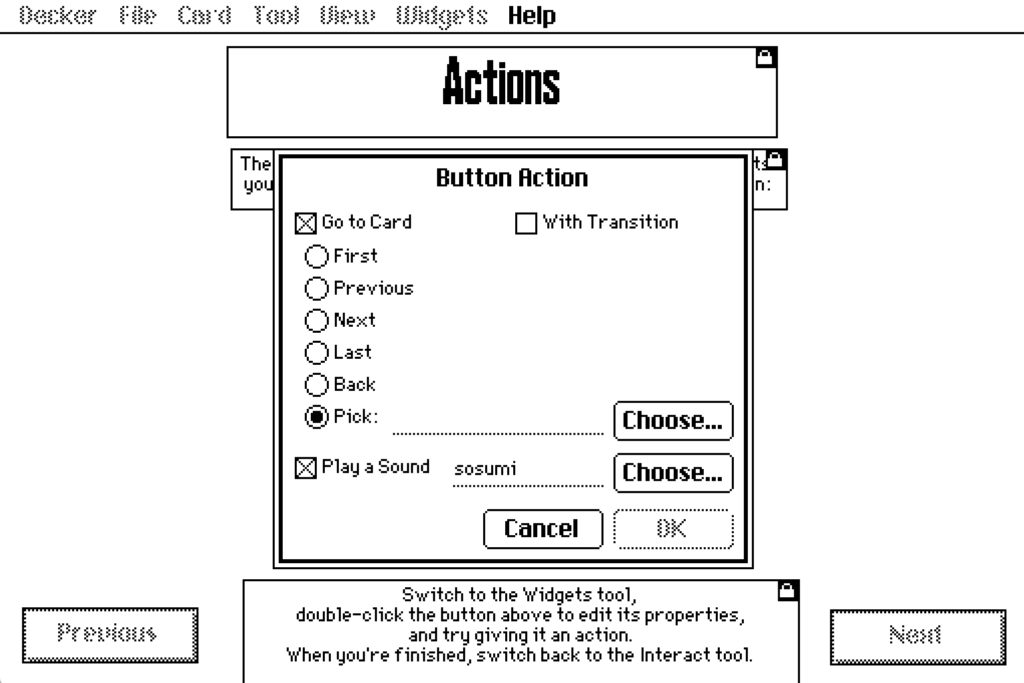
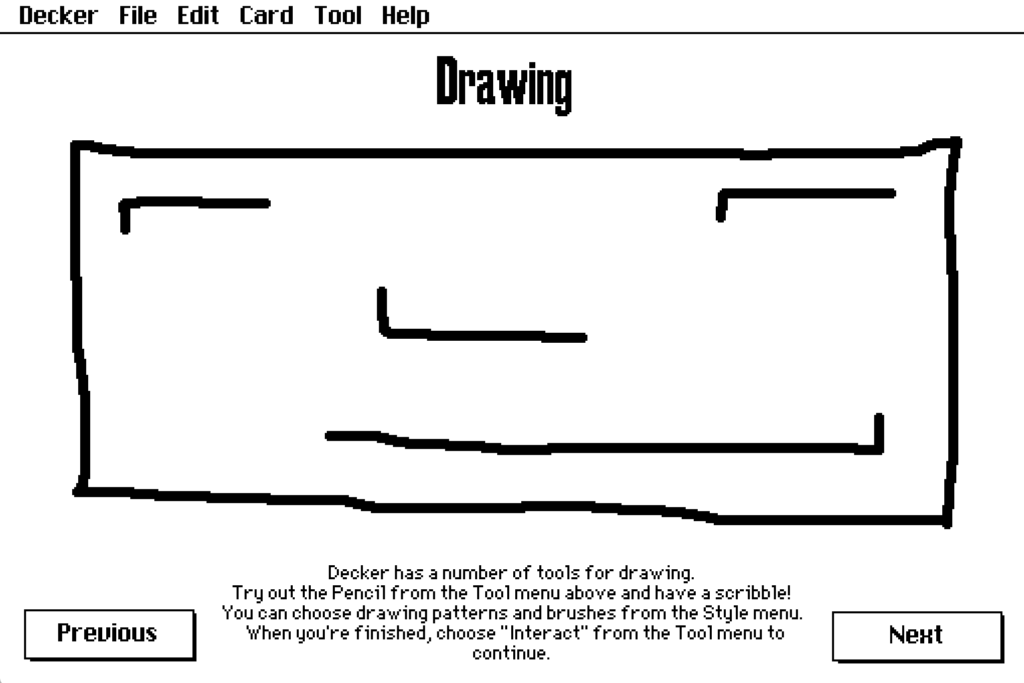
Yet Hypercard still has its fans even today. Decker (not Docker), the subject of this post, is a kind of homage to Hypercard made for current OSes. It looks, on purpose, like it’s a program for early versions of Classic Mac OS, with 1-bit graphics and copious use of dithering. Yet despite that it’s still reasonably powerful. So, rediscover the promise of computing circa the late 80s, with Decker.
We love it when we find weird and unique indie games to tell you all about! Our alien friends to the left herald these occasions.
EDIT: there was a WordPress display glitch that was causing images to overlap the text. I’ve changed the formatting a bit to keep it readable.
There’s hundreds of new games released every day, and there’s no way to can even find out what they all are, let alone try all of them. So there’s an inescapable element of randomness to what meets my eyes, and thus to what I bring to you. It’s useless to ask, “Why did you link to that silly little trifile when Important Game by Known Developer goes without remark?” Our finds are always going to be kind of idiosyncratic.
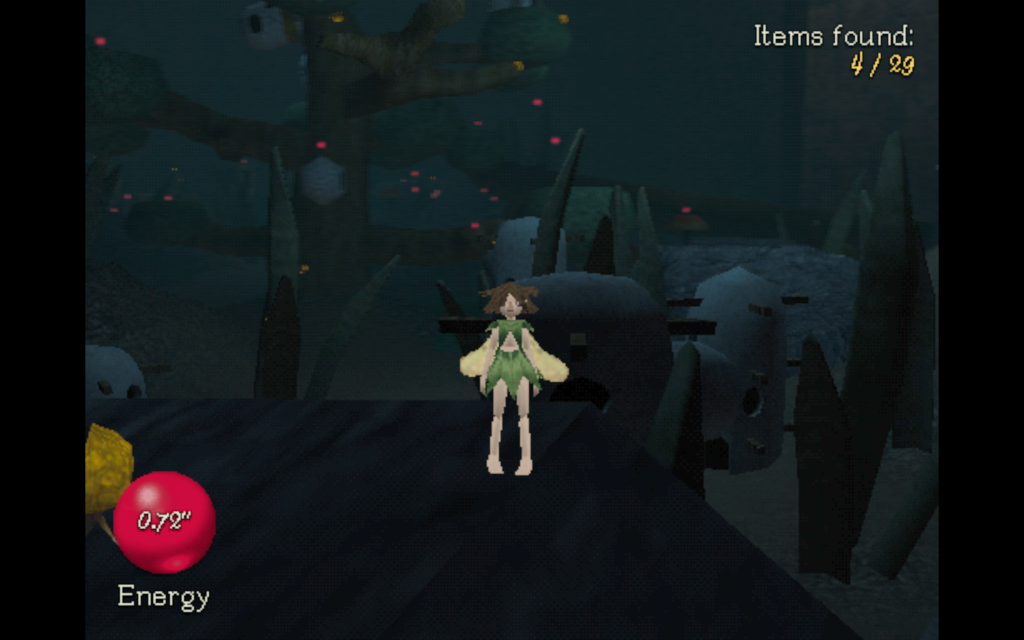
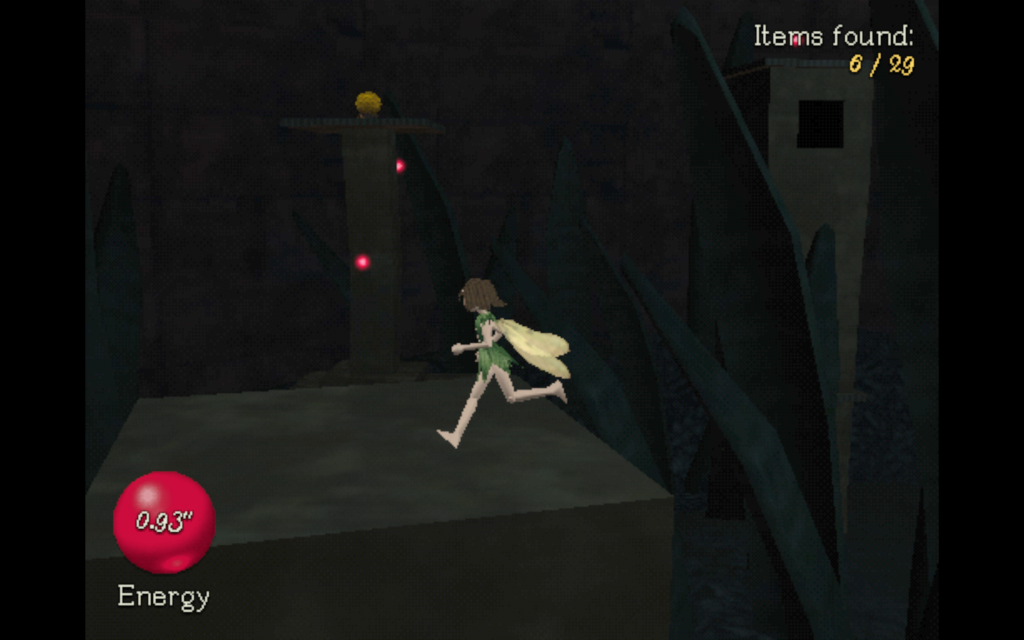
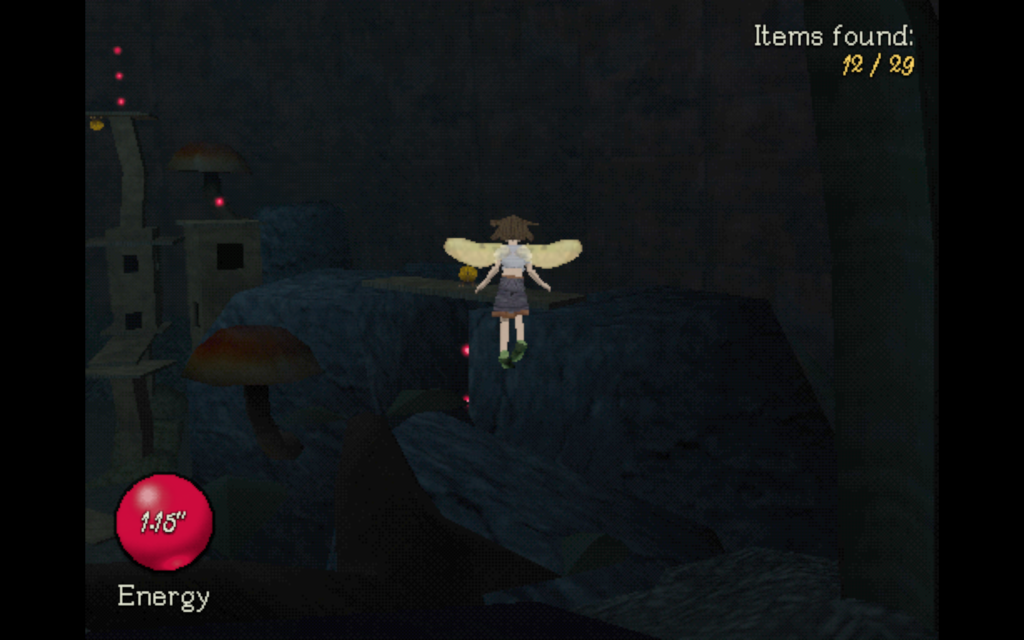
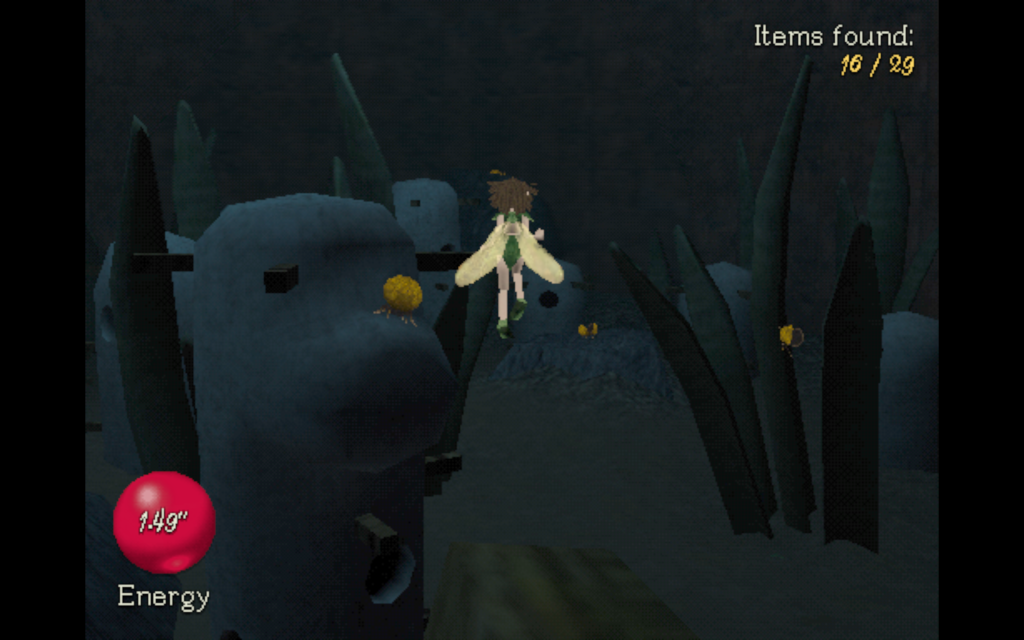
So it is with this one, Feydome, a slight but fun game made in two weeks for a game jam. It’s a laid-back 3D exploratory experience where you’re a barely-garbed, at first, fairy, searching an eerie abandoned village for clothes to wear. Movement is by WASD, with the Q and E, or else the left and right arrows, rotating the camera. Yes, it’s an exploratory dress-up game!
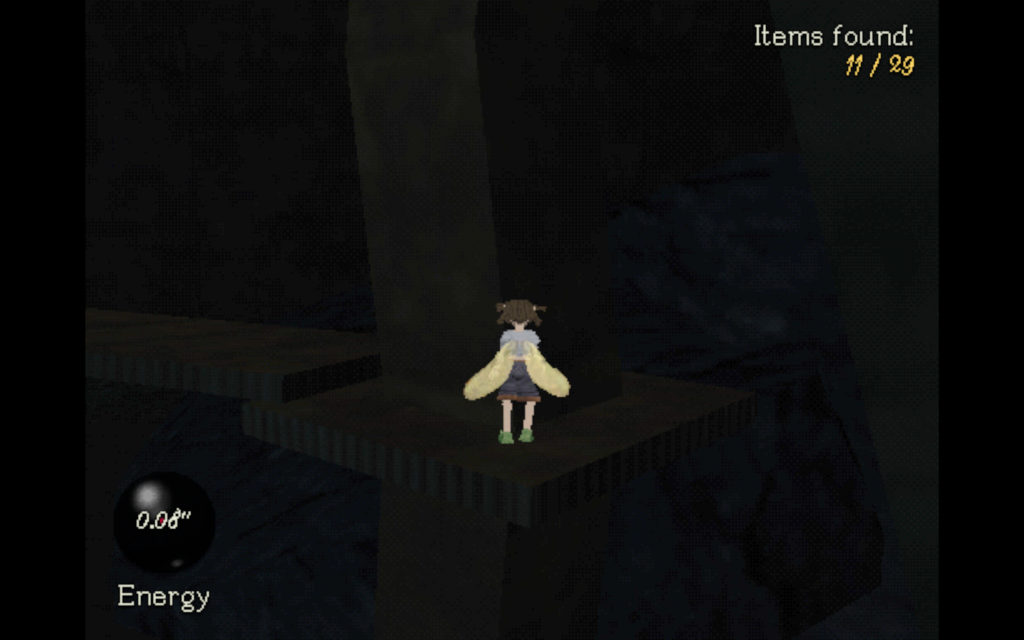
At the start your fairy is weak and can barely fly at all. You find glowing orbs that each grant a tiny bit more wing stamina, but never enough that you can fly indefinitely. Each orb very slightly extends the amount of flight time, by around one or two frames. So you’re always tied to the ground, but there are a lot of orbs to find, and that extra time adds up.
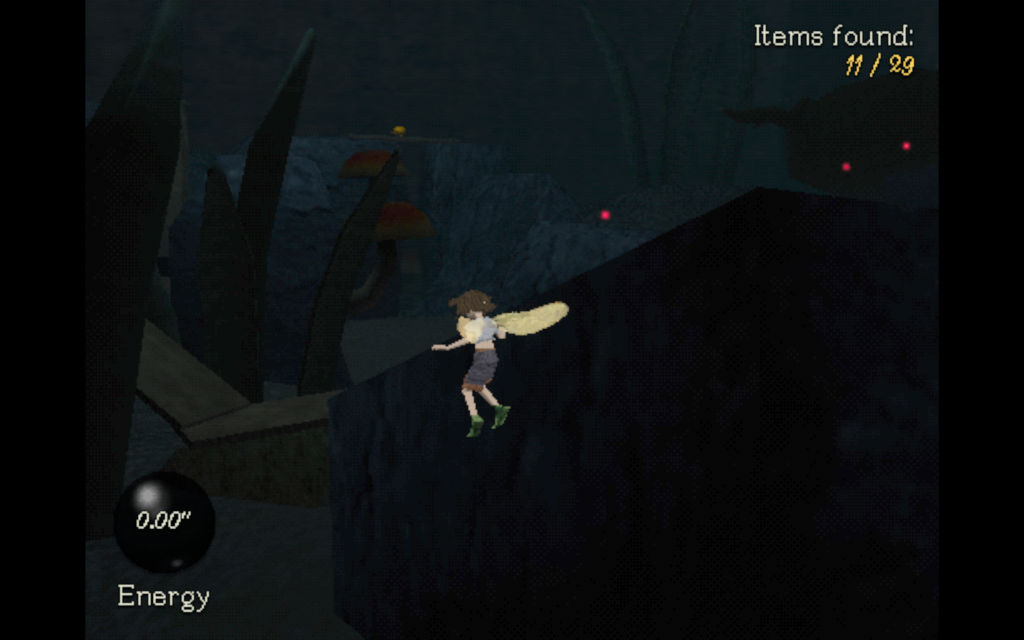
The fairy can glide if you hold the fly button down, even when out of energy, and if you keep tapping the space bar you can glide much further, which is a huge help. It helps to devote one hand to this, while using the other to move forward.
While you can rotate the camera, you can’t adjust the angle vertically, so you can’t look above or below, and there is no mouselook. The developer says that an expanded version is being made, maybe these control oversights will be addressed in that.
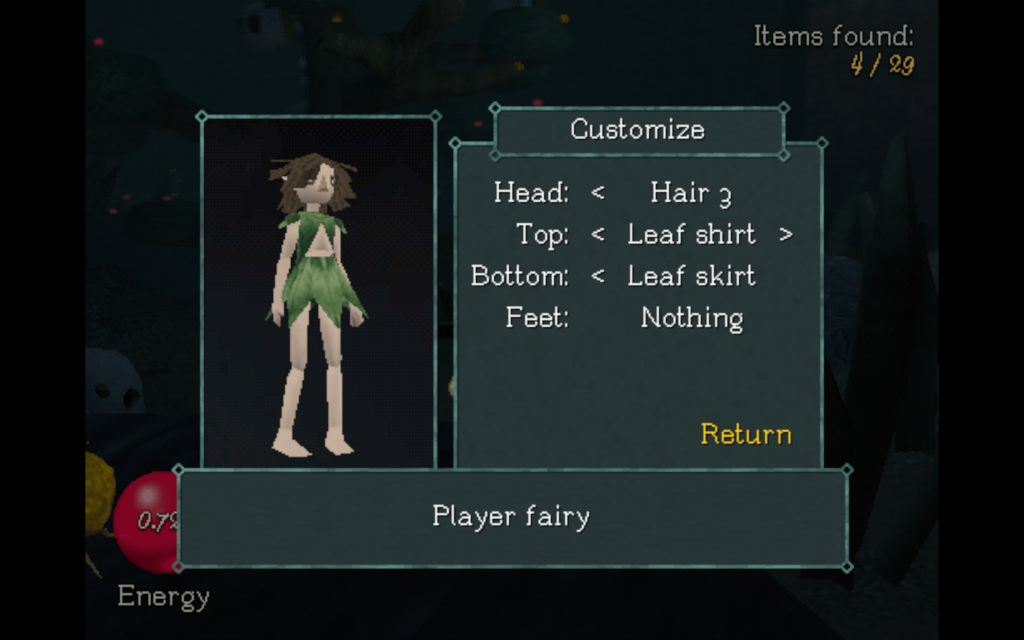
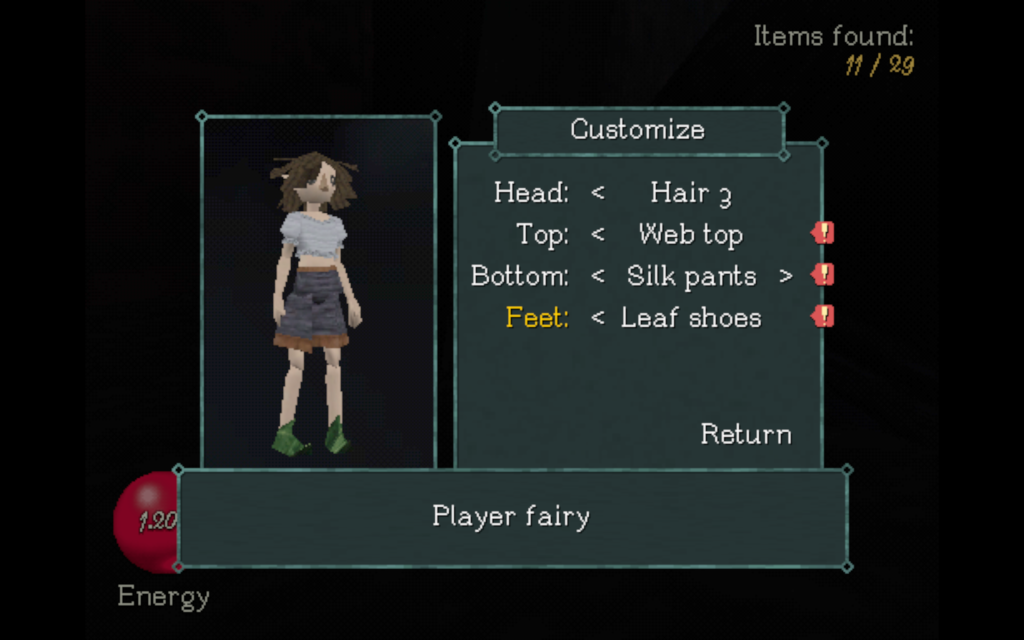
The pieces of clothing, 29 in all, are in weird chattering spheres that are stuck all over to the walls, floors and ceilings. When collected, a sphere stops chattering, which is of great help in tracking down the last few. Clothes go into your Customize Menu. You start out with just a Tied Fiber top and Leaf Panties bottom, but each item you find helps to make your wee friend more presentable in polite society (if there were any in this game).
There are no enemies, and no moving objects besides the fairy. While it’s difficult to get around at first, it’s surprising how even an extra half second of flight time expands their horizons. Mind you, there is no reward for finding all of the clothing. There is no ending; the journey is entirely the point with Feydome. You’re left alone in the abandoned world, you and your wardrobe, until you exit the game. There’s no save function either, but the game’s so short that it can be finished in one sitting anyway. Maybe 40 minutes in all, if you focus on finding everything.
But it’s fun to explore! It’s a satisfying gameplay loop, finding orbs, using the extended flight time to find yet more orbs, and punctuating the process with occasional new clothes. I’m sure this kind of gameplay has been done before, but this is a neat example of it, and it doesn’t cost anything to try.
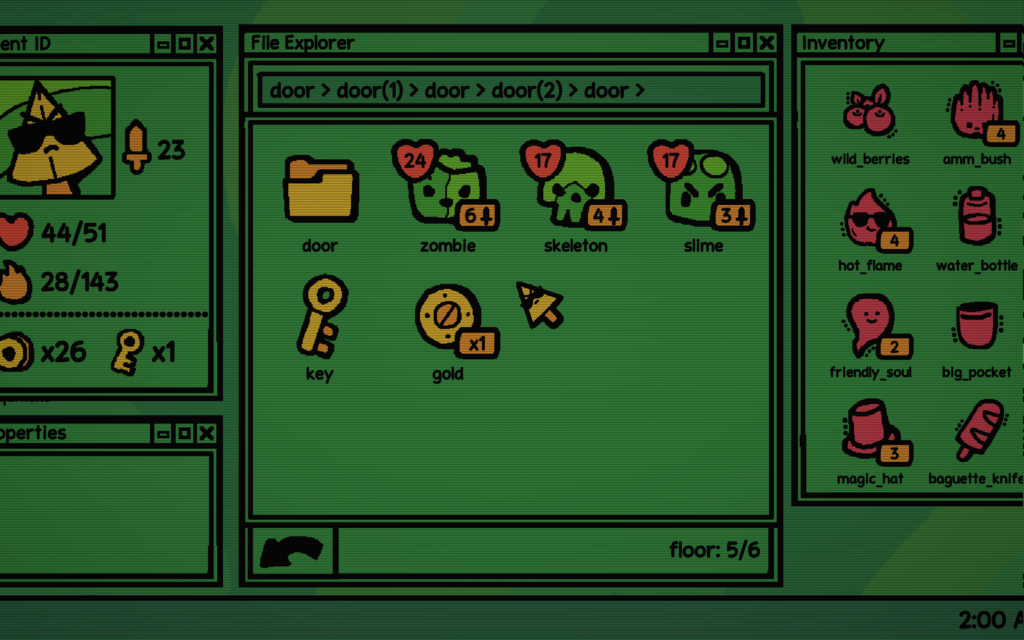
Folder Dungeon, on itch.io, is a short and not-too-difficult game where an adventuring cursor has to dig through the folder structure of a hard drive to find an important file. Each window is a room of the dungeon; entering a Door folder takes you to another room down. You can go back the way you came using the back arrow icon at the bottom of the window.
In addition to doors, rooms can contain items, which can be picked up by clicking on them. Gold is among the items, the value of the coin indicated by a number. Some items cost money; if they do, they’ll have a coin and a number on the item. Some items, notably Health Potions and Ice Cream, take affect immediately; they never enter your inventory, but work immediately on your stats whether you needed it or not.
And, some of the things in rooms are monsters. If you do something other than attack a monster by clicking on it, then every monster in the room has a percentage chance to attack you; if you attack a monster, then it always counter-attacks if it survived the attack, but other monsters in the room don’t get the chance to attack.
Somewhere in each folder structure is an Exit icon. When you find it, you can only enter it once all the monsters in its room have been defeated. You don’t have to defeat all the monsters in a room to leave it, but it does give the monsters in the room a chance to attack you.
The most interesting play mechanic is, every action you take generates “heat.” You can only take so much heat. If heat reaches your maximum capacity, you take one damage per action until you leave the level (which resets heat to 0) or you lower your heat by collecting an Ice Cream.
Note, as you can see in the above screenshot, there’s a display bug in the current version that cuts off the left and right sides of the screen. Or is it a bug? It didn’t actually prevent me from playing? Maybe it’s an aesthetic choice? Anyway, I managed to finish the game on my first attempt, but it was close.
It’s not a command to delete temp files as root on a Unix-styled system! It’s a fun and free little game over at itch.io!
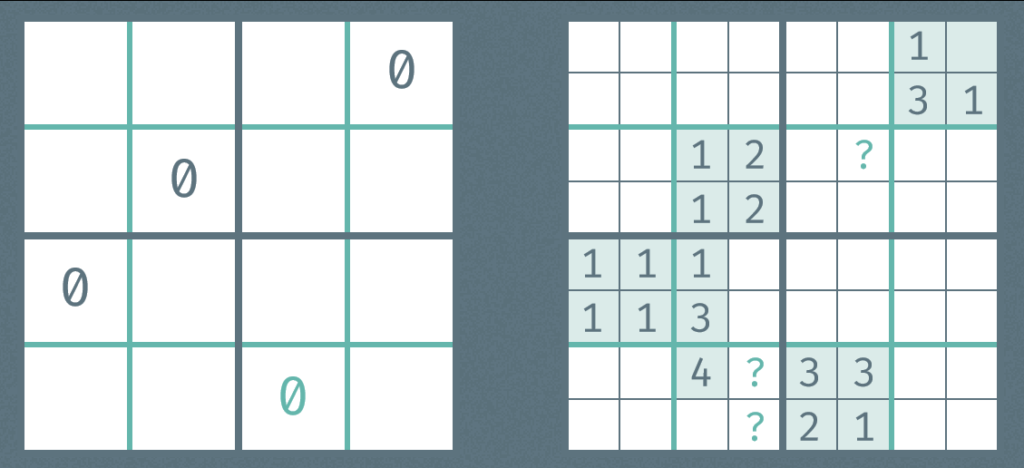
The board on the left is a Sudoku-like game; the board on the right is Minesweeper. The two boards match: the numbers on the Sudoku board are the number of mines in the matching area of the Minesweeper game. You use each to help you solve the other!
It’s not perfect, mind you. There’s currently no way to mark a square that definitely has a mine in it, just the question marks you see in the right-hand board above. There are still cases, familiar to players of standard Minesweeper, where you end up having to guess. And don’t click the “change size” button if you care about the current game: it doesn’t make the boards larger, it starts a new game with bigger Minesweeper and Sudoku boards!
Still though, I have to give creator Rianna Suen props for a cool idea! I found this through the “map obelisk” area during Roguelike Celebration, which is a pretty cool place to find things beloved of clever people!
Every year, the creator of A Short Hike turns on the servers for a pumpkin-carving game. This year he plans to keep them up until about a week after Halloween, so enjoy it while/when/if you can!
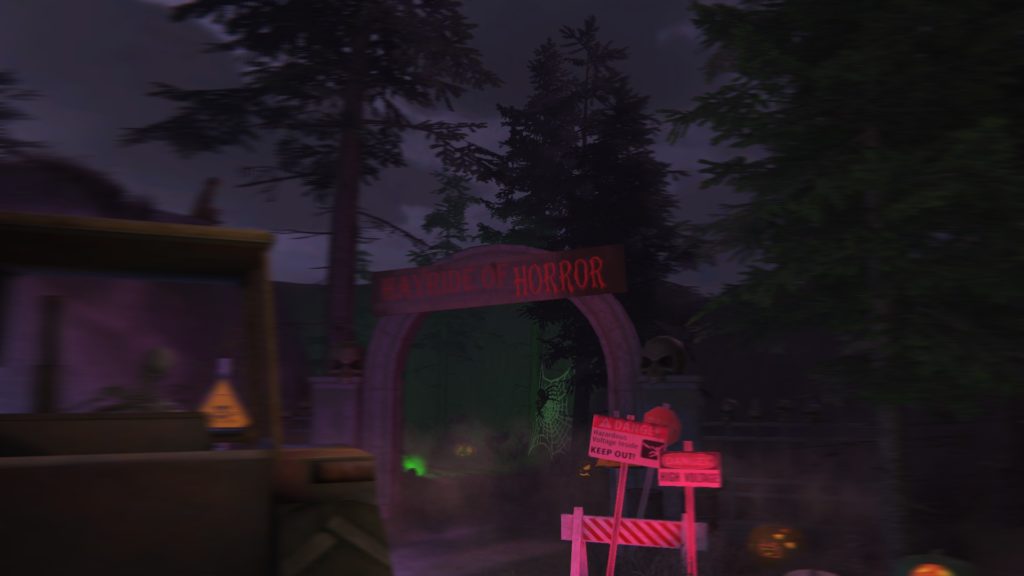
The carving interface is easy to use, although it does result in a glitch that has to be undone sometimes. Keep trying though!There’s over 2,000 pumpkins to be seen so far, with the ability to favorite ones you like and award the best ones badges!There’s more than just pumpkins to see, you can go on a hayride, explore a maze and find interesting spots too!Nice Elder Sign!