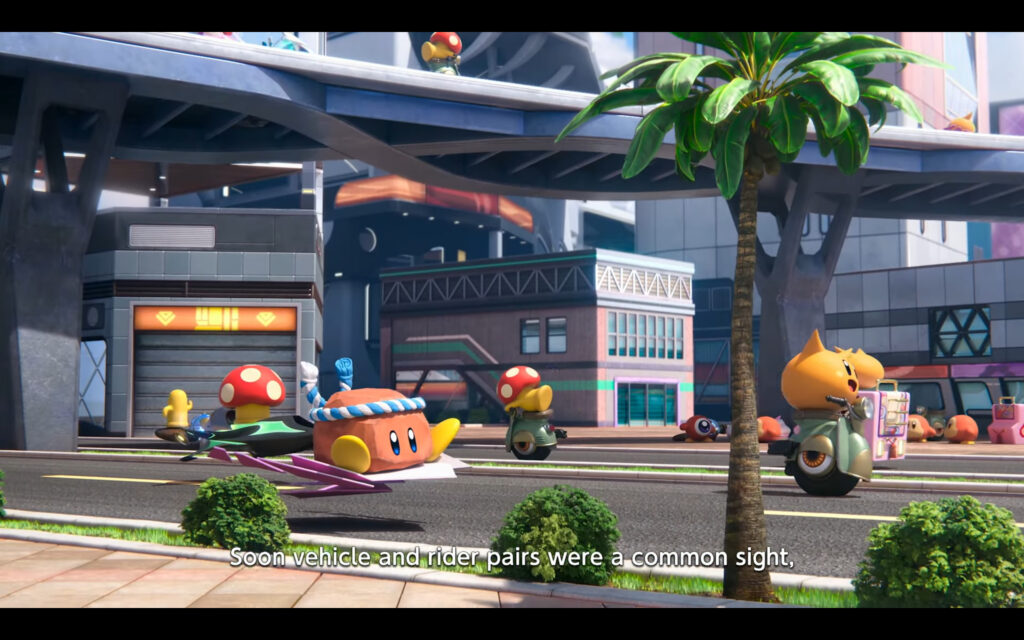
So it’s over, and all of those Switch 2 demo apps used to play it are now useless hunks of code. If you load it up now, it’ll tell you the period is over and direct you to the eShop page for the full game. Maybe they’ll offer another one someday, they’ve been known to dust off Splatoon demo apps as a promotion from time to time, but odds are it’ll never work again.
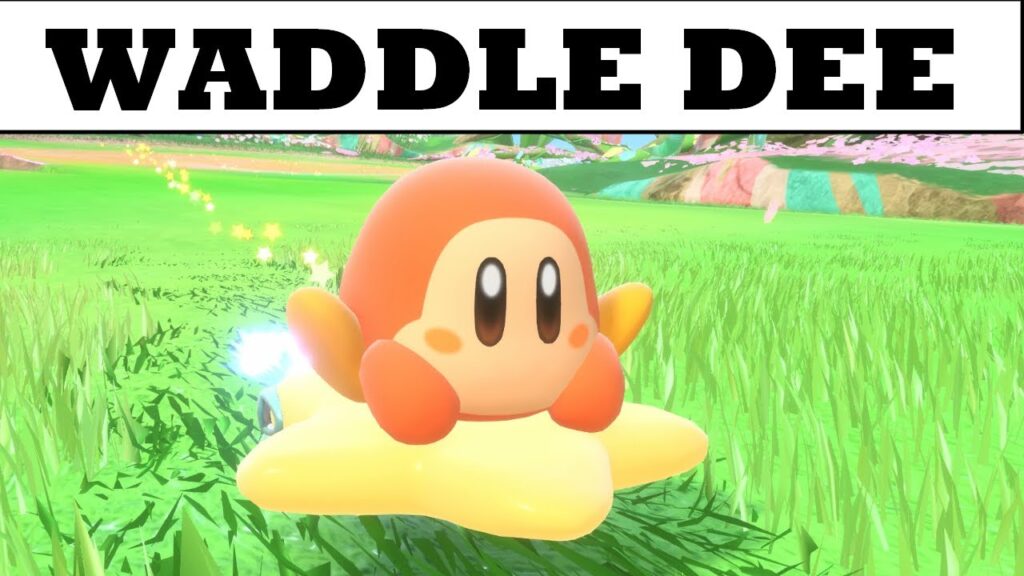
Debuting in the second demo: Regular Waddle Dee! Motto, “I have no mouth and I must RIDE!” (Image taken from a thumbnail for this video.)
It seemed to go well, and I only had a couple of disconnects, despite being saddled with rural internet. Most of my play in the second demo period was spent with the fine folks of the Kirby Air Ride Online Discord, people who are fanatical about the original game, and seemed to like the new one just fine.
I love Masahiro Sakurai’s determination to make the kind of games he wants to play, and I love that that’s so different from other games. We need lots more people like Sakurai making big games, but should remember that he can only do it because his games consistently sell well, and that he’s the creator and director of one of the biggest series there ever was, Super Smash Bros.
It’s like a last vestige from the classic age of console game development. Even if you don’t like them yourself, it’s important that these different games are being made, they help keep the gaming world viable, if just a bit, for new concepts. Without Smash Bros., it’s obvious we wouldn’t have Nickelodeon All-Star Brawl or Multiversus. Personally I have grown tired, very tired, of the idea of crossovers, but I don’t think that can be laid at Sakurai’s feet. It’s the executives that love the idea of mixing their properties together, even though it makes of their worlds and stories the same thing you get when you mix red, yellow, green and blue paint together: a big pot of gray.
Sakurai’s in a unique position, as both creator of one of Nintendo’s biggest series, but also no longer working at Nintendo. When you see his beautiful living room in his game design videos, that was paid for by the moneytrucks Nintendo must send him daily.
Let me impress upon you how weird the Kirby Air Ride games are. The “main” mode, the one the first game’s named after, Air Ride, is pretty basic. It has no Grand Prix mode, even in the sequel. Every race stands alone. The main way you play Mario Kart doesn’t even exist in Air Ride(ers). That’s a pretty strong statement that it isn’t a standard kart racer!
Of City Trial, it’s most interesting aspect is how invented it is. Most games try to follow elemental archetypes. You’re a shootyperson on a battlefield; you’re a swordperson in a dungeon, you’re in a maze, you’re jumping across platforms, you’re a commander of troops, you’re running a civilization, etc. City Trial can’t be summed up so easily.
I especially admire how each City Trial match can end so differently. You might have a fight, run a race, or participate in a vehicular version of a track-and-field event. This probably turns some people off; even the Kirby Air Ride Online people, when they run their tournaments, hold them in a customized version of the Gamecube game that disables many of the events and Stadiums. It makes for better spectating if the game doesn’t sometimes douse the game in a heavy fog, or if the Grand Finals doesn’t end up decided by whoever jumps the highest. If they hold Kirby Air Riders tournaments, how will they feel about Air Glider and High Jump returning to the event pool, joined now by Skydiving?
It became evident during the second demo period that Sakurai, despite talking about Air Riders for nearly two hours on the internet, has kept his lips shut about some substantial aspects of the game. Two vehicles that have never been seen before debuted, the Vampire Star that attacks nearby players automatically, and the Bulk Tank, which takes a heavyweight option and makes it more. We still don’t really know much about the Road Trip mode, which didn’t feature in the demo at all, not even appearing on the menu screen.
Well the demo is over now. The full game will be out on the 20th. See you on the riding fields, ya bunch of hamsters. (1 minute)
NOTE: In another world, Roguelike Celebration is going on today! A lot of people worked hard to organize it, and more worked hard to present at it, including some of the coolest people in indie gamedev, IMO, just to apply a little timely peer pressure. As I write this it hasn’t happened yet, so not a lot to say that I haven’t already, but I’ll say more about this once the talks have actually occurred. In the meantime….
I overall really like the direction the news of Kirby Air Riders is going, even if I have a few mixed feelings about it. There’s a lot of cool and funny new elements, but it also feels like Sakurai might be leaning a bit too hard into the Smash Bros. style. So many of the new features are note-for-note similar to Super Smash Bros, which I can’t just abbreviate to “SSB,” because that’s the same initials as this blog.
Like the fully-voiced opening theme song. The feature of Smash Ultimate that I hated more than perhaps any other part was that stupid theme song. It’s not that it’s a bad song itself, but every time I started the game up I was greeted by a song about the most overused tropes, not just in gaming, but in current-day media altogether: light and darkness. Oh, if my griping might start a movement to take pop culture back from terrible good-slash-evil narratives I would be a pleased whatever-it-is-that-I-am. I got the Adventure Mode out of the way very early in my time with Ultimate, I didn’t need to be reminded it existed at every startup. Air Riders has one of these songs too. I’m sure it’s nicely sung and produced, but it’s the opposite of what makes Kirby music great: bright, cheery, impressively scored tunes with an incredibly quick tempo.
Other features in both games:
For starters, the interface, especially the menus, are extremely Smash-like.
Amiibo support, in the sense that both games store machine learning parameters onto the figure’s 2K of flash memory to support trainable characters. Yes, figure players are back, the feature only interesting to me and a handful of others. I wonder how the game will utilize the approximately ½K of flash storage available to game applications this time?
Uses a currency for unlocks, and a weird kind of fake economy. Smash Ultimate has gold and “SP.” Air Riders has “Miles,” which are essentially gold coins again. Is anyone annoyed that gold, a metal without a lot of industrial use, is still absurdly valuable mostly because of jewelry use and tradition?
A very similar visual style. When unlocks happen, words splash across the screen in your face in exactly the same way familiar to anyone who followed the Smash Ultimate updates eight years ago.
Sakurai says it’s different, but “Global Win Power” still looks a whole lot like “Global Smash Power.”
On top of it all it uses the Smash Announcer, who unless my ear is mistaken (it frequently is) has been with the series since Melee, at least in English.
Not that the requisite griping is over, there’s lots of really fun things unveiled too. Like the inclusion of loads more Kirby characters, some of them pretty deep cuts. My favorites have to be Lololo and Lalala, who are direct references to HAL Laboratory’s early MSX hit Eggerland, known in the US as The Adventures of Lolo. Other than an obscure Windows release many years ago now, Lolo and Lala basically live on Planet Popstar these days, with no forwarding address left to the King of Eggerland.
Do you have any blocks that need pushing? No? Well we’re just going to hang out in case you get some.
Í’m struck by the fact that, by having so many varied villains who all have become Kirby’s friends over the years, Kirby’s adorable little universe has become one of the largest and deepest in all of gaming. Among Kirby’s friends are a mischievous penguin, a mysterious knight with a battleship, a lady robot entrepreneur, a mouse thief, a spacefairing alien, a spider person, a tricky clown, and more. Most of these characters were created after Sakurai left HAL and Nintendo, but yet are fully embraced by Air Riders, and I love that.
And there are so many weird little unnecessary touches. There’s a full lobby-like “paddock” where characters can congregate between matches, and they gave everyone full walking and jumping animations just for interacting within it. Sakurai says it took a lot of effort to make them, and I believe him. Also, it seems to be fully catered. Chef Kawasaki’s been busy, I see.
The best reveal was the new game mode, Road Trip. I’ve always liked Smash Bros’ weird side game modes, like Smash Run and Smash Board. There’s no one working in big gamedev who is as free with his thinking and design atoms as Masahiro Sakurai. He takes all these design elements and combines them in a way to create these little narrative engines. Road Trip fills the biggest gap of the original Kirby Air Ride, a game that, despite the greatness of City Trial, had absolutely no Story or Grand Prix mode, and so seemed a bit light. And indeed, there’s still no Grand Prix, or other structured racing-only mode.
Back to Road Trip, I especially like that it uses the patches from City Trial, so as you play you also create customized vehicles.
Kirby games don’t usually give you much of an indication of what day-to-day life in Dream Land is like, this is more than we’ve ever gotten.
All of the tracks from Air Ride are returning in Air Riders, although it seems the original City Trial City isn’t. Also returning is Top Ride, Sakurai’s weird homage to, of all things, Atari’s incredibly ancient Sprint series. He’s never mentioned Sprint in a Direct, but it’s so obviously a riff on Sprint. Even if he’s never heard of Sprint (given the breadth of his knowledge of the history of video games that seems really unlikely), it had to have been inspired by other games that were inspired by Sprint.
Another of Air Ride’s signature features, the Checklist, is back. To explain: each game mode has a grid of boxes, each with some feat or objective to perform. While you can unlock them in any order, you aren’t told what any of them are at first. But after you stumble upon your first unlock, the conditions of the squares surrounding that one are revealed to you, so it results in a kind of progression. Some of the squares unlock features when opened, and as you clear the board you’re eventually granted a handful of free checkmarks, to help clear out the hardest challenges.
In Air Ride, the Checklist was the only thing providing continuity between play sessions. That’s less the case with all the things there are to unlock in Air Riders, but what with Nintendo’s stubborn resistance to implementing Achievement features, as about the nearest thing to that Nintendo’s ever published, they’re welcome.
There’s a whole menu dedicated to making visual effects less jarring!
Here’s a flurry of little things I noticed:
A bespoke boss, a mecha version of our favorite emperor penguin*, called Robo Dedede. Say it quickly, it’s fun!
A special kind of collectable called gummis. They seem to have no purpose except to pile up onscreen in a physics engine and letting the player sift through them like a greedy candy miser.
A transforming vehicle, that transforms like a Transformer, metal bits shifting around into an alternate shape.
For the first time in any Kirby game, you can be nice to Whispy Woods, instead of making the old tree cry.
Some fun cameo characters revealed: Tortilding (from Forgotten Land), King Golem (from Amazing Mirror) and Computer Virus (Super Star), the funniest Kirby boss of all, where you fought it in a mocked-up JRPG-style battle.
A track only named “?” in the Direct, which uses music from the Nightmare fight from Kirby’s Adventure (the first “serious” opponent the pink blob creature ever fought), and features the Heart of Nova in the background.
For the first time really in a Nintendo game, it looks like they paid serious attention to accessibility! You can turn off screen-shake and move the camera so that motion isn’t so extreme. As time has passed I find myself more and more bothered by screen-shaking effects, though I’m not sure if that’s me, or just that they’re much more common nowadays than they were in the days of the NES.
Once of the license designs shown off uses iconography from the Japan-only Kirby Cafés.
I’d love to go to a Kirby Café some day!
* I think the official line is that King Dedede is some kind of eagle, but he’s never shown any hint of flying like a real bird, and the idea of Kirby’s first major antagonist being a penguin with royal pretensions is too much fun to reject.
There is a whole developing competitive scene around Masahiro Sakurai’s hugely underrated racing/combat game starring colored blob-monsters, Kirby’s Air Ride. (Previously: about City Trial, Sakurai talks KAR, stats explainer video). It’s like F-Zero, but cuter, but also meaner. Its standout mode, City Trial, is possibly Sakurai’s greatest creation, yes more than Smash Bros., yes more than Kirby themself. If you’ve never tried it, it’ll be hard to picture. I linked to my previous explanation, but here’s a quick summary.
Up to four Kirbys (including possible computer Kirbys) roam around an open world map that’s not too big, but not too small either. They start out with weak star vehicles, but there are better/weirder/different replacement vehicles randomly scattered around the map. There’s also “patches,” each of which is a small but significant improvement to one stat, randomly placed too. For 3-7 minutes, everyone tries to get the vehicle most suited to their play style, and as many powerup patches as they can. But they can also attack each other, using powerups that are also, yes, randomly scattered around. There’s also random events that occur. And Legendary Machine parts to collect. After time runs out, all the players are thrown into a random contest. Surprise! You were collecting Glide powerups the whole time, but you’re in a race event! Or you got Top Speed powerups, but you’re in a battle event! You don’t know which event will happen. Everyone’s often given a strong clue, but it isn’t always accurate!
City Trial is a great spectator game. It’s fun watching human players zoom around building their machine’s power, and sometimes savagely tearing at each other with all the ferocity a cute blobular creature can muster. Each Trial is a little story to itself, its participants struggling to increase their power in the limited time. Which a single patch isn’t much, really good players can scoop up over 100 of them in the short period allowed, and machines rapidly advance from merely fast to pure manifestations of bewildering, near-uncontrollable speed. Then the contest is chosen, it’s over in less than a minute, and the next round begins, everyone back at square one. It’s so intense.
Kirby Air Ride was one of a very small number of games to use the Gamecube’s Network Adapter, meaning it supports LAN play, and through that function rabidly enthusiastic players have turned it into an internet-capable game. KAR, as it is amusingly called, has been further hacked to make it more suitable for competitive play.
The community has a homepage with details on how to get involved and downloads for their customized version and emulator, a Youtube channel with loads of great matchups, and a Discord. Here are a few matches to show you what I mean.
I post two complete matches below, here’s some things to watch for:
The star each Kirby starts with is the Compact Star, which has good default turning and acceleration but little else. Particularly, its Defense is the absolute worst, and no number of Defense patches will improve it!
Each stat except HP can get up to 18; HP tops out at 16.
Stats from patches are multiplied by the stats of the vehicle the player is riding. A high vehicle stat means each patch will make the effect even greater!
Players can hop off their star at any time. While not on a vehicle will point out the location of other stars within the field of view.
When a player is attacked, they usually drop a patch, which the attacking player may be able to snatch away.
If a player’s star gets destroyed, they drop a lot (although not all) of their patches onto the ground. Players can’t collect patches while not on a vehicle, so the attacker can scoop many of them up unchallenged!
If time runs out when a Kirby isn’t on a star, they’ll be given a Compact Star for the event, which usually means they’ll lose.
The Shadow Star (the purple glowing one) has the highest attack but low defense. The Wagon Star (like a pink cube) has very high health and defense, but can’t boost, so isn’t great for racing. Both tend to be strong choices.
Patches can generate out in the open, but blue boxes can drop from one to four of them when broken open.
Gray patches are power-downs.
Scattered around the map in some matches are Legendary Machine parts. If one player collects all three parts of a Legendary Machine, they get it immediately, and it replaces the machine they had before. There are two of these, the Hydra, a big green monster with extremely high attack but that needs charge boost power to even move, and the Dragoon, a red/white wing with very high maneuverability, flight and speed. Completing either one usually, but not always, spells victory in a match; Hydra particularly can be stunlocked before it can move during the end-of-game contest, and worn down before it has a chance to react. There are rules to how Legendary Machine parts can appear: they always generate from Red boxes, and appear in certain parts of the map, at certain times.
The patches also have patterns to how they appear. The probability of finding different patch types is a subtle clue for which contest will occur.