

‘@Play‘ is a frequently-appearing column which discusses the history, present, and future of the roguelike dungeon exploring genre.
The opening to NAQBU, a free web game, certainly makes all the right references. Its name first shows up as MORIA, and its similarities to Robert Alan Koeneke’s early roguelike are obvious. If you sit at its title screen, it also shouts out to the makers of Rogue, Hack, Larn, NetHack, Omega, Angband and ADOM. I feel like this game was made for me directly: I’ve played all of them.
I promised creator Luke Steuber that I’d write an essay with my opinions on Naqbu, and I’m not one to write something big without getting as much mileage out of it as I can, so here they are:
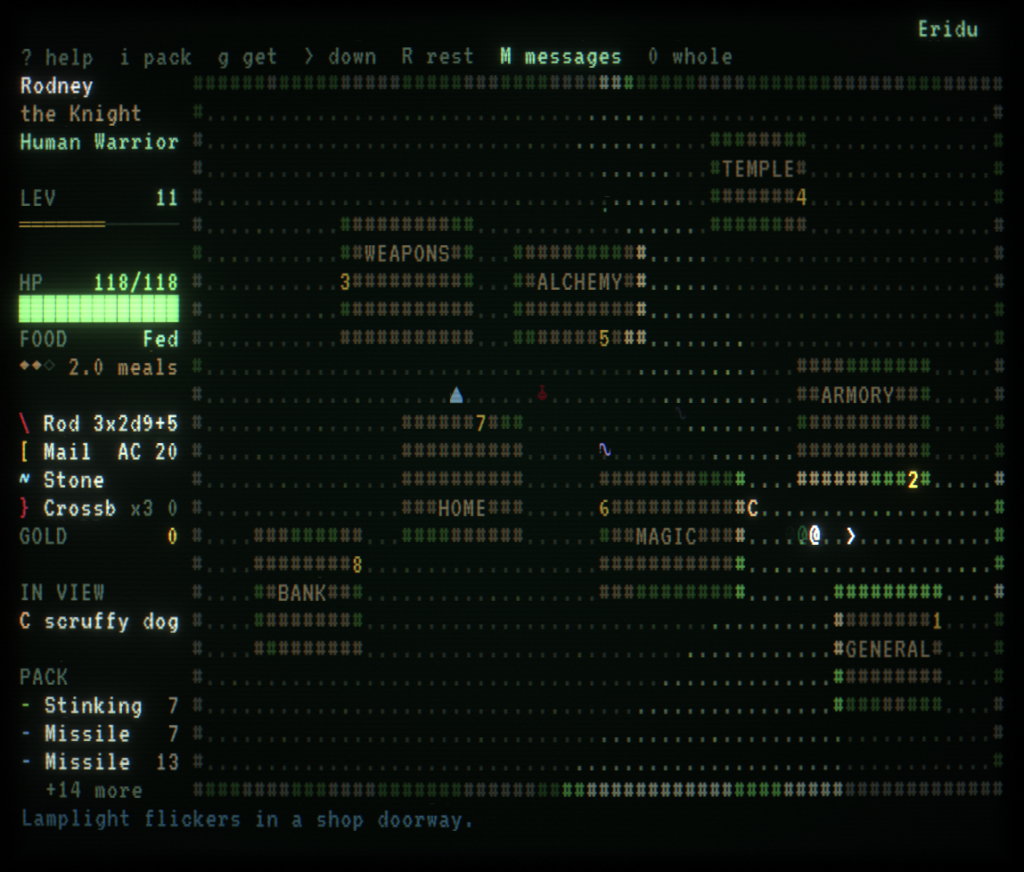
Your job is to descend into The Dungeon and beat the boss monster down there, as @-signs have done since time immemorial, which for the purposes of roguelikes is 1980. I would tell you what it’s called, but a lot of the monsters and items have non-English names that don’t fit easily into my memory. I don’t think they’re procedurally generated, some objects and monsters have names taken, or else derived from, from Mesopotamian mythology, and don’t seem to change from game to game.
Naqbu right now is a very young game, so any of this could change, but right now it plays like a very simplified Moria, with only ten levels and without its vaguely Tolkienesque theming. Like Moria, above the dungeon is a small town with various amenities, and also like Moria each level of the dungeon is regenerated when you enter it. A couple of its enemies even make cameo appearances, like the white worms of the early levels.
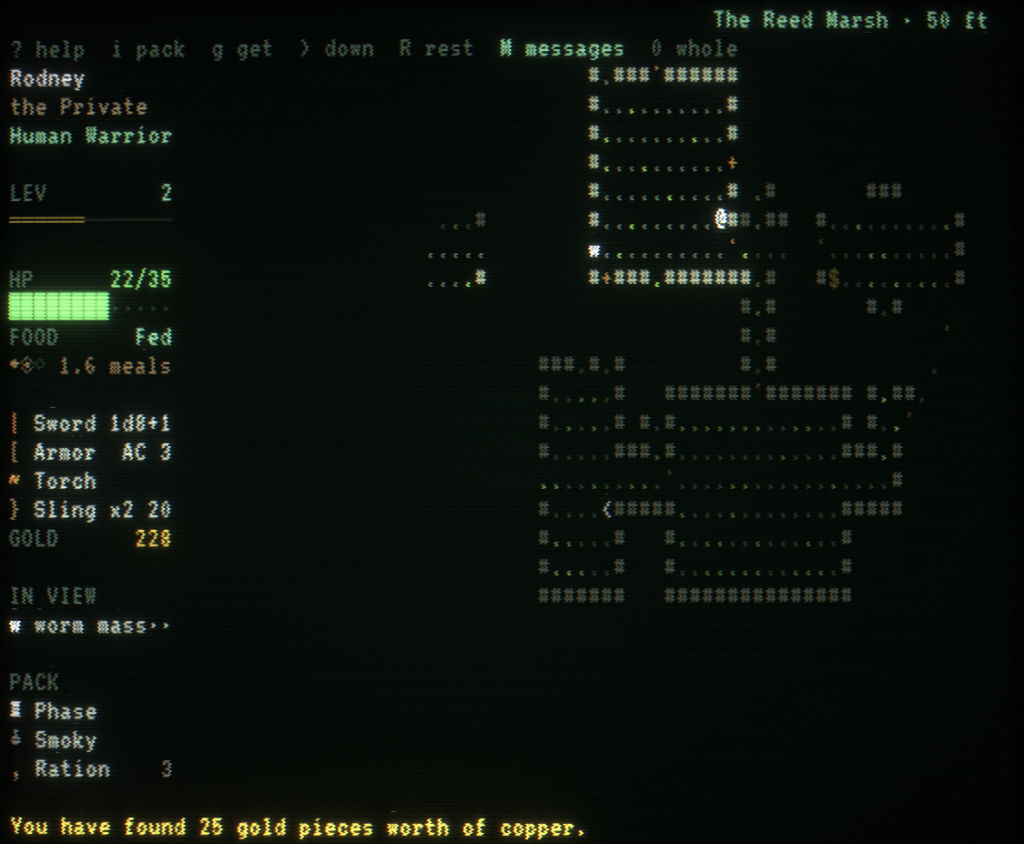
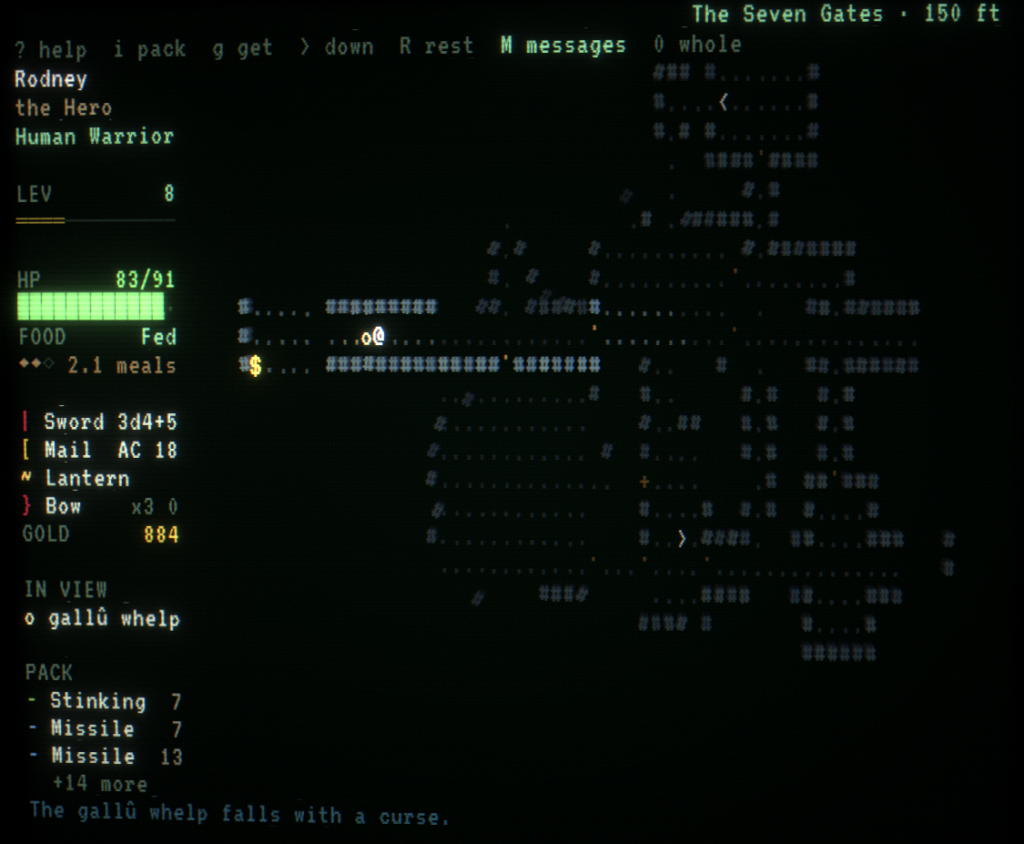
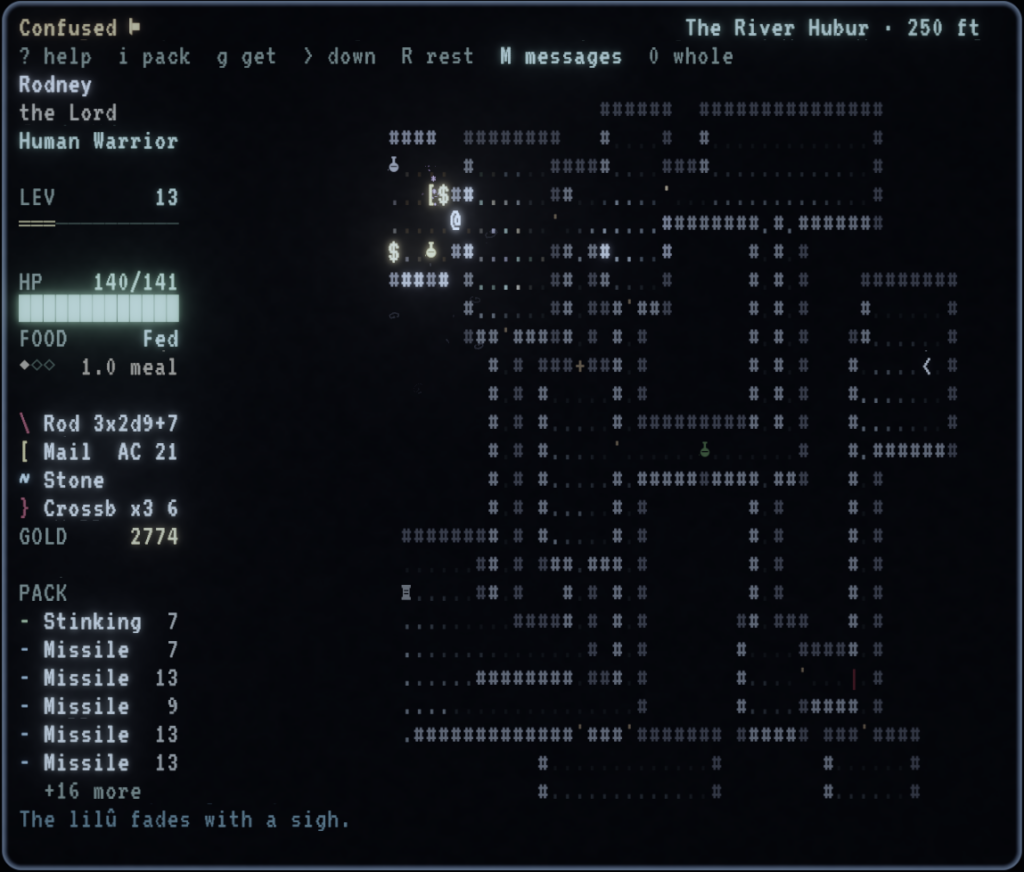
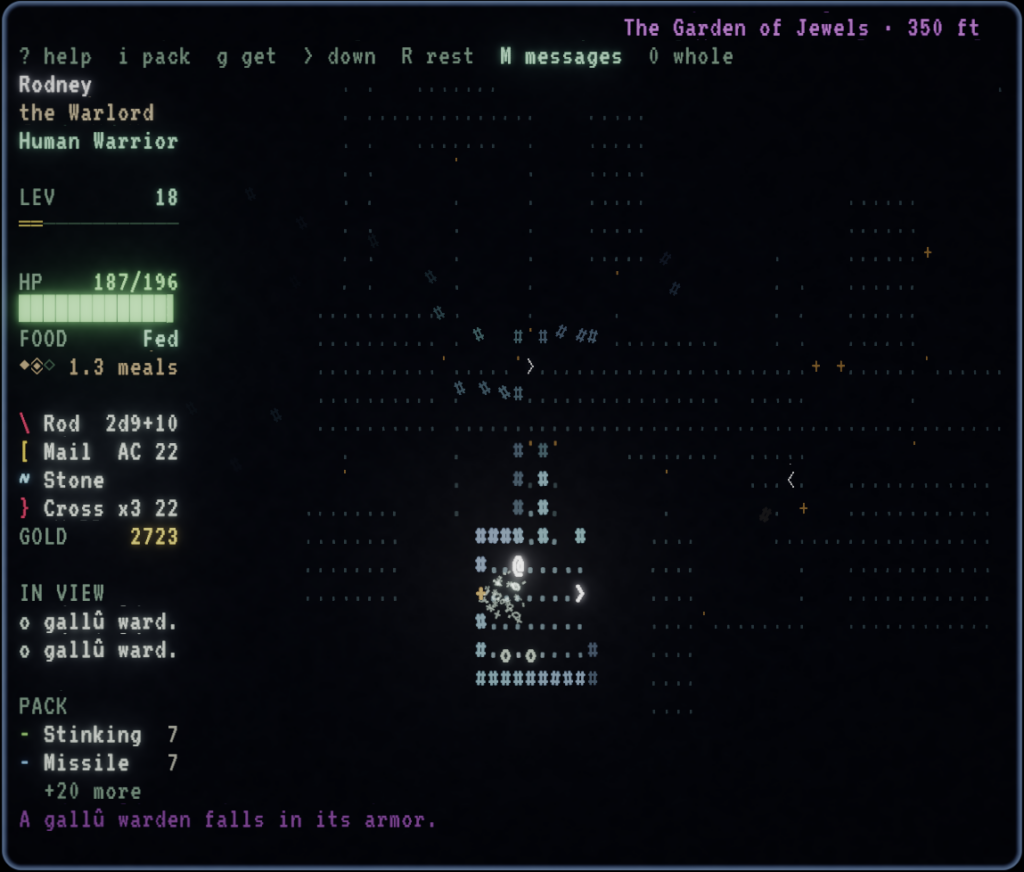
While Naqbu (mostly) uses ASCII characters for its graphics, it isn’t a terminal game. It uses a terminal-like appearance as an aesthetic choice, which is also an approach used by some versions of Dwarf Fortress and Caves of Qud. Naqbu then applies a layer of extra glitz on top of that, which reminded me a lot of the terminal emulator cool-retro-term. Magic items produce character-based animations around you when used, and some dungeon levels have display gimmicks. This is sometimes a little distracting; an effect I encountered later in the game offset the player symbol a few pixels to the right, and so made it a bit difficult to figure out just where they were standing. A few monsters have screen-warping effects around them that also make it hard to target them with attacks sometimes. (A few of the screenshots included here are a bit distorted because of them.)
Moria-likes vs Hack-likes
Being a Moria-like, Naqbu is a tactical game about fighting monsters. In Moria-likes, such as UMoria and Angband, even though they have some item identification such as in Rogue, the creatures that live in the dungeon are the chief obstacle of the game. The alternative are Hack-likes, where it’s more like the dungeon itself is your true enemy, and the monsters that live in it, while a big part of the challenge, are just one aspect of it. Naqbu doesn’t even have traps in its current form, and only a few kinds of bad item.
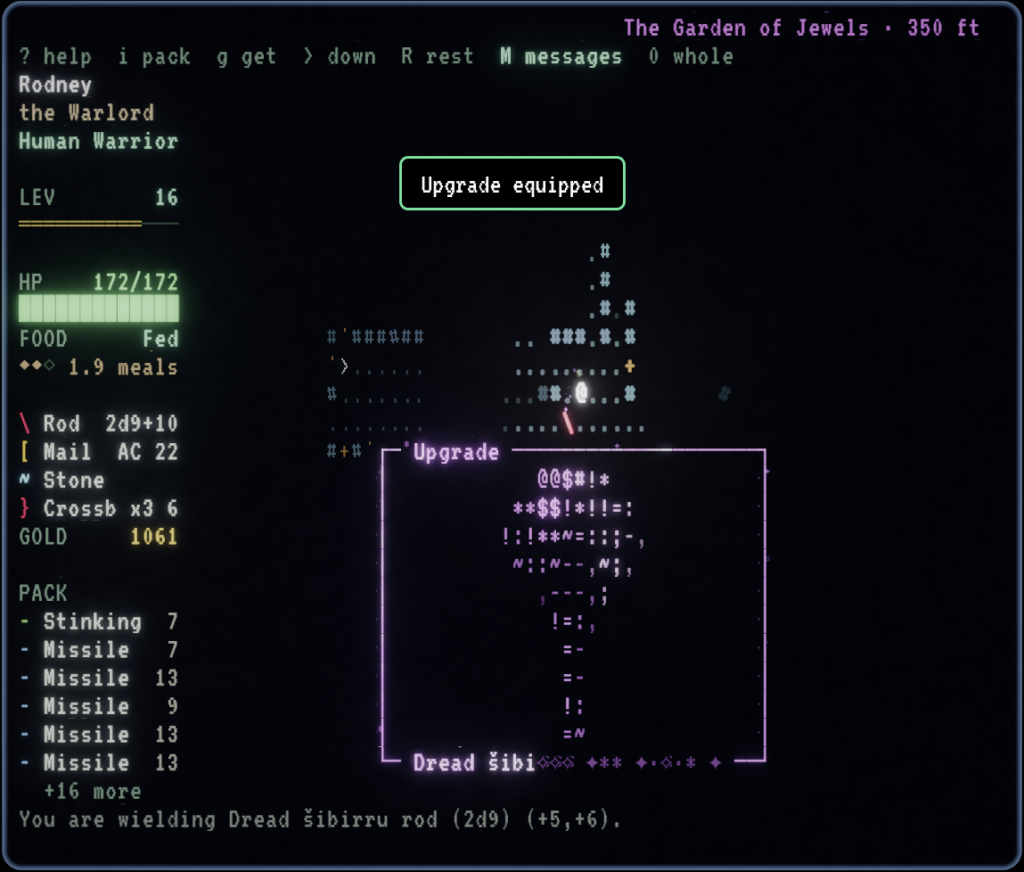
Naqbu has a lot of little comfort features. When you find a piece of equipment in the dungeon that’s better than what you’re currently using, the game will equip it to you automatically. That’s possible because none of the weapons or armor have any special functions at the moment, and there are no cursed items. There’s not much question whether one item is better than another, since it mostly comes down to numbers. Equipment power thus is largely the result of how much exploring you’ve done, and how deep. You can find scrolls of enchant weapon and enchant armor, and there is some minor strategy around whether you use them immediately or to wait until you’ve found a really good item, but with the game’s current difficulty I didn’t have any problems winning it on my first try even using them as soon as I found them.
Naqbu uses a Moria-like item identification system, which seems kind of like it plays lip service to Rogue’s challenging identification. There are a small number of bad items that give the ID system some teeth, there’s only three kinds of bad potions and just one bad scroll. All of the bad potions can’t be sold in the town shops, a pretty obvious tell that they’re useless. None of the bad items inflict any permanent harm on you either, so it’s a matter of saving potions until you have three with prices of 0, using one of each of them on the town level to identify them, then you’ll never be fooled by them again for the rest of the game. There aren’t a lot of different kinds of magic items anyway, making it a simple matter to learn what they all are, despite the complete lack of identify scrolls in the game.
The Dice Are In Charge
There’s a phenomenon in roguelikes where, after a certain point, it’s like the random number generator plays your character, where it determines your character’s strength more than your playing strategy does. All the best equipment is found in the dungeon, and how much you can boost them depends on how many enchant scrolls you find. For the most part it’s obvious how to make use of these items. There are no real decisions to be made there.
Rogue had some interesting risk/reward aspects with its items. There were monsters and traps that could decay your weapons and armor, but leather armor couldn’t be rusted, meaning every scroll of enchant armor that went into one was permanent, but otherwise it was the weakest armor.
You could wear a ring of maintain armor, but those were rare, and also increased your hunger rate slightly. You had a hard choice to make: did you hope to find strong banded mail or plate mail and put all of your enchant armor scrolls into them then try to preserve it, or did you pile them all into leather armor? What happens if you put on cursed armor then? Enchant armor scrolls will uncurse it, but you’ll then still have mostly-bad armor with a single plus added. Alternatively you could hope to find a scroll of remove curse, then switch to a suit that’s a better home for that plus.
Potions of raise strength drunk when at maximum strength raised that maximum, but rattlesnakes could drain strength and you might not ever find a potion of restore strength to get you back up to maximum. And all of these items had to be identified to know when to best use them. If it’s easy to identify items, then it becomes a lot more obvious what the optimum moves are. That’s what I mean by the random number generator playing the character: if you find an improvement item, you just use it right away, because there’s no reason not to. Hard item choices make the challenging combat more interesting by giving a player a way to blunt the monsters’ claws and teeth, but it’s not something that’s a real part of Naqbu.
It’s true that identification helps you know what to keep and what to drop, but there isn’t much drawback in using the bad items anyway. They certainly won’t harm your player’s long-term state, like Hack’s scroll of destroy armor or potion of sickness can. In practice, you use all the potion and scroll types once, and from then on you just never pick up the bad ones. In my run of Naqbu, I knew all the bad items by dungeon level two, so there was no strategy to it at all.
All of this is usually true of Moria-style games anyway. Because the dungeon levels can be regenerated endlessly, there is no real limit to the number of state-improving items that can be generated. This means that, at some point, the design expects the player to have spent time improving their state up to maximum or close to it. This is a reason why I tend to prefer Hack-likes, which generally don’t let players generate endless items, and tend to become broken when they do, as with Nethack’s exploit (now fixed I think) of farming black puddings. I’m not sure what can be done to reconcile this, but maybe Naqbu’s creator Jason Steuber can think of something? Or maybe he doesn’t see it as an issue that needs to be solved, I’d say that’s valid, but more on that further down.
Metagame Elements
Maybe Naqbu’s most interesting features come from its inheritance system. As you play and build up gold, you can improve your house to store more items, and expand your pack to carry more. Your house persists between lives: later characters will be able to take advantage both of stored items and its increased size. There’s also a bank where you can save money between lives, and even pays you interest for money saved, a notably Larn-like feature. A new character also inherits a percentage of earned experience points from
Now I should note that I won my first game of Naqbu, so I can’t say if any of these features work. I’m taking the game’s word for it, and making some assumptions about them too. As it stands now the game is too easy for these features to matter for that much. Now, it’s a good thing that you don’t have to use them to win, it’s possible to go too far in that direction, which is a problem I had with Rogue Legacy.
Building a Better Dungeon
Right now Naqbu is unbalanced in the player’s favor. It’s really too easy. It’s possible to die, yes, but with proper care and timely item use the game is very winnable. Please don’t take me as some kind of final authority in roguelike design, but I have played a lot of them. I think what Naqbu could use is a general tuneup, a lot of different game systems tightened up a bit.
Naqbu has scrolls of recall, which teleport you back to town after a delay of around 20 turns, and for 3,000 gold you can build an obelisk at your house that will teleport you down to the deepest level you’ve been to. That eliminates a lot of traipsing through the same dungeon levels, which is important when the monsters on the early levels are no longer a significant challenge. But nothing prevents you from doing it anyway if you need to restore your stocks of items. The dungeon levels are rebuilt every time you reenter one, complete with a new stock of items to find, so it’s an endless source of supplies. There are shops on the town level, but it’s unlikely that you’ll need them much beyond the first couple of levels.
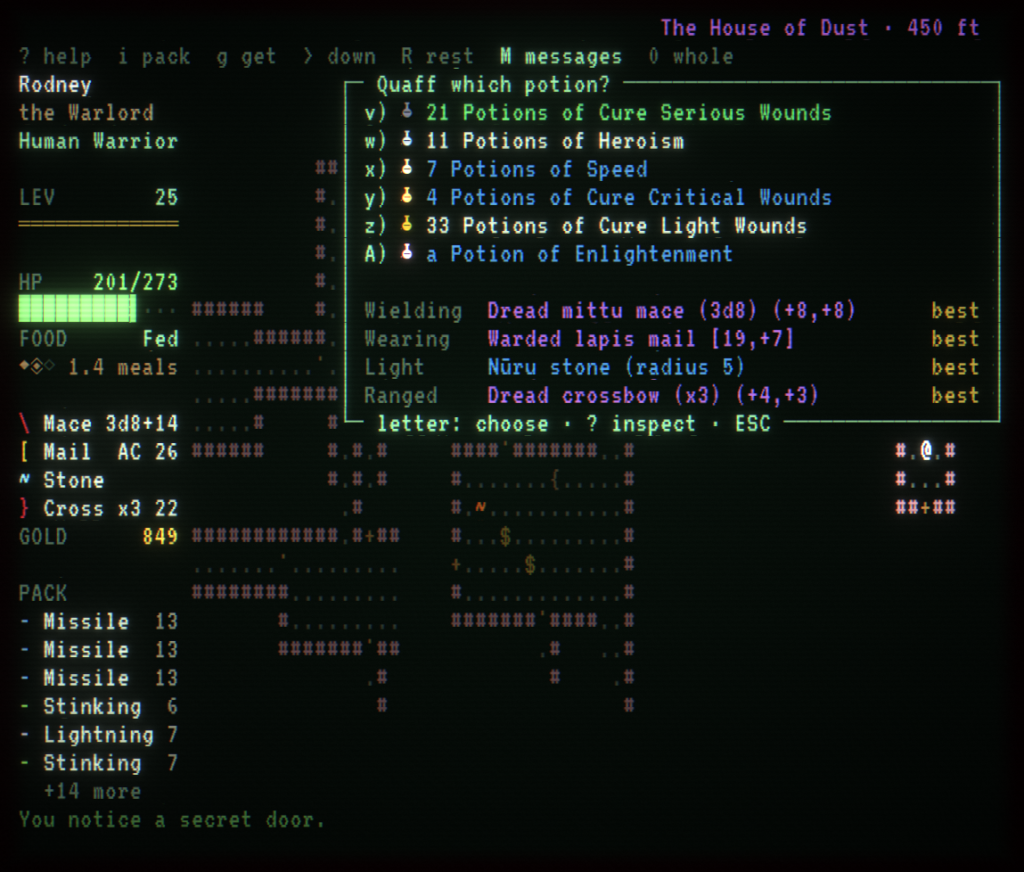
Items don’t have weight themselves, it seems: you can carry multiple suits of armor to sell in town without issue. Naqbu has Moria-style inventory limits. That means items of the same type automatically get pulled together into stacks, and carry limits are by slot, so you can have as many potions of a type in a stack as you can scrounge up. By around dungeon level 8 I had a stack of like 40 cure light wounds potions, and a not-insignificant number of stronger types. I also had a big stack of short-range teleport scrolls for getting out of scrums, and a few potions of speed, an underrated resource in many games, to tip combat odds in my favor. There are some nicely challenging monsters in the deeper dungeons, but by the time you reach them you have so many help items from exploring the earlier levels that you’re never in much danger.
If I were to try to improve Naqbu, I would tighten up each of its game systems a little bit. Maybe limit item stacking a bit. Implement a better state improvement system, where the choices aren’t all obvious. Add traps. Lessen the item generation so the player has an incentive to use the shops on the town level. Add some more kinds of items, so the player will have to choose between what to carry, and to make identification harder. Make equipment power more from intrinsic properties than just increasing their numeric power. Give more early-game monsters interesting properties besides just hitting you.
Maybe some of these problems I identify are from my own dissatisfaction with Moria-style design, but Moria makes up for it by having a lot of really mean monsters too. I think there’s room for Naqbu to make an identity for itself, not by making the monsters harder, but by making itself a bit more Hack-like and getting its challenge there, making it harder to build the player’s state.
It’s possible that’s my own biases speaking. There are lots of people who prefer Moria-style play, but if Naqbu wants to remain on that route, I think the monsters will have to get harder to make up for it. Naqbu currently limits player experience level to 25, which I reached by dungeon level 9. When you can’t grow the player character through experience any longer, there is a lot less incentive to explore the dungeon, and the focus on the game moves almost entirely to gaining more items, and if you have enough items to win by that point there’s really nothing else left to do. There is no more improvement in state left to gain.
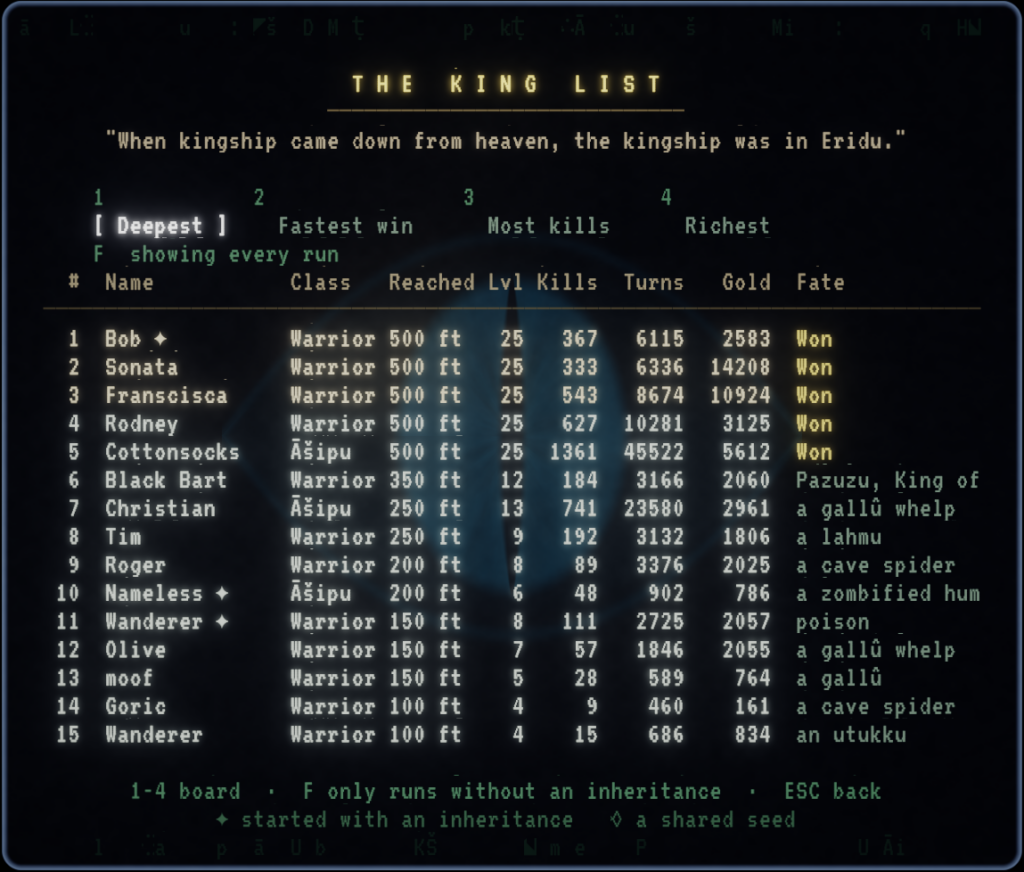
Naqbu maintains a universal score list. At the moment there are only fifteen players on it, and five of them are winners. This proves pretty handily that the game isn’t very difficult. My own game is currently 4th place on the list as I write this.
I feel like there’s more I could say, but it’s almost 5 AM as I write this, and it’s already really lengthy. I threw it together quickly and obsessively. I wanted to get something out there, not just to contribute my opinions to the author while the design is still malleable, but also to get the news about the game out quickly. I think it’s a shame that there’s only been 15 players of Naqbu so far. I think all of its problems are due to the fact that the game’s only a couple of days or so old as of this writing, and that it has lots of potential. I have so many things to keep a watch for that I find it hard to make promises, but I’ll try to set aside a little sliver of my overtaxed brain to check on Naqbu’s progress in the coming weeks.
Naqbu (by Luke Steuber, web, $0, no AI use)
