
PC-88 Versions of Nintendo Games

It was a weird time. Around the time as the Famicom was just getting started, Hudson Soft struck a deal with Nintendo to release some of their games for the PC-88 Japanese personal computer platform.

Many of these games had weird differences from Nintendo’s originals. The best known of them is probably Super Mario Bros. Special, a very weird version with paged scrolling, which is to say, no scrolling at all, but just flipping forward one screen at a time. Super Mario Bros. Special isn’t on the subject page of this post, which is old enough that it’s only available on the Wayback Machine, but it is on the website World Of Stewart, and wonder of wonders that page is available on the living internet! Playthroughs of the whole game, in its clunky miscolored XOR-sprite glory, can also be seen on Youtube, here, for instance. (51 minutes)
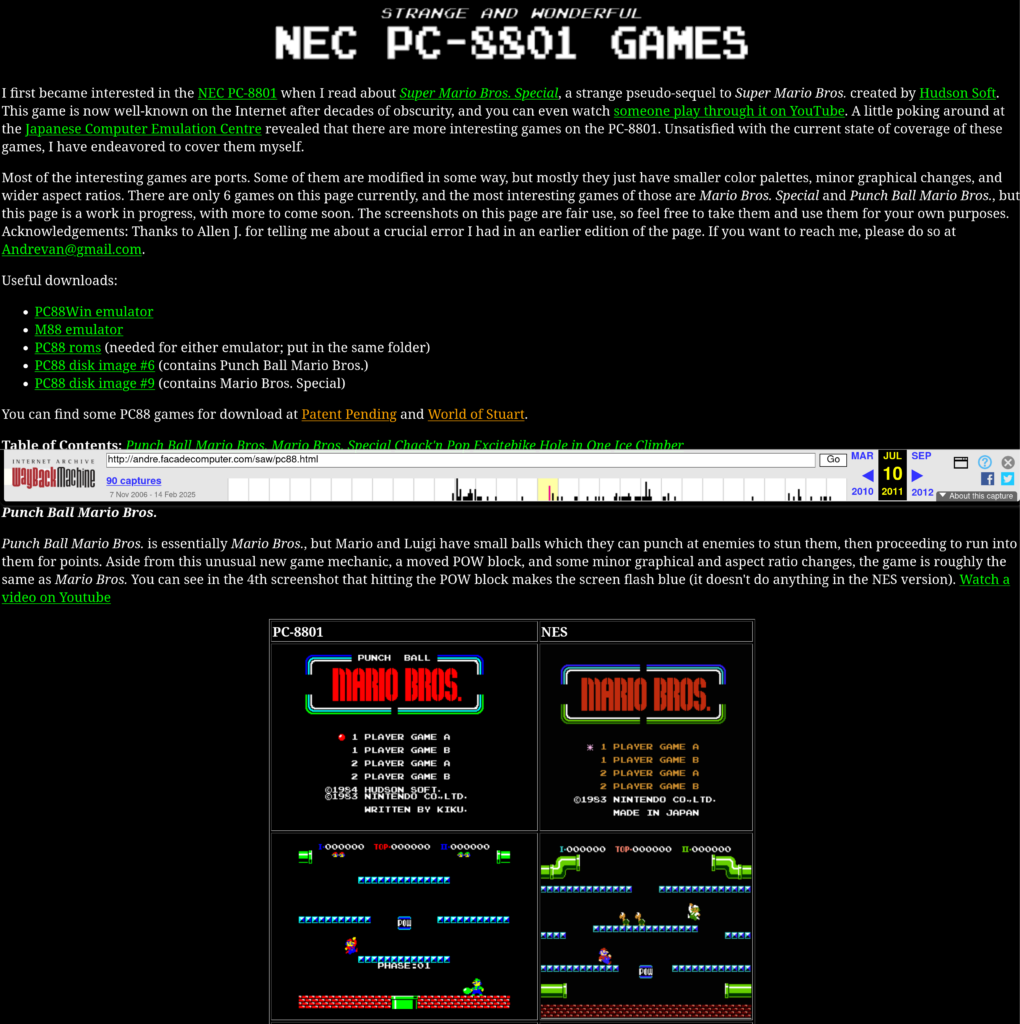
You can tell the page is old because it has a Digg social media button. (Wait, what’s that? They’re trying to revive Digg?) Please excuse the Wayback Machine banner stuck in the middle of the screenshot, it’s an artifact of Firefox’s screenshot tool.

There was also Punch Ball Mario Bros., which took the basic premise of Mario Bros. and just, well threw it away, just tossed it right in the trash, and replaced it with punching a ball around to attack enemies. Gameplay of that is also on Youtube. (5½ minutes)

Another version of Mario Bros., Mario Bros. Special (which isn’t Super Mario Bros. Special but something else) It’s harder to find Youtube video of that because Google assumes you must be looking for the Super version, but it can be found. (8½ minutes) If you recognize the title screen music from that then you are really a supergeek! (I did recognize it, so yes, that includes me.) And the game, wow… it really doesn’t look fun to play.

Some other games listed include Excitebike (11 minute video), Ice Climber (7½ minute video), the (only slightly Nintendo and with janky music) HAL Hole-In-One Golf (15 minute video), and (the very non-Nintendo) Chack’n Pop (4 minute video). Hole-In-One is a predecessor of Nintendo’s Golf, if you’re looking for that Nintendo connection.

One thing all of these games, except maybe Hole-In-One, have in common is they look like they’re excruciating to play now! They either have way too fast or slow controls, or ear-tearing scratchy music, or both. But they are interesting as curiosities, so here they are. Curious!

Strange and Wonderful NEC PC-8801 Games (Wayback Machine)

On the SuperGrafx

What is the SuperGrafx? Why don’t we remember it as well as its predecessor, the PC Engine/TurboGrafx 16, with which it was backwards compatible?

Sharopolis on Youtube digs into the system and its capabilities (17 minutes):

As you can tell by the video’s cover image: Amazing Power, No games. The SuperGrafx only had five games released for it throughout its lifetime, pretty harsh for a system that cost around $300 by today’s money. That cost, relative to that of the PC Engine CD, which was also expensive but could play CD games with vastly greater storage, was probably what doomed it. For those really seeking an arcade experience in Japan there was the Sharp x68000, famous at the time as the true enthusiast’s system with a good number of nearly exact arcade ports. It also cost around $6,000 in today’s money, and still $3,000 in then-money.

The system used the same chip as the PC Engine before it, a 6502 variant running at 7 mHz, meaning it was only a 8-bit system. But was that really so bad? The major 16-bit competition for it was the Motorola 68000, another venerable chip at the time that was used in the original Apple Mac, the Sega Mega Drive/Genesis, the Commodore Amiga and the Atari ST. Yet the 68000 also had some more overhead. Many instructions on the 6502 completed in from two to four cycles, whereas the minimum cycle count of a 68000 instruction was four, with some taking up to 20. This, of course, is offset by the 68000’s greater number of registers and ability to work with two bytes at once for many instructions.

Its graphics were essentially two of the PC Engine’s graphics chip, with some circuitry to interface their outputs together. This description brings uncomfortable reminders of people deriding the Wii’s graphics as “two Gamecubes taped together,” but it’s a much closer description of the SuperGrafx’s graphics. But in practice this meant twice the sprites, dual-plane backgrounds, and double the potential colors on-screen at once, while the MegaDrive/Genesis infamously was still stuck with 64.

The SuperGrafx’s failure in the market was one of those inflection points of the growth of video gaming. If it had succeeded then NEC might still be a player in gaming today, and maybe Hudson Soft would still be an independent entity, instead of just another property for Konami to mine for nostalgiabucks.