Code Adventures: fancypants, a Command-Line Text Conversion Utility

๐•‹๐•™๐•š๐•ค ๐•จ๐•–๐•š๐•ฃ๐•• ๐•ฅ๐•–๐•ฉ๐•ฅ ๐•จ๐•’๐•ค ๐•”๐• ๐•Ÿ๐•ค๐•ฅ๐•ฃ๐•ฆ๐•”๐•ฅ๐•–๐•• ๐•จ๐•š๐•ฅ๐•™ ๐•ฅ๐•™๐•– ๐•ฆ๐•ฅ๐•š๐•๐•š๐•ฅ๐•ช ๐•ž๐•–๐•Ÿ๐•ฅ๐•š๐• ๐•Ÿ๐•–๐•• ๐•š๐•Ÿ ๐•ฅ๐•™๐•– ๐•ฅ๐•š๐•ฅ๐•๐•–. ๐“ข๐“ธ ๐”€๐“ช๐“ผ ๐“ฝ๐“ฑ๐“ฒ๐“ผ ๐“ฝ๐“ฎ๐”๐“ฝ ๐“ฑ๐“ฎ๐“ป๐“ฎ. ๐—”๐—ป๐—ฑ ๐—ฎ๐—น๐˜€๐—ผ ๐˜๐—ต๐—ถ๐˜€. ๐•ฌ๐–‰๐–‰๐–Ž๐–™๐–Ž๐–”๐–“๐–†๐–‘๐–ž, ๐–™๐–๐–Ž๐–˜.

Can you read those? There’s a good chance you can! If you can’t (like if they all show up as hollow boxes) it’s because the font you’re reading this post in doesn’t support those kinds of characters, which are from the math symbols section of the Unicode character set.

It’s a command-line version of a web Unicode text converter, of the sort found at the other end of this link. It’s written in Python, and the source is at the end of this post. I saved it to a file named “fancypants” and put it in my home directory’s bin directory (which you’ll probably have to make first), where many Linux distributions are configured to look for things to execute if you type their names at the command prompt. (Yes, all of this assumes you’re running Linux. It’s not just for supergeeks anymore! If you’re running Windows you’ll have some adjustments to make, including figuring out how to add the script’s home to your path. It should work on Macs, although I don’t know if it’ll look in your home’s bin either.)

Oh, you will have to run a chmod +x fancypants on it. And the script as written assumes Python is at /usr/bin/python, where most distros will put it.

The script expects to be executed in the form:

fancypants [style] [text to convert]

The text should probably be in quotes if there’s any spaces in it, as should the style just in case. So to produce the first text mentioned at the start of the post, I entered:

fancypants "=" "This weird text was constructed with the utility mentioned in the title."

Usable style specifiers are “=” for double-stroke, “/” for script, “!” for a boldface kind of thing, “f” for the medieval script-looking fractur, and a few others that you can pretty easily see in the source code below. In fact each specifier has some synonyms if the single-character versions are too obscure for you to remember. And hey, if you don’t like the names I gave them you can use your own! The moment you paste it into a text file, this all becomes yours to do with as you please. Think of it as the blog version of a type-in program from an 80s computer magazine.

As a bonus, the names “r”, “rot” or “rot13” will perform a ROT13 code on the letters, useful for encoding spoiler text that readers can decode at ROT13.com. There are utilities that you can use to send the generated text directly to the clipboard, for pasting wherever you want, but since those differ if you’re using X.org or Wayland for your display manager (or, sure, Windows or Mac) I’ll leave those for you to figure out.

And if you can’t read the characters above, then I’m sorry that you’re missing out on the fun. It’s all pretty whimsical really, it’s not some huge thing that you’re missing. Come back tomorrow, I’m sure we’ll have a post about Mario or somesuch.

#!/usr/bin/python
import sys

base = "ABCDEFGHIJKLMNOPQRSTUVWXYZabcdefghijklmnopqrstuvwxyz1234567890!@#$%^&*()-_=+[]{};':\",./<>?~"
equals = "๐”ธ๐”นโ„‚๐”ป๐”ผ๐”ฝ๐”พโ„๐•€๐•๐•‚๐•ƒ๐•„โ„•๐•†โ„™โ„šโ„๐•Š๐•‹๐•Œ๐•๐•Ž๐•๐•โ„ค๐•’๐•“๐•”๐••๐•–๐•—๐•˜๐•™๐•š๐•›๐•œ๐•๐•ž๐•Ÿ๐• ๐•ก๐•ข๐•ฃ๐•ค๐•ฅ๐•ฆ๐•ง๐•จ๐•ฉ๐•ช๐•ซ๐Ÿ™๐Ÿš๐Ÿ›๐Ÿœ๐Ÿ๐Ÿž๐ŸŸ๐Ÿ ๐Ÿก๐Ÿ˜!@#$%^&*()-_=+[]{};':\",./<>?~"
script = "๐“๐“‘๐“’๐““๐“”๐“•๐“–๐“—๐“˜๐“™๐“š๐“›๐“œ๐“๐“ž๐“Ÿ๐“ ๐“ก๐“ข๐“ฃ๐“ค๐“ฅ๐“ฆ๐“ง๐“จ๐“ฉ๐“ช๐“ซ๐“ฌ๐“ญ๐“ฎ๐“ฏ๐“ฐ๐“ฑ๐“ฒ๐“ณ๐“ด๐“ต๐“ถ๐“ท๐“ธ๐“น๐“บ๐“ป๐“ผ๐“ฝ๐“พ๐“ฟ๐”€๐”๐”‚๐”ƒ1234567890!@#$%^&*()-_=+[]{};':\",./<>?~"
bold = "๐€๐๐‚๐ƒ๐„๐…๐†๐‡๐ˆ๐‰๐Š๐‹๐Œ๐๐Ž๐๐๐‘๐’๐“๐”๐•๐–๐—๐˜๐™๐š๐›๐œ๐๐ž๐Ÿ๐ ๐ก๐ข๐ฃ๐ค๐ฅ๐ฆ๐ง๐จ๐ฉ๐ช๐ซ๐ฌ๐ญ๐ฎ๐ฏ๐ฐ๐ฑ๐ฒ๐ณ๐Ÿ๐Ÿ๐Ÿ‘๐Ÿ’๐Ÿ“๐Ÿ”๐Ÿ•๐Ÿ–๐Ÿ—๐ŸŽ!@#$%^&*()-_=+[]{};':\",./<>?~"
bolditalic = "๐‘จ๐‘ฉ๐‘ช๐‘ซ๐‘ฌ๐‘ญ๐‘ฎ๐‘ฏ๐‘ฐ๐‘ฑ๐‘ฒ๐‘ณ๐‘ด๐‘ต๐‘ถ๐‘ท๐‘ธ๐‘น๐‘บ๐‘ป๐‘ผ๐‘ฝ๐‘พ๐‘ฟ๐’€๐’๐’‚๐’ƒ๐’„๐’…๐’†๐’‡๐’ˆ๐’‰๐’Š๐’‹๐’Œ๐’๐’Ž๐’๐’๐’‘๐’’๐’“๐’”๐’•๐’–๐’—๐’˜๐’™๐’š๐’›1234567890!@#$%^&*()-_=+[]{};':\",./<>?~"
monospace = "๐™ฐ๐™ฑ๐™ฒ๐™ณ๐™ด๐™ต๐™ถ๐™ท๐™ธ๐™น๐™บ๐™ป๐™ผ๐™ฝ๐™พ๐™ฟ๐š€๐š๐š‚๐šƒ๐š„๐š…๐š†๐š‡๐šˆ๐š‰๐šŠ๐š‹๐šŒ๐š๐šŽ๐š๐š๐š‘๐š’๐š“๐š”๐š•๐š–๐š—๐š˜๐š™๐šš๐š›๐šœ๐š๐šž๐šŸ๐š ๐šก๐šข๐šฃ๐Ÿท๐Ÿธ๐Ÿน๐Ÿบ๐Ÿป๐Ÿผ๐Ÿฝ๐Ÿพ๐Ÿฟ๐Ÿถ!@#$%^&*()-_=+[]{};':\",./<>?~"
block = "๐—”๐—•๐—–๐——๐—˜๐—™๐—š๐—›๐—œ๐—๐—ž๐—Ÿ๐— ๐—ก๐—ข๐—ฃ๐—ค๐—ฅ๐—ฆ๐—ง๐—จ๐—ฉ๐—ช๐—ซ๐—ฌ๐—ญ๐—ฎ๐—ฏ๐—ฐ๐—ฑ๐—ฒ๐—ณ๐—ด๐—ต๐—ถ๐—ท๐—ธ๐—น๐—บ๐—ป๐—ผ๐—ฝ๐—พ๐—ฟ๐˜€๐˜๐˜‚๐˜ƒ๐˜„๐˜…๐˜†๐˜‡๐Ÿญ๐Ÿฎ๐Ÿฏ๐Ÿฐ๐Ÿฑ๐Ÿฒ๐Ÿณ๐Ÿด๐Ÿต๐Ÿฌ!@#$%^&*()-_=+[]{};':\",./<>?~"
fraktur = "๐•ฌ๐•ญ๐•ฎ๐•ฏ๐•ฐ๐•ฑ๐•ฒ๐•ณ๐•ด๐•ต๐•ถ๐•ท๐•ธ๐•น๐•บ๐•ป๐•ผ๐•ฝ๐•พ๐•ฟ๐–€๐–๐–‚๐–ƒ๐–„๐–…๐–†๐–‡๐–ˆ๐–‰๐–Š๐–‹๐–Œ๐–๐–Ž๐–๐–๐–‘๐–’๐–“๐–”๐–•๐––๐–—๐–˜๐–™๐–š๐–›๐–œ๐–๐–ž๐–Ÿ1234567890!@#$%^&*()-_=+[]{};':\",./<>?~"
rot = "NOPQRSTUVWXYZABCDEFGHIJKLMnopqrstuvwxyzabcdefghijklm1234567890!@#$%^&*()-_=+[]{};':\",./<>?~"
tilde = len(equals)-1

def convert(convertchar, intext):
outlist = []
match convertchar:
case "=" | "equal" | "equals":
clist = equals
case "/" | "slant" | "script":
clist = script
case "!" | "bold":
clist = bold
case "!/" | "bolditalic" | "boldital":
clist = bolditalic
case "m" | "mono" | "monospace":
clist = monospace
case "b" | "block" | "mathbold":
clist = block
case "f" | "fraktur":
clist = fraktur
case "r" | "rot" | "rot13":
clist = rot
case _:
raise ValueError("Unknown charset " + convertchar)
return intext
for char in intext:
try:
index = base.index(char)
except:
outlist.append(char)
continue
outchr = clist[index]
if outchr != "~":
outlist.append(outchr)
else:
outlist.append(base[index])
return "".join(outlist)

if __name__ == "__main__":
convertchar = sys.argv[1]
intext = sys.argv[2]
print(convert(convertchar, intext))

Code Adventures: Simulating One Handed Solitaire

My style in titling these things is to just present the subject on whatever it is I’m linking to in the title, so you might expect that this is about someone else doing that and me reporting on it. But no! This time it’s something I did myself!

First, you have to know of a card game called One Handed Solitaire, as reported by Metafilter member ChurchHatesTucker here. CHT’s been on a tear in presenting various card games lately, here’s the other recent posts they’ve made on solitaire card games, with a dungeon crawl flavor: Clear the Dungeon, Tomb of the Four Kings, Scoundrel.

One Handed Solitaire is very simple, and an example of a “zero player game.” There are no decisions to make; winning or losing is completely down to the initial state of the deck. Here are the rules in text:

You start with a shuffled deck of cards. Draw four to form your hand. Your hand is considered to be in sequence, you must keep them in the order drawn. Now:

  • If the first and fourth cards are the same suit, discard the second and third cards from your hand out of play. This of course moves the fourth card to be the second card.
  • If the first and fourth cards are the same rank, discard the first four cards from your hand.
  • If neither of these things are true, draw another card from the deck to the front of your hand. This makes a new first card, and changes which the fourth card is.
  • When the deck runs out and you can no longer remove cards, the game is over. If you clear your hand and there’s still cards in the deck you’re not done, draw four more.

Your score (lower is better) is how many cards are in your hand when you run out of deck and can no longer discard cards. The average score is about 13.32 cards left. If you get a score of zero, that is you discard all of the cards from your hand and the deck is empty, you win.

Here are the rules demonstrated by Gather Together Games in a Youtube video (1ยพ minutes):

ChurchHatesTucker ran a simulation of 200,000 runs and found the win rate of the game is close to 0.7%. I ran my own simulation, in a Python script, and found that out as well. I’ll put my code at the end of this post. No AI was used in its writing, and permission is not given to use it to train AIs. In fact, that’s true of all the text in this blog.

My first attempt found a win rate of 0.94%, but that turns out to be because I left out the aces from the deck! I tried a run with only 20 cards in the deck the 2-6 of each suit, and the win rate became about 7.5%.

If you want to try yourself, here’s the Python code I used. If you have Python installed, just paste it into a text file, give it the extension .py, and run it. It assumes you’re running it in a Linux or other Unix-like system; if you’re on Windows, you might have to change the “shebang” line at the front to point to where your Python is.

#!/usr/bin/python
import random

def draw(deck):
if len(deck) > 0:
return deck.pop(0)
else:
return None

def gameend(deck, hand, verbose):
score = len(hand)
if verbose >= 1:
print("Deck exhaused. Final score:",score)
if score == 0:
print("Win!")
if verbose >= 2:
print("Deck state:",deck)
print("Hand state:",hand)
return score

def play(verbose = 0):
deck = ["2H","3H","4H","5H","6H","7H","8H","9H","TH","JH","QH","KH","AH",
"2D","3D","4D","5D","6D","7D","8D","9D","TD","JD","QD","KD","AD",
"2C","3C","4C","5C","6C","7C","8C","9C","TC","JC","QC","KC","AC",
"2S","3S","4S","5S","6S","7S","8S","9S","TS","JS","QS","KS","AS"]
hand = []
random.shuffle(deck)
for a in range(4):
hand.append(draw(deck))
if verbose >= 3:
print("Game starting--")
while True:
if len(hand) < 4:
drawcard = draw(deck)
if drawcard == None:
return gameend(deck, hand, verbose)
if verbose >= 2:
print("Drew a",drawcard)
hand.insert(0, drawcard)
continue
cardtop = hand[0]
cardfourth = hand[3]
if verbose >= 3:
print("********: Deck length:",len(deck), "Hand length:",len(hand))
if verbose >= 2:
print("CARDS:", cardtop, cardfourth)
# case 1: if the 1st and 4th cards match suit, discard the second and third cards
if cardtop[1] == cardfourth[1]:
d1 = hand.pop(1)
d2 = hand.pop(1)
if verbose >= 2:
print("Discarded",d1,"and",d2)
continue
# case 2: if the 1st and 4th cards match rank, discard the top four
if cardtop[0] == cardfourth[0]:
d1 = hand.pop(0)
d2 = hand.pop(0)
d3 = hand.pop(0)
d4 = hand.pop(0)
if verbose >= 2:
print("Discarded:",d1,d2,d3,d4)
continue
# case 3: if neither is true, draw a card
drawcard = draw(deck)
if drawcard == None:
return gameend(deck, hand, verbose)
else:
if verbose >= 2:
print("Drew a card")
hand.insert(0, drawcard)
# end of loop

if __name__ == "__main__":
numgames = 10000000
wins = 0
scores = []
scoresum = 0
for count in range(numgames):
score = play(verbose = 0)
scores.append(score)
scoresum += score
if score == 0:
wins += 1
#print("A win on game #",count+1)
if count % 500000 == 0:
print("Played",count,"games...")
print("Finished playing",numgames,"games")
print("Wins:",wins)
print("Win rate:",wins/numgames)
print("Total score:",scoresum)
print("Average score:",scoresum/numgames)
print("Run compete.")

What I’m Working On: Dungeon DX

A few weeks back I mentioned Dungeon, a Commodore 64 CRPG system created by David Caruso II and published in 1990 on the disk magazine Loadstar. We’ve made it available through emulation on itch.io for $5. It’s here, and it’s awesome. It’s not just a way to play CRPG adventures but to make them yourself, and it even contains a random dungeon creation feature.

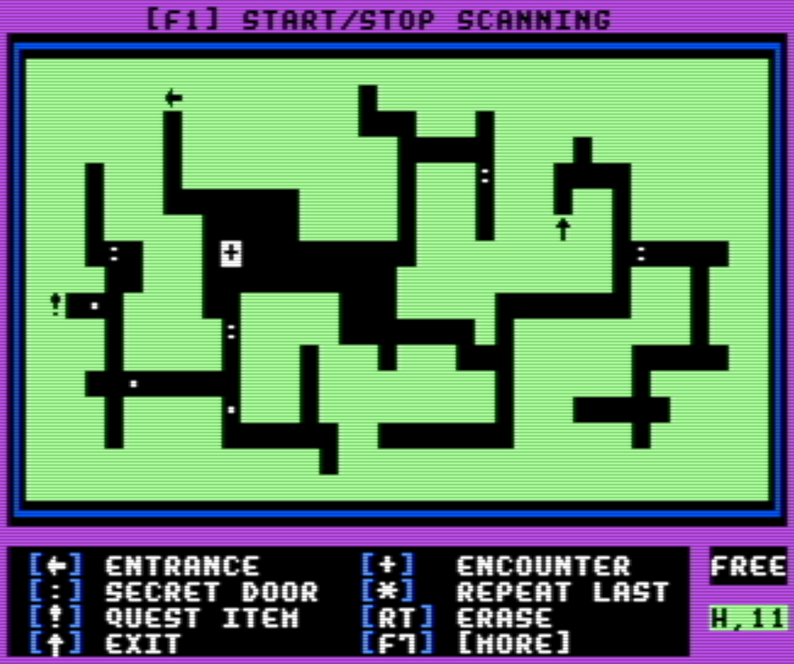
Dungeon’s map editor

I make it available with some trepidation. Dungeon has a few significant bugs. For example, it supports two disk drives throughout, but if you use its Dungeon Maker then you need to set it for single drive mode, or else you’ll encounter a Disk Error just at the worst possible time: when saving your project. Its randomized “Lost Worlds” often create dungeons that strand your character in impossible situations, and while there is a way out of them, it involves loading the Guild menu 15 times.

But I’ve played a lot of these random dungeons, and I think overall David Caruso II made a clever little game system, and I think his ideas are worth building upon. That’s why I’m working on a remake/update of Dungeon, that I’m calling Dungeon DX.

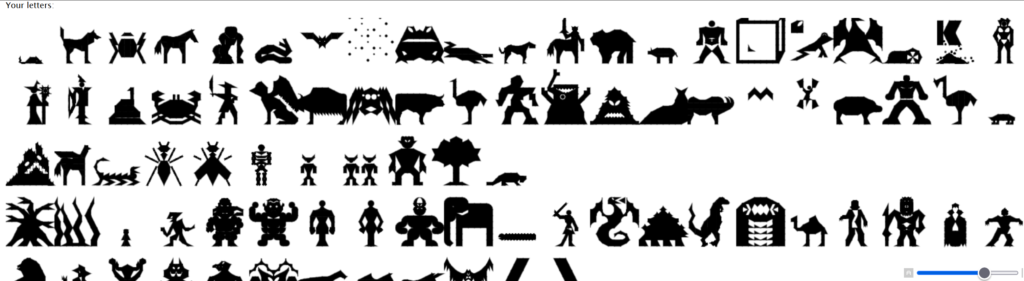
I’m making it in Python using the Pygame library. I’ve tried making a game with Pygame before and had some problems with it (I may bring myself to talk about that experience someday), but using it now I’m pleased to see Pygame 2 has become a lot more performant, and that’s even before trying to compile it into a faster form. I’ve built for Dungeon DX a kind of bespoke terminal emulator, but one with support for loads of cool graphics effects. I’ve made dungeon art and monster images for it using the website Fontstruct, which gives the images a low-tech, but distinctive look.

A collection of monsters, in font form, still being worked on. They’re reminiscent of the monster silhouettes from early editions of Call of Cthulhu!

I’ve been working very hard on it, to the extent that I can feel myself getting my hopes up that a substantial number of people may actually play and enjoy it. Most of the times in the past that I’ve done that I’ve had those hopes get crushed, but hey, maybe the nth+1 time’s the charm?

Besides not having all of its bugs, why do I think this project is worth working on? These are the things I find appealing about the original Dungeon, the reasons that I played so much of it myself, things that I don’t generally see in CRPGs these days:

  • It’s not a game but a game system. It isn’t a single huge campaign that you play and finish, and it isn’t a single story. Your characters can keep going so long as there are adventures to be had.
  • In structure it isn’t like a novel, but it’s more like a series of short stories. Each dungeon is a single screen, that fills out as your character explores it. That may sound a bit like a classic roguelike, and there are some elements of that, but the feel is subtly different. Each single-screen dungeon usually has more adventure packed into it than in a single roguelike dungeon level.
  • It’s like a collection of short stories, but that stars your character as they progress through it. The focus is more on the development of that character as they continue their adventuring career. Like how the Conan the Barbarian novellas are each an episode in the life of a single adventurer.
  • It features what’s known in some circles as slow character growth. D&D has rapid growth, and it’s gotten even faster as the system has changed through the years. 5th Edition characters advance to second level absurdly quickly, after earning only 300 XP, and that advancement practically doubles their power! 0th-level Dungeon characters (it starts counting at 0) have a lot more durability, but it takes them more time to advance to Level 1, and when they gain it their power only increases a little. In this, a lot more of a Dungeon character’s life is decided at character creation. But it also means, as they increase in power, you know it’s due to your own efforts.
  • It’s more simulationist that CRPGs have become as of late. A lot of CRPGs have crept towards gamishness, which generally is okay, I mean they are games after all. But I think RPGs work the best when you can imagine them as being the adventures of real people, so as their power has crept up, and their abilities have gotten more abstract and arbitrary, they have come to feel more and more like playing pieces than living people.
  • While there’s a random dungeon maker, you can also make your own adventures for it, and give them to other people! That’s potentially a very great thing. It reminds me of EAMON, an 80s CRPG game system that people could create their own adventures for. (There are still websites devoted to EAMON! It’s a rabbit hole worth exploring, but that’s something more suited for its own post.)
  • And finally, it’s hard. Characters die frequently. You can revive them up to three times, and if you don’t mind reloading the guild menu 15 times you can turn the game off to preserve their life, but defeat is frequent without very careful play. You often have to play like a scavenger: take what easy-to-find rewards and successes you can, build your power over time, seek out easy adventures, and don’t take unnecessary risks. Dungeon characters are not heroes, not at first anyway, and if they’re ever to become heroes you’ll have to watch their steps.
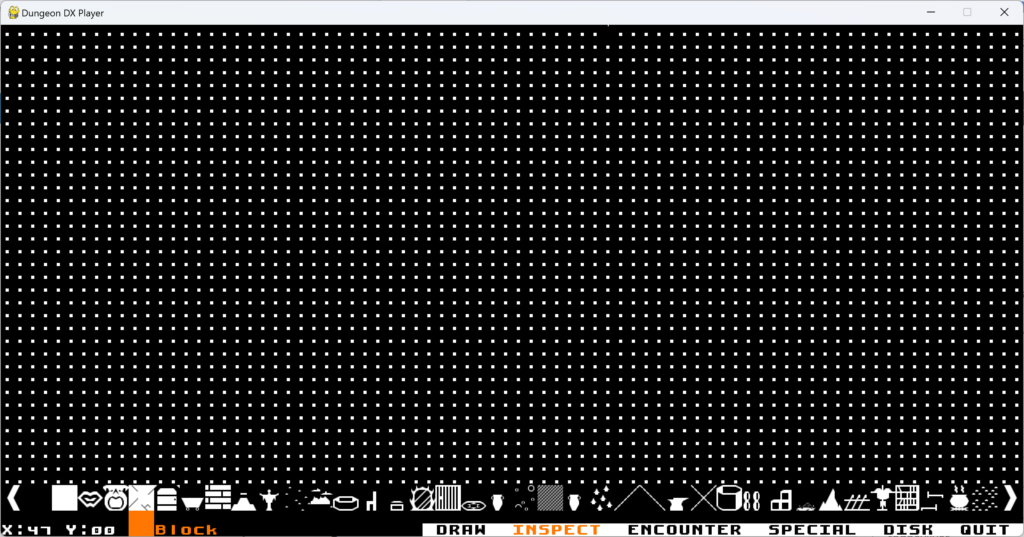
The current appearance of the new Dungeon Maker module

Because these are the aspects of Dungeon that I like, they’re the elements that I’m focusing on in making Dungeon DX. My plans aren’t to make it quite as hard, but to still emphasize that these people are not demigods, not yet. A character’s career may be the story of the creation of a demigod, like how Conan, through countless trials, eventually became king of a great nation. It’s kind of a lie that people who rise to greatness frequently do so because of their own efforts, but it’s a pleasing lie, and it makes for a fun saga if you don’t take it too seriously.

My other plans for Dungeon DX, which may change, for while progress has been rapid (because Python is awesome), I’m still iterating over lots of things:

  • A retro look, kind of akin to how Dungeon looks on a C64, but still with enhancements. It doesn’t use pixel art, instead using vector graphics created in Fontstruct.
  • Dungeon was all one-on-one fights. Dungeon DX should have parties of three characters, fighting enemy groups that can be larger than that.
  • Dungeon doesn’t let characters keep items between adventures. For the most part, characters only advance through gaining experience. DX should let characters have a persistent inventory.
  • Dungeon doesn’t have any money system at all! DX should both have money and a shop where basic necessities and equipment can be obtained.
  • Dungeon doesn’t simulate much of the basis of exploration. My ideas for DX let characters rest in the dungeon, for example, but they must consume food to do so.
  • Dungeon has very little graphical splendor. Dungeons themselves are just blocks of green, with black tunnels dug through it, and once in a while a graphic character. That has to change.
  • Dungeon’s encounter model isn’t scriptable at all, which limits what can be done. It’s a lot more flexible than you might think it would be, given the C64’s memory limitations, but the edges of what’s possible are still easily reached. I want to change that.
  • Dungeon’s magic system is very interesting for its own sake, a collection of 16 spells that are more useful outside of battle than in it. Only one of those spells that does direct damage to enemies! Magic is much more of general utility. While my design has more damage-doing magic than that, I want to keep that feeling that magic is not primarily for harming monsters.
  • Dungeon doesn’t let characters learn spells themselves: all magic comes from items that contain it, and depletes with use. There’s interesting things about that system, but it kind of means that high-Intelligence characters aren’t very viable if the dungeon constructor doesn’t give them any magic to use early on.

RPG In A Box

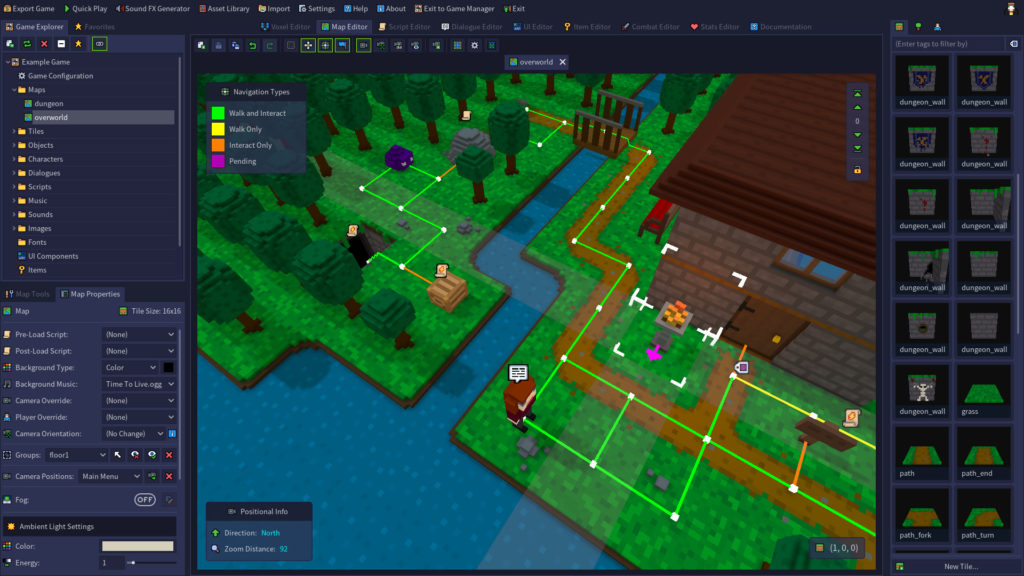
Lots of players are also armchair designers, so we like to present interesting tools as they appear. One that recently went up on Steam is the voxel-oriented RPG In A Box ($29.99). It has that interesting 3D-yet-8-bit vibe that make the Dragon Quest Builder games so appealing.

There are a lot of interesting tools out there for a variety of skillsets, and greatly differing levels of flexibility. Some considering are RPG Maker MZ and MV (who knows what the letters are meant to stand for), Zelda Classic for action games, and for more flexible tools it might be worth checking out Godot, or maybe creating something with Python and Pygame.