DiggDead

We’re a gaming site sure, but I think our broader focus is on using computers for entertainment purposes, and it’s not as if sites like Digg and its aggregation successor Reddit don’t gameify their workings to a significant extent, what with the reputation and the karma and the scoring and whatnot.

Digg has been restarted before, in fact several times! Some history is called for here.

A Timeline of Digg’s Several Graves

2004 Digg is launched, let’s call this Digg 1
2005 Reddit is launched; at first it’s much the underdog
2006
2007
2008
2009
2010 “Digg v4” happens, a badly handled redesign (I call it Digg 2), a mass exodus to Reddit begins
2011
2012 Digg’s traffic has fallen by 90%; Digg redesigns again (Digg 3), changing over to entirely editorially-curated content; Digg’s IP is sold in two chunks
2013
2014
2015
2016
2017
2018 Digg’s remaining assets are sold to a company called “BuySellAds,” which should give you some indication of where their priorities lay; later it’s sold to the even more hilariously evilly-named “Money Group”; Digg 4
2019 Lemmy, a Fediverse alternative to sites like Reddit and Digg, is launched
2020
2021
2022
2023
2024
2025 June: Digg relaunched in private beta, Digg 5 why not
2026 January: Digg goes public; March: then is taken offline yet again a couple of months later

Yes, Digg is a year older than Reddit, and yes, at first it was the obvious frontrunner. Nowadays Reddit could definitely stand to have some more challengers, but it looks like it’s not going to come from Digg, at least not in the near future.

I got in near the end of Digg’s private beta. I think I was one of its more prolific commenters, and I had considered starting a SetSideB community there. Ha ha, I’m glad I didn’t now! There were people on Digg making concerted efforts trying to push it rightward, trying to spread the meme that Reddit, the very site that once hosted TheDonald, was somehow far left-leaning. I’d tell you more about their odious arguments, but I blocked them as soon as I noticed them. Digg had good block button, at least.

There had been problems with AI bots trying to push content, yes, but Digg also used made a lot of use of AI itself. Moderation was handled partly by algorithm, and many pages would have Digg-generated AI summaries, marked “tl;dr.” I came to resent them.

A BusinessWeek cover, archived by Wikipedia, from Digg’s heyday

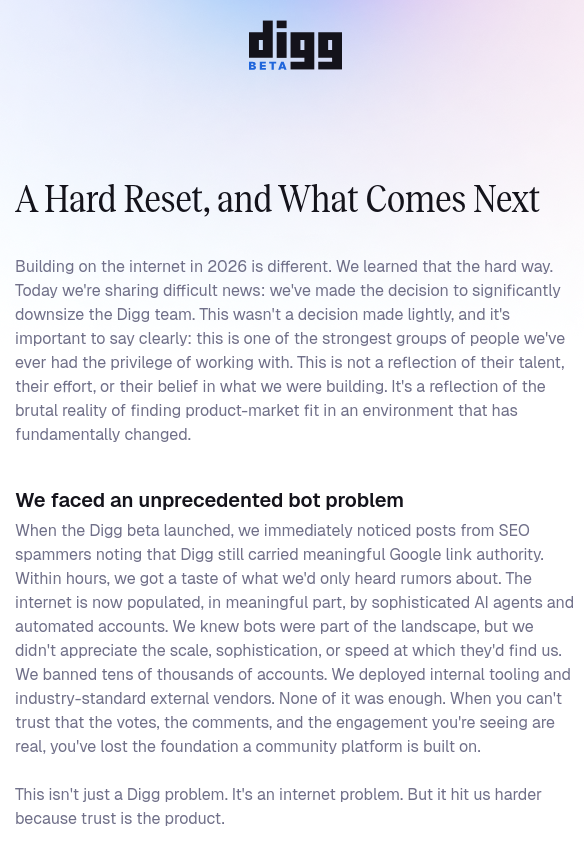
Original co-founder Kevin Rose, in many ways the face of Digg, is back on board. He seems to come back every time they’re having problems, but never seems to stay for long. Digg’s apology message, which is now their entire website, came suddenly. We users were given absolutely no advance warning, the site, and all of our posts and comments and votes, were just gone entirely. Here one moment, gone the next. Good job there Rose.

I don’t think it’s right to say, as the front page now does, that “[t]he internet is now populated, in meaningful part, by sophisticated AI agents and automated accounts.” That is true if you view it in terms of posters. But the web is mostly comprised of readers. One of Digg’s early ideas, lifted somewhat from Slashdot, was that users with good posts get more influence. That also became Digg’s downfall, as power users with high influence banded together to upvote each other’s posts, making themselves more and more powerful within that framework.

I wonder if AI agents could be used by nefarious actors to automate gaming such a system? I don’t know. At a certain point, the problems with a system start to look, not like fixable problems, but like inherent flaws. But anyway, my fondness is still for entirely human-curated sites, like my favorite hangout spot Metafilter. It certainly has problems, but it doesn’t have a runaway bot problem, or at least none that I’ve noticed so far.

Please support the human-made web. The whole online world depends on it. Thank you.

On Finding and Preserving Discord and Youtube

This editorial doesn’t necessarily reflect the views of this blog. However, blogs don’t have views anyway, so what would that even mean?

This is a slightly edited version of a diatribe I emitted on mefi.social. I really want people to see it and think about what it means though.

A dismaying thing is how much of current gaming culture is locked behind Discords, and/or is revealed to the world only through Youtube videos.

These two phenomena are the result of the Myth of the Benevolent Corporation, which was largely started by early Google and their “Do No Evil” policy, which sustained the early web for a good while but itself did huge damage to online culture, and yet promises to do much much more, when they decided that profits mattered more.

When Youtube started, everyone saw it as a kind of miracle. In the early days videos were limited to 10 minutes, but even so they began attracting a huge amount of material. When they switch to just letting people upload anything for free, that exploded.

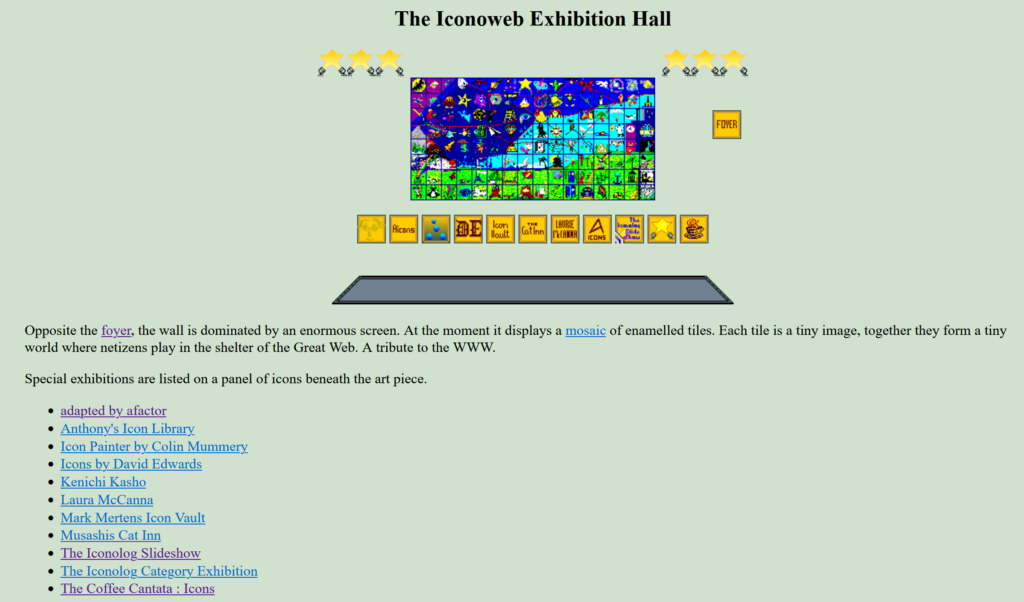
I love this page, at http://cs.gettysburg.edu/~duncjo01/archive/icons/iconolog/pavilion/iconHall.html. I’m really sad that the world depicted within has shrunken so much, and of the list of links on this page only three survive.

It’s not just gaming stuff that I’m talking about really, although as a popular fixation for people it’s kind of a hint of things to come. Lots of information is currently exposed to the world through Youtube videos and minidocs.

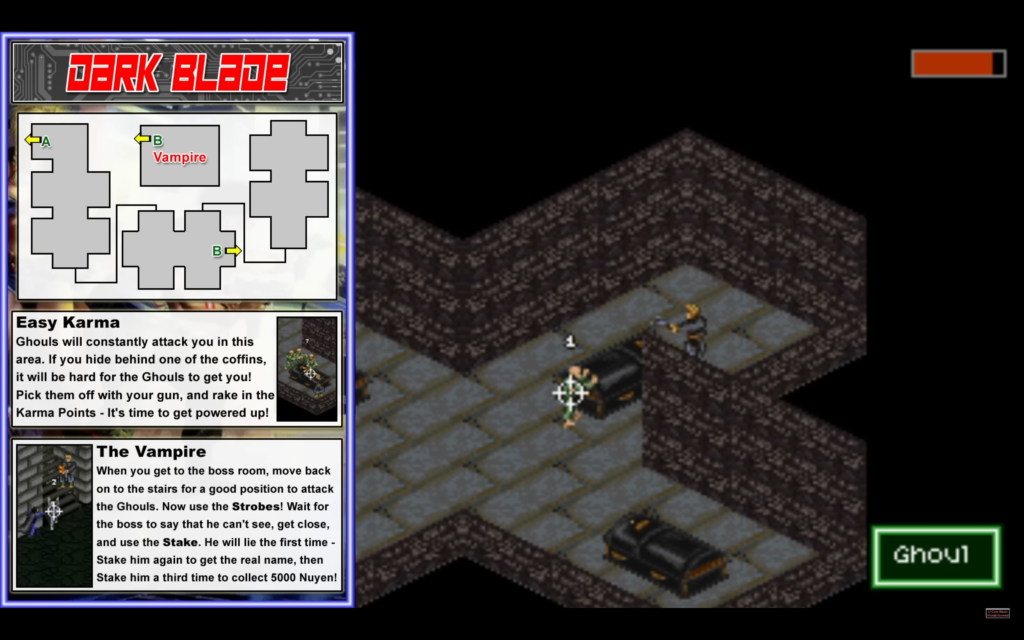
From U Can Beat Videogames’s video on Shadowrun. It’s great, but some day it’ll be gone. How will people beat an ancient obscure SNES game like this then?

But Youtube has always been a time bomb for all this content. It’s inevitable that Youtube will someday begin deleting things. If not sooner, then later. Yet there are few entities capable of preserving all of it, or even most of it. All of this will [get destroyed] like [crying] in [a downpour].

Of course, it’s not like videos like these have any other hope as it stands. A collection of the incredible size of Youtube’s is so big that only a government could realistically do it, and most of those have their own issues when it comes to continuity of mission and funding.

But combined with Discords as a means of communication, and (bizarrely) information, a lot of online culture is currently a black box to outsiders, unless they sign up to dozens of miscellaneous Discords. And there is a limit to the number of servers you can follow, which is reputed to be 100. (It used to be that Google could get you a quick answer to a question like how many Discord servers can one user follow, but now I’m not sure.)

Social media companies, who all seem to be racing each other to make their services as crappy as possible to non-paying users, are no solution either.

There used to be a Mastodon search engine, at search.noc.social. This is what remains of it. (Yes, it’s just a white page with the text “project has been removed.”)

Fediverse to the rescue! But no, a lot of it is transitory, sometimes intentionally so! In some circles even suggesting that Mastodon be just searchable, let alone preservable, will subject you to a storm of criticism. It’s true that being opaque to general search helps protect vulnerable users, a noble cause, but it also makes Mastodon’s discoverability very low. (One solution, which I think I mentioned here before, is an opt-in search solution called tootfinder, but it currently only goes back three months.)

And I don’t see many other people talking about this, even though the sudden decay of Twitter and Reddit has made this essential problem more visible than its been for a long time.

I feel like going onto every Discord I follow, gaming research ones in particular, and ringing alarm bells, but it’s a task just to find them out, and really what good would it do. People use Discord because it’s free and easy and they even maintain the server for you. These kinds of spaces have always relied on some patron to uphold them; the only real differences are before they were visible to search and the Wayback Machine, and now, it’s a single company that will increasingly hold access to these places obscured behind a storm of pleas to subscribe to Nitro, and someday will delete them entirely.

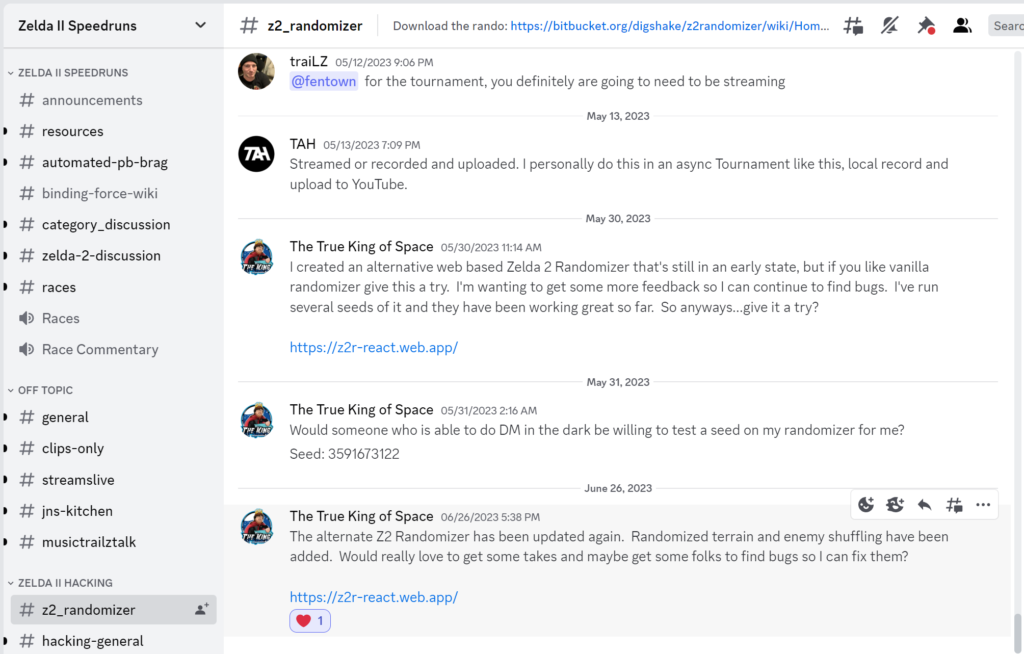
The Zelda II Randomizer Discord. As a community, it works okay. As a way of storing information, well, it sucks rocks. As a way of preserving everything, it’s DOOOOOMED.

If you think I’m being hyperbolic, there are vast swaths of online culture that are already lost permanently: the Compuserve forums of the era immediately preceding the rise of the web. Compuserve was once the biggest online presence. And AOL, which grew to eclipse it in size, likewise holds (still? I don’t know, it’s on AOL!) a vast amount of early internet culture.

Newsgroup archives are a bit better off because of their openness, although nowadays it’s mostly seen as just a way to enable piracy.

Still, essential web services are at least preservable. The Fediverse resembles those, at least in principle, so it’s immediately better off than Discords and Youtube, for making old information findable, even if it’s currently really hard to do it (and some people are outright opposed to it).

It is time to wrap this all up. I say things like this frequently these days. Maybe someday someone will listen. The power and reach of the internet doesn’t have to rely on big companies. I also have qualms about the ability of a even a horde of individual servers to keep things going, mind you. All those dead links on all those surviving old websites, they once represented living projects too.

I think what we ultimately need is an independent organization that can keep up old sites and communities, and provide a place for new ones, maybe supported by donations, without the explicit profit motive of the bigcorps. Something that looks like the Internet Archive or Wikipedia. There’s places where you can host plain websites even today, like the Tildeverse (but its individual pieces, like Fediverse servers, always feel like they could vanish at any time), ancient-yet-still-here Angelfire (of which, like the Lycos it’s a part of, it’s amazing still survives), or the newer, enthusiast-focused Neocities (which too has no guarantee of longevity).

Companies can live longer than people, or their interest cycles. It doesn’t feel right that something like a website require someone to dedicate their life to maintaining it, but due to the dysfunctional way our economic has come to see companies (involving the hateful words fiduciary duty) are also vulnerable to the winds of change. It feels like a non-profit, or at least a durable privately-held company that isn’t pushed by rapacious groups to chase every profit lead no matter how disastrous, may be a solution. I don’t know if it really is, though. I’m just watching this, mostly from the outside. I hope someone can do something though, to overturn the cold tides of entropy. I really do.