
First, to recap
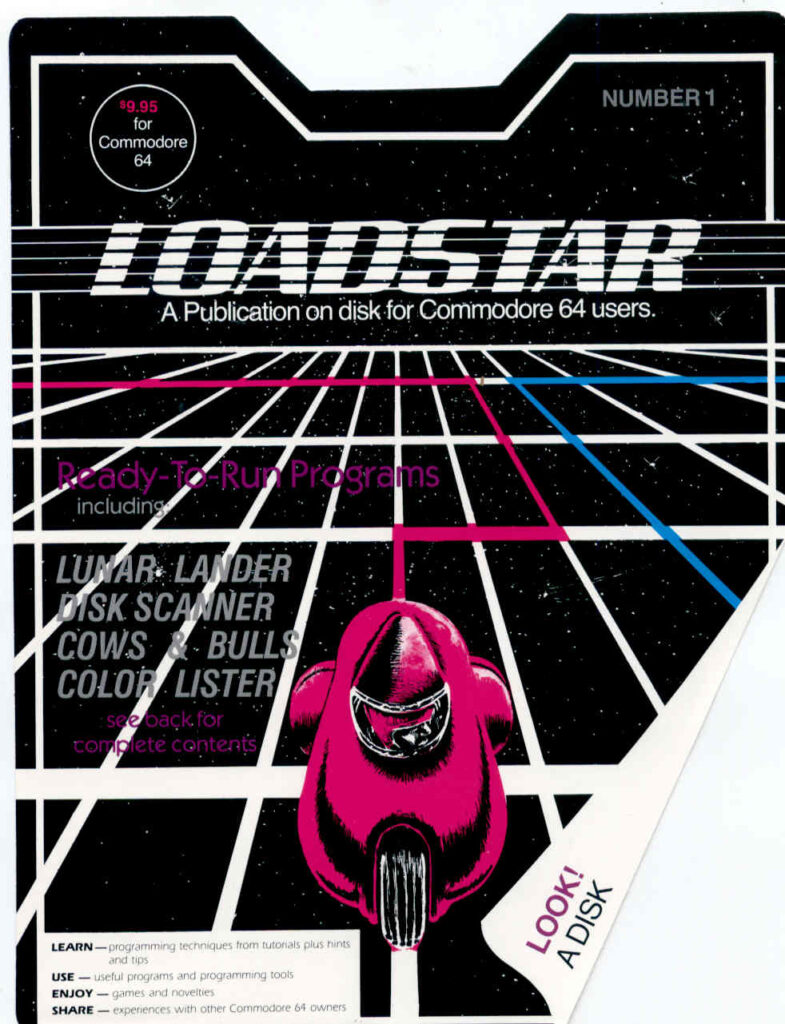
Way back in 1984, having had success with their first product Softdisk, the nascent Softdisk Publishing released the first issue of Loadstar, a “magazine-on-disk” for Commodore 64 microcomputers.
Softdisk is mostly known these days as being the former workplace of several people who would go on to found Id Software, creators of Commander Keen, Wolfenstein 3D, Doom and Quake. Softdisk published, as the Id guys’ last work for the company, Catacomb 3D using the Wolf3D engine, and a Commander Keen episode.
Softdisk released other products too, but Loadstar eventually proved to be something special. Early on they assumed that their PC and Mac products would be their legacy, but then Microsoft and then the internet came along and it suddenly became much harder to make a go of it with a monthly paid software collection. Softdisk became an ISP; they got bought out by a bigger ISP; nowadays they don’t exist really, except as a bag of rights owned in pieces by Piko Interactive and/or Catacomb Games, who bought their Id-related assets.
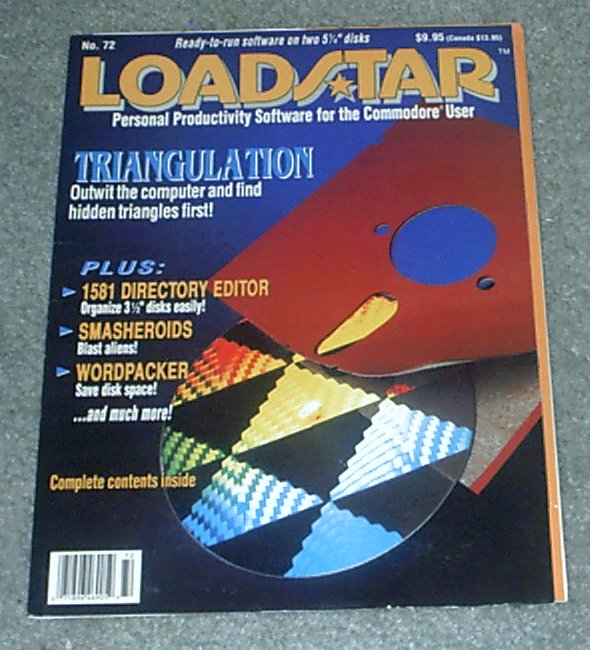
But some time before then Loadstar and its relevant assets had left the company. Defying expectations and buoyed by the large userbase of the Commodore 64 (quick googling suggests they sold 70 million units), Loadstar was still doing fairly well for itself. It was no longer sustaining the whole company like it once had, but it was too large an audience to ignore. So Softdisk spun Loadstar off to J&F Publishing, under the captaincy of its longest-serving Managing Editor Fender Tucker, and they kept the lights on a while longer.
When Fender retired from Loadstar at the dawning of the year 2000, he passed managing editorship over to Dave Moorman, who kept it going for 49 more issues. It was starting to become hard to find new things to keep Loadstar going at this point. While Dave had some regulars sending in new things, a large back catalog to mine for material, and skill enough to write some software for Loadstar himself, its release rate slowly dropped from monthly to, in 2007, two issues in that year. Then a tornado his his house and destroyed the tools he used to make Loadstar. One more issue made it out in the following year, that had been in production and finished by Ricky Derocher in 2008. And that is where Loadstar’s story ended.
Next, what I’ve been doing
A year or so ago, with the permission of Fender who still owns Loadstar and J&F Publishing, I threw together something called Loadstar Compleat. A prior product also called that had been sold by Fender for some time, a CD-ROM with the 199 issues from before and during his run, along with the 42 issues of another magazine, Loadstar 128, and various other products and odds and ends.
I took the issues from there, replaced some bad copies with better ones provided by Ricky Derocher, added in the 51 later issues from Dave Moorman’s editorship, and added a kind of shell program to make browsing and searching through them all easier. I packaged this all together and threw it up on itch.io as Loadstar Compleat for $15. Since then I’ve now also given three talks on Loadstar and its history, in person at VCFMW 2025, virtually for TPUG, and three days ago also in person at VCFSE 2026. (There should be video of that soon, I’ll link to it here when it enters my notice.)
Now, possibly, the future
Dave has always said he wanted Loadstar to last to its 256th issue, to make it an even binary number (28, or 100000000). Even though Loadstar only had about 100 subscribers left by that point he was still committed to doing it, and only the fury of nature prevented him from making it.
I mentioned this at VCFSE, musing that perhaps I could finish the task he had started, making a final six issues of the venerable disk magazine, and a couple of people there thought that it might be a good idea. And I think I have enough knowledge now of Loadstar’s underpinnings that I might be able to accomplish this. With all the tools available for producing software for retro platforms now (I have an upcoming article on those in the works), it is arguably easier to make C64 software than it’s ever been, and now that there’s the Ultimate64 and Maxi65, the size of the C64 platform is growing once again.
So, let’s start making plans for how this could happen. In addition to doing whatever needs to be done to understand Loadstar’s file formats to get its Presenter system to fulfill our purposes, I figure we need:
- Contributors, and contributions. Commodore 64 software, hi-res artwork (at least one image for each issue for the loading image), SID music (at least one piece per issue for the Presenter background music), articles and anything else we’d need to keep up Loadstar’s standards according to the systems they used in their late period, which used a polished Presenter menu program written in machine code, a text reader to display documentation and articles, and miscellaneous other niceties.
- Means to compensate them. We aren’t sure if this can support itself financially yet. For right now, we need to keep our options open. If we get a lot of interest it’s not out of the question that this could mean a bit of actual money, but for now free issues are what we’re considering.
- A means to produce physical disks. These issues would be sold digitally (as .d64 and .d81 disk images for emulators), but it feels like to be a real disk magazine, there must be actual Commodore-formatted 5 1/4″ and/or 3 1/2″ disks to sell too. You can still get 5 1/4″ disks. Amazon sells them ten for $25.
We’re currently discussing ways to accomplish these things. I’ve started a thread at loadstarce.com to discuss this project. We are fortunate that many of the Loadstar editors are still around, including Fender Tucker, his associate editor Jeff Jones, and Dave Moorman, as well as people who care about Loadstar’s memory like Ricky Derocher.
There are two things we need right now. The first is indication of interest. Would you be interested in buying something like this? How about spreading the word about our little venture?
The other thing we need is “content”: software, writing, art and music, in formats appropriate for the Commodore 64. C64 art must be hi-res VIC-II format. Music can’t just be any old SID tune but in the format its Presenter used (more information on that as I determine it). Software doesn’t have to be machine code, for Loadstar published many BASIC programs, and multiple BASIC extensions too, including one, Dot.BASIC Plus, that still has a website and working downloads!
Are you any of you interested in, and capable of, providing these things? I don’t know how much we can pay you yet. For my part I will make the rounds online and approach people who might be interested in helping revive Loadstar, if just for a little while.
And who knows, if this proves popular enough, maybe we could go past issue 256? Shooting for 512 seems like a ludicrous dream, certainly not something I could do in my remaining lifetime, but who knows for sure? Let’s dare to dream.
If you want to be involved in the continuation of the frankly improbable legacy of Loadstar, you can reach me:
- on Mastodon, at either @setsideb@mstdn.games or @rodneylives@mefi.social.
- on Bluesky, at @rodneylives.bsky.social.
- via email, at johnwh (at) gmail.com.
- on Metafilter, via MeMail to JHarris.