I’ve already introduced The Bard’s Tale in prior posts, so in brief: The original Bard’s Tale trilogy were all Wizardry-style dungeon exploration RPGs in the classic style, called by some “blobbers.” Indeed they did a lot to define that style. A few things that Wizardry did weren’t adopted by later blobbers, especially its particular form of permadeath, its simulation of “Out” parties and retrieving lost characters from the dungeon, and its willingness to obliterate your entire group instantly and permanently if you teleported into solid stone.
The Bard’s Tale, on the other hand, looks exactly what the standard picture of a classic blobber looks like today. So long as you have the cash to revive a character there is no real penalty for dying, there is no absolutely solid stone to teleport into, and there’s no concept of “Out” parties, for if your party wipes their corpses get mysteriously teleported back to the Adventurer’s Guild, where if there’s enough gold in their cold pockets you, I guess in the capacity of being a caring guardian spirit, can tell the priests to bring them back to life.
But while not as eager to annihilate members of your group, neither is The Bard’s Tale an easy game. Compensating for the lack of permadeath, dungeons tend to be much more diabolical in design, with magical darkness, teleporters, spinners and antimagic zones in evidence. Dungeon levels are bigger than Wizardry’s, there are more of them, and most significantly to a new player, “Town,” here named Skara Brae, isn’t a simple menu of options but an entire level of its own to explore! And at the start of the game, you don’t know where anything except the Adventurer’s Guild is! You have to do significant mapping before you can buy equipment, recharge your spell points, or even raise your experience level.
In this 7th installment of the video series, the player finds and begins to explore the third of the game’s dungeons, finds some interesting items, suffers from disk corruption and loses some progress, earns it back, and fights a jabberwock.
Have you ever wondered what the appeal of a rock-hard, old-school, Wizardry-style, first-person, overly-hyphenated classic CRPG is?
The original Bard’s Tale, notthe PS2 action RPG reboot, and not the more-recent continuation either, created by Michael Cranford, is not as harsh as Wizardry, but is still a tough game, and one that demands that you map it out as you go. Instead of a menu-based town like in Wizardry, you have to actually explore the town of Skara Brae to find important locations within it like Garth’s Equipment Shop, Roscoe’s Magic Emporium or even the Review Board where you gain experience levels, and surviving the town’s random monsters long enough to do those things is your first major challenge. Yet despite, or maybe because of, that difficulty, the series sold more than a million copies, and was an important early hit for both developer Interplay and publisher Electronic Arts.
The C64 Appreciation Society is working through the original Bard’s Tale in an in-progress series of videos, ranging from 10 to 15 minutes in length, and they’re excellent both for an introduction to the classic series, and for understanding what made the game so popular.
The playlist is in reversed order, so if you watched it from that you’d start with the episode 4 and then watch 3, 2 then 1, and it’s really for the best to watch them in the correct sequence, so here those are: Episode 1 – Episode 2 – Episode 3 – Episode 4. Embedded here is the first of those episodes:
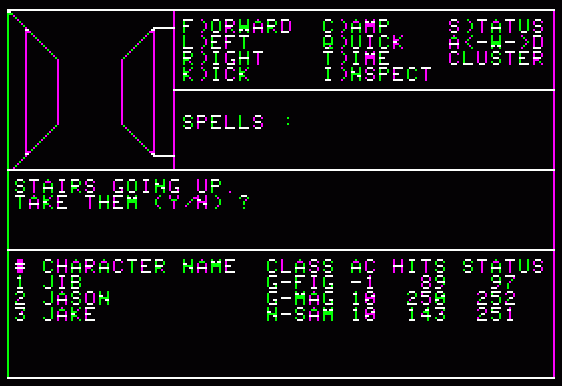
Apple II Wizardry. All images in this post are from MobyGames.
In @Play yesterday I mentioned a number of games that use Wizardry’s weird world metaphor. They’re sort of like roguelikes in that the world is divided into a grid of discrete spaces, but instead of viewing them from overhead, you are given a first-person view from the center of that space.
You don’t move with the same kind of smoothly-adjusting motion as Wolfenstein 3D would bring a while later, but movement instead jerks along one space at a time, and you turn in 90 degree increments. These games all disorient the player just enough that mapping them becomes important, but can be easily mapped on graph paper. Your more fiendish RPG dungeons of the type have tricks they play on you as you explore specifically to disorient you, like teleporting you to an identical-looking corridor without telling you, or spinning you around randomly. Wizardry and Bard’s Tale in particular delight in doing this.
It’s such a distinctive and immediately recognizable way to represent dungeon exploration that I’m surprised there isn’t a fan name for it, like “shmup” or “belt scroller.” I’ve calling them blobbers, but those actually get their name from the fact that, if you are commanding a party of characters, they’re all considered to inhabit that one space. The term doesn’t really apply to the mode of movement, only the atomicity of your group.
I gave a list of a good number of games that offer this kind of movement, but shortly after I thought of a bunch more, and they’re such a weird and varied bunch that I figured I’d take it as an excuse to catalogue as many examples as come to mind, and say some words about them in passing.
In the beginning there’s the Wizardry games, of course. I don’t actually know if it’s the first of the type, but it’s the earliest I can think of. Wizardry games using this format include, I believe, the first seven in the series; the 8th (and last in the core series) finally switched to a full 3D engine. There’s also some Japanese Wizardry games, and some of them use the style as well, but I can only personally vouch for one. That’s eight in total.
There’s some games that use Wizardry-style mazes as only a part of the experience. Some of the Ultima games do this. The Ultima predecessor Akalabeth uses them, and I know Ultima III does too for its dungeons. That’s two more.
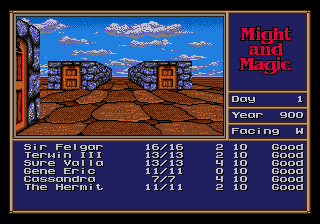
Might & Magic II for Genesis, image from MobyGames.
There’s two major series of Wizardly-inspired games. The original Bard’s Tale series were blobbers in the truest sense of the term. That’s four: I, II, III and Construction Set. The hugely underrated Might & Magic series also used them for both dungeons and their game worlds up to V. That’s nine more, for a running total of 19.
On the NES there are some surprising examples of the form. I already mentioned Interplay’s Swords & Serpents, a unique and probably doomed attempt to make a Bard’s Tale RPG on a ROM-based system. There’s multiple oodles (boodles! froodles! zoodles! poodles!) of interesting things about that game, like its character-specific password system and its four-player support, but we don’t have the time here to get into that. In fact, I could say that about nearly this entire list.
Two of the most ridiculous kinds of characters to explore 1st-person dungeons are a super spy (as in Golgo 13: Top Secret Episode) and lightbulb-tonguing uncle to a weird and macabre family (as in Fester’s Quest), both also on NES. Adding them to the pile brings us up to 22.
I mentioned Phantasy Star on Sega Master System and Arcana on SNES. There’s also Shining in the Darkness on Genesis and Double Dungeons on the TG16. There’s at least one Madou Monogatari game that uses the system, but I’m only adding games that I can remember without Googling or looking anything up, so I’m only counting it once. We’re now at 27.
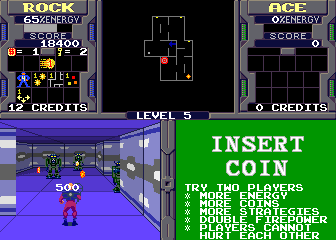
Xybots
There’s 3D Bomberman on the MSX, an early experiment in the Bomberman series where the mazes you’re in are 3D. In the arcade there’s Ed Logg’s Xybots, which was intended to be a Gauntlet sequel but the play ended up being different enough that he changed it to a sci-fi game. Xybots breaks the rules slightly because your character is visible, but it’s still that kind of grid-based, first-person maze. More recently there’s, hm… at least five Etrian Odyssey games? That brings the count up to 34.
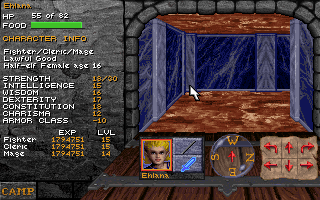
Some more miscellaneous RPGs I mentioned last time: Dragon Wars, Eye of the Beholder, and Dungeon Hack. I particularly like Dragon Wars and Dungeon Hack, although for completely different reasons.
Dungeon Hack
Oh! Let’s not forget about the D&D Gold Box series, which use 1st person grid mazes for dungeon exploration. That includes Pool of Radiance, Curse of the Azure Bonds, Secret of the Silver Blades, Pools of Darkness, Champions of Krynn, Death Knights of Krynn, Unlimited Adventures, and the Buck Rodgers game made in that style. There are other computer D&D games from the time, but they didn’t use that engine. These games also had other modes of exploration, and overhead-view combat, so they aren’t as tied to the format.
Finally there are some other miscellaneous games. Blobber-style mazes were a low-resource way of immersing the player in a labyrinth, even if there was nothing else in there of interest. My first exposure to the field was a C64 BASIC game called, natch, Labyrinth. I remember seeing a shareware DOS game called 3-Demon. The game that Strong Bad poked around in the Friendlyware video I linked last time is Killer Maze, and definitely fits the discretely granular bill.
It’s a good excuse to embed the video. (14 minutes)
So, all in all that’s 48 games completely from memory! But I’m sure there’s more; can you think of any others?
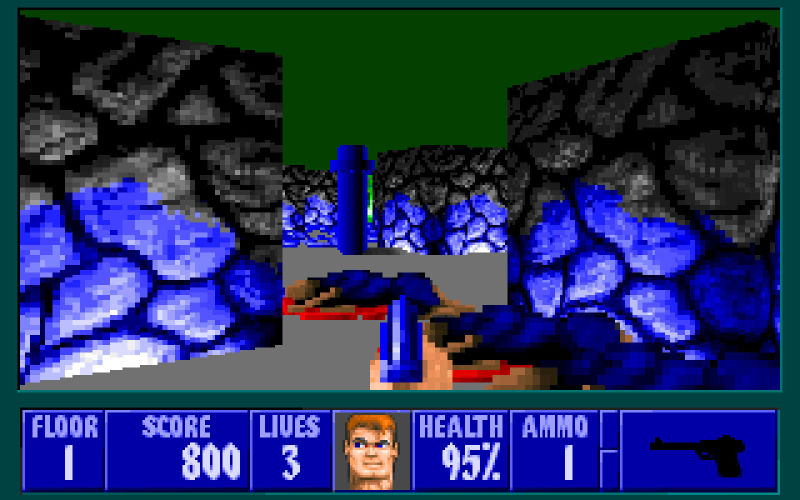
Wolfenstein 3D
When Wolfenstein 3D came out this entire style of world presentation immediately fell out of favor. Wolf 3D has very much that same kind of grid-based world, but no longer is your position locked to the center of each space. You can turn in angles of less than 90 degrees, and there’s more of a real-time immediacy to the game that’s a lot more engaging.
Wolf 3D pretty easily destroyed this genre. Almost no blobber mazes show up from that point on except for some edge cases that are explicitly calling back to the old style, like the later Japanese Wizardry games and Etrian Odyssey. It is interesting that, once computers became powerful enough to render worlds in a more fluid and immediate kind of way, it made these kinds of distinctive presentation shortcuts irrelevant. It’s kind of saddening.
EDIT: One I had intended to include but somehow left out is Dungeon Master, which xot reminded me of in comments!