An Overview of Type-In Computer Magazines

In the old old old old old old old OLD* days, people wrote computer programs by either filling boxes on paper cards or punching out squares, like they did (maybe still do?) for standardized tests. The cards would be fed into card reading devices, some of them called Hollerith machines, to be read into the computer’s memory. (Asides: Hollerith machines were invented in the 1800s. IBM’s start was in making them. IBM’s website though won’t be keen to publicize that they were used by the Nazis.)

(Another aside: What do the olds mean? Old #1: before social media. Old #2: before smartphones. Old #3: before Google. Old #4: before before the World Wide Web. Old #5: before the internet. Old #6: before online services. Old #7: before home computers. Old #8, the all-caps one: before timeshares. There is an awful lot history in the early years of personal computing that gets overlooked.)

The ultimate point after all this discursion is that paper, while little used today, is a time-honored way of entering computer programs. A while after that neolithic era, when home computers first hit it big, there grew a market for programs that weren’t as big and expensive as boxed copies on store shelves. That was the age of the type-in program magazine.

It’s the same age that that Loadstar thing I keep bringing up belongs to, but truthfully it lies only on its edges, as it was a disk magazine, created specifically to bypass the trial by fire that type-in magazines subjected its users to: sitting at a keyboard for hours, laboriously entering lines of code, or even plain numbers, in order to run some simple game, novelty, or other software. Loadstar itself served as the disk supplement, that is, media that carries all the programs from a print magazine’s issue, for both Commodore Magazine and Power/Play. (That age of Loadstar stretches from issue 9 to 61.)

I don’t know when the first magazine that published software in print form was, that’s a solid fact kind of question, there definitely was a first at some point, but there’s been tens of thousands of magazines, some of them really short-lived and obscure, and there’s a great many edge cases to look out for. Mad Magazine, to offer just one example, published a type-in in one issue.

To state that solid fact definitively requires more time and resource access than I have. But a strong claim could be made for The PET Gazette.
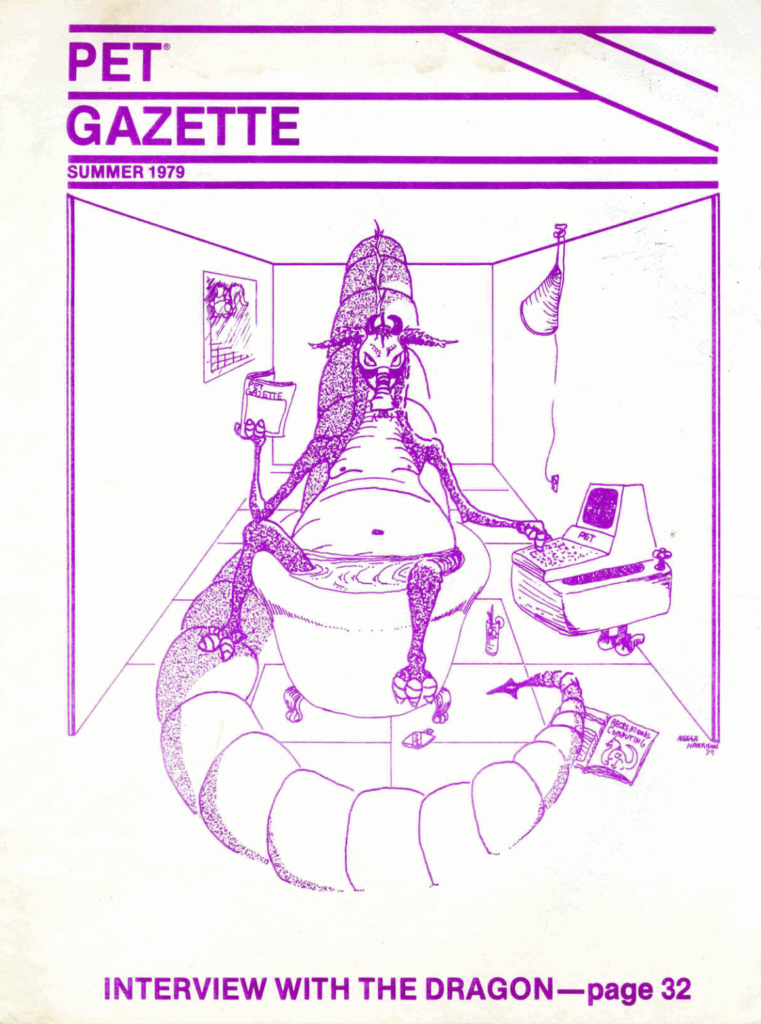
Computer magazines used to look like this! That’s what they’ve stolen from you!

The PET Gazette’s first issue was near the end of 1979. It was more of a fanzine, with a few aspects of a science journal, than a general magazine. It served a highly motivated and focused audience, the kind who would drop $800 in 1970s money on a machine that had 4 or 8K of RAM. The kind who thought making a machine perform automated calculation or data manipulation, all by itself, seemed really really neat. (I kind of feel that way, even now.) The kind like that, or that else bought one of the even earlier kit computers, like the KIM-1, which users had to assemble from parts, soldiering iron in hand, and for which a video monitor was a hopeless extravagance.

I would say at this point that you might know PET Gazette by its rebranding in the early 80s, to COMPUTE!, title in all caps, with exclamation point. But then I would be expecting you to say “Wow, I had no idea!” But who these days even remembers Compute? (I’m not going to persist in replicating 45-year-old marketing stylization, I have difficulty making myself type Xbox.)

As its title indicates, PET Gazette focused primarily on the PETs, along with the KIM-1 which is like a sibling. Compute served a community of users of many different platforms, of like half a dozen: Commodore microcomputers of course, but also Atari 8-bits, the Apple line, the TRS-80s, the early days of the IBM PC, and at times even some more esoteric models.
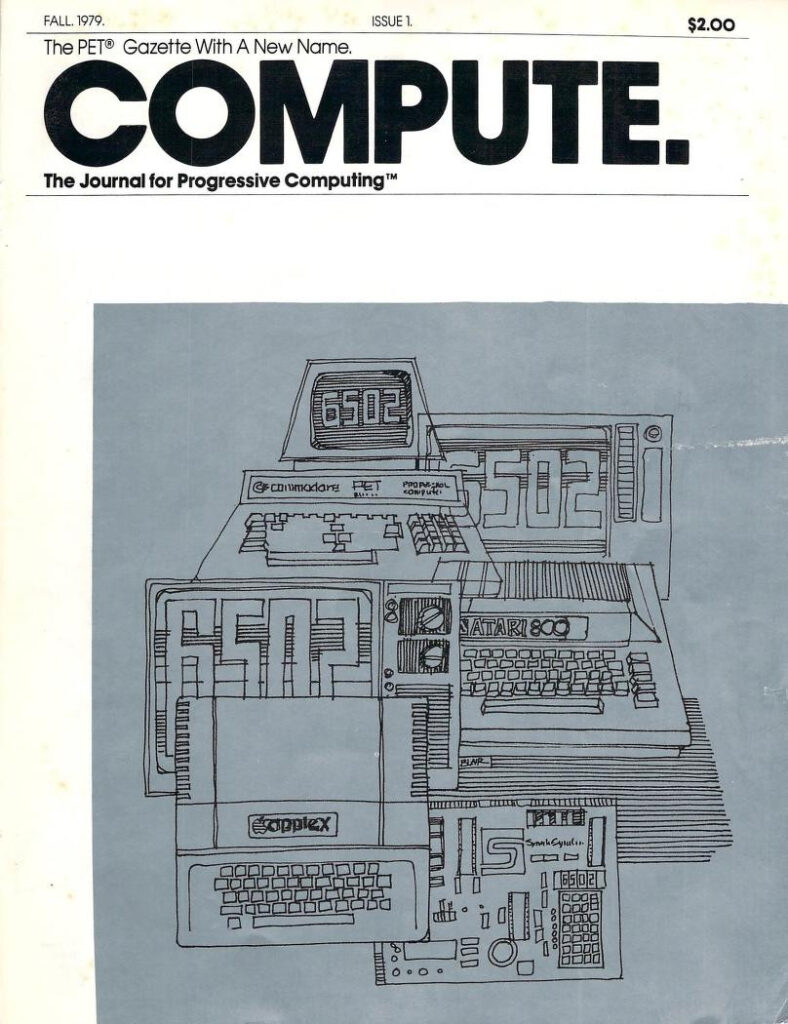
Compute’s first issue. At the start, it used a period in its title instead of a bang.
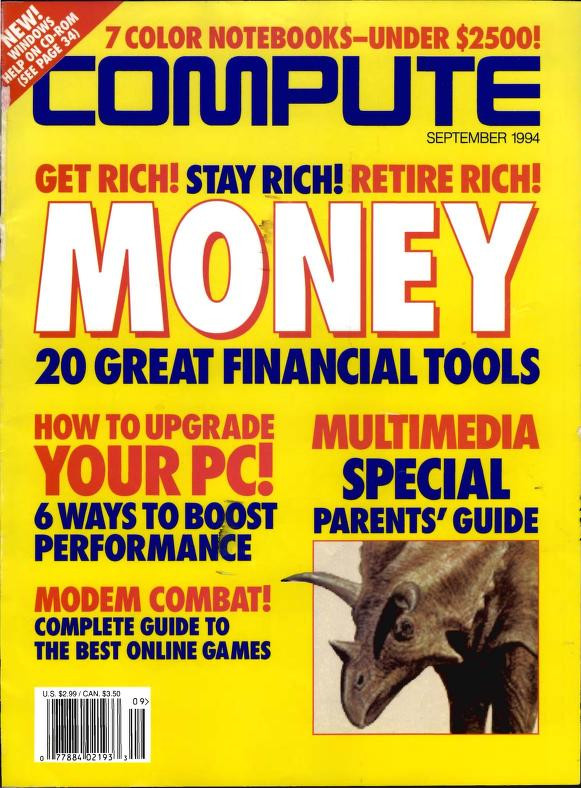
Compute’s last issue. It had dropped type-ins a few years before. By this time it had dropped the exclamation point and was owned by the publishers of Omni (hence the font of its title). It got sold to the murderers of many a tech magazine, Ziff-Davis, in order to get ahold of its subscriber list.

Compute soon spun off two or three subscriptions for specific platforms, for users who wanted more than what was limited, by space reasons, to one or two programs an issue. By far the most significant of these was Compute’s Gazette, its title a tribute, to those who knows, to the Compute empire’s origins.

I’ve mentioned here before, certainly, that Loadstar lasted for a surprising and amazing length of time, 22 years. Compute’s Gazette (Internet Archive) wasn’t nearly so long-lived, but it still made it pretty far. Wikipedia claims that it survived to 1995, but really its last issue as its own magazine was in 1990; then it persisted for a bit as an insert in Compute, then as a disk-only periodical.
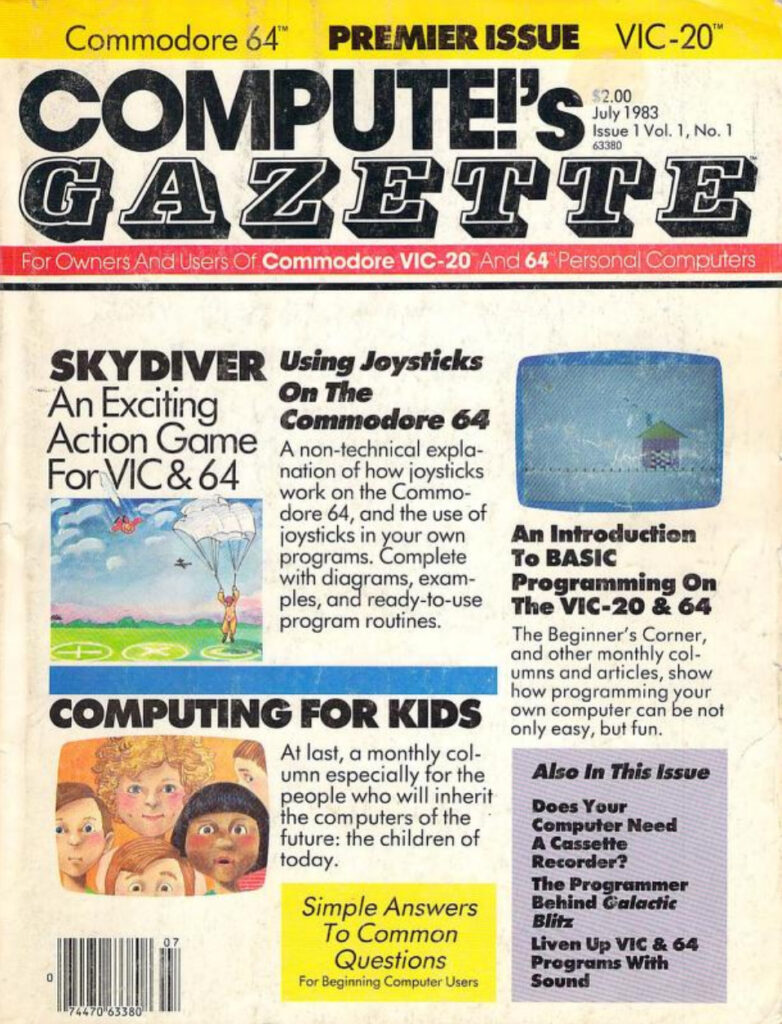
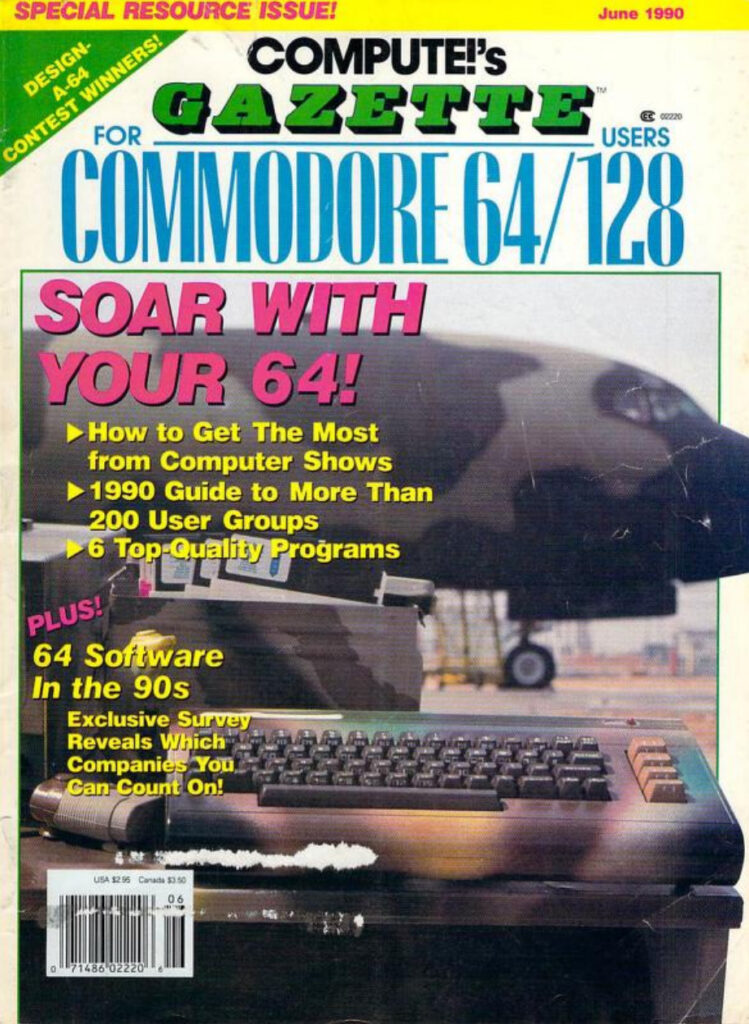
Look at that cover! Distinctive! Informative! Interesting!
…and the last cover. I don’t think it’s nearly as interesting, but by that point it was lucky to be a magazine at all.

Fender Tucker tells me that when Compute’s Gazette closed up, they paid Loadstar to fulfill their remaining subscription obligations, so at least they did right by their remaining customers. It was a dark day when CG perished, though, the former heavyweight of the type-in scene.

Some other type-in magazines of the time were Ahoy! (again, with an exclamation point):
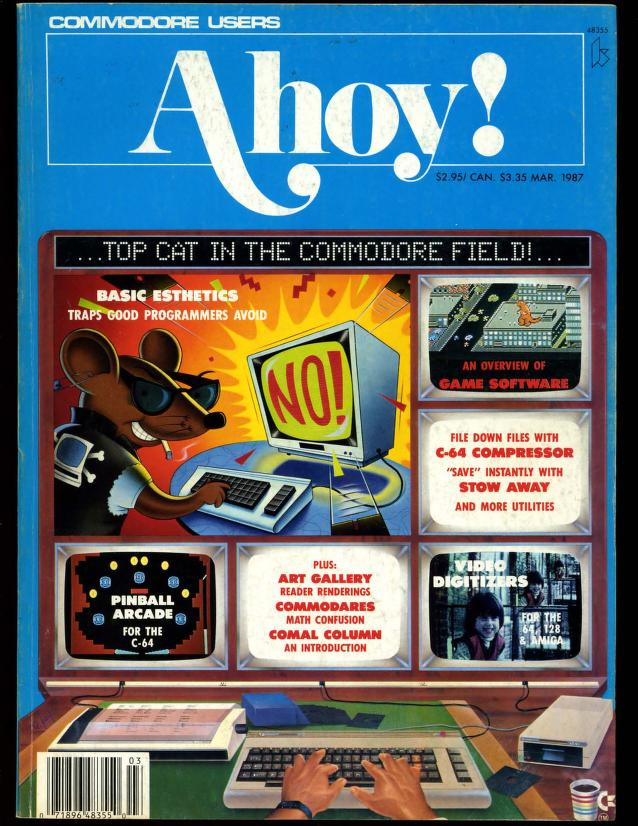
Ahoy also had a distinctive design!

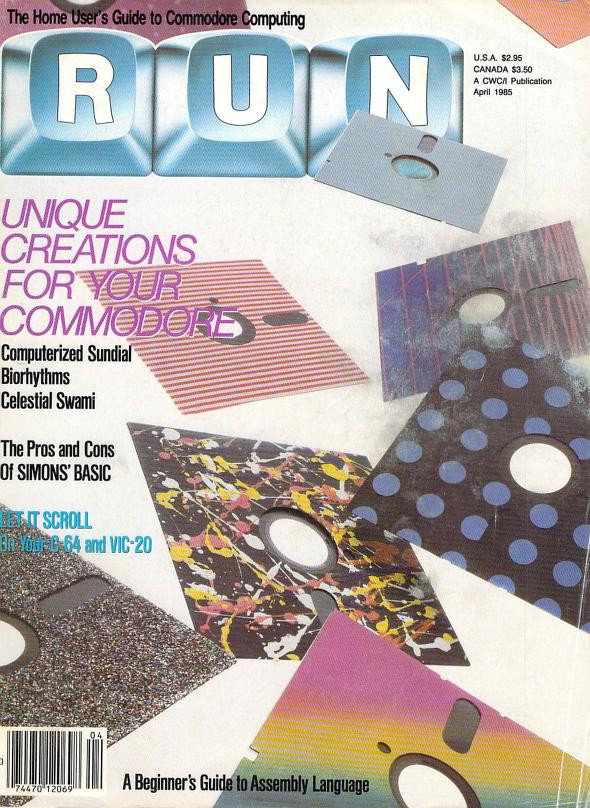
…and Run:

The word has arrived via the Floppy Days podcast that the Compute’s Gazette may soon return. What really happened is that James Nagle saw that the trademark had lapsed and registered it himself. There’s no continuity of editor, writer or IP with the original. Yet I still hope that Nagle’s effort, which rebrands the Gazette as supporting all retro computing platforms, succeeds. His heart is in the right place at least. Here’s their website. I hope that they at least have the sense to offer a way to enter programs other than typing them in by hand; that was always the worst thing about these magazines.

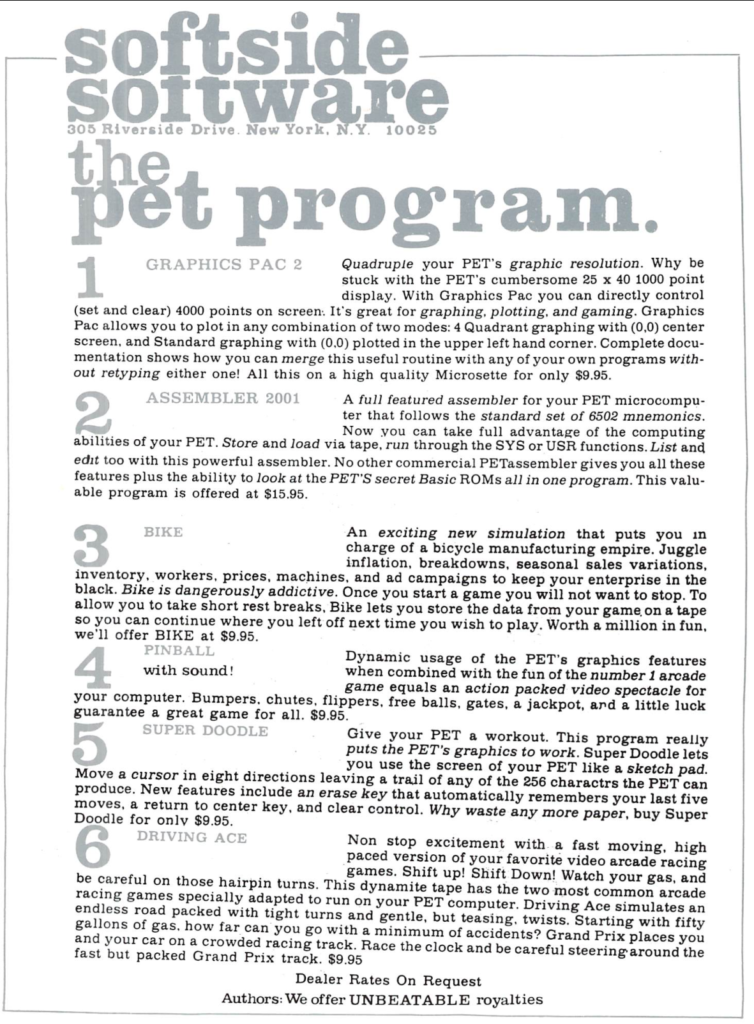
An Ad From Compute Magazine #001

This is an ad, on the first page of the first issue of Compute Magazine, for “the pet program” from “softside software,” names all in lowercase. I have no idea if any copies of these programs remains in existence in our universe, but two places to look would be zimmers.net’s FTP archive and the Silicon PET Archive, and even in this era of the internet there are a fair number of PET software archives remaining.

Softside was far from the only company to put out its hopeful shingle through the pages of early computer magazines. At the time, magazine publishing worked with a lead time of several months. It is possible that Softside Software had gone under even by the time this ad saw print, but then again maybe not. A forum thread on AtariAge mentions several BASIC games sold by a “SoftSide,” apparently an Atari 8-bit magazine-on-disk, but they were based in New Hampshire, and the Softside of the ad was in New York.

Notes on the programs proffered:

  1. Graphics Pac 2: I’m not sure what they mean, as the reference I’ve found claims the PET didn’t have a bitmapped display, but there were several models, and further add-on cards that added bitmapped displays, an 80-column mode, and even (gasp) color. A simple “Microsette” itself would not be enough. We are near the end of the PET’s reign as Commdore’s core product though.
  2. Assembler 2001: It is easy to laugh this off nowadays when assemblers are mostly free software (and thank frog for that), but this was before that, and before the internet. $16 is a great price for an assembler from that time.
  3. Bike. Apparently it was a Hammurabi/Lemonade Stand style game, where you made business decisions through simple menus and entering figures. Maybe someday someone will write such a game about running Commodore. You might scoff at the warning that “Bike is dangerously addictive,” but standards were lower then. It was 1979; Wizardry wouldn’t be published until 1981. “Worth a million in fun, we’ll offer Bike at $9.95.” I admire their chutzpah.
  4. Pinball. “Dynamic usage of the PET’s graphics features” would have meant using its hardcoded, unchangable ROM graphics character set, with no sprites. “With sound!” That would mean its simple piezoelectric speaker. Don’t expect Raul Julia’s voice, or even Gorgar’s, to talk to you from the machine.
  5. Super Doodle. Certainly of no relation to Omni Software’s popular Commodore paint program. Super Doodle lets you use any number of colors so long as they’re black or green, and a resolution of 40×25 characters. “Why waste any more paper.” Well probably because loading your notes off of tape would take too long.
  6. Driving Ace. Offers two games for $9.95. The description doesn’t give a good sense of what they were like, but there are essentially only three kinds of racing game: scrolling in one direction (Monaco GP style), one screen or scrolling all around (Sprint style), and 3D (Pole Position through to Ridge Racer to F-Zero). I presume one of these is like Sprint and the other is like Monaco GP; I don’t think the PET was capable of even a slight approximation of 3D, but then, Pole Position’s hardware shouldn’t have been capable of what it could do either.

The ad is from Compute Magazine, most often stylized as COMPUTE! with an exclamation point, grew out of The PET Gazette in 1979. That former publication centered around the computing devices from Commodore International’s subsidiary, Commodore Business Machines. CBM had been around for over two decades up to that point as a maker of typewriters, adding machines and calculators, but in a maverick move by its co-founder and president Jack Tramiel, they bought MOS Technologies, which had just startled the nascent computing world by creating an ultra low cost microprocessor, the 6502. Tramiel had learned from a bit of a bastard move by Texas Instruments, who used their ownership of much of their supply chain to release a line of calculators that sold for less than Commodore’s production costs. Now, Tramiel owned the company that produced the chip that would soon launch the personal computing revolution, and could make other chips too, and Commodore was set to soon pull off Texas Instruments’ trick on the home computer industry with the VIC-20 and Commodore 64.

But until then they made other computers. They made the KIM-1 “single board computer,” and the PET 2001 and other machines with the PET branding. The PET Gazette’s audience was originally those machines, but burgeoning success convinced them to publish a more generalized 6502-focused magazine, and that magazine was Compute.

I have more to come on Compute, which in many ways was the archetypal type-in program magazine. It was far from the only one; other magazines offering type-in software at the time, names now even more obscure than Compute’s, were Creative Computing, Family Computing, and Commodore’s own publications Commodore Magazine and Power Play. Compute would for a while languish somewhat in the shadow of its own sister publication, borrowing part of its name from its predecessor, Compute’s Gazette, which focused on Commodore’s computers, the VIC-20, the Commodore 64, and later the Commodore 128.

The PET Gazette was founded by Small System Services Inc., and was published out of a shop, the Corner Computer Store, in Greensboro, North Carolina. Presumably that changed as the subscription rolls increased. Eventually Compute would be sold to ABC Publishing, a subsidiary of the broadcast network, and it would continue happily for several years. When its fortunes began to wane it was sold, first to Penthouse Publishing (really!), where its logo was redone to resemble that of its own publication Omni, then later to Ziff-Davis, who only wanted its subscriber list anyway; I don’t think they ever published an issue. As it became clearer that the future would be MS-DOS and Mac, its focus shifted, but they kept up their small systems focus for surprisingly long. I don’t think the Penthouse era provided any coverage that wasn’t DOS, Windows or Mac, but it would take time to check. Corrections later, if necessary.

A 1982 Issue of Compute Introduces the Commodore 64

Overseeing the early days of computing was Compute! Magazine, properly stylized with an exclamation point. They got their start as The PET Gazette, changing over to Compute as their focus spread into more types of home microcomputers. Compute stuck around as a multi-platform for some time, but ultimately spun off a couple of manufacturer-dedicated magazines. One of these was Compute’s Gazette, whose name harkened back to those PET-exclusive days. It focused on Commodore machines, and would then outlive Compute itself by some years.

The early years of Compute magazine are joyous. They’re filled with esoteric data, geeking out over low-level coding matters, and lots and lots of type-in programs. But it is depressing to me, reading over the early issues, knowing how numbered are its days. This whole genre of computer magazine, that encouraged users to type in programs, that offered coding tips, sometimes even offered add-on disks of software, is now only a memory. We are all poorer for it.

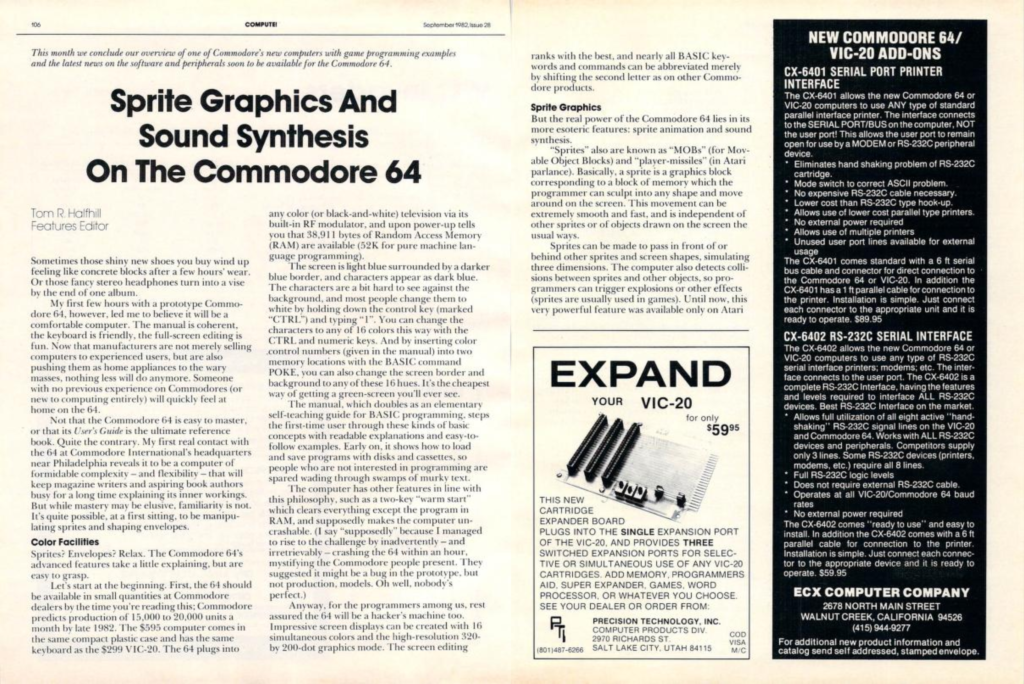
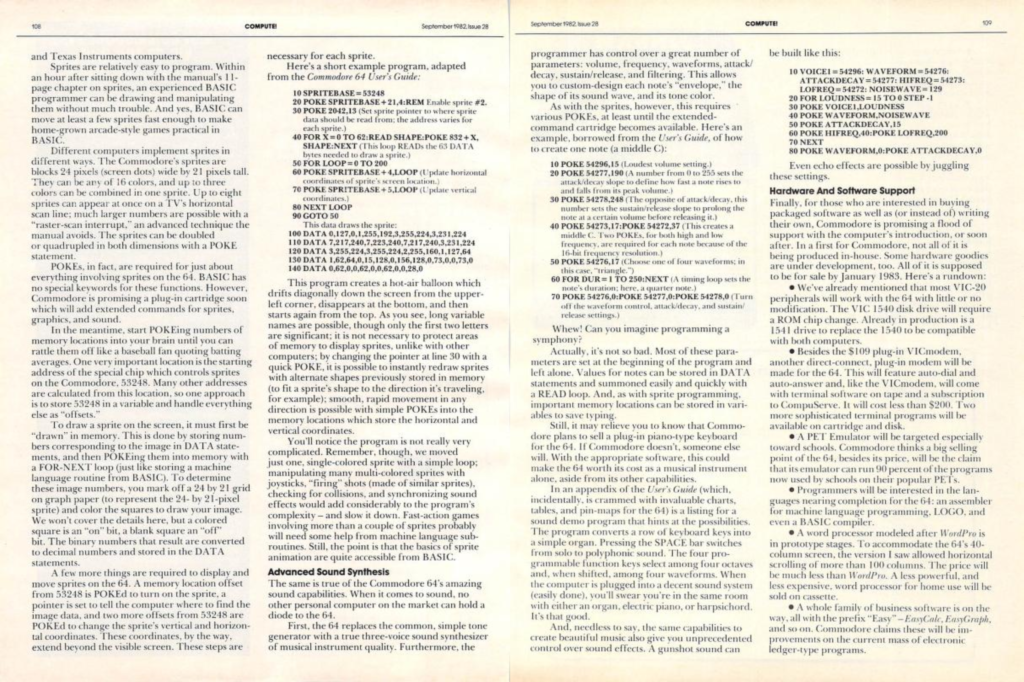
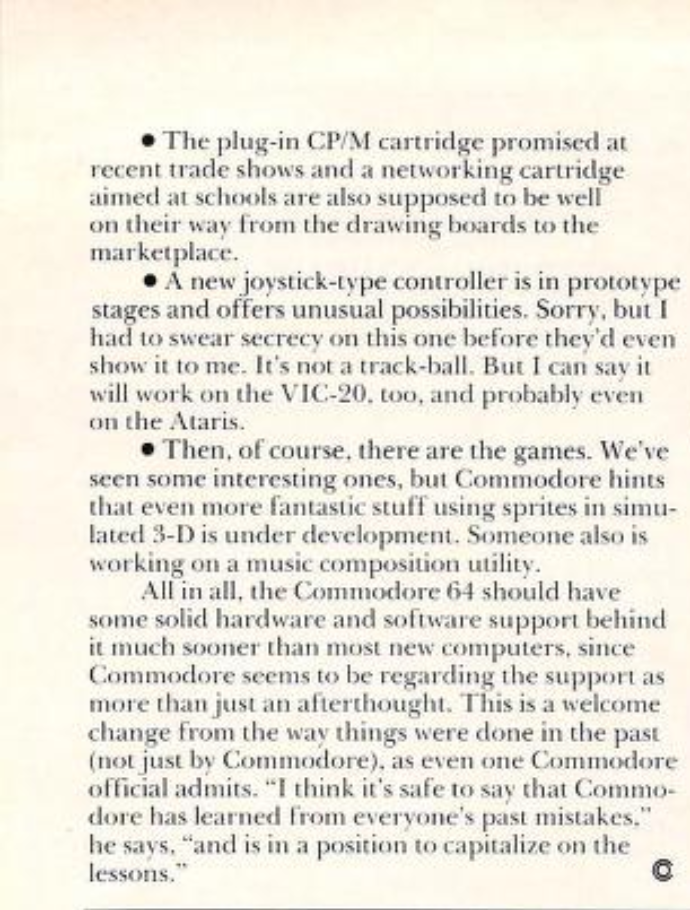
The writing on the wall for this style of magazine could perhaps be seen as early as September 1982, when Compute published an article about a great new upcoming product from Commodore, the Commodore 64. Not because of the style of the article or anything specific about the computer. Just that, by being so greatly popular, the C64 greatly expanded the magazine’s audience, which would inevitably steer it towards becoming more “mainstream,” which ultimately would be the death knell for a publication like this.

Still, it’s fun to look back on. Here is that article in image form, or you could find it on the Internet Archive, where the archives of Compute live on, for a time.

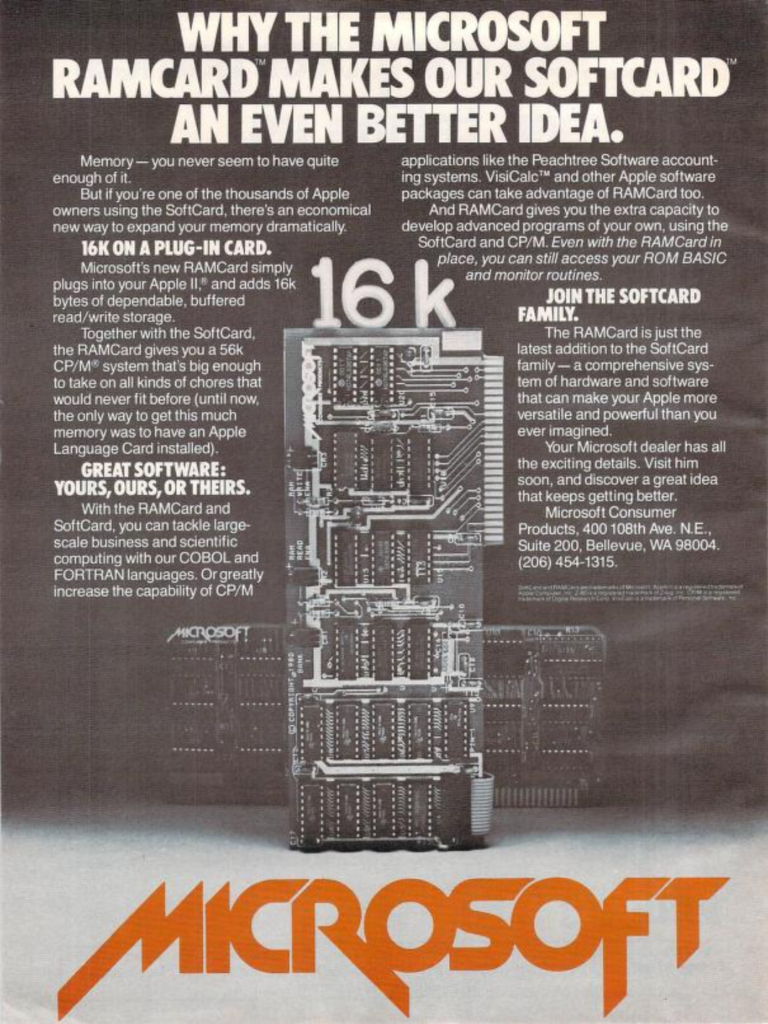
An extra, from that issue, is an ad for one of Microsoft’s first peripherals, a memory card for the Apple II: