Oh we here at Set Side B try to make all kinds of posts, but among my personal favorite kind are finding some deep dive into some aspect of a game’s inner workings and presenting it. These days, for multiple reasons (such as ease of monetization) many of these dives turn out to be Youtube videos, but not always.
Christian Hammond (Bluesky) has begun a series of text articles looking into the specifics of the implementation of Famicom/NES game Faxanadu.
To explain its name, Faxanadu’s name comes from Xanadu, an early JRPG from Japanese computer game maker Nihon Falcom. Falcom didn’t make Famicom games themselves, but they did sometimes license their games to other developers to make Famicom ports of them, or spinoffs. Faxanadu, developed by Hudson Soft, is such a spinoff. It has nothing to do with Xanadu other than being a non-scrolling exploratory platformer. Its name is a combination of “Famicom” and “Xanadu,” you see. While it’s not at all as popular as a Dragon Quest/Warrior, it’s well remembered by many.
Christian disassembled the whole game, and found out that it has three separate binary scripting languages. His series to document and explain them so far has only Part 1, which is here, but the rest are forthcoming soon.
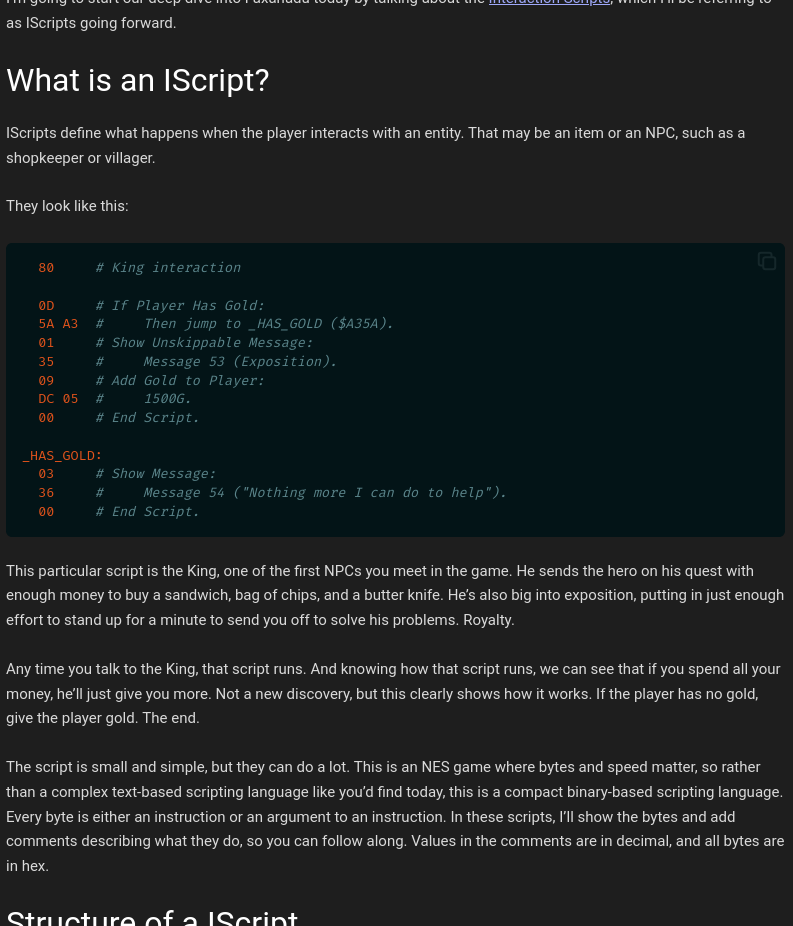
This first part explores what is possible using interaction scripts, or “IScripts,” which are run when the player runs into some object or speaks to an NPC. It’s quite easy to understand. If you have some interested in how these things are built and run, it’s worth it to take a look.