
How the C64’s Disk Drives Formatted Disks

The 1541 disk drive was infamously slow, probably the slowest of the 8-bit floppy disk drives, the result of a VIC-20 Kernal bug that was inexplicably kept in the C64 for the sake of backwards compatibility. The problem could be fixed by writing your own disk routines, which is why so many games used fastloaders.

But the bug isn’t always at fault. The 1541 disk drive takes over a minute and a half to format a disk, but as it turns out it had good reason to, and the time consumed had nothing to do with the C64’s code because the drive does all the work itself; the Commodore 64 just waits throughout the process.

Commodore History goes into considerable detail on the process here (16½ minutes). During formatting the drive wipes out all the data that had been on the disk, lays down syncing structures, writes the disk ID to every sector, puts down the directory track and sets up the Block Allocation Map (BAM), and more. It’s an interesting, if not too useful these days, exploration of what disk drives at the time had to do to make the disk’s magnetic surface usable for data storage.

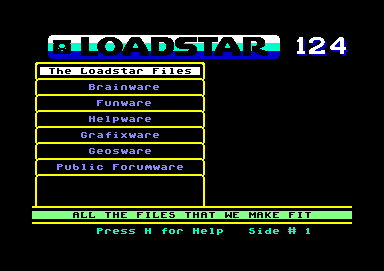
Loadstar!

Now is the beginning of a fantastic journey!

Aah that’s a screen I haven’t seen in a long long time.

1982 saw the founding of the Apple II computer magazine-on-disk Softdisk. Soon after Softdisk Publishing produced disks for other home computers too. One of them, Big Blue Disk, has gone down in history as previous employer of some of the original principals of id Software, especially John Carmack and John Romero. But another of Softdisk’s legacies was their Commodore 64 product, Loadstar, probably the longest-lived Commodore 64 software publisher. They published C64 software from 1984 to 2007. And most, if not all, of it is available online!

Loadstar is yet another of those computer gaming stories that must be told, and I’m in a pretty good place to tell some of it, because I beta tested for them for many of those years, and sold programs to them as well. Yes, several of their releases bear the programmer name John “The Mad Gamer” Harris. You have to understand, this was long before the word gamer reached common usage. In fact, as someone who may have primacy over the use of the term, I hereby forbid its use by anyone with misogynistic, anti-trans or racist intent. It is so decreed, hey-nonny-nonny!

Loadstar was lots of fun. Every month they’d send you two disks in the mail with several new pieces of Commodore 64 software on it. Under the watchful eyes of Fender Tucker and Jeff Jones, and later on Dave Moorman, it’s not that they grew an empire of Commodore programs, but they did manage to sustain that platform for a small but avid userbase for far longer than you’d have thought possible.

I plan to start doing Loadstar reviews eventually, but in the meantime, you can try out some of the later issues of this important piece of computing history at the site linked below. Note that you’ll have to have a means of running C64 software to use them, of course. The emulator VICE is known to work well. And if you want to hear the words of Fender, Jeff or Dave yourself, all three are on Facebook.

The LOADSTAR Library