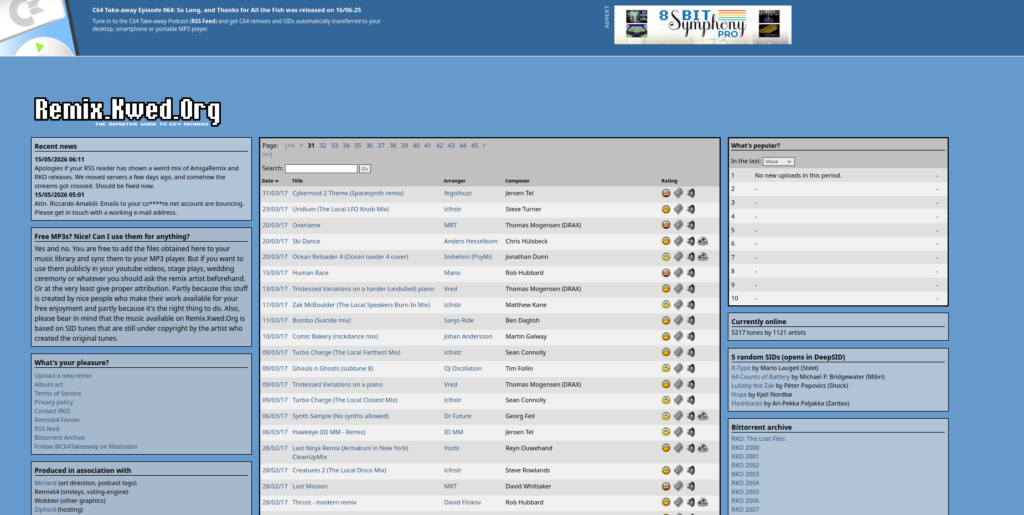
Still working on various other things, but fortunately I found out today about remix.kwed.org, which is kind of a version of OCRemix that focuses (but I don’t think is exclusive to) Commodore 64 music remixes. These aren’t also not all played by a C64, but are remixes of songs from them, so, not all chiptunes. If you need a jam to get you started, try this remix of M.U.L.E.
One of those things I mentioned is, I’m getting a table at Vintage Computing Festival Southeast 2026 in Atlanta! And they said they wouldn’t mind if I did another presentation on the history of Loadstar, so it looks like I’ll be doing that again too! If anyone reading this is in Atlanta July 31, or on August 1-2, please drop by and say hello!
Sundry Sunday is our weekly feature of fun gaming culture finds and videos, from across the years and even decades.
I find myself looking back upon the Dreamcast’s library, which was outrageously experimental. Sega tried so many things to see what would stick, but sadly few of them did, even though they’re really cool games.
There’s probably no better example of this than Space Channel 5, which I sometimes like to call “How Many Ways Can We Remix Mexican Flyer?”
Mexican Flyer is a real song, that existed long before Space Channel 5 and the Dreamcast. It was first published by Ken Woodman and His Piccadilly Brass in 1966 on their album That’s Nice. Here’s audio from Youtube (2 1/2 minutes):
Space Channel 5 remixes it several ways. Here’s the beginning, which is a fairly straight rendition. (That link was made with Youtube’s Clips feature, which doesn’t embed too well in WordPress.) Here’s the start of the second level (5 minutes):
Space Channel 5 isn’t a very long game, with only four levels, and although there’s alternate sections of a couple of levels that unlock after finishing the game and a subgoal of rescuing all the hostages, it doesn’t have a lot of replayability. It’s an enjoyable trip while it lasts, though.
It ends with a (mostly) a capella version, about ten minutes long:
And here’s the music isolated without the gameplay sounds overtop it (3 minutes):
Ken Woodman passed away in 2000, only a few years before Mexican Flyer began its video game afterlife. He also did music for a couple of British radio productions, and arranged music for Shirley Bassey, Tom Jones and Sandie Shaw.