Sundry Sunday is our weekly feature of fun gaming culture finds and videos, from across the years and even decades.
Hello. Here is a jazz cover of the Balatro song. I don’t say Balatro theme song because it only has one song. Here is the jazz cover (8 minutes). Enjoy responsibly.
That’s the title on the video. Here’s a link to it. (4 minutes) It’s played by “The 8-Bit Big Band,” and it’s pretty snazzy. Even if you haven’t heard the Mii Channel theme since your Wii left service, it’s a pretty popular piece of game music even now. The channel doesn’t post often, but they have a lot of bangers, relatively speaking.
Their video just before this one was a Klezmer version of Bonetrousle, Papyrus’s theme song from Undertale (5 minutes), with animation to boot, and that description is intriguing enough that I’m going to embed it here too.
Sundry Sunday is our weekly feature of fun gaming culture finds and videos, from across the years and even decades.
Tay Zonday was the Chocolate Rain guy (5 minutes, over 143 million views!), and his voice is still as deep as ever. He’s made a new song, (5½ minutes) with Dave Days and Gary Brolsmo, reminding us all about the long and strange journey the internet has carried us through. It’s only had 19 thousand views so far, but maybe we can do something about that?
Sundry Sunday is our weekly feature of fun gaming culture finds and videos, from across the years and even decades.
This week it’s simple. It’s easy. I won’t say it’s pure, I won’t insult your intelligence by going that far, but I will insult your intelligence with a video game music done in the Seinfeld theme song style round up. Let’s go.
Note that these are game music compositions done in the style of the Seinfeld theme. A different category would be the Seinfeld theme done in the style of different games. That I will leave for some other time.
Sundry Sunday is our weekly feature of fun gaming culture finds and videos, from across the years and even decades.
Submitted for your perusal: a version of classic game tune The Death That I Deservioli, the epic Lap 2 music from Pizza Tower that plays if you’re cocky enough to ignore the exit gate and be transported to the end of the level to escape again within the time remaining.
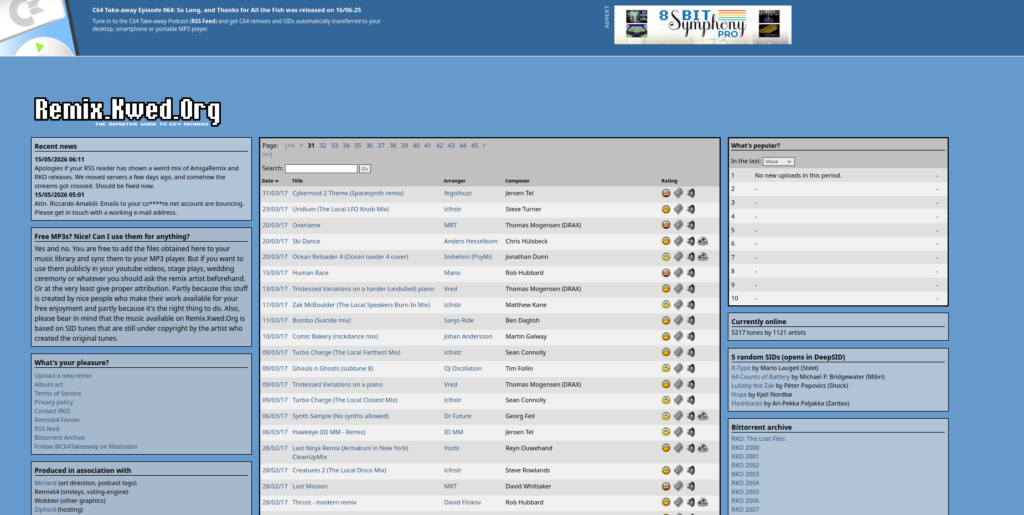
Still working on various other things, but fortunately I found out today about remix.kwed.org, which is kind of a version of OCRemix that focuses (but I don’t think is exclusive to) Commodore 64 music remixes. These aren’t also not all played by a C64, but are remixes of songs from them, so, not all chiptunes. If you need a jam to get you started, try this remix of M.U.L.E.
One of those things I mentioned is, I’m getting a table at Vintage Computing Festival Southeast 2026 in Atlanta! And they said they wouldn’t mind if I did another presentation on the history of Loadstar, so it looks like I’ll be doing that again too! If anyone reading this is in Atlanta July 31, or on August 1-2, please drop by and say hello!
Sundry Sunday is our weekly feature of fun gaming culture finds and videos, from across the years and even decades.
A comment says, Fludd was their favorite They Might Be Giants album, but that doesn’t quite work; Fludd’s from Super Mario Sunshine, the 3D Mario game after Super Mario 64.
Even so, Seanathan S has made quite the recreation. (3 minutes) No vocals, but if you know the song you can recognize the track that’s duplicating the syllables of the singing and sing along with the. Everything is intact, even down to Flansberg’s counterpoint chorus at the end.
Sundry Sunday is our weekly feature of fun gaming culture finds and videos, from across the years and even decades.
Nintendo’s latest attempt to do something with their Mii characters just hit the Switch (and along with it, the Switch 2). The game is Tomodachi Life, and while, like its real-time counterpart game Animal Crossing, it’ll take time before we really know everything it has in store, whether it’ll blow all of its content on the first couple of days of play or if it has new scenes, conversations and items that it’ll unlock over time.
Miis originated on the Nintendo Wii game system, an extraordinarily popular game that, now, seems almost forgotten. Besides the odd Wii Sports sequel and Miis, it seems like there’s not a lot of the Wii’s innovations that have persisted into later systems. Maybe games with motion controls? We know the Switch and Switch 2 are capable of them, but not a lot of games are as enthusiastic about them as the Wii.
We can set aside the question of whether that’s a good thing or not, but to interject my own opinion, Miis, one of the defining features of the Wii, really should be utilized more. Remember when the whole internet was abuzz about them? Social media would be full of everyone’s takes on recreating celebrities or comic characters with Nintendo’s limited yet oddly expressive tools. The Wii showed them off in a number of ways. The Mii Channel downloaded random Miis from other users Wii systems, and the Check Mii Out Channel provided a way to show your creations off to other users. Both of these sharing methods are defunct now, even if you have an operational Wii. They could well stand to make a come back, but who knows if Nintendo will ever think to do so.
Beyond that, there was a secret code that let you upload Miis into a Wii Remote. And now, on the Wii-U and Switch systems, you can upload single Mii into an Amiibo figure at a time, a trick I used to rescue our entire Mii collection from my Wii-U… but more on that story later.
Louie Zong, Youtube musician and comedy creator, posted a tribute to the Mii Channel a couple of weeks ago. (3 minutes) If you had a Wii, it’s certain to bring back memories. Maybe even fond ones.
With the exception of two or three musicians (They Might Be Giants among them), for the most part I’ve agreed with what Marge Simpson once said: “Music is none of my business.” (Not counting that one episode where it was revealed she had been fangirl at the height of Beatlemania.)
Because of this, I just have to assume that this 16½-minute video from Cat’s Eye and Cybershell finding many (although they admit not all) of the songs that the musicians behind the Japanese version of Sonic CD drew samples from is on the up and up. The Japanese version’s soundtrack was by (looking up spelling on Sonic Retro) Naofumi Hataya and Masafumi Ogata. They mostly don’t seem to touch the US version, which had mostly different music by Spencer Nilsen and David Young, maybe because of those many musical references. Whichever you prefer is mostly a matter of taste, and how well you can handle an intro track for a game about a cartoon hedgehog with lyrics about “leather and lace” and “toot toot sonic warrior.” (Didn’t I make a post about that at one time? A search suggests no, but I was sure I had….)
Lots of names and bands that I’ve never heard of, and songs that I’ve never heard! Look, I know, it’s a huge area to be ignorant of, but at this point I don’t feel like I could possibly do it any justice, so I guess I’ll just go back to my CD of Flood. (Starts absentmindedly singing the lyrics to Particle Man for the hundredth time….)
Extra: this Sonic Retro forum post where The Sunshine Feeler dove into figuring out who did the vocals on the Japanese version, which reveals the amazing fact that the artist who did the rap portion of the intro song, Casey Rankin, also sang the remix of the DK Rap for Smash Bros. Melee!
Sundry Sunday is our weekly feature of fun gaming culture finds and videos, from across the years and even decades.
This is the kind a strange and pointless thing that Sundry Sunday was envisioned as hosting, a guy, account name Speedbag Bard sure why not, punching a bag in time with the Mortal Kombat-themed song “Techno Syndrome.” I don’t know if I’d call it a theme song; I’m not sure Mortal Kombat has a theme song. Maybe the movie has one.
Oh, the video! It’s here (3½ minutes), uncovered by Faintdreams over on Metafilter. I like his Buc-ee’s shirt!
Sundry Sunday is our weekly feature of fun gaming culture finds and videos, from across the years and even decades.
Maybe it’s weird this has never happened before. Both Earthbound and TMBG are both very weird and fun musically, after hearing this mashup of the two it’s surprising how well the two go together.
And I’m not sure which I should be more embarrassed about, that I know all these Earthbound songs so well, or that I know a good four-fifths of the They Might Be Giants tunes from these excellent mixtures from idiokiot (25 minutes).
The dislike for me here is the title, since Earthbound is so much more than “beating Giygas,” but I admit it’s a pretty good match of TMBG’s name.
Earthbound is, of course, the classic SNES JRPG, known in Japan as Mother 2, created by Shigesato Itoi. It has my vote for the greatest JRPG of all, for while it isn’t as popular as Dragon Quest or Final Fantasy, it has a knockout story, full of wit and detail. Mother is one of the very few video game series that, I think, transcends its medium, and becomes something great, not great in the since of being better than good, but in the sense of profundity, and yet at the same time it isn’t pretentious at all, it’s light and funny and whimsical but also deep and dark and terrifying. It’s easy to play and lots of fun too. I’ve heard it described, I think it was by Ben “Yahtzee” Croshaw, as Peanuts Fights the Cthulhu Mythos, and that begins to get to it.
Animation collaborations are, of course, a thing where a bunch of people get together to make an animation together, each taking one small part of the whole. Not only do they not attempt to maintain a consistent art style, that’s in fact the last thing they try to do. Each clip is wildly different from the others, and that’s the point, the clash of styles making the whole surreal and surprising.
Both of these come together, in this piece that animates a portion Earthbound where the player is accompanied by the Flying Men, and I guess I have to explain that too.
So in a place near the end of the game your protagonist Ness visits the realm of Magicant, a bizarre realm created from the depths of his own mind. It is full of dangerous monsters, culminating in an artifact called Ness’s Nightmare, a powerful enemy that can wipe Ness out if the dice don’t roll his way.
Ness is also alone for this segment, except for the aid of the Flying Men, who call themselves Ness’s courage, helpful bird people who tag along with Ness, providing both muscle and extra hit points. But while they are strong and useful, they are not invulnerable. There are five Flying Men, and they join Ness one at a time. If one of them runs out of HP it dies, and in the house where they live, one of them is replaced by a tombstone. If you go back and recruit another one, and he also dies, then another tombstone appears. The dialogue from the successive Flying Men becomes less happy and more desperate as their numbers decrease, until finally they’re all gone, and Ness is left to finish the area alone.
This is just one example of the many wonderful ideas in Earthbound, as a unique a video game as there ever has been.
The animation that’s this week’s subject is a collaboration between many people, set to the Flying Men’s theme song, which is never actually heard in its entirety within the game. The music heard comes from a soundtrack album.
I won’t pretend it’s very comprehensible to those who’ve never played the game. Sometimes Earthbound fanwork, unlike the game, gets obtuse and navel-gazey, and difficult to understand to those not drenched in the lore. This one’s a bit like that. But maybe it’ll spark something in you, anyway. The music’s nice at least!
That’s what I have for you today. See you tomorrow!