My Experience with the Global Test Ride Demo
Acronyms:
KAR: Kirby Air Ride, the original for Gamecube.
KARs: Kirby Air Riders, the new game for Switch 2. (Note the following lowercase ‘s’.)
Who’d have thought that a Kirby game could be so vicious? If you think Smash Bros is a fun and lighthearted romp then this game will show you how perilous a Sakurai game can be. Several of the characters, even among the limited selection in the demo, are former bosses (King Dedede, Meta Knight, Magalor, Susie), so you might think of this game as them taking out their frustrations on Kirby for beating them up.
I should say that the demo was missing many items and events, this only covers elements from the Global Test Ride demo, available here. The first Global Test Ride is over, but there is another one on November the 15-16th, depending on your timezone. The full version of Kirby Air Riders is out on the 20th.
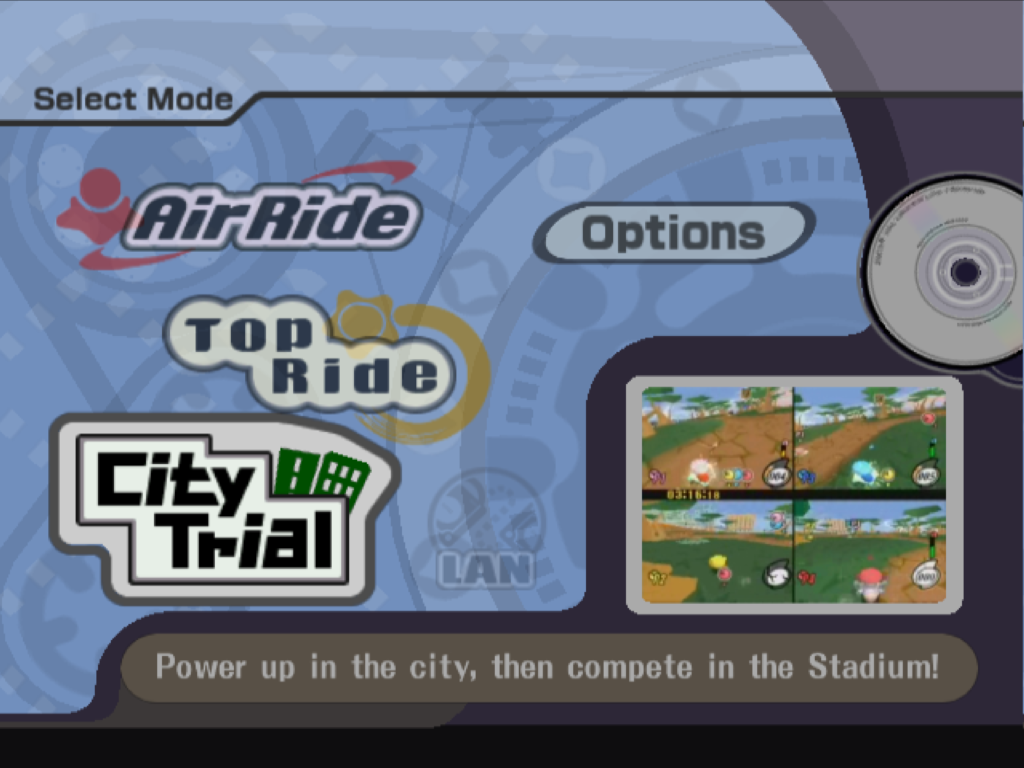
While it allowed playing Air Ride, the namesake mode, in an offline capacity, the demo focuses on City Trial, the mode everyone remembers from the original KAR. The game comes with a bunch of tutorials, and they can be played even outside of the demo period. They explain the basics adequately, so other than a bit of a recap I’ll content myself with explaining City Trial in more detail.
If you’d like to see what it was like during play, I recorded some of my adventures playing the demo and uploaded it to Youtube, here (1 hour, 22 minutes):
How it works
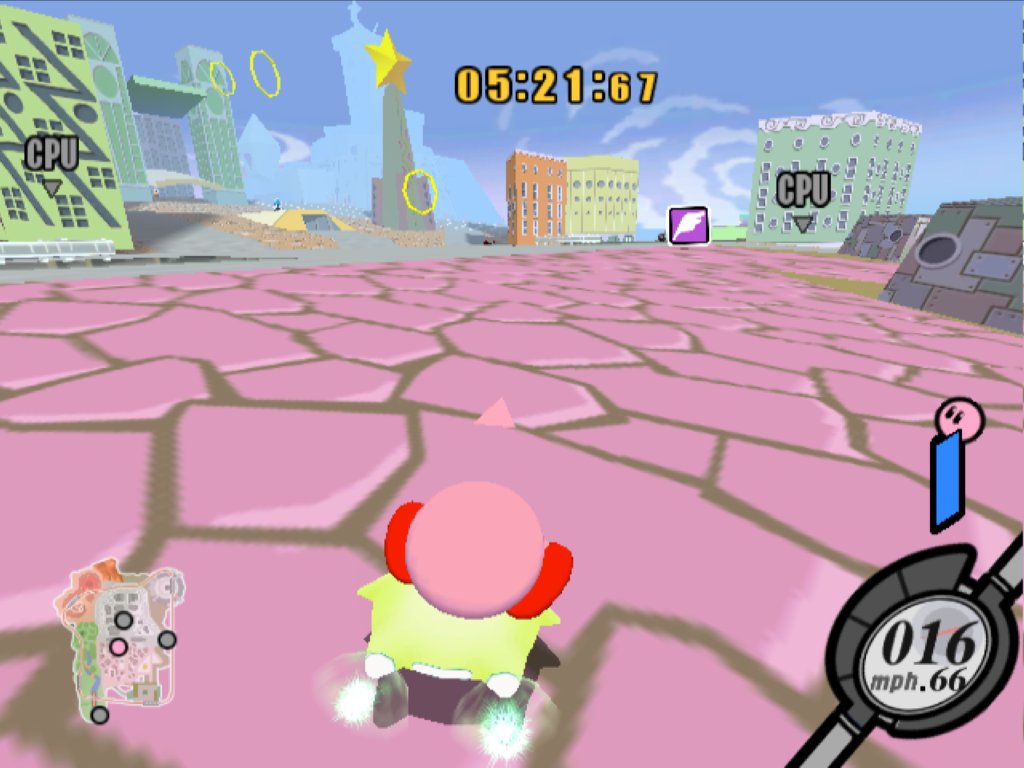
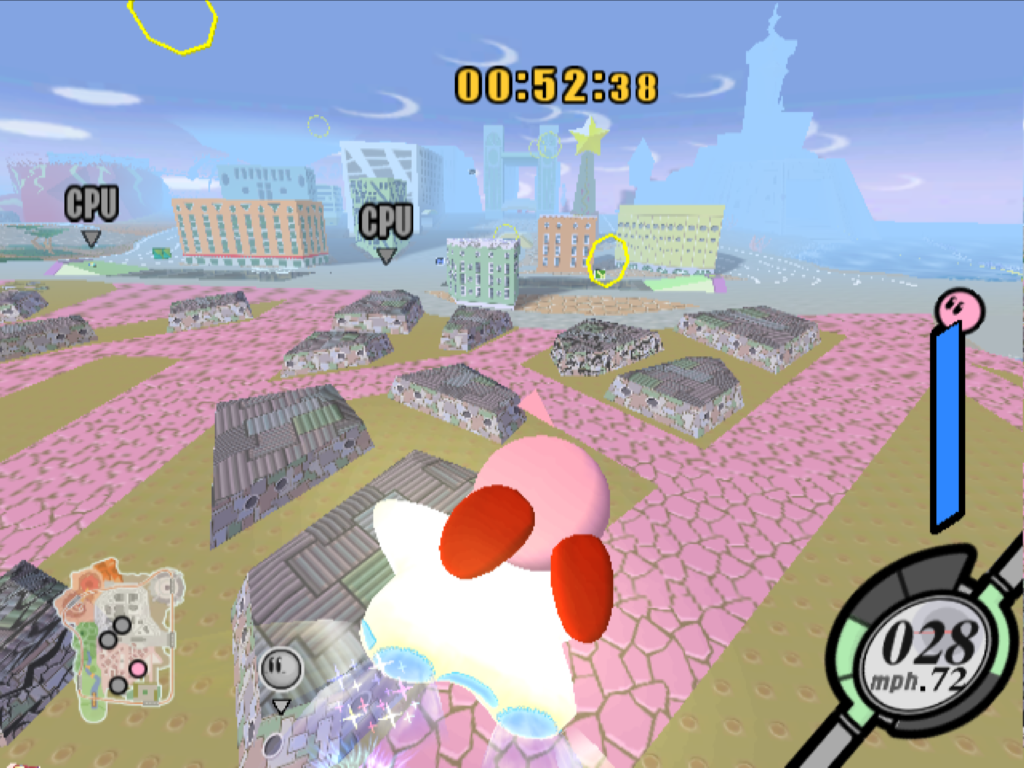
- You and up to 15 other people are thrown onto a big sandbox map, a city on Kirby’s home planet of Pop Star called Skyah. In the demo, in practice, you’ll be playing with 15 others; I never had a match with fewer than that.
- You all start out riding Compact Stars, which are maneuverable and can glide a bit, but are really fragile and have little else to recommend them.
- Rapidly move the control stick from one side to the other to do a “Quick Spin.” This is an essential move! While you can damage other machines just by driving into them at a sufficent speed, Quick Spins make it easier to do damage, and you even get a brief period of invulnerability at the start of a spin.
- You have five minutes to pick up “patches,” single-color icons that increase your stats a bit in one of a number of categories. Get as many as you can!
- There are different colors of boxes that appear. Blue boxes are the most important, as they contain both patches and food items that can repair damage. Red boxes contain Copy Essences that give you different attacks; Green boxes have other kinds of items. Only the patches are permanent. Break boxes by either boosting into them repeatedly or using the “quick spin” move.
- You can also change vehicles. Ride up to an empty vehicle and hold down the Y button (sometimes called “Special” in the game) to switch to it. You take all of your patches with you when you do this!
- While you can get off your vehicle by holding Y for a while, there is little reason to do so. You can’t even pick up power-ups while unmounted.
- You can attack other players. So, too, can they attack you, and as mentioned at the start 16-player City Trial can be incredibly vicious. Stay on your guard. Players who are attacked usually lose a patch or two. If your vehicle gets destroyed, you’ll lose a bunch of patches, although not as many as in the original KAR, where you usually lost half of your patches. By the way, when I say you’ve “died,” I really mean your vehicle got destroyed. Your character cannot be harmed.
- The city is pretty big, and has several hidden areas. Generally, the more out-of-the-way areas are safer, and have more powerups to collect.
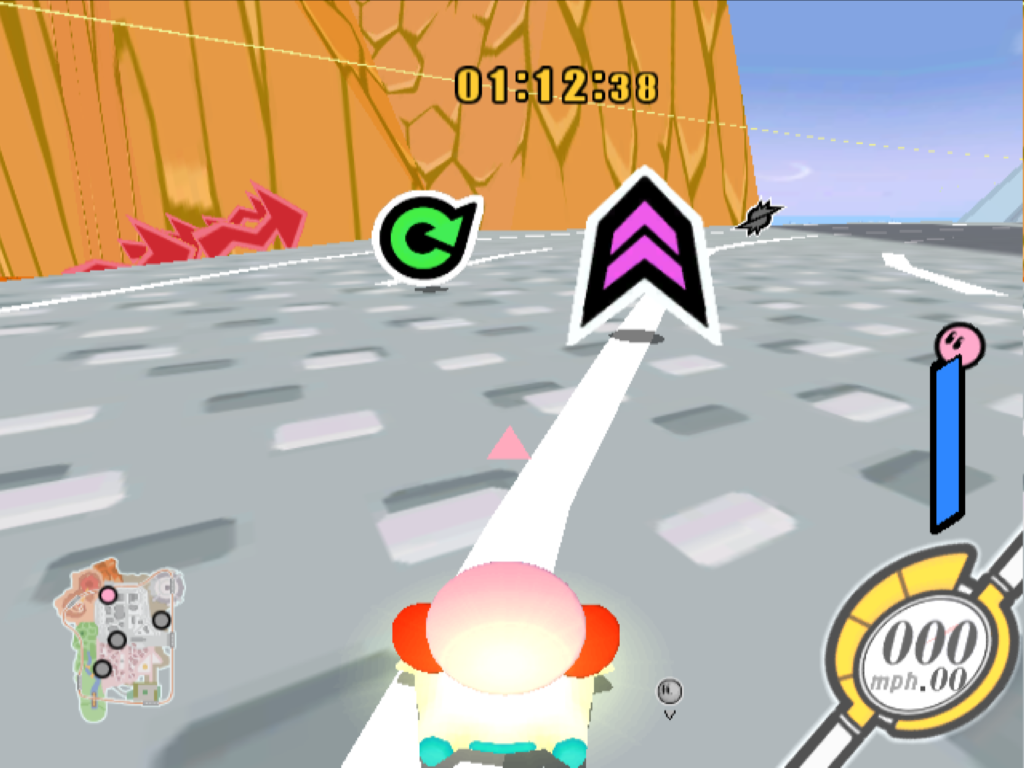
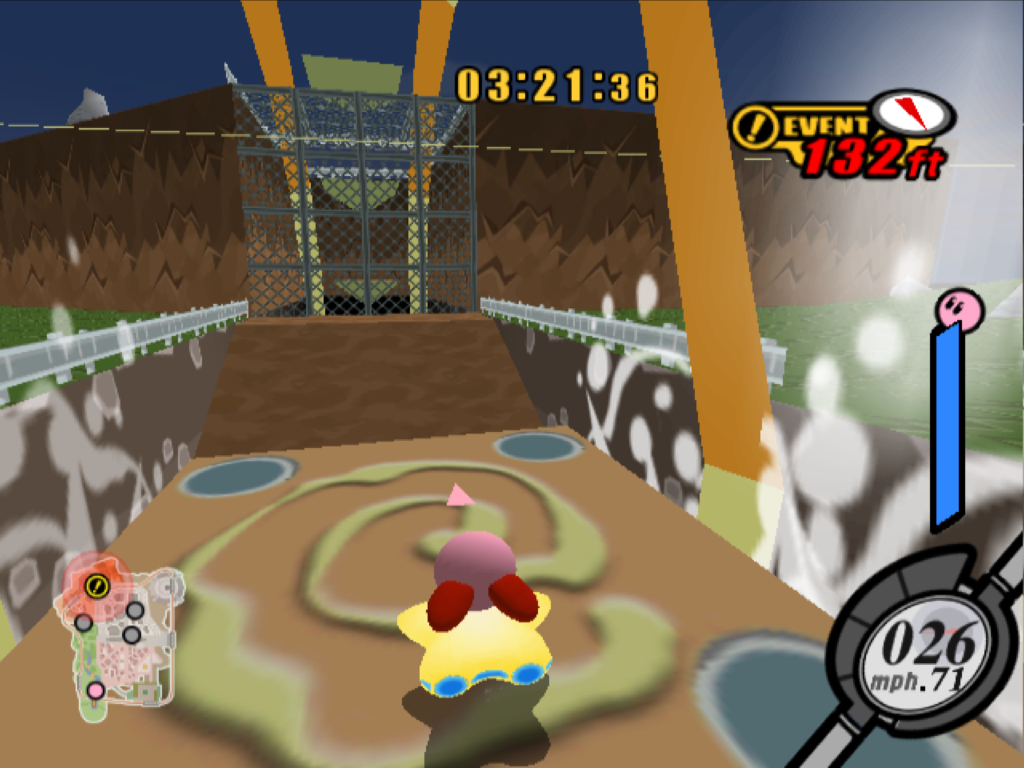
- Throughout the time period, different random events can occur. Some good, some bad, and some are just weird. If the event has some special location, an arrow will often appear around you pointing which direction it’s in.
- One kind of event is the competition event, and it’s like a minigame. You’re told a “quick race” or a “dustup derby” is about to begin, with a start location somewhere in the city. It’s up to you if you want to participate, but if you do you’ll get at least eight random patches for participating, a few more if you arrive early, and you’ll get some more if you place well. Even if your vehicle gets destroyed in the event, it isn’t permanent. If you choose not to participate you can continue to explore the city, and without the participants attacking you might come out ahead. It’s your choice.
- The purpose of all of this comes after time runs out. You’ll be given a selection of one of four “stadiums” to participate in using the machine and all the patches you’ve collected. The stadiums are all very different from each other: there are races of several types, battles, combat against enemies, button-pressing competitions, jumping contests, and even boss fights. At least one will be recommended to you based upon which machine you’re riding. Think carefully: some machines are unsuited to some stadiums. If your machine is really unsuited (a wheeled vehicle in an aerial stadium), the game will even stop you and ask if you’re sure, but it’ll let you do if anyway if you tell it yes.
- This bit is important. Each stadium is its own game: you’re playing to win your stadium, not the City Trial session. Due to this a large game of City Trial can have up to four first-place finishers. If a lot of players (more than eight) pick a stadium, it’ll be split off into two separate competitions with their own winners. If you’re the only person to pick a given stadium, you win it automatically.
The finer points
Machine choice
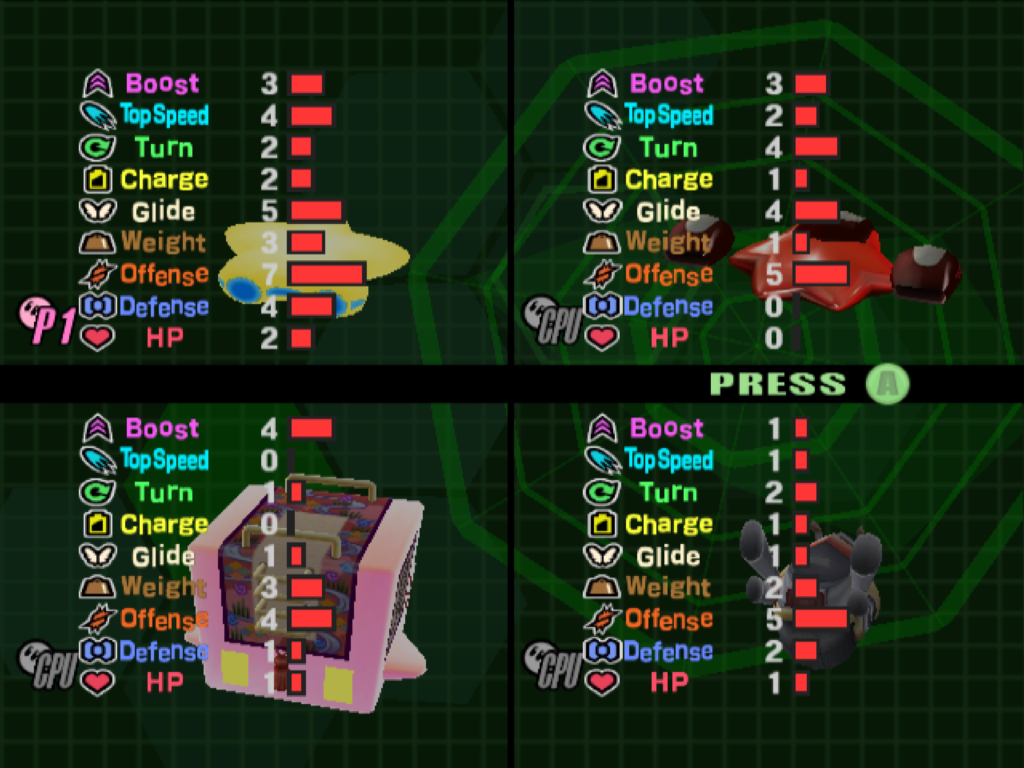
You start out with the Compact Star, which is extremely fragile. I don’t know if this is still true, but in KAR it was found to have zero defense, meaning Defense patches had no effect on it!
You’ll want to switch to another machine, scattered around the city, as soon as possible, before some of the players will pick up the stronger machines. Shadow Star is prone to being taken out in one hit, with the main compensation that the rider can do the same to other vehicles. Also, Wing Star has always been notoriously killable, and Paper Star is even more frail. All of the flight-focused machines are made of paper, figuratively or literally.
The sturdiest machines are Rex Wheelie, Bulk Star, Wagon Star, Battle Chariot and Tank. Especially Wagon Star, whose health bar can extend up and off the screen.
You can choose your character too, and that can have a substantial effect on your longevity. Throughout all the vehicles and characters there’s a general theme of lighter: easier to get killed and fly, and heavier: does more damage and sticks more to the ground.
Evasive maneuvers
Driving in a straight line is pretty dangerous. In fact with people riding Battle Chariots and Tanks roaming around almost anything you do can be lethal to your machine, but driving in a straight line out in the open pretty much paints a big bullseye on your back. The more fragile your machine, the more important it is to avoid open spaces and driving in obvious straight lines.
Try not to brake for too long, or drive into walls. This might seem obvious, but there are players that look for people driving into barriers.
Awareness
Despite all these things, you’re gonna die sometimes. Somethings that could help: look for icons at the bottom of the screen indicating pursuers. And be aware of a red border along a side of the screen: that means there’s a big danger nearby, like a bomb explosion or a Gordo.
Machine advice
If you decide to go with a flying machine, all I can suggest is being very careful. Most of them can’t take more than one or two hits. If you go with one, you’ll want to spend most of your time in the air, where it’s much easier to survive, and get your stats from the tops of buildings and flying through rings
The most important stat, as with the original, is Top Speed. Not only is it generally useful in most stadiums, but the faster you move, the quicker you can get to patches, and the faster you can grow your machine.
Unlike in Kirby Air Ride however, depending on your choice of character you might have low acceleration, a.k.a. Boost. And all drivers that have high Top Speed have low Boost, and vice versa. If you’re playing a high Top Speed character, Boost may be a higher priority for you. At least one machine, the Bulk Star, can’t move at all unless you charge it up, so the Charge patches will be more important to you.
Places
– Underground mall
No place is completely safe, but the underground areas tend to have a better ratio of reward to risk. The mall is tight corridors and little room to avoid conflict, but also more boxes than other places.
– Crystal Caverns
The crystals here can be destroyed, and contain patches. They tend to get cleared out early in each match, but it’s pretty common for one or two to be missed if you find yourself here anyway.
– Shipwreck
The lift pad in inside puts you on deck, where you can use the cannons to immediately become airborne
– Plaza
This central location has ramps for getting into the air
– Rails
Like the original, there’s a system of rails that goes around the outside perimeter of the city. KAR enthusiasts tend to call these “rail jail,” since getting on them tends to mean you’re stuck for a few oh-so-important seconds. Now the rails sometimes have a patch on them, and you can escape a rail by holding to the side for a second or two. Be careful now to fall off on the wrong side though.
– The Volcano
During the Portal event you can sometimes find a lunar landscape, which is actually beneath the Volcano! The lift pad inside it sends you way up high in the air. Is there another way into the Volcano? I’m not telling! Because, honestly, I don’t know. Sakurai says there is, but that could just be via the portals.
Events
– Meteors & Gordos
Both involve huge round dangerous things falling from the sky. You don’t have much vertical range of vision, so it’s difficult to avoid them while you’re out on the surface. It might be a good idea to hide underground during these events.
– Bosses (Dynablade, Grand Wheelie, Kracko)
Fighting the bosses is dangerous, but can be a good source of patches. As with any event that attracts lots of players to one spot, you might actually get more benefit from attacking the distracted players than the boss.
– Lots of Boxes
They all appear in one location. Again, attacking the gathered players feeding at the trough works well here.
– Portals
The game hurries you into them, but they just lead to other places in the city. As explained before though, one of them leads to the lunar chamber beneath the Volcano.
– Competition events
It’s usually a good idea to participate in the competition events even if you don’t have a good vehicle or character for it. There are two kinds: Races and “Dustup Derby” bouts that are kind of like vehicular deathmatch. Even if you lose, your state is restored afterward, and you get at least eight random patches, risk-free, just for participating.
– Secret rooms
There’s a few secret rooms in the city that are usually locked off, and only open for this event. When they open, each has several of the same powerup in it. Sometimes they’re patches, but sometimes they’re just attack items. Unlike KAR, there’s more than one secret room in the city this time. The arrow around you points to the nearest one that still has powerups in it.
– UFO
One of the few upsides of aerial machines is being able to get up on the flying saucer when it occasionally visits. There’s a lot of patches up there, often including an All patch, which increases all your stats by one point.
– Rare boxes, and Rare boxes with fakes
Rare boxes have lots of patches and few downsides. Rare boxes with fakes, though, are infuriating; opening the wrong box will inflict a lot of damage on you, and has a good chance of destroying your machine outright. If it follows a similar philosophy as KAR then there’s some way to tell them apart, but in the hectic atmosphere of the demo period I didn’t have a chance to figure out what it was.
– Treasure chests
Search the city for a key, then take it to a treasure chest for a prize. The arrow around your vehicle points the way, although the two times I spotted this rare event I wasn’t able to get anywhere near one of the keys.
– Tiny players! Gigantic items! All the boxes contain the same items! All machines fly more easily!
Some of the events are just strange happenings. At least the worst events from KAR, dense fog, fake items and bouncing items, don’t seem to occur here, or they don’t in the demo.
Priorities
– In the original, Top Speed was the undisputed king of powerups. Higher Top Speed means you can explore and find more patches faster, and most of the stadiums prioritize speed. Two things challenge Top Speed’s domimance. Bigger characters and vehicles tend to already have a good speed, but are slow to reach it; for them, Boost (acceleration) might be a greater priority. Second designer Masahiro Sakurai said in KARs’s first Nintendo Direct stated that Top Speed actually reduces your Defense a bit, which as far as I’m aware is new. Now Top Speed, while still very important, is a bit more of a tradeoff. Rider/vehicle combos with lower acceleration will want to get more Boost (which should properly be called Acceleration). Weight increases speed a little and makes you a bit more durable. Flight patches on a wheeled vehicle are practically worthless, and Flight lowers durability a bit too. Look out for the gray patches though, those are powerdowns.
– The best Copy Abilities are Needle and Sword. Both are excellent for attacking bosses. Plasma is also pretty good, and easier to use than in KAR.
– There are also special weapons and powerups. One of them, the Firecracker, has gotten a severe downgrade since KAR, it’s only got ten automatic shots now instead of the original’s 25 and so is useless if there isn’t a target in sight right away. That’s a common issuen with the powerups, but it’s especially bad with the Firecrackers.
Stadiums
Oval Course: A race around a simple course. In KAR, all of the Air Ride courses got used as stadiums, but there’s been no hint that this will happen in the new City Trial.
Drag Race: A quick trip down a straight course. While races are a bit more competitive in KARs than they were in KAR because of the new trail-of-stars catchup drafting mechanic, this still usually comes down to whoever has the best speed stat.
Beam Gauntlet: The event doesn’t mention the fact that this is a race, but through a treacherous obstacle course. If your machine gets destroyed along the way, you end up in last place.
Gourmet Race: While called a “race,” the players are actually trying to collect as many food points as they can. The winner, I think, is usually the one who knows how to get extra food on top of the buildings, instead of grubbing the ground grub with the other players stuck down there.
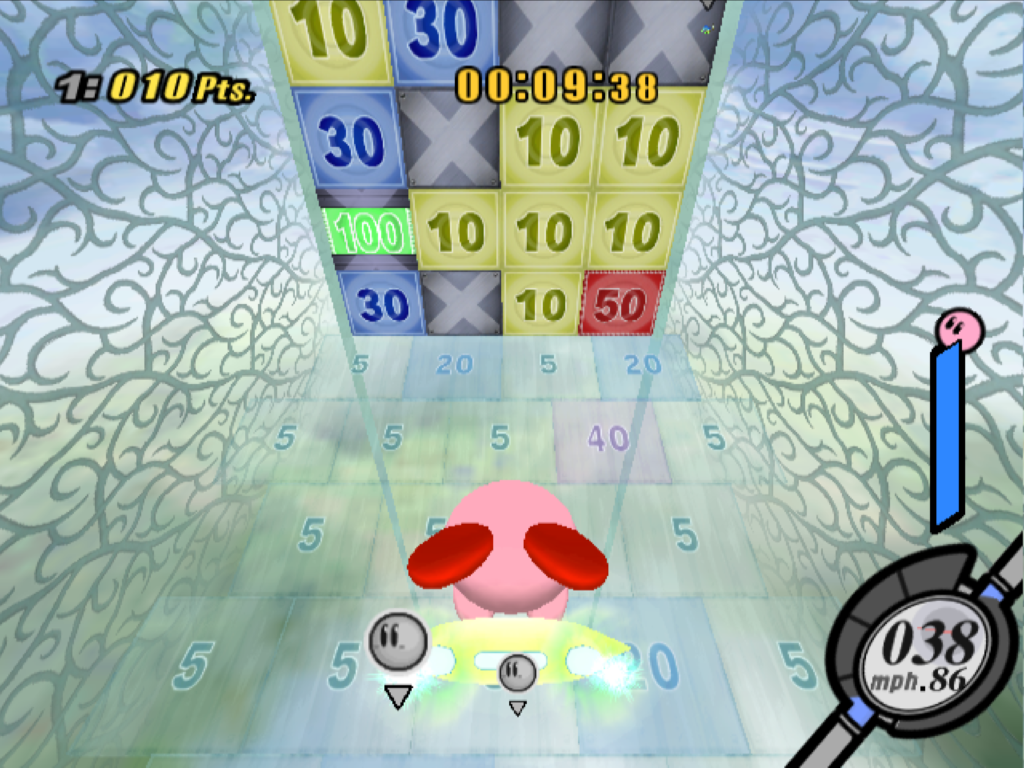
Target Flight: A good event for upsets, if your vehicle has enough airtime to make it to the target board you might earn up to 100 points. This event gives you two tries to get the best total score.
Skydive: Also prone to upsets, this is my favorite of the new stadiums. Use the boost button to plummet down through the target rings, and find the highest-value landing place you can. You get a time bonus for finishing quickly, so even if you somehow end up here with a non-flying vehicle, you can get a good basic score by just plummeting down as fast as you can.
High Jump: Use a ramp to jump as high as you can. This one is mostly a stat check: how good is your flying power?
Air Glider: Use a ramp to jump as far as you can. While also a stat check in essence, at least in this one you have to strike a balance between forward speed and height.
Dustup Derby: a version of the “deathmatch” event from the city. If your machine gets destroyed you get another one, letting you stay in the game (but also letting the other players kill you again for another point).
Kirby Melee: the players are put in an arena with a cloud of basic enemies, many with copy abilities, and compete to defeat as many as they can. I found the Needle copy power to be very helpful here, if you can snatch up an enemy that has it.
Vs. Boss: A co-op event where all the players work together to defeat a bit enemy. The only boss in the demo is Robo Dedede. If you don’t work hard at attacking it you won’t win, although the players get ranked either win or lose. Quick Spins won’t cut it: you’ll need to use the powerups that appear in the arena to have even a slight chance.
There was also stadium where you tried to change more buttons to your color than the other players, and another battle event where there are powerups that make you huge and extra powerful. I’m pretty sure there will be more events in the full game than featured in the demo.
References:
Kirby Air Riders Direct #1 and Kirby Air Riders Direct #2