We love it when we find weird and unique indie games to tell you all about! Our alien friends to the left herald these occasions.
Less a game than a puzzle, and not so much runnable software than a website, enclose.horse is a very nice thing to spend a few minutes of your day, each day, on.
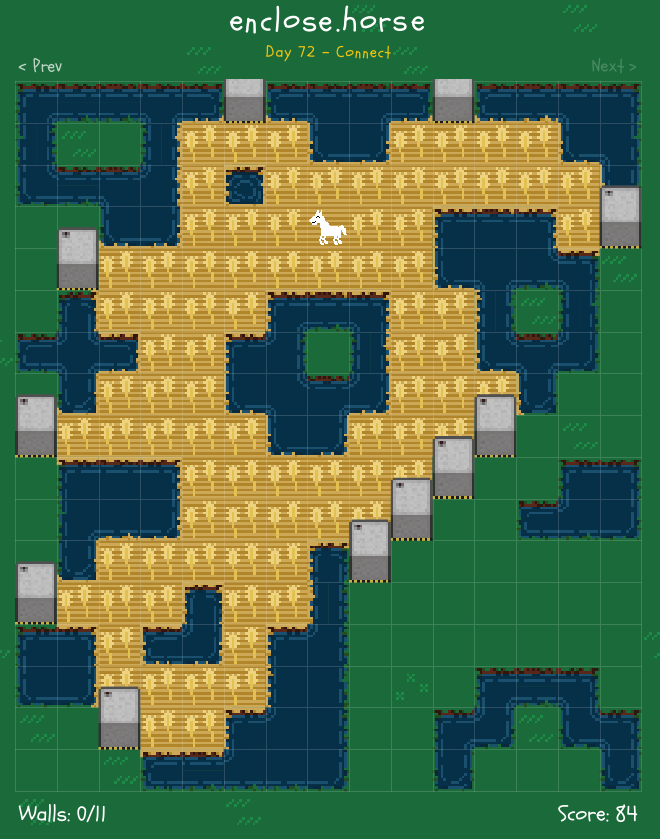
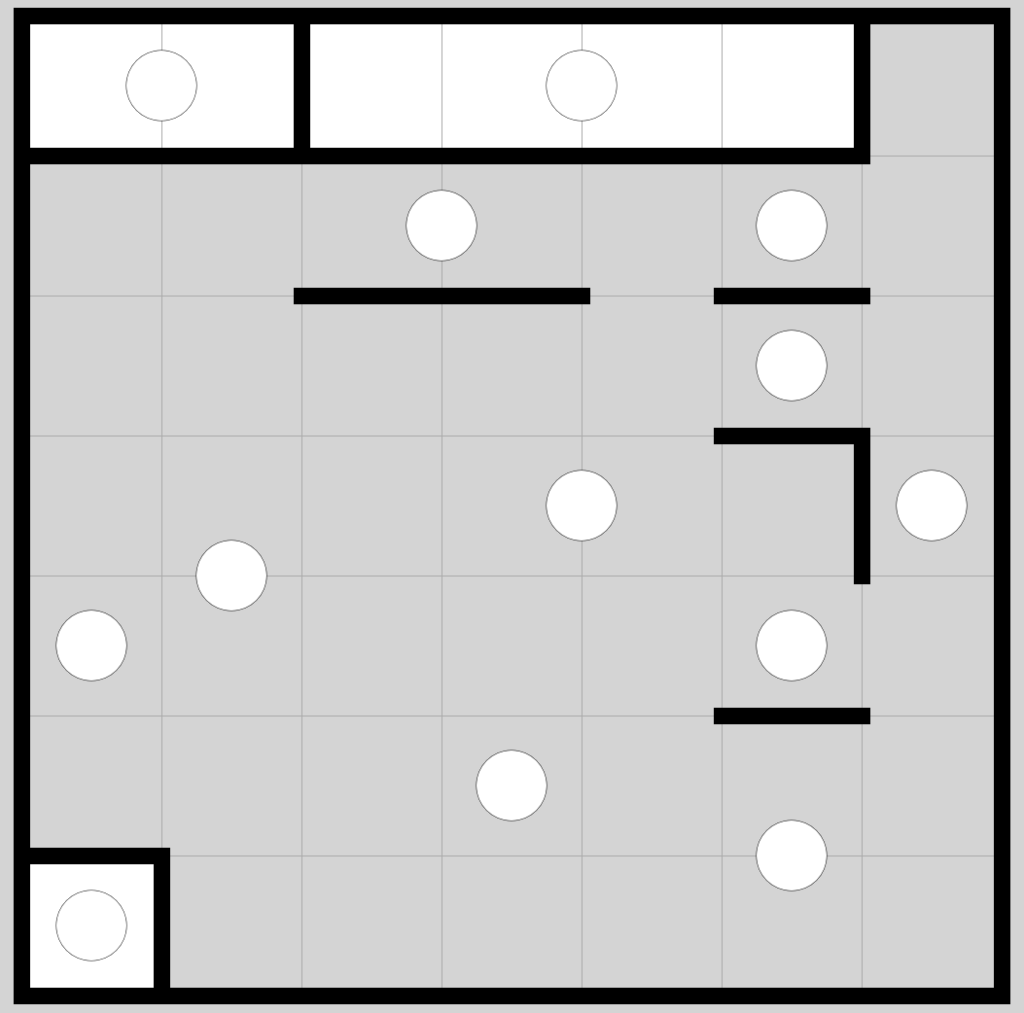
Every puzzle is a map of a field, with an arrangement of lakes and a horse somewhere in it. You have a number of square blocks to try to completely surround the horse. The horse does not like to be surrounded (click on them to get their opinion), so the more space you can enclose the horse within the higher your score.
When the horse is surrounded, a field of wheat springs up to show you how much space you’ve left the horse. Each space of wheat is one point. Some puzzles have cherries on the map, and also enclosing those is worth five bonus points. There’s also Golden Apples, they’re worth ten points. There’s bees too, trapping the horse with those is five points off your score. And there are pairs of portals, which count as an additional avenue of escape for Horsie that you must also account for.
This is not the perfect solution to today’s enclose.horse puzzle. Can you see how it could be improved?
The puzzles vary in difficulty. It’s usually easy to score at least something, but your true aim is for an optimal, perfect score. When you submit your score (you only get one try!) you’re told what the perfect score is and shown a solution that earns it. You can also browse past puzzles and see how well you do at those, create your own with a simple editor, and play other users’ puzzles.
The site continues to be worked on. Up until a couple of days ago there was a Check button, that you could use to find out what a puzzle’s perfect score was, so you could keep trying until you achieved it. However that introduced a bit of reluctance to submit anything that wasn’t perfection (it certainly made me a lot less likely to submit a score), so in the past couple of days it was removed, and that was probably for the best.
Give it a shot, while it’s harder than you’d think, it’s also not usually very hard. I think you’ll like it.
It’s a scary yet hopeful time for web media. As it must periodically, the hard fist of capitalism has let a number of very talented individuals slip out of its grip, and they’ve started their own little ramshackle internet presences to try to slice themselves out a sliver of the money pie.
Here I present six such groups. Some you’ve probably heard of, some you may not have. I am essentially on their side, but I also have to be on my own side, which is frankly impoverished. There is no way I can subscribe to all of them simultaneously. I figure, few of you can either. Maybe, by explaining their offerings and what they’re about, I can help you to come to a better decision. Maybe by doing so, I can help myself too.
Of course it doesn’t take much for a small group of hopefuls to stake out a tiny claim on the digital frontier, and I’m only covering the names I know of personally here. Hence the word “partial” in the title. If you know of some other small, worthy group that the world should know about, please leave a comment on this post! No spamming please. Speak personally and sincerely, and I may check them out and report back later. (No promises. My project list is long.)
Note 1: I try to report when these places have homepages, Youtube accounts, Patreon pages and Bluesky accounts. Many of them have Twitter accounts too. Will I tell you about them? NO.
Note 2: I performed a test with all these sites. I logged out, deleted site cookies, turned on a VPN, disabled my ad blocker and checked how obtrusive were a site’s paywall to a new user. The results are part of the notes below.
Note 3: I do complain about paywalls below. I have a very limited income, I can’t afford to subscribe to every place, and paywalls make sections of the web basically inaccessible to people like me. If I am to be honest about my perspective in my writing, I must complain about paywalls. I try to be as understanding as I can, and I do subscribe to some of these sites (currently Aftermath, Second Wind, and a trial for Defector). It used to be viewing ads could help out a person like me, but as ad partners have sought to extract more and more profit with autoplaying videos, maddening overlays, invasive user tracking, and sometimes outright introducing insecurities into page loads, blockers have become essential kit to the serious web user.
(There used to be a site, Project Wonderful, that was run by Dinosaur Comics creator Ryan North, and prided itself of serving useful, unobtrusive and safe ads. It was a personal project of his and eventually he had to shut it down. I think it’s still a niche that needs filling.)
DEFECTOR
When? – Founded September 2020 Who? – Webugees from Deadspin What? – Sports reporting and general culture. Cost for full basic access – $8/month, $79/year. $12/month or $119/year also gets you a daily newsletter with “exclusive content,” and access to extra episodes of the podcast Normal Gossip. There’s also a Richie Rich tier at $1,000/year. (Let’s band together and make calling silver spoon levels Richie Rich tiers. Well, I’m going to do it anyway.) Notes: The Defector is the oldest of the new indie media groups listed here, getting well ahead of the curve by getting fired from Deadspin in 2020.
I want to like Defector, a great deal. Wait I introduced this the wrong way: I do like them! They’re the ones on this list with the most buzz and good will behind them, from the virtue of their quality and their writing. Sadly, their main bailiwick is sports reporting, and I bounce hard off of that. They have other content too, and that content is one of the reasons they’re no longer with Deadspin. I still tend to subscribe to them if they have a free or low-cost trial going (which is the case at this moment). But it’s a plain fact that the major part of their output is sport-related.
Lots of people like sports, and a lot of sports people liked Deadspin before the exodus, so I think they won’t have trouble keeping the lights. Completely logged out and IP-masked, the paywall kicked in after the fourth article read, I assume in the month. That seems fair to me, although if I link a page from them on social media, it means some people won’t be able to read it.
Defector has a website, podcasts, a Bluesky account, and a great little addition, a weekly crossword puzzle, although I haven’t done any due to the fact that the worst clues in any crossword puzzle are those involving sport. Defector also has a Youtube channel, but it hasn’t had many posts in the past year. Maybe they’ve ceded that space to Secret Base (see below).
AFTERMATH
When? – Founded November 2023 Who? – Webugees from Kotaku What? – Culture and review, mostly of video games but other things too. Cost for full basic access (read all articles, all podcast episodes) – $7/month, $70/year. They have a $10/$100 tier for commenting privileges—a lot of these sites hide commenting or Discord access behind a higher-level tier. There’s a Richie Rich tier at $999. Notes: Aftermath has the star power of nearly everyone who used to be popular at Kotaku behind them, and seems to subsist on their name recognition. Those names are: Luke Plunkett, Nathan Grayson, Riley MacLeod, Gita Jackson and Chris Person. Aftermath has generally good gaming and related topic content, and harbors an affection for the oldweb, which endears them to me, despite the thing I’m about to mention. Ahem.
Aftermath appears to paywall all of their articles with no freebies, which is annoying, even to people who subscribe (like me!), because it makes sharing links from them hard. Aftermath has a website, podcasts, an RSS feed, and is on Bluesky.
SECOND WIND
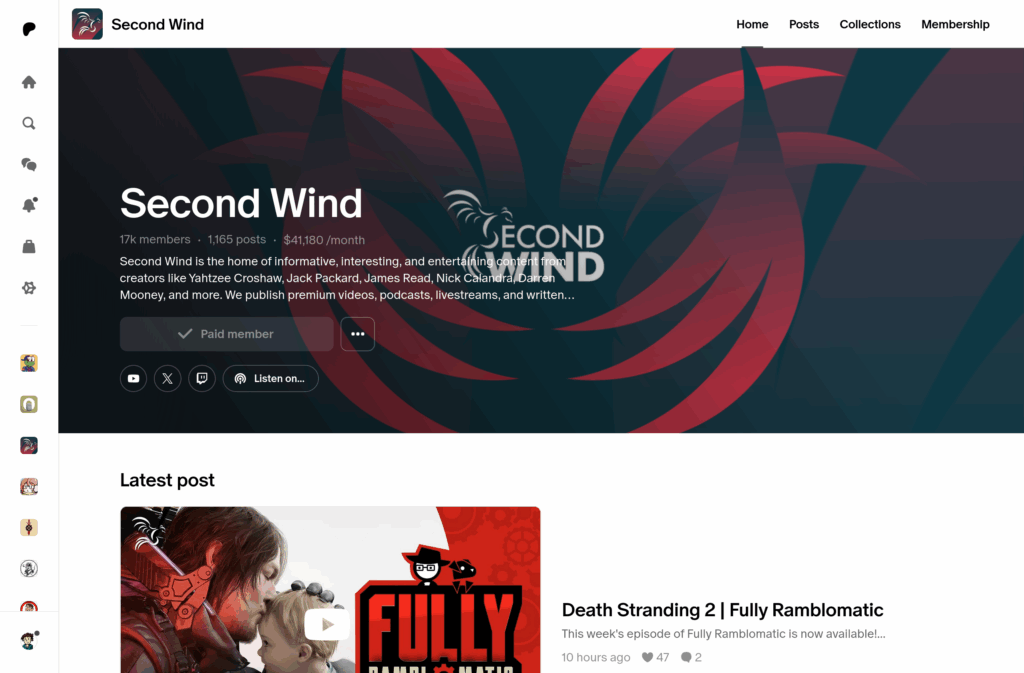
When? – Founded November 2023 Who? – Webugees from The Escapist What? – Video game culture and review Cost for full basic access (all posts readable) – Through Patreon, $5/month or $54/year. This means all premium videos. Higher tiers are $25/month (gets you a digital artwork each month) and $50/month (hang out with the Second Wind folk in a monthly Discord meeting). Notes: A lot of these new wave pop media groups have a somewhat fuzzy focus, but Second Wind sticks pretty closely to video games. This is where Ben “Yahtzee” Croshaw went, leaving his long-time series Zero Punctuation to make a close copy of it called Fully Ramblomatic.
The story of the internet is that it’s really hard for an independent content creator to make a go of it without a leg up from someone, somehow. Yahtzee’s was nominally from The Escapist, but truly he hit it big back in the days of Big Blog, from several high-profile links including from Boing Boing. Second Wind has, in turn, gotten a lot of juice from Crowshaw’s star power, but they have other things to offer too.
A weird thing about Second Wind is that they don’t have a website of their own, but they are on Youtube and Twitch, they have a Patreon, and they’re on Discord. That seems to be it; if they have other avenues of output, their lack of a home site makes it difficult to find them. Hey! SW people! It’s not hard to make a basic website! Consider it! RSS would also be good! They are on Bluesky at least. They have “podcasts,” but only distributed as part of their Youtube channel, which is not what a podcast is.
404 MEDIA
When? – Founded August 2023 Who? – Webugees from Motherboard What? – Reporting and commentary on technology and the internet in general Cost for full basic access (all posts readable) – $10/month, $100/year. That’s high, comparatively. There’s also a Richie Rich tier at $1,000/year. Notes: 404 Media lists their people at Jason Koebler, Emanuel Maiberg, Samantha Cole, and Joseph Cox. As purveyors of general tech writing, they have a pretty broad remit. Judging by their headlines they have been fervent crusaders against the “AI” slop industry.
404 Media engages in paywalling and modal subscription ad overlays, but doesn’t paywall as much as Aftermath does. If you go to their site to see what they’re about without a subscription, depending on the article, you might be allowed to read the whole thing, or you might be cut off after two paragraphs, or it might just be denied entirely. I never got ads, even with my ad blocker off, despite a tiny link marked “advertisement” in some empty spots on pages. (I’d consider adding an ad blocker exception for 404 Media, but it doesn’t seem to matter either way.) 404 has a website, an RSS feed for paid subscribers (info here), and an ad-supported podcast with a paid version with more content.
SECRET BASE
When? – The SB Nation Youtube channel was renamed to Secret Base in August 2020, but content that would be part of this was made as far back as 2017 and earlier. Who? – A portion of the people at SBNation, particularly Jon Bois What? – Articles and videos, 90% related to sports Cost for full basic access – Through Patreon, $5/month, that gets you early access to their wonderful videos. A $10/month tier gets you some unnecessary niceties. If you can’t afford it, their videos appear on Youtube eventually, months later. Notes: Secret Base is legendary* for making sports videos of interest to non-sport enthusiasts, a trick they picked up from probably their most prominent creator, Jon Bois. Secret Base has a Patreon and a Bluesky account. They take the monetization tack of releasing their videos on Patreon months before Youtube. I figure that’s not a bad strategy in this difficult era. Secret Base’s Youtube videos are highlights, not just of Secret Base but of all of Youtube, including Dorktown, Pretty Good, Weird Rules, Chart Party and Fumble Dimension. Secret Base doesn’t have a top-level domain site, but they do have a sizable subsite at SBNation and that terrific Youtube channel.
* What do I count as legendary? What I hear a lot about them from other places, notably social media and Metafilter.
DUMB INDUSTRIES
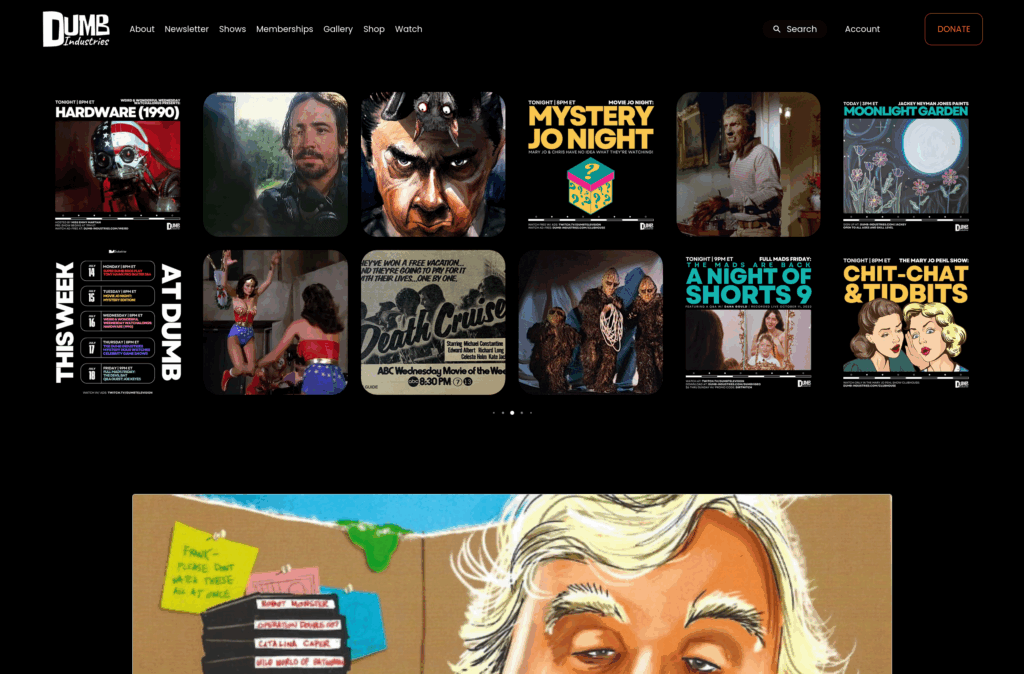
When? – Signs suggest that it began to offer content apart from the Maximum Fun network in 2020 Who? – Teevee-ugees from Mystery Science Theater 3000 and some others What? – Comedy videos and livestreams Cost for full basic access: They offer five memberships to different products. Three of them are free for basic access, but all have at least one paid tier. For the free products, throwing them $2/month gets you access to archives. The paid-only memberships are $5/month (Mary Jo Clubhouse) and $15/month (Jackey Neiman Jones’ Art Lessons). Subscribing their Twitch stream to remove ads is $7.99/month Canadian, which as of this writing is $5.83 US. (With an Amazon Prime subscription you get one free Twitch subscription; even though it’s part of “Prime Gaming,” Dumb Industries only streams games once in a while.) Notes: I’ve followed Dumb Industries for awhile and I think it’s worth including them. They show a number of comedic segments: movie and shorts riffing from Frank Conniff and Trace Beaulieu, 70s video streaming and commentary from Mary Jo Pehl, art lessons from Jackey Neyman Jones, a new riffing show, Movies Are Dumb, with Chris Gersbeck, and a variety of things under “Odds & Ends,” which are offered with any membership. They have a website, sell videos for stream and download from Vimeo, and have both a Twitch and a Youtube channel. Note that a portion of their gig is selling videos, which are not available on demand unless purchased.
I think you might find it interesting or useful or entertaining, or some combination of the three, to have a list of interesting gaming websites to look through and follow. They’re all pretty cool; I’ve tried to weed out some that don’t update often, but sometimes the content on the site overrides that.
The three big indie gaming sites at the moment are Second Wind, the newly-liberated Giant Bomb, and Aftermath, even if they do annoy me greatly whenever they call blog posts “blogs.” I feel like they do it on purpose, or something. Take note that currently Second Wind does not actually have a dedicated website of their own; their internet presence is on other sites and services, especially Youtube and Discord.
Two sites I suggest avoiding are Kotaku, which is run by soulless drones, and, whenever possible, the vast array of Fandom.com sites. This is often not possible, as lots of people use them for free site hosting, but it’s frequently the case that Fandom doesn’t have its users’ interests foremost on its mind, and if a wiki creator decides to leave Fandom for green pastures, you’ll often end up competing with your old site, and it’ll come in ahead of your new site in Google searches for a long time after, maybe forever, because of their strong search engine optimization. Notably the Nethack Wiki had to fight against the ghost of their old selves for a long time, and the Fandom version of the site still, after over a decade, comes up in the first page of Google results. (A useful browser extension for Chrome and Firefox is Indie Wiki Buddy, which marks search results that turn up Fandom sites, while not removing them entirely in case they’re the only real option.)
Some other useful sites:
The Cutting Room Floor, of course, is an amazing resource, bringing together development information on thousands of games.
Hardcore Gaming 101 may be the website with the most complete information on all kinds of video games that exists, other than Wikipedia of course, and WP prioritizes general audiences, not enthusiasts.
Gaming Alexandria is preservation-focused, and hosts scans of old gaming and computer magazines, including scans of Japanese type-in computer magazines, a category that has not been well-preserved in the West despite some programmers having moved into mainstream commercial development after having gotten their start with magazine publishing.
Game Developer Research Institute collects information on a vast array of companies and hosts a number of interviews with classic gamedevs too. They also keep an informative blog (being, a series of blog posts).
Computer Archeology updates but rarely, but has useful information on several classic arcade games. They’re the site that figured out the cause of the long-standing arcade Galaga bug that sometimes cause the enemy insects to stop firing.
We’re now moving into the category of personal sites, but don’t count them out because it’s mostly one or two people who make them!
Donnie Hodges’ Website doesn’t update often, but has such a wealth of info that I can’t leave it out. Note that Hodges has come out as non-binary, but their site still keeps their pre-transition name.
Gaming Hell is lots of fun, and has old-school web design that reminds me of the ancient |tsr’s NES Archive. Their linklist was the source of several sites, in turn, in this list/
Finally, more out of a sense of memory than anything else, there’s Press The Buttons, home of the blog and podcast of my late friend Matthew Green, currently still on the internet. I don’t know what will happen to it now that he’s gone. He wasn’t the only host of the Power Button podcast. I hope the surviving members keep it going. If they do, you should follow it, too.
It’s April 1st again, and I’ve taken to doing a change of pace post on this day every year. Two years ago, it was a plea for returning to the old days of the web, or at least the good, rose-colored parts of it. Last year, well, I forgot last year.
I want to return to the subject of the OldWeb. It is certainly true that it was fairly exclusionary, the home of a lot of sexism, and a bit of racism (although, I think, not as much as recently, at least not overtly). But there was also the feeling that, if you just went out and created something silly and wonderful, that it would find its audience, somehow.
If you go out looking for lists of old websites, you might happen upon this one. Don’t follow it yet: it uses a word that it probably shouldn’t, and you shouldn’t take this link as an endorsement for that. The reason I link it is that it’s a big long list of fun websites.
I checked through the list, and something like 95%, 19-in-20, of them are broken links, completely different sites, or squatted domain names. There are a handful that survive, but they’re in the minority. So it goes. Someone who cares could possibly hunt up old archived versions from out of the mighty Wayback Machine.
Many of the links, well, not many people will weep for them, but there was one site in particular of which I rued the passing: the homepage of Furnitures, the Great Brown Oaf. This guy:
Hey kids, it’s Furnitures! The Spongebob who never was!
Have you ever seen such a charming drawing? Don’t answer that: you probably have. But I think there’s a lot to like for this creature-thing. His coarse fur, his too-wide smile, and his vacant expression.
Furnitures is the star of a children’s show, called Furnitures the Great Brown Oaf. It is a show that doesn’t exist, has never existed, and unless the nature of the world changes substantially will probably never exist. Despite these facts, a person called Henry Stokes created a fansite for it.
Somewhere Henry called the show “slightly demented,” and that fits. In its backstory, an “anonymous philanthropist” found Furnitures (actually a sea mammal) in his travels, and was so charmed by it that he captured it and dragooned it into hosting a kids’ show, despite the fact that Furnitures is only vaguely aware of its surroundings.
Furnitures was last seen on the living internet in 2009. But… on the site was an email address for its creator. And I tried emailing that address. And surprisingly, I got a response. Henry Stokes is not only still with us but he answers his email!
I told him of my fond memories of the (very weird) website, and asked if I could revive it. And he said yes!
So I have. I have dredged up the files for the fake-fansite for fake-show Furnitures, the Great Brown Oaf, removed the edits made by the Internet Archive, further modified them to (slightly) adhere to modern web practices, and put it all up on Neocities, a wonderful free host for silly little web projects like this one, in the mode of late, lamented Geocities.
If you want to have a look, just go here! You might enjoy it for a few minutes! Maybe the obsession will, like a contagious disease, leap from me to you, and the legend of Furnitures will live on! Someday, when Henry Stokes and I are gone, and Neocities has shut down, as it someday must, maybe one of you will remember this site, and revive it again. It’s already the first hit on Google for “Furnitures the Great Brown Oaf,” whereas before it was mostly sites selling housewares.
If we work together like this, Furnitures the Oaf may have a lifetime longer than any of us. This Great creature will grow and, have a reality greater than any human being, which would be an awesome thing for a totally made up being to be.
So please, follow my link, and let the invented Oaf and his friends live in your brain, as it does mine. Despite his size, he doesn’t take up much room.
Yetso the Fiend, a pirate, who has a baboon for a heart. (The character does, not the actor who plays him.)
It’s true. It’s meant for things like WiFi login pages and displaying online manuals, but it doesn’t have a field for entering URLs yourself.
Seems unfair to me, but I suppose they thought everyone has a smartphone these days. (Until recently, I didn’t!) And I understand the web browser was a persistent security hole for the Wii-U. So while they include a web browser in the Switch for those reasons, it’s locked-off from the users. It’s still a security risk, mind you.
Now, a weird thing about the Switch is it’s multitasking system. The OS reserves a large portion of its memory for an “applet.” This is one of a number of system programs intended to provide a number of services to the user and running game software. Each of the round button options on the Home menu starts up an applet. The eShop is an applet. The system keyboard is an applet. And the web browser is an applet.
One thing about the applets is only one can run at a time! Games can actually run in the background while the Home menu and an applet are open, but if a game calls upon the system keyboard to enter text, then you go to the Home menu and open something else, the keyboard will stop. When you return to the game, it’ll have to be restarted.
We love it when we find weird and unique indie games to tell you all about! Our alien friends to the left herald these occasions.
Some of you may remember seeing, from a while ago, a clever hack that implemented a series of interactive puzzles on a website. If you didn’t see it, or don’t know much about how these things usually work, you might not think much of that, we’ve all been playing web games for two decades now, and an entire web platform for them (Flash) has arisen and died in that time. It now has an updated version, with new puzzles to figure out!
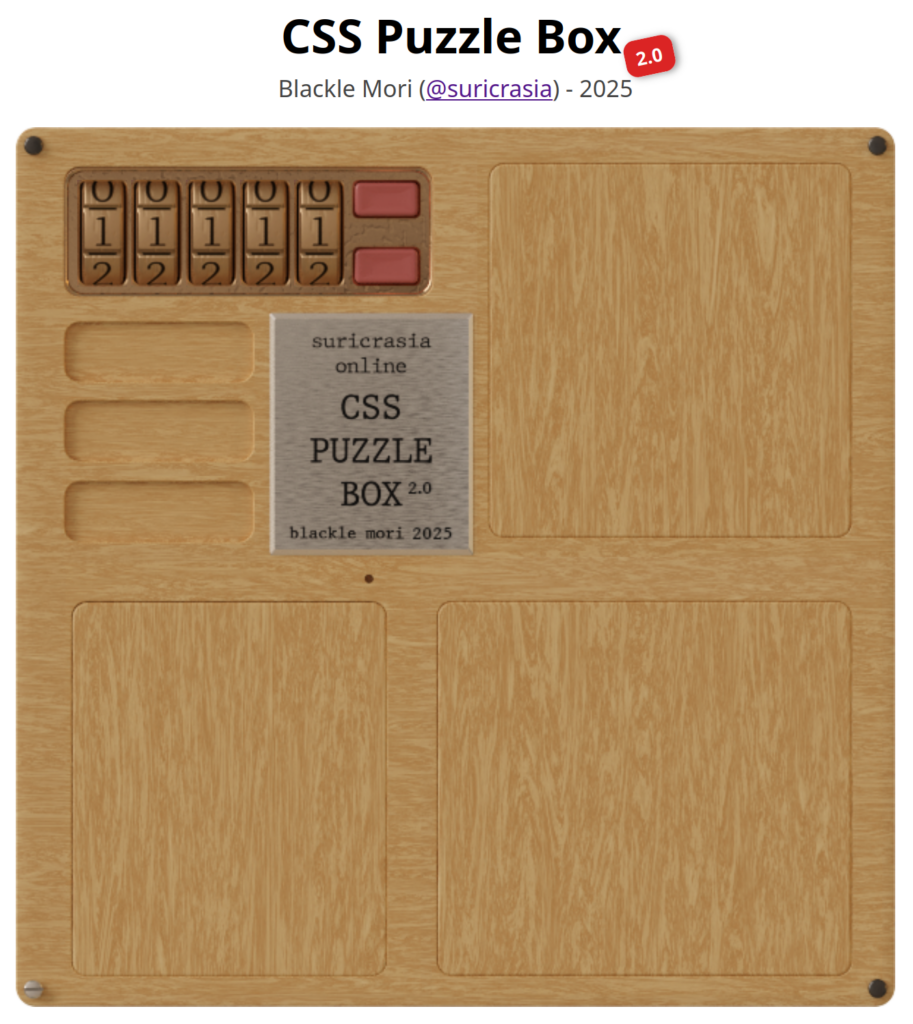
CSS Puzzle Box 2.0, starting state
Nowadays these things tend to be made using Javascript, or some language that renders down to Javascript. That’s what makes the CSS Puzzle Box amazing: it doesn’t use Javascript! It’s implemented entirely with HTML tags and CSS! See for yourself! Caveat: it doesn’t work on mobile platforms, some of the click or drag handles are a little hard to hit with your clumsy human finger. On desktop browsers, watching for the cursor to change when it’s over an interactive element is tremendously helpful.
It’s challenging, but far from impossible. It requires some close observation to get started, but after that you can probably get through it with enough time spent and effort expended. The hardest puzzle is one of the first, “Lights On,” one of those puzzles where clicking on a square inverts that light and those adjacent. You can follow these directions (swapping off lights for on ones) to solve it, or click on the O in the Lights On title a few times to skip it, or just muddle through—if you get stuck with just one or two lights on and can’t clear them, mess up the puzzle by clicking everywhere on it randomly and try again, and eventually you’ll happen on a pattern that resolves nicely.
So, about the technical underpinnings. Its creator blackle mori (Mastodon) wrote up a nice breakdown of how it manages to do what it does without scripting. Part of it includes the <details> tag and its accompanying <summary> tag, a way in pure HTML to have collapsing content. If you want to know the tricks there they are, but you don’t have to care about that to enjoy the puzzles. Good luck!
Two whole days in a row of non-Youtube links? Who’d have thought it possible! Shame yesterday was on Nintendo-related things, the other over-frequent subject of our little blogmachine, but I guess you can’t have it all.
Aftermath is composed of just five webugees (original word plz steal) from various other bigcorp contentboxes, and is one of a whole wave of similar creator-owned outfits that also includes Second Wind, 404 Media and Defector. All seem to be doing pretty well… for now… but we’re hoping all the best for all of them, at least until they grow into Kotakus, Escapists or Washingtons Post of their own, and come to oppress an entirely new generation of writer. But that’s the future, and there’s still time to avoid it, at least according to my good friend, the Ghost of Collective Ownership Future.
Aftermath’s principals have an article up describing their experiences, and its variously enlightening and illuminating. Running a small business is a process rife with pitfalls, and when you’re just five people, most working part-time and not able to afford to just pay others to take care of the hard parts, it can be difficult, especially when at your last jobs you could just focus on doing the thing you’re good at, the thing you like doing. Another problem that being only five people creates is fragility. Not intending to jinx them at all, but if one of them were to suddenly pass away, could the remaining four keep the banner held aloft?
But they are doing it. It’s working! And they have plans to expand next year. If you want to follow them and help keep them afloat, they have a trial subscription going where you can read them for one month for just $1. And their monthly rate is just $7 anyway, $10 for commenting privileges and Discord access.
Reading the article, especially the bit about how sites like this tend to slowly bleed subscribers over time just as a fact of their existence, as life happens to their readers in the aggregate, but gain them in lumps as new features are introduced or bursts of publicity occur. It feels like we could all stand to recognize this, and remember these sites need subscribers to survive. Aftermath’s rates are quite reasonable I think, considering that the New York Times charges $25 a month for their output, and as a bonus Aftermath doesn’t even publish frequent transphobic op-eds from right-wing jerks. Huh!
The World Wide Web is now over thirty years old. In that time, more content has vanished from it than remains now, but some of it can still be dredged up from the shadowy archives of the Wayback Machine. This is the latest chapter in our never-ending search to find the cool gaming stuff that time forgot….
DHTML means “Dynamic Hypertext Markup Language.” The term is little-used now; it later got renamed AJAX, and now is pretty much just how websites are made if they have any interactive aspects. It was originally presented as an alternative to Flash applets, which were threatening to crowd out actual web pages at that time.
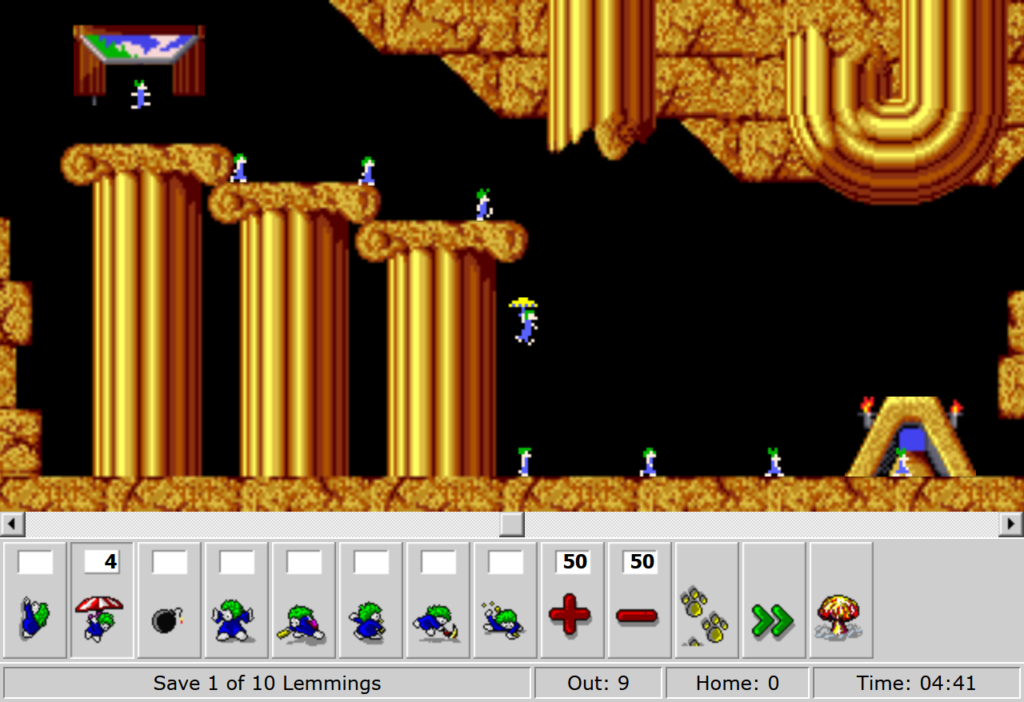
Lemmings, of course, is Psygnosis’ classic puzzle game where you grant members of a horde of suicidal rodent people specific skills to guide them to an exit while losing as few of them as possible to the hazards of their ridiculously dangerous world.
Back in 2004, DHTML Lemmings was a brilliant example of how much could be done with Javascript. Original Lemmings was released in 1991; we’re now further away from DHTML Lemming’s release than the original game was when it was published.
Its first home went away, although the server and even its page still exist. It says that the Lemmings page was taken down (and implies they did it to dodge legal liability), but promises something called The Pumpkins to replace it. It never did, but the promise survives. The game itself has been preserved, relocated as-was to a subpage of the site of Elizium, a dark rock band from the Netherlands.
Only the first ten levels of each difficulty, about one quarter of the original Amiga game, are presented. And this version has not survived the years unaltered: the distinctive sound effects and music appear to be missing. Still though, what’s here is playable, and fun. Enjoy, if you have the inclination and deliberation. And check out those requirements: IE 5.5 or better, or recent Firefox or Opera. And a 500 Mhz processor, wow!
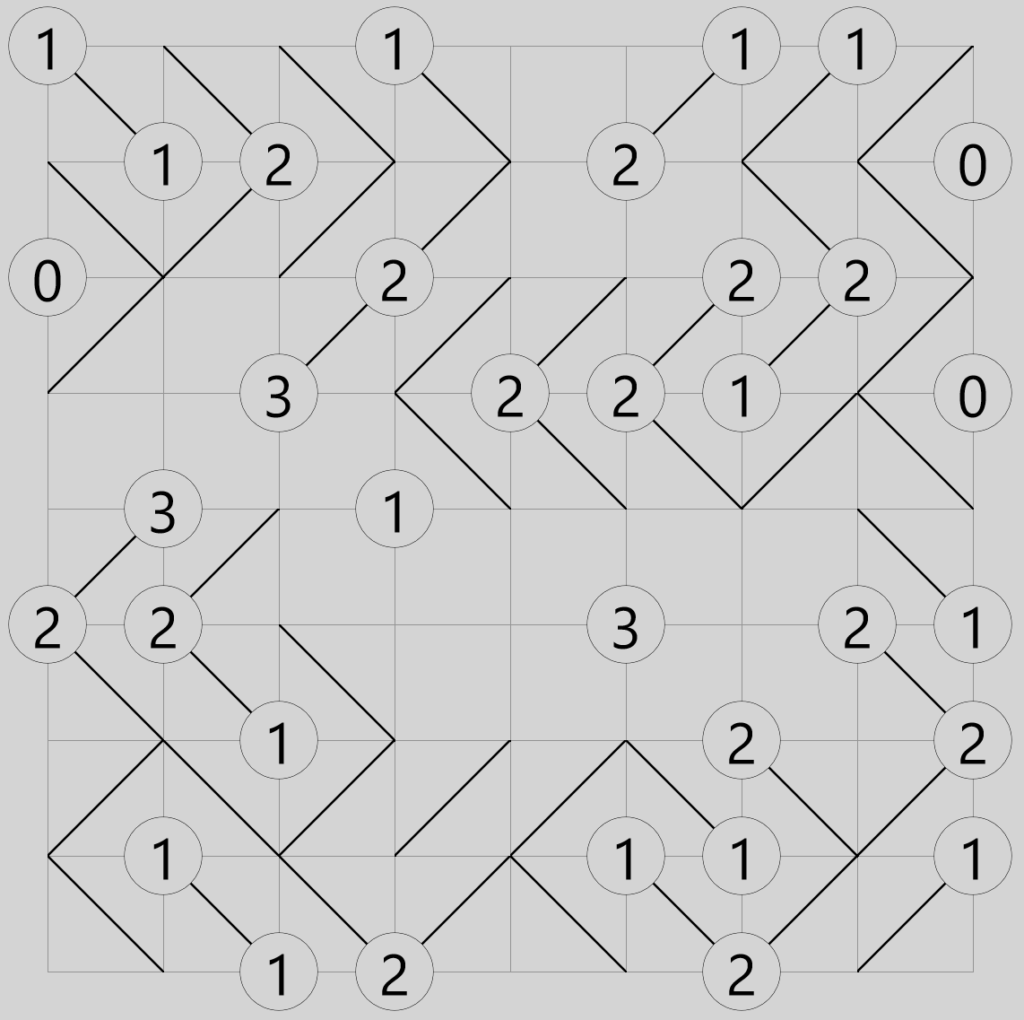
This is Slant. I could tell you so much about Slant, but I think a lot of the fun of these puzzles is figuring out a good process for solving them yourself.
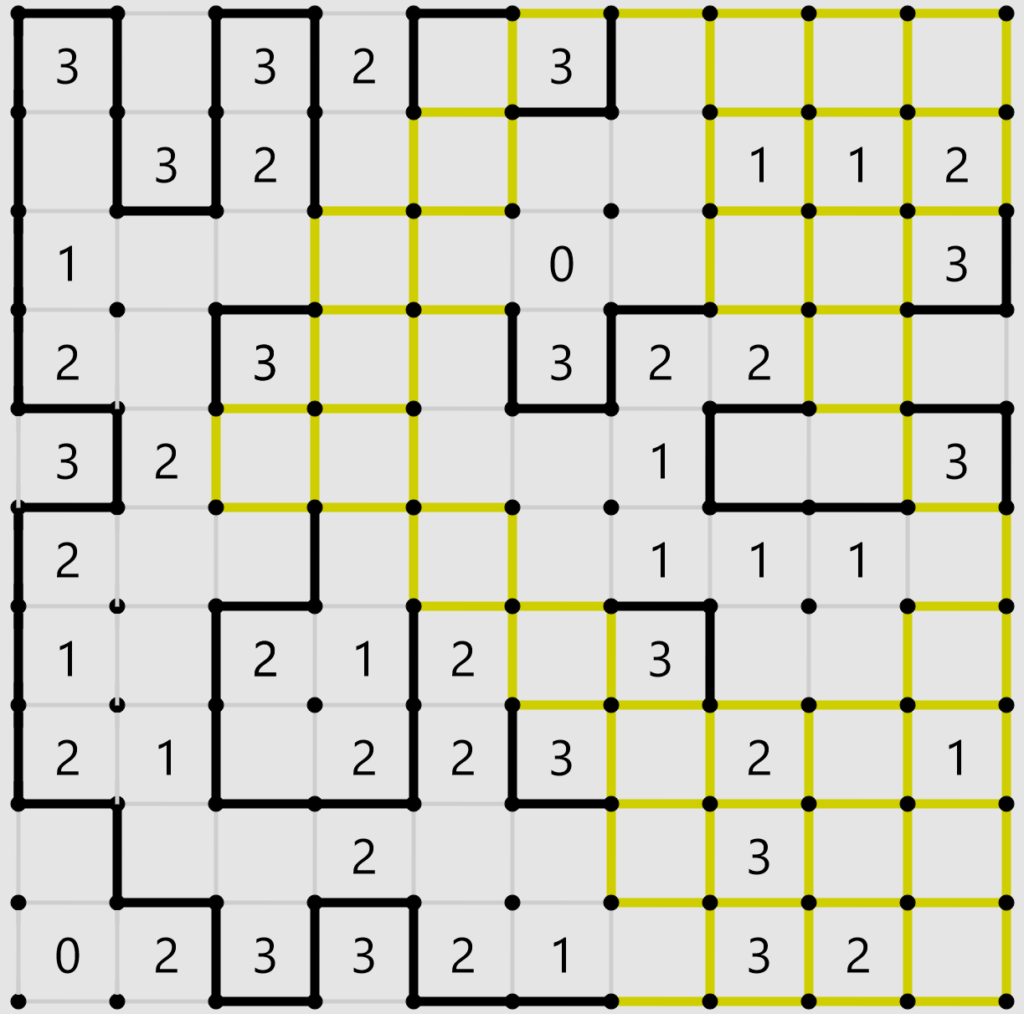
Loopy
I got a treat for you people today, a genuine treasure of the internet, a collection of forty computer-generated puzzles of wide-ranging types, from Sudoku (called “Solo” because of trademarks) to Minesweeper. And they’re not only all open source and free, they’re free for many platforms. Not all the puzzles are yet available for all platforms, but it’s continually being worked on, with new puzzles added from time to time. It has been for nineteen years; when it got started it only had five puzzle types. It’s one of the best things out there, and I’m amazed it’s not better known generally.
Galaxies
I can’t overstate what a wonder this collection is. All the puzzles are their own executable, if you don’t just play them on the web anyway. Each one of these puzzles offers many hours of happy puzzling. My own favorites are Loopy, Slant, Bridges, Dominosa, Galaxies, Net and Untangle. Most of the puzzles are of a type that should be familiar to fans of the Japanese puzzle magazine Nikoli, but they’re all randomly generated, and playable on multiple difficulty levels.
If the name Simon Tatham sounds familiar, he’s the guy who also created and maintains the popular networking tool PuTTY.
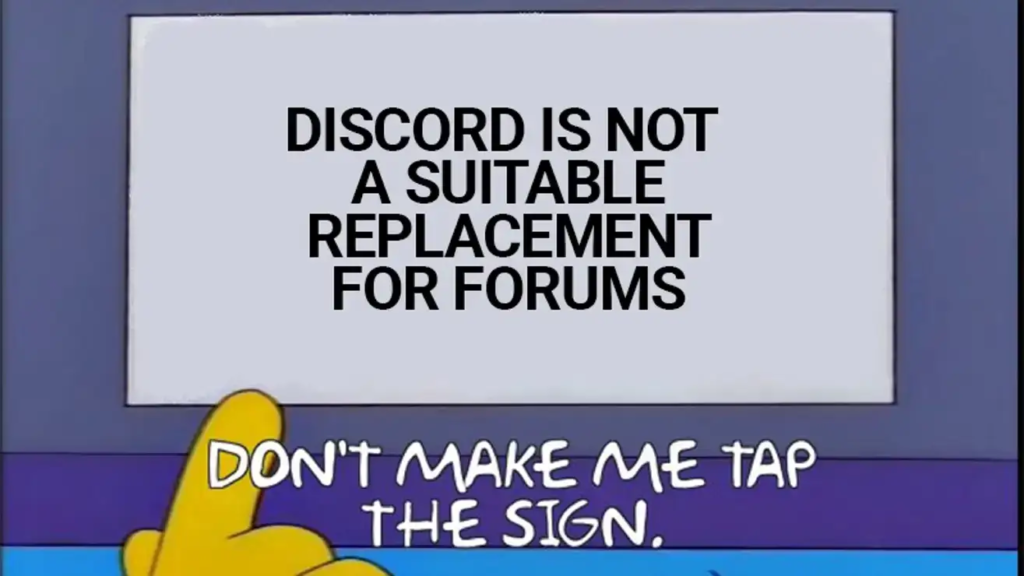
The news section of the site is on hiatus for the time being, as I’m not sure if anyone reading this really cares about a weekly news roundup (if you’d like to see it return, let me know!), but a post on Kotaku from Luke Plunkett really struck a chord with me, about the awful trend of closing web forums in favor of Discords. I rarely agree with games writing so much.
The switching of game discussion, and even support, from publicly-visible, archivable, Googleable forums and bulletin boards to proprietary Discords is yet one more way that the internet is becoming objectively worse. Everything posted to a Discord will be locked off when the last active link to it dies. It’s a giant black hole to which future internet users won’t have access, and where the scroll rate rapidly makes past discussions into an impenetrable text wall that its search feature is not great at sifting through. It’s an information commode.
Not that there aren’t some advantages to the Discord format, but there are also advantages to Facebook and Twitter. As we’ve seen with both those sites, the disadvantages far outweigh them.
Truth be told, I’m a member of like 40 different Discords (I even started a couple of them), dedicated to a plethora of topics, by necessity, and it’s always a hassle to sort through them, seeing as the list isn’t even presented as a list of titles, just of at-times maddeningly obtuse icons. Discords have their place, ideally for small groups of members, maybe topping out at a couple dozen. If your group has hundreds of members, consider that there are probably better answers, ones that don’t require that a user install special software to their devices to communicate with you.
Randall Munroe’s popular and (by now) venerable geek webcomic XKCD has been known to make “interactive posts” sometimes, little apps or even games that readers can play with. Lately there’s been two in particular of these, both focused towards space exploration: Gravity, made to promote Munroe’s recent book What If? 2, and Escape Speed, created in celebration of SpaceX’s recent launch, or at least celebrating the idea of it, since its actual fact turned out to not be so great.
Both games are much larger than they seem to be at first, offering a vast amount of void to whoosh around and entertaining planets to find within all that space. Gravity is mostly just for exploration, while Escape Speed is more like an actual game, starting your ship off with very modest capabilities that grow in power as you collect upgrades, which are gray circles with stars on them. You can find at least one upgrade on or near most objects out in space, and sometimes several.
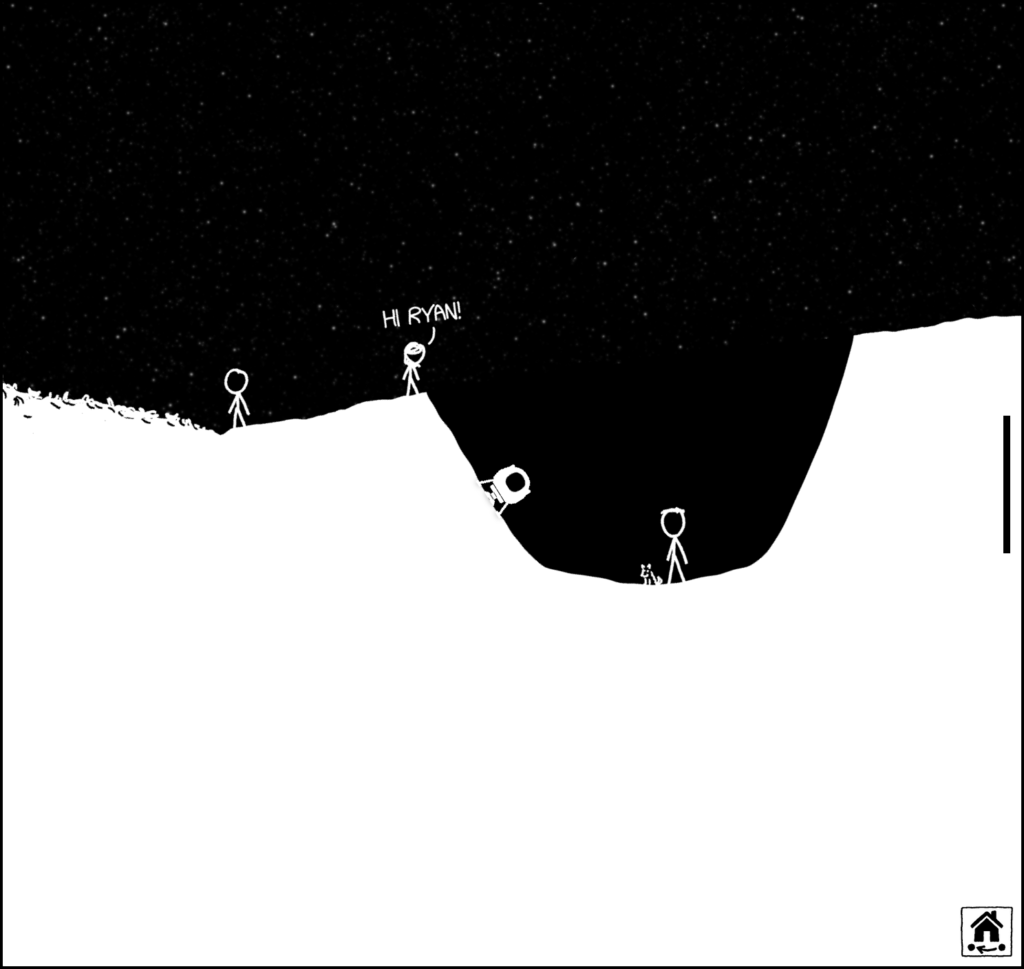
This tableau is a reference to the time that Dinosaur Comics creator Ryan North got stuck in a skatepark pit with his dog, and it made the news.
There’s a lot to find, especially in Escape Speed, which also has a lot of minor collectables to locale, which it’ll track between runs. Escape Speed even has a couple of objectives to complate: locating the Hyperdrive, which requires finding out what happened to the map of Boston on Subway Planet, and eventually escaping from the huge crystal sphere that contains the game universe. Both games have enough going on that they have giant pages on the Explain XKCD fan wiki revealing their secrets. In case you can’t be bothered to discover them yourself, here’s the one for Gravity, and here’s the one for Escape Speed.
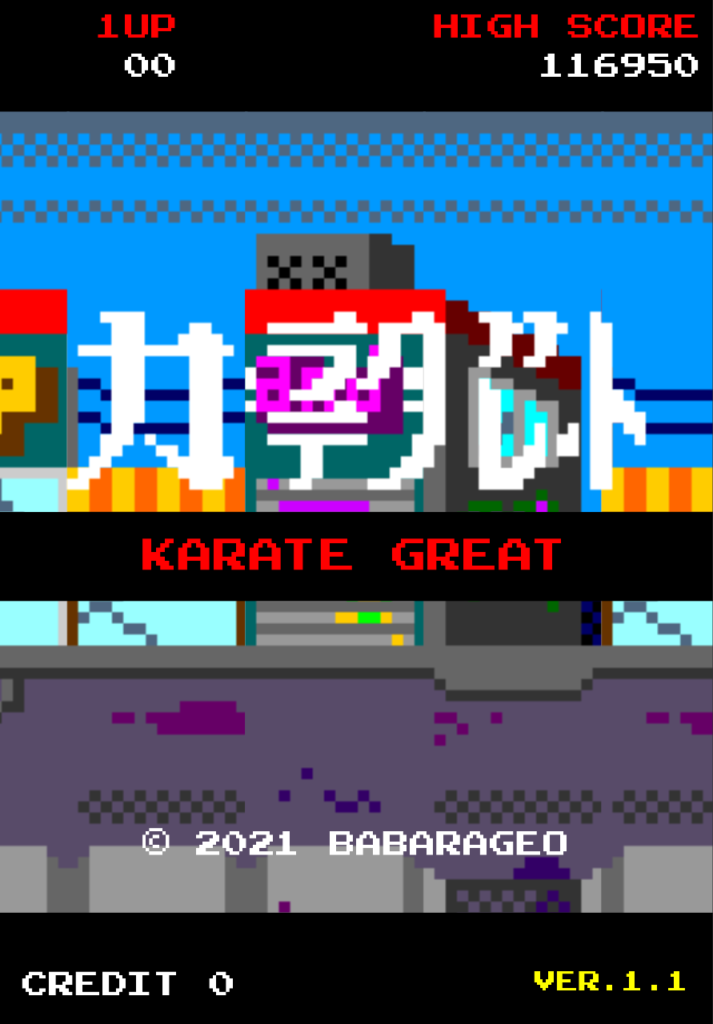
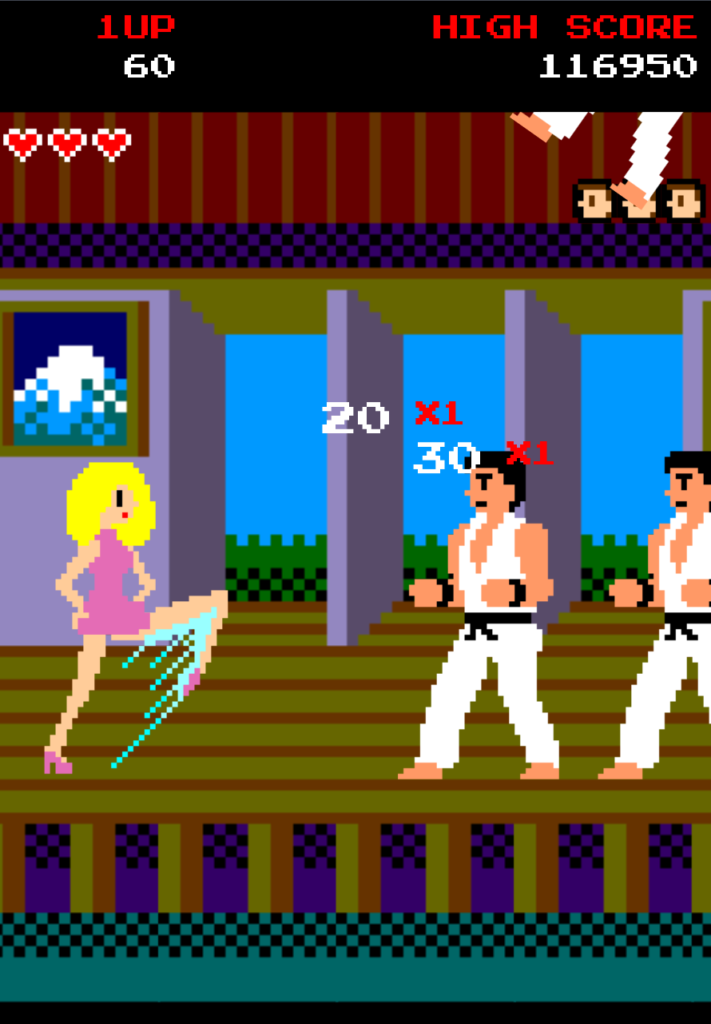
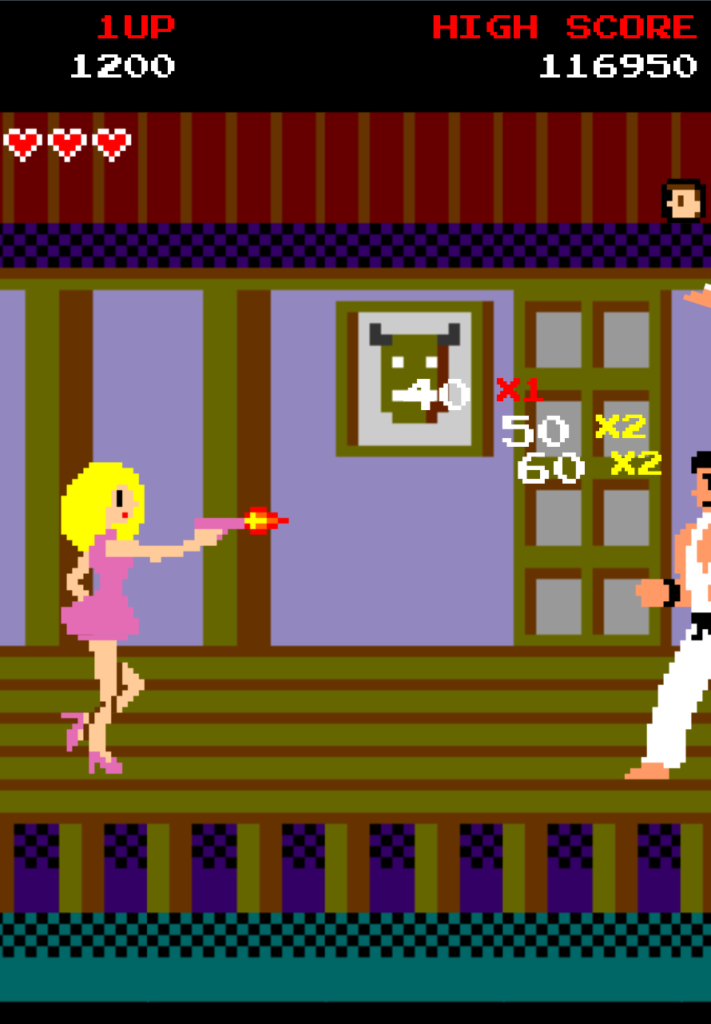
Another work of Babarageo, Karate Great riffs on Kung Fu, known as Spartan X in Japan in which you have to take down hordes of mooks, and the occasional boss, using karate moves. This revision of the idea gives you only one control, an attack that’s activated by clicking/tapping the game screen. This causes your leggy karate lady to swiftly knock basic opponents right off the screen, and inflict damage on bosses both mini and major. Further, if you can hit four opponents in quick succession, she’ll switch to some gun fu, pulling out a pink pistol and just blasting following opponents. Why doesn’t she use the gun all the time isn’t explained; it only shows up as the fifth through eighth hits of a combo. And if you can get in a ninth hit… well I don’t want to spoil it, but it makes short work of most bosses.
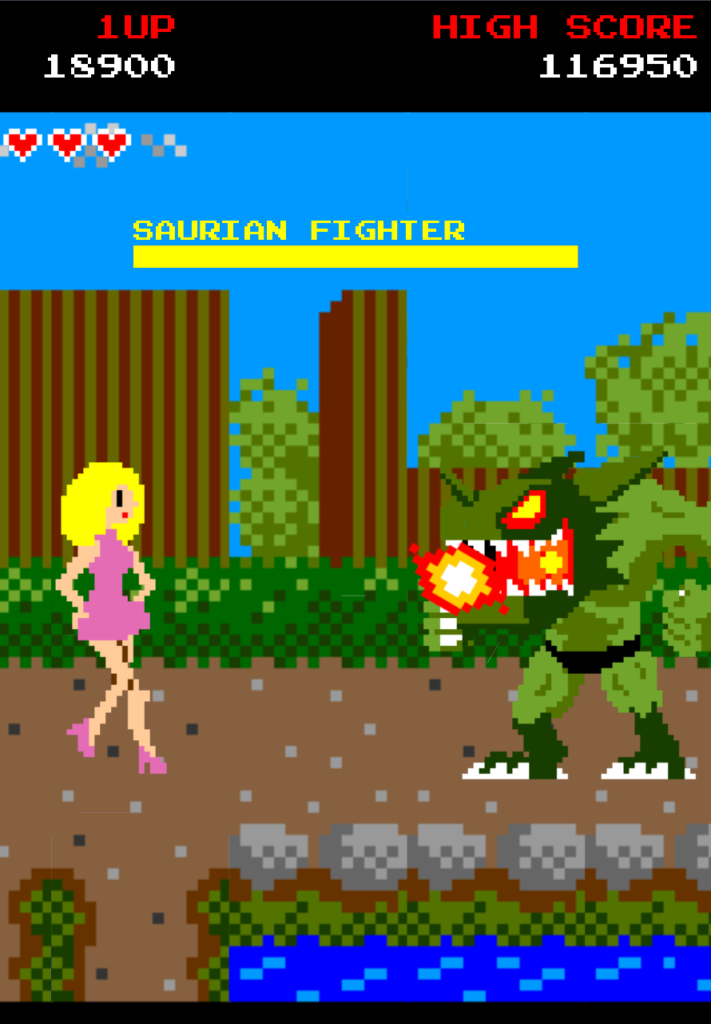
All of these moves make K-lady pretty overpowered for most of the game! It isn’t until the last couple of stages where you face opponents where just clicking away at the screen rapidly won’t suffice. The last boss, an evil CEO, has an attack that can’t be deflected by the normal means, and will probably stymie you until you come to realize that you have to learn how to trigger the combo-ending move to thwart it.