On Romhack Thursdays, we bring you interesting finds from the world of game modifications.
Most of the things we’ve presented here so far have been play hacks, or occasionally graphics hacks, but there are lots of hacks that exist purely to translate games into other languages. This week we offer two of these, both translations of Idol Hakkenden.
One of these, and arguably the much more playable, is from LIPEMCO! Translations and was made in 2018. (Say it aloud with me: “LIPEMCO!”) It is a fairly direct translation that keeps all the references to Japanese culture, and has much more text.
The other is from 2020, and is from Polinym of Woolsey Fan Company, which retitled it Pop Star Debut. It’s less technically impressive, with brief text that enhances the feeling of crazy logic that suffuses the game through.
Notice how, due to sprite mirroring to save memory,
Erika/Sabrina’s one sock keeps switching legs
Portopia-style adventure games are all heavily menu-driven. Portopia was written by a young Yuji Horii, who would adapt the style into the combat system of Dragon Quest and, soon after, became an ultra super rich person.
But in those ancient days there were a lot of games that used a Portopia-style system to present adventure stories, and a lot of them were on the Famicom. Not a lot of them made it overseas, but sometimes we’d get glimpses of the style, like in Princess Tomato of the Salad Kingdom, or the adventure sequences of The Goonies II and Dr. Chaos. The popular NES ports of ICOM Simulations’ computer adventure games Shadowgate, Deja Vu and The Uninvited could also be considered of this style, even if the games themselves started out on the Macintosh, in English.
While Portopia was a murder mystery, some of these games, like Idol Hakkenden, were not. It’s pretty much just a traipse through a linear plot where you help a fairly dopey young girl to become one of those media-destroying pop culture sensations. Take a look at the fairly hype intro movie I included above for a sense of it. In it, protagonist Erika (Sabrina in this translation) dances to the theme song, alternatively spinning before monitors showing her face, the lava pit of a volcano, and outer space. I don’t think two of those three settings actually appear in the game, but I haven’t made it through the whole thing yet, so, who the heck even knows?
These kinds of adventure games are known for being sometimes a bit random with the actions that are needed to advance the plot. To pick just one example (this is from Pop Star Debut, it does make a little more sense in the other translation, although not much more):
- Early in the game an item that can be looked-at is a Rock (it’s an Ashtray in the more accurate translation), suddenly appearing on the list of things that can be examined in a room despite Sabrina having visited that location before, when it was Rockless.
- Looking at it causes her to react in disgust. A passing old man compliments her on her tidiness, and gives her tickets to a planetarium show. The Rock, meanwhile, vanishes again. (They’re probably filming another Fast and Furious movie.)
- While at the planetarium, you can speak with one of your entourage, a girl named Sonya, who tells you that she has an idea: you will need a nutcracker. “Like the ballet?” asks Sabrina. We hope.
- So you go back to the Lobby, and ask the lady there for a nut. They sell “Fortune Nuts” there, ah. They don’t have nutcrackers, but you’re told “Aquariums have them.” Standard aquarium equipment, certainly.
- The aquarium does not, in fact, have a nutcracker. What they do have, however, is an otter named Kip.
- Kip cannot open the nut himself. But one of your followers, if asked, will tell you he might could do it with a Rock. Like, the one that was in the Lobby?
- When you go back, it has reappeared, in the Take list, and it can be picked up. Then you can bring it back to the Aquarium where, if you perform a song for the otter, it will deign to open the nut. The lyrics go, and I quote: “Kip! Can you? Big jaws! Klap! Snap! Open my nut Oh! Kip! Please! Yeah!!” I am given to understand that in Japanese the lyrics matched music that played in this sequence, but it was too difficult a task for the translator to manage. The first translation’s version of this sequence is presented below.
- The song communicates to the otter the nature of your request, and he agrees. Sadly, it breaks his teeth, and also the fortune sinks to the bottom of his tank. Some other means must be sought to retrieve it and learn its no-doubt essential wisdom.
And the game continues from there.
The group sponsoring the Pop Star Debut release, the Woosley Fan Company, borrows its name from 8- and 16-bit era Square translator Ted Woosley, who gained some notoriety for his loose, but distinctive and energetic, translations. It was he who added the well-known “You spoony bard!” line to Final Fantasy IV (a.k.a. II) in the US. The description of the hack mentions it’s not a literal translation, but tries to convey some of the same energy. It turns out that the translation takes a lot of liberties.
The hardest thing about writing a fan translation is not always the language itself, but squeezing the changed script into the memory space of the original game. Japanese is a more compact language than English, with concepts generally expressible using fewer glyphs. Pop Star Idol uses many subtle cheats to get its script to fit, including condensing common digraphs into one character. Even with these savings, some of the translated text seems rather terse. The first translation expands the rom size by over 100K to fit a more accurate translation, although Pop Star Debut’s much abbreviated text is entertaining in its own (largely unintentional) way.
Both versions have places where you’ll probably end up just trying every option available to you to find the trigger to advance the story, but that’s pretty much what you have to expect from this kind of game. So long as you’re prepared to accept this, and bring along a great deal of patience (especially for Pop Star Debut), Idol Hakkenden is a fun glimpse into a style of game we mostly never got to see in the U.S.
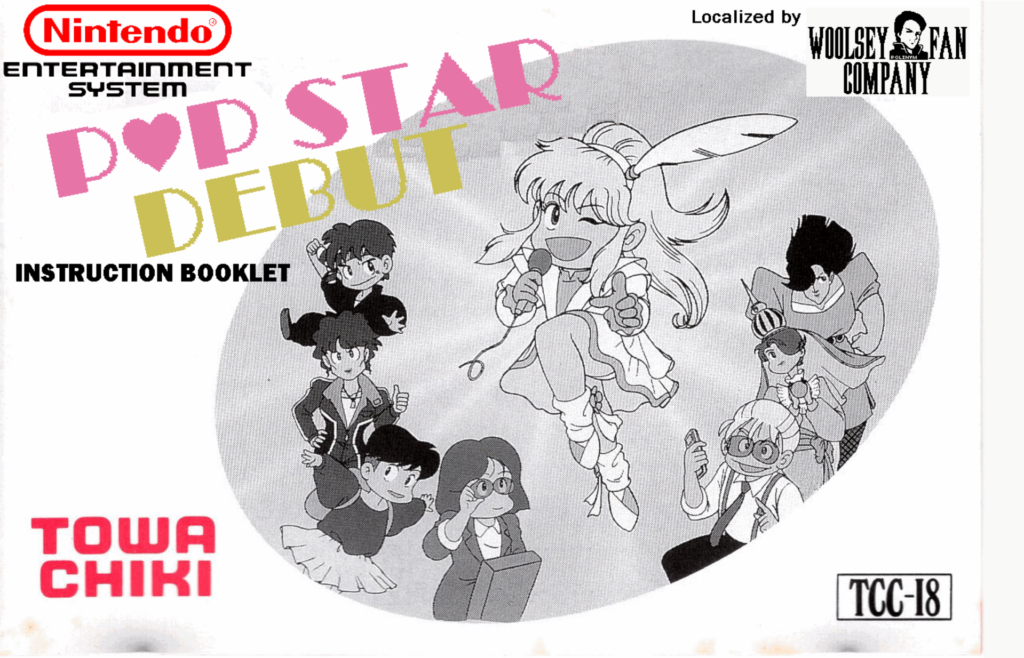
One more thing: Pop Star Debut did go the extra mile of creating an English PDF of what the manual might have looked like had their translation been released as an English NES release. It’s included with the hack!
Idol Hakkenden Translation (romhacking.net)
Pop Star Redub Fan Localization (romhacking.net)
“LIPEMCO!”