Matt Sefton Remembers Maboshi’s Arcade

Mat Sephton, aka gingerbeardman (Mastodon, Bluesky), creator of a GotY Playdate game, spent some time tracking down the origins of MaBoShi, aka Maboshi’s Arcade, one of the most unique and distinctive independently-made WiiWare games. He blogged about it back in 2013 (anna anthropy did so too back then). Since then there have been DS and iOS remakes of the games, although they all lack a special gimmick of the WiiWare version.

(Aside: did you know that I believe very strongly in the power of hyperlinks? You should too!)

The arcade hosts three games, and they all would have been terrific on their own. My favorite is the Snake variant, a genuinely novel take on the concept and the one I’ve gotten the furthest in. But the cool thing about the Wii version is that up to three players can play at one. Each plays their own games and has independent progression, but intriguingly, their games are not entirely separate. Things that one player does in their game can affect, either positively or negatively, the events in adjacent games. Even if you don’t play with other people, random attract mode games will start up on adjacent screens, and provide a bit of variety to your game.

All three games are demonstrated, on Wii, in the following video (18m). Just watching it makes me want to dig out the Wii U where my own bought copy of the game lives and play another round of Square.


An “Arcade Raid” in West Virginia

The title of the video makes it sound like feds crashing an illegal gaming establishment or something, but instead, it’s a number of people who discovered an abandoned house with a bunch of arcade games in it! And they didn’t crash it uninvited, but instead, once they figured out it existed, they contacted the Mayor’s office of the nearby town, discovered that the property had fallen into the town’s ownership, and arranged to purchase the machines from them. So, a happy ending! (34 minutes)

Well, mostly happy. Some of the machines had been stolen in the meantime, and some of them weren’t in great shape. The Centipede they tried to rescue fell apart. But they did manage to obtain a real classic, an Atari Food Fight, one of the arcade games designed by GCC, who also hacked together Ms. Pac-Man for Bally/Midway, and Quantum, also for Atari. It’s overall a nice story, as these machines aren’t getting any younger.

The video concludes with gameplay of the two rescuers competing against each other at Food Fight, and one of them managed to trigger a full-length Instant Replay, playing the complete (I believe) Instant Replay music, which is rarely heard since it gets trimmed to the length of the play, and requires waiting out nearly the entire timer to hear it!

Homebrew Distribution Tools: NES Bag and GBC Bag

The scenario: you’ve made a homebrew NES, Game Boy or Game Boy Color game, maybe by using a paid tool like NESMaker, or a free tool like GBStudio. Or maybe you used an assembler. Or maybe you hand-forged it yourself out of elemental bits with the chip documentation laid out on a table beside you? (Don’t laugh, I used to write 6502 code like that back in the day, when I didn’t have an assembler! The Commodore 64 Programmer’s Reference Guide was a godsend.)

The problem: you’ve made something you think is pretty darn great. Maybe you’d like to distribute it for people to use easily without having to set up an emulator, like it were some kind of native application? Maybe you’d even want to sell what you’ve made, and participate in the equatable exchange of goods and services you’ve heard people talk about in huddled whispers, but never thought you might engage with yourself?

The solution: Use EASTPIXEL‘s NESbag or GBCbag!

The indicated programmacalities* take a supplied rom image (even if said image never came from actual ROM chips) and erect a software box around it. Then you can distribute that package to other people, and they can double-click it to run it, just like it were a standard desktop executable, and it’s even rumored to be Steam Deck compatible.

A pre-built version is supplied for Windows. For Linux you’ll probably have to compile some code, if just because there’s so many distributions. For Mac, you’ll have to compile it yourself as well, but the process is rumored to be pretty simple.

* Feel free to use this word in your own conversations! People will love it!

Balatrones

(That’s plural for Balatro, a Latin word for buffoon.)

Funny, I thought I had made a post about this, but it doesn’t seem to have saved. Well, I’ll try it again.

Everyone knows Balatro now right? It’s won several awards, and was nominated for a handful of others. It was also developed entirely by one person, LocalThunk, who, gasp and shock, seems to be a decent person. And it was written in Lua for the LÖVE framework.

What’s more, there’s now several ports of Balatro for unexpected platforms. I presume they aren’t all entirely faithful to the original, but it’s fun to see how others iterate upon the theme.

For the Nintendo DS (Github, GBAtemp article):

For the Commodore 64 (itch.io):

For the Commodore Plus-4:

Oh wow, for the Commodore PET, and before you ask, this is the best that system can do, it had no color, only beeps for sound and its graphics were locked in ROM:

The Playstation Vita and Apple Watch also have ports, with varying degrees of fidelity to the original. Note that the PET and Apple Watch versions don’t appear to be public yet, and may never be. The Watch one particularly looks difficult to play.

From Casual Jumping to Casual Cleanup

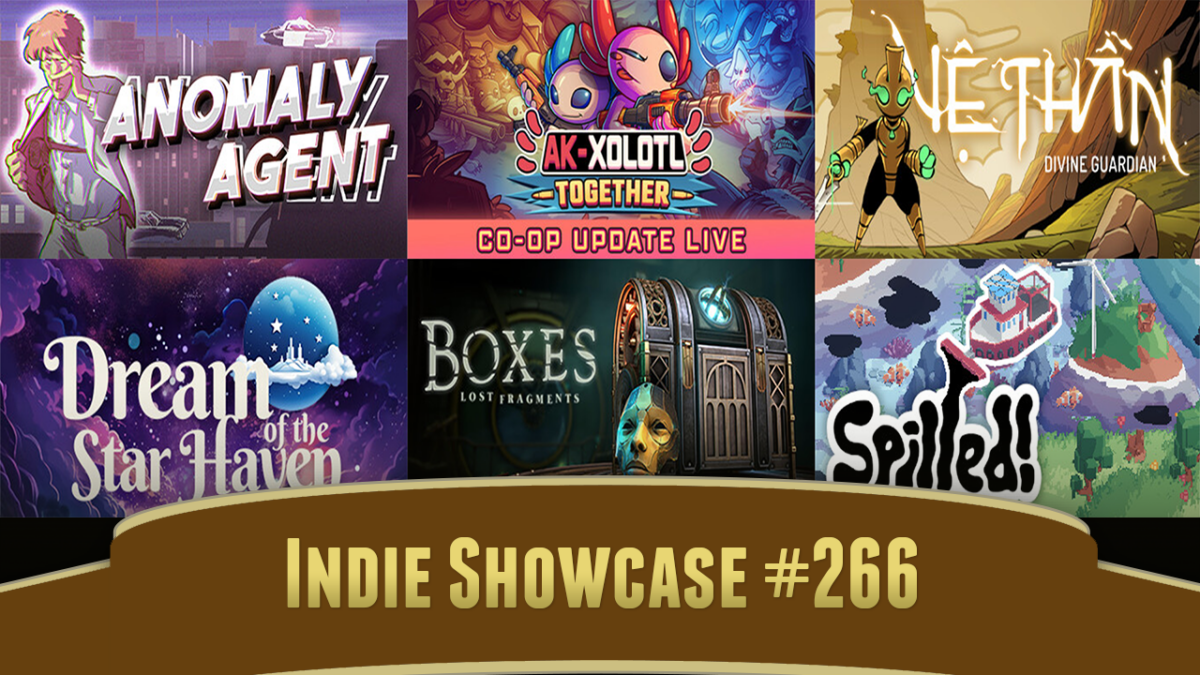
The weekly indie showcases highlight the games we play on stream, all games shown are either press keys or demo submissions.

0:00 Intro
00:14 Anomaly Agent
2:16 Ak-Xolotl
4:35 Ve Than: Divine Guardian
6:12 Dream of the Star Haven
7:14 Boxes: Lost Fragments
9:38 Spilled

Sundry Sunday: The Sounds of Luigi

Sundry Sunday is our weekly feature of fun gaming culture finds and videos, from across the years and even decades.

Something of a follow-up to last week’s post, this one’s another of nathorz’s animations of Nintendo voices (1 ½ minutes), this time of perennial second-banana Luigi. Most are from Charles Martinet’s voicing, but there’s also Danny Wells from the Super Mario Bros. Super Show, and John Leguizamo from the first Super Mario Bros. movie. There’s also some voices I don’t recognize; I presume Luigi from the more-recent Super Mario Bros. movie is in there somewhere.

Some other of nathorz’s animations include sounds of Kirby, Wario, Yoshi and the Kong of Donk.

C64 Demo: NINE by Iftkryo

The demoscene is a rich source of awesome, and at times ridiculous, imagery and sounds. Once in a while we sift through it to find things to entertain you with.

On Youtube, some Commodore 64 observers have been in a bit of a tizzy examining a new demo by Iftkryo, called NINE (3m).

If you don’t know anything about the computer, it might not seem too interesting. A block-graphics wizard lifts his hat and out comes nine large digits in different colors that then float around the screen.

The more you know about the Commodore 64, though, the more interesting it is. The machine’s graphics chip, the VIC II, is can only display eight hardware sprites at once. Then the sprites cluster together on the same scanline, meaning ordinary multiplexing can’t be happening. Then they drift up into the upper boarder. It demonstrates complete mastery of the hardware, doing a lot of things that simply shouldn’t be possible.

Iftkryo has produced a video giving away his secrets, closely explaining how the demo does its magic (22m):

It’s a good exploration of a number of weird C64 graphics tricks: sprite multiplexing of course, opening up the side and top boarders, and making productive use of mysterious graphics that appear off the top of the screen if the boarder is gone. While little code is shown, it’s definitely on the more technical end of things we present here. I’d give it a four out of five on Drebnar’s Geekiness Scale. But if you like learning about obscure tech details of a forty-year-old computer? And who doesn’t? There it is!