
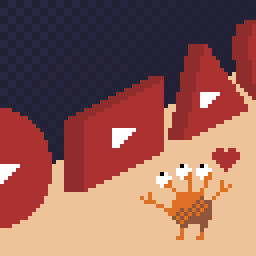
Sundry Sunday: The Amazing Digital Circus Goes Full Shooter

Sundry Sunday is our weekly feature of fun gaming culture finds and videos, from across the years and even decades.

The circus is back, the creation of wonderful Youtube animator Gooseworx and distributed by Glitch on Youtube and Netflix. We’ve linked to several of their past installments, for being obviously computer-game adjacent. It’s about a bunch of humans trapped in a virtual world, as cartoon characters, overseen by a well-meaning but generally hapless AI overseer.

Here are the previous times we’ve linked TADC: Episodes 1-3, Episode 4 and (with Wigglewood) Episode 5. If you aren’t caught up it might be a good idea to see the ones you’ve missed; if you’re new, you should at least watch the first episode to get a good idea of the situation and the characters.

So, that new cartoon (34 minutes). Fed up with trying to come up with interesting adventures for the trapped humans, ringmaster Caine just dumps a bunch of guns in on them and puts them in a standard first-person shooter scenario: everyone gets three lives, go ahead and kill each other. the stakes are pretty light because they can’t die, a fact understood intuitively by the most mischievous of the Circus’s inmakes, Jax.

Not many of the characters like Jax. He’s the most cartoon-like of the bunch of them, always teasing the others, sometimes relentlessly, and making them the butt of his jokes. He really leans into his animated reality, a Bugs Bunny figure (although one who hates cross-dressing). But it’s hinted that he hasn’t always been like that, that he lost a friend, a frog called Ribbit, to being abstracted, the closest a Digital Circus character comes to truly dying, turning into a big blob-like eyeball monster and then being sent by Caine to a dark place called The Cellar for the safety of the others.

It’s a fun episode, but also very dark. Of course, most Amazing Digital Circus episodes are that way. Here it is:

White_Pointer Game Reveals More Classic Console Graphic Tricks

We’ve linked them before, and more than once, but they’re one of a small number of Youtubers who consistently does great work. Here they look at the effects in a number of games and reveal how the programmers coaxed surprisingly complex effects out of the hardware for each of them. (25 minutes)

The games and effects covered this time:

  • Art of Fighting on the PC Engine, zooming in and out from the fighters as they approach and draw away from each other
  • Road Rash on the SMS, which created a startling effect of a road undulating and going over hills for 8-bit hardware
  • Ranger-X on Genesis/Mega Drive, artillery shots firing into the distance in the background and multi-plane parallax scrolling
  • The Lawnmower Man on Genesis, SNES and Gameboy, fast 3D virtual reality scenes (well, slower on Gameboy)
  • Donkey Kong Country 3 on SNES: vertical stretching of a boss
  • Contra 3 on SNES: rotating both a large boss, the background and the player on the screen at once when the SNES only had one hardware scroll background layer
  • Super Metroid: the Power Bomb explosion effect

If you enjoyed this you’re in luck, for they’ve done many other videos like this one. They’re all in this 21-item playlist.

New to SSB: Horrible Horrible Ads!

We figured it was time to ca$h in on our burgeoning popularity and put ad$ in the $idebar! Wahhaha! We are to be gazillionarie$!

No seriously, while we’re testing some ways to bring in at least a little income (maybe a podcast?), we don’t expect to make more than a few dollars from the sidebar ad, which is provided by the ComicAd Network. But ComicAd has some things about it that I like. It was inspired by Ryan North’s late, lamented Project Wonderful, a terrific little ad system that used to adorn the sidebar of Metafilter for readers who weren’t logged in.

It’s about as unobtrusive as you can get for ads, it doesn’t track users (that’s really big in this privacy-conscious era), and the things it advertises are small projects, like ours. I think that good ads can provide a useful service, both to sites and users, provided no one gets too greedy. Lots of the excesses on the internet nowadays are caused by just that, greed, driving people to excess. A small image advertising a webcomic isn’t that bad, and may even be fun. Blanketing sites with ads for a vast exploitive Microsoft-sponsored AI company that drinks up rivers and floods the world with slop, that’s what we who like to put judgemental names on things call evil.

It also matters how they’re presented. Something I personally loathe is the suddenly-appearing, page-covering dialog box, usually with a big SUBSCRIBE button, and a tiny almost-invisible X in a corner somewhere. I notice with some annoyance that even the new batch of creator-driven new web media sites do this a lot. Anyway. I place that qualm onto a small boat made of folded paper, and with my breath I push it out into the ocean. Fwoooo!

This is an experiment, and it might disappear in the coming weeks, or change form. If you have an ad blocker and decide you don’t want to see it, that is fine. As I said, we’re not getting much money from this, at least not right now. If you have comments, concerns, qualms, caveats, issues, problems, etc., please use the comment form below to let us know. Thank you.

NES Pac-Man Bug Update

Some time ago you may remember I explained here a bug I had discovered in the official NES port of Pac-Man. When you get very far into the game, starting at the 8th Key level, the ghosts spend a long period of time at the start of each level just circling around their home corners of the board. I recorded video of it happening here (30 seconds):

Well I was just notified this morning by a comment on that video, with the handle kirkbradfordmyers7196, that this happens because a table of ghost scatter times in the code is too short, so it reads data from an unrelated source which indicates a long period of time, much longer than the scatter phase is supposed to last.

kirkbradfordmyers mentioned that they’re working on a romhack that provides a fix for this bug, and others that exist in the code, and hopes to get the game much closer to the arcade. We wish them luck, and hope they’ll come back and tell us about their work when it’s done.

Poking Technology Reverse Engineers A Supercheap Console

It’s been a while since I linked a good solid ultra-geeky hacking video. Poking Technology is really good at this sort of thing. Here he takes apart one of those extremely cheap portable game consoles (1 hour 12 minutes), the kind you might find at the checkout line at Walmart for ten bucks, put logic analyzers on it, run it through Ghidra, and basically figure out how it works.

I find this stuff fascinating. Look, I’m not going to claim everyone will be interested in it, but that’s one of the advantages of running a daily blog that casts a super wide net, if you’re not interested in this there’ll probably be something more to your liking tomorrow. And if this is your kind of thing, take it from me, it’s really going to be your kind of thing. I’ve been munching on this video a few minutes at a time, and I’m still not at the end of it yet, I don’t know where this leads. I hope it goes somewhere where he puts his own code on it, which I kind of suspect he might.

Here is a bonus video, also from Poking Technology! He’s the guy who made that 6502 version of CP/M I linked a while ago. Here he uses his reverse engineering skills to make a port of classic Z80 CP/M to one of those bespoke LCD word processors that they made in the early 90s (1 hour 18 minutes):

CP/M fascinates me. It was the first real crossplatform OS for microcomputers, and it was also extremely small. It could be implemented in as few as 5KB of memory, and those 5,120 bytes got you a character-based screen, disk access, a file system and I/O support. If it looks like DOS to you, it’s because it was originally created as a clone of CP/M, and so lots of CP/M’s limitations transferred over to DOS, like its single-letter drive names and its 8.3 filename structure. But CP/M was first released in 1974! It was silly for Microsoft to have adapted that limitation too, and as a result until Windows 95 their consumer OSes had to live with the same limitation, when even Commodore 64s could have 16-character filenames. Jeez! PC-DOS/MS-DOS would soon get directory support, which CP/M didn’t get until the under-adopted version 3; until then it had to use a less-flexible system where a disk could be split up into numbered “user areas.”

CP/M being so small, it was also very simple, enough that one person could understand everything going on under the hood, something you really can’t say about OSes these days. That complexity has been used, in recent times, in service of their makers against their customers, to push in all kinds of misfeatures that many people would rather not have.

Nowadays CP/M is a footnote, its founding company Digital Research is a mere bag of property rights owned by Lineo, while Microsoft is worth hundreds of billions of dollars, and it’s very much because of a single decision by people at IBM to go with PC-DOS, later MS-DOS, from Microsoft. IBM offered both OSes, but they sold CP/M for 8086 for $240, several times what they sold PC-DOS for, and that’s why Windows is huge today and CP/M is a footnote. But there is no reason to believe definitely that, if the decision had gone the other way, that we wouldn’t be bemoaning Digital Research’s terrible decisions now instead of Microsoft’s.

But it’s also the case that DR might have turned out differently, while we know Microsoft would become the uncaring behemoth that harmed people’s perceptions of computing since the 80s, and is now propping up OpenAI and trying to shove it into everything. Remember everyone, to always strive to be better than your hypothetical replacement, or someone on a random blog decades in the future might ask aloud if we’d be better off without you.

40 Sonic Adventure 2 Facts

Yesterday’s was the appetizer; this one’s the main course. It’s from Choa again, and it’s 40 obscure facts about Sonic Adventure 2 (18 minutes). The Chao get mention in it too, don’t worry, but it’s mostly about the maxi-game, not the mini-game.

There’s some very interesting facts in there, like how the game seems like it was intended to be set in San Francisco, that getting to the end of a stage with every ring in it gives you an automatic A rank, or that you can summon Big the Cat in cutscenes by tapping the A button!

The Sonic Adventure games are artifacts of their time. Sega kept making games in their style, like Sonic Heroes for instance, or the Wii Sonic games, but they never really seemed to be headliners after the Dreamcast days.

I think now we can generally agree they’re failed experiments. There was a certain jankiness to them. You never knew if the camera was going to suddenly glitch out, and either leave you unable to see where you are, or change the control context and send the snarky rodent thingy hurling off the land to his doom, shouting “No!” as he fell. Or you might fall through a floor, or move through a wall, or whatever. The exploration-based treasure hunting stages with Knuckles or Rouge (in her first game), or the mech combat stages with Tails or Dr. Eggman (playable!) tended to glitch out less often, but it could still happen.

Despite the obvious effort put into it, it always felt like it had been rushed through without much playtesting. As I watched Choa’s video myself, a lot of memories, many of them bad, sublimated out from the depths of my brain. But I still feel a lot of fondess for the games, the jank included. They weren’t like anything else out there, and there still hasn’t been much else like them since.

One of the facts mentions a Green Hill stage. Even people who played Sonic Adventure 2 back then might not know about it. To unlock it, you had to earn every blessed emblem in the game, all 180 of them. Any objective there was to do in SA2, you had to do it. Some came from completing stages, but for some you had to get A ranks. Some of them involved having Chao win at sports. You had to get all of them in order to play a special level inspired by the iconic Green Hill Zone from Sonic 1. It was a ton of work for that nostalgia bomb, and yes, I ended up doing all of that to see it. It was okay.

My favorite fact about SA2, not covered in the video, is that the lass bosses were called the Biolizard, and then its upgraded version, the Finalhazard. Oh the questions! Why was it the Biolizard, all lizards are biological as part of their essential lizardness, did Gerald Robotnik invent other kinds of lizards? Why did it upgrade into something with the incredibly generic name Finalhazard? If had just been called the Finallizard, that’d have been silly oh yes, but actually would have made more sense.

And what else did Gerald get up to, up there on the Space Station Ark, trying to create the Ultimate Lifeform? “Behold my latest creation: the EVILWALRUS! No no wait better, the MUTANTOTTER! Oh I know, how about the POWERCHICKEN! Nah I’m fooling, the Ultimate Lifeform is really this hedgehog person over here. I know, he seems moody. Please humor him, he’s going through an emo phase. It might cheer him up if you listened to his poetry.”

50 Chao Garden Facts

Choa has 50 interesting facts about the Chao Garden minigame in Sonic Adventures 1 and 2 (14½ minutes).

The Chao Garden seems like such an odd inclusion in the Sonic Adventure games now. In fact, they seemed like an odd inclusion back then too, about 25 years ago.

It was created as the successor to the “A-Life” aspect of the Nightopians in NiGHTS into Dreams, itself not really a huge part of that game, but it encouraged repeat play to see what they would evolve into. The Chao Garden, for those unfamiliar, was a virtual pet sim included as a side game. Animals rescued in the levels of the main game could be collected, then brought to a number of small areas where they could be presented to one of a number of little blue creatures, the Chao, that they could raise and modify. The Chao didn’t eat the creatures, they instead kind of nuzzled them. Personally, I think they should have eaten them; it makes more thematic sense than whatever magical sparkly thing was going on.

Giving animals to Chao increased their stats, and could even give them new skills. Sonic and friends could then have them participate in various contests, load them up into a mini game on the Dreamcast’s “VMU” memory card, or “bred” with other Chao.

The original platform of the Sonic Adventure games was the Dreamcast, and while the Sonic Adventure servers were running, you could upload them to a babysitting service (or so I seem to remember), or visit the “black market” to obtain various items of benefit to your Chao. It was a really detailed and thought-out pointless minigame, and it came to be identified with the Sonic Adventure games, following the games of the series as it was ported to other, less-doomed platforms.

Choa’s video has more information than a non-fanatic could ever hope to fully understand, but it’s interesting to hear about. These kinds of virtual pet games aren’t made too often, and even less as part of headliners like the Sonic Adventure games were.

Best Games of Steam Next Fest Part 2

This is part 2 of my (Josh Bycer’s) favorite demos from the June 2025 Steam Next Fest event.

00:00 Intro
00:18 Baby Steps
1:58 Ball X Pit
4:12 Sands of Hope
5:28 Blaze of Storm
6:24 Chico’s Rebound