With the exception of two or three musicians (They Might Be Giants among them), for the most part I’ve agreed with what Marge Simpson once said: “Music is none of my business.” (Not counting that one episode where it was revealed she had been fangirl at the height of Beatlemania.)
Because of this, I just have to assume that this 16½-minute video from Cat’s Eye and Cybershell finding many (although they admit not all) of the songs that the musicians behind the Japanese version of Sonic CD drew samples from is on the up and up. The Japanese version’s soundtrack was by (looking up spelling on Sonic Retro) Naofumi Hataya and Masafumi Ogata. They mostly don’t seem to touch the US version, which had mostly different music by Spencer Nilsen and David Young, maybe because of those many musical references. Whichever you prefer is mostly a matter of taste, and how well you can handle an intro track for a game about a cartoon hedgehog with lyrics about “leather and lace” and “toot toot sonic warrior.” (Didn’t I make a post about that at one time? A search suggests no, but I was sure I had….)
Lots of names and bands that I’ve never heard of, and songs that I’ve never heard! Look, I know, it’s a huge area to be ignorant of, but at this point I don’t feel like I could possibly do it any justice, so I guess I’ll just go back to my CD of Flood. (Starts absentmindedly singing the lyrics to Particle Man for the hundredth time….)
Extra: this Sonic Retro forum post where The Sunshine Feeler dove into figuring out who did the vocals on the Japanese version, which reveals the amazing fact that the artist who did the rap portion of the intro song, Casey Rankin, also sang the remix of the DK Rap for Smash Bros. Melee!
Interesting fact about Mario Kart 7 (the one for 3DS). You might expect the CC values for the traditional three speeds/difficulties in Mario Kart games to be more of a name than a value the game tries to actually simulate, and usually you’d be right.
But MK7 actually means them. The vehicle speeds are actually derived from the CC number in that game. 100 CC is actually twice as fast as 50 CC, because the acceleration multiplier is double, and 150 CC is triple.
Meaning, if you hacked the game, or else made a mod, like CTGP-7, that let you set the CC number, by changing that one value you could affect the whole game, and try ridiculously fast, or slow, game speeds never intended by the designers.
But there is no need to stop there. CC is just a float. PabloMK7 hacked the hack and tried weird floating-point values for CC that shouldn’t rightfully work, like infinity, and NaN (“Not A Number”) , just to see what would happen. (5½ minutes) And then very high finite CC values, and infinitesimally small CC values, like point-lots-of-zeros-then-one CC, causing the engine to break in amusing, and somewhat frightening, ways.
So then, what would happen? Take a look for yourself:
Jeremy Parish, formerly of 1UP.com, currently of Retronauts and Video Works on Youtube, made an April Fool’s video, but because he’s Jeremy Parish it took the form of an interesting backgrounder on The Wizard, that big-budget Hollywood movie that’s like a feature-length advertisement for the NES and Super Mario 3. (18 minutes)
The Wizard stars Fred Savage of The Wonder Years, a popular show that you barely hear anything about any more. Like thirtysomething, remember that? I don’t either.
Many of my nights lately have been consumed with trying to play enough Caves of Qud so that I don’t embarrass myself too badly when I finally decide to talk about it. Most of my early explorations were in permadeath Classic Mode, but I have come to realize that playing it that way would mean I would need several years to finish it. I may not actually finish it before I write on it. On Nethack I had the advantage of being obsessed with it for years, had read many spoilers on it and participated on the Nethack Usenet group. These days much discussion of that nature has moved onto Reddit, which I have strong moral qualms about visiting now, not to mention that its app sucks on toast.
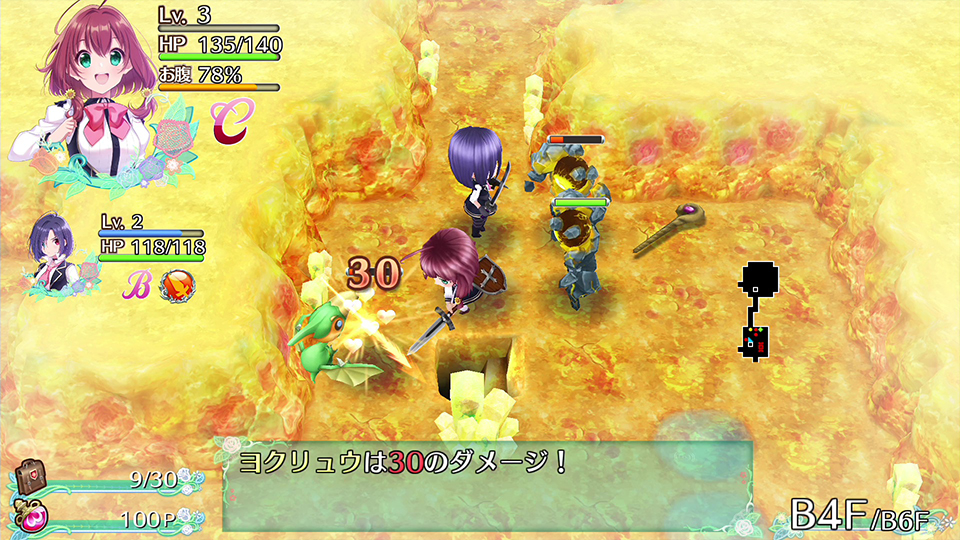
My play time for this game on Switch is 30 hours. I do not recommend it.
For most of the episode we try to treat the game as if all that skeevy stuff doesn’t exist, but don’t close it when it seems like it’s over….
As for the skeeve, the game’s official website has a section marked OPPAI, which I do not link to directly from here, in case it gets Set Side B on some kind of list.
I don’t make many @Play posts these days, and I’m sad that I have to drag out the tag for something like this. I am working on a lot of discussion about Caves of Qud (if I can link to Omega Labyrinth Life here I can certainly call out Qud), but the game is so blasted huge! Hopefully I can bring you something on that front soon.
Why is it misunderstood? Because it received several ports to other platforms around the time it was popular, they all lacked the special something of the original game, and in more recent times the game has been unfairly derided on the strength of those ports.
What is it that makes Dark Castle great on original Macs? It’s a combination of super-sharp art, responsive and unique controls (it’s a platformer but you attack enemies by throwing rocks at them with the Macin-mouse) and character. The game has gotten more worthy remakes in the current era, but still faces difficulties. One of the best modern versions sadly became unplayable on later-day macOSes when Apple decided to no longer support 32-bit software, a decision that I can’t possibly attribute to Steve Jobs, but somehow it still feels like it has to be his fault, somehow.
Now, as the video tells us, there’s a new remake programmed in Unity, released on the Mac App Store but also Steam, and is finally playable in a decent port for non-Apple platforms. It even got a whole episode of Retronauts about it, which I can’t link because, ha ha, it’s paywalled. I’m sure this video will give you enough information to decide if it’s worth your time, and even if it isn’t, it’ll fill you in one one of those many secret little corners of video game history that Set Side B exists to point out to you.
Can you read those? There’s a good chance you can! If you can’t (like if they all show up as hollow boxes) it’s because the font you’re reading this post in doesn’t support those kinds of characters, which are from the math symbols section of the Unicode character set.
It’s a command-line version of a web Unicode text converter, of the sort found at the other end of this link. It’s written in Python, and the source is at the end of this post. I saved it to a file named “fancypants” and put it in my home directory’s bin directory (which you’ll probably have to make first), where many Linux distributions are configured to look for things to execute if you type their names at the command prompt. (Yes, all of this assumes you’re running Linux. It’s not just for supergeeks anymore! If you’re running Windows you’ll have some adjustments to make, including figuring out how to add the script’s home to your path. It should work on Macs, although I don’t know if it’ll look in your home’s bin either.)
Oh, you will have to run a chmod +x fancypants on it. And the script as written assumes Python is at /usr/bin/python, where most distros will put it.
The script expects to be executed in the form:
fancypants [style] [text to convert]
The text should probably be in quotes if there’s any spaces in it, as should the style just in case. So to produce the first text mentioned at the start of the post, I entered:
fancypants "=" "This weird text was constructed with the utility mentioned in the title."
Usable style specifiers are “=” for double-stroke, “/” for script, “!” for a boldface kind of thing, “f” for the medieval script-looking fractur, and a few others that you can pretty easily see in the source code below. In fact each specifier has some synonyms if the single-character versions are too obscure for you to remember. And hey, if you don’t like the names I gave them you can use your own! The moment you paste it into a text file, this all becomes yours to do with as you please. Think of it as the blog version of a type-in program from an 80s computer magazine.
As a bonus, the names “r”, “rot” or “rot13” will perform a ROT13 code on the letters, useful for encoding spoiler text that readers can decode at ROT13.com. There are utilities that you can use to send the generated text directly to the clipboard, for pasting wherever you want, but since those differ if you’re using X.org or Wayland for your display manager (or, sure, Windows or Mac) I’ll leave those for you to figure out.
And if you can’t read the characters above, then I’m sorry that you’re missing out on the fun. It’s all pretty whimsical really, it’s not some huge thing that you’re missing. Come back tomorrow, I’m sure we’ll have a post about Mario or somesuch.
Just a quickie today. I mean the post, not the linked video, which is 18 minutes long. Hunter R’s done lots of videos about various aspects of Animal Crossing, and this one’s no different. In the most recent game, New Horizons, most of your village (or “island” in that game) can be edited, but for the whole rest of the series you’re mostly stuck with the land as it’s generated, and with this video, we know how it’s generated, at least for the first game.
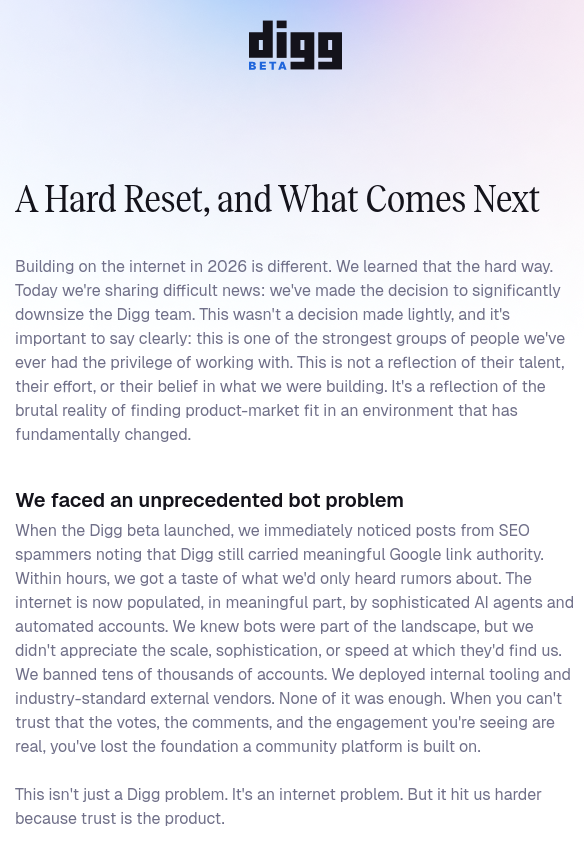
We’re a gaming site sure, but I think our broader focus is on using computers for entertainment purposes, and it’s not as if sites like Digg and its aggregation successor Reddit don’t gameify their workings to a significant extent, what with the reputation and the karma and the scoring and whatnot.
Digg has been restarted before, in fact several times! Some history is called for here.
A Timeline of Digg’s Several Graves
2004 Digg is launched, let’s call this Digg 1 2005 Reddit is launched; at first it’s much the underdog 2006 2007 2008 2009 2010 “Digg v4” happens, a badly handled redesign (I call it Digg 2), a mass exodus to Reddit begins 2011 2012 Digg’s traffic has fallen by 90%; Digg redesigns again (Digg 3), changing over to entirely editorially-curated content; Digg’s IP is sold in two chunks 2013 2014 2015 2016 2017 2018 Digg’s remaining assets are sold to a company called “BuySellAds,” which should give you some indication of where their priorities lay; later it’s sold to the even more hilariously evilly-named “Money Group”; Digg 4 2019 Lemmy, a Fediverse alternative to sites like Reddit and Digg, is launched 2020 2021 2022 2023 2024 2025 June: Digg relaunched in private beta, Digg 5 why not 2026 January: Digg goes public; March: then is taken offline yet again a couple of months later
Yes, Digg is a year older than Reddit, and yes, at first it was the obvious frontrunner. Nowadays Reddit could definitely stand to have some more challengers, but it looks like it’s not going to come from Digg, at least not in the near future.
I got in near the end of Digg’s private beta. I think I was one of its more prolific commenters, and I had considered starting a SetSideB community there. Ha ha, I’m glad I didn’t now! There were people on Digg making concerted efforts trying to push it rightward, trying to spread the meme that Reddit, the very site that once hosted TheDonald, was somehow far left-leaning. I’d tell you more about their odious arguments, but I blocked them as soon as I noticed them. Digg had good block button, at least.
There had been problems with AI bots trying to push content, yes, but Digg also used made a lot of use of AI itself. Moderation was handled partly by algorithm, and many pages would have Digg-generated AI summaries, marked “tl;dr.” I came to resent them.
A BusinessWeek cover, archived by Wikipedia, from Digg’s heyday
Original co-founder Kevin Rose, in many ways the face of Digg, is back on board. He seems to come back every time they’re having problems, but never seems to stay for long. Digg’s apology message, which is now their entire website, came suddenly. We users were given absolutely no advance warning, the site, and all of our posts and comments and votes, were just gone entirely. Here one moment, gone the next. Good job there Rose.
I don’t think it’s right to say, as the front page now does, that “[t]he internet is now populated, in meaningful part, by sophisticated AI agents and automated accounts.” That is true if you view it in terms of posters. But the web is mostly comprised of readers. One of Digg’s early ideas, lifted somewhat from Slashdot, was that users with good posts get more influence. That also became Digg’s downfall, as power users with high influence banded together to upvote each other’s posts, making themselves more and more powerful within that framework.
I wonder if AI agents could be used by nefarious actors to automate gaming such a system? I don’t know. At a certain point, the problems with a system start to look, not like fixable problems, but like inherent flaws. But anyway, my fondness is still for entirely human-curated sites, like my favorite hangout spot Metafilter. It certainly has problems, but it doesn’t have a runaway bot problem, or at least none that I’ve noticed so far.
Please support the human-made web. The whole online world depends on it. Thank you.
I feel like I’m a bit late on this one, but there’s still two weeks of March left. Some crazy wonderful people every year devote the month of March to classic Macintosh stuff, both hardware and software, and primarily things before the release of OS/X in 2001. The original MacOS traces its lineage all the way back to 1984’s original Macintoshes, and existed as Apple’s primary OS for 17 years. Now it’s been 24 years since the switchover, but a lot of people still like the system that served as Apple’s mainline OS for so long.
MARCHintosh has a website that organizes it, and even offers a style guide. It was created as a fruit-flavored adjunct of similar month-long pun-inspired retrocomputing celebrations DOScember (website currently down for a redesitn) and SepTANDY (doesn’t seem to have a home site at all). Should there be more? VICtober? JUNIX (thanx Ben Zuddist)? I vote yes, regardless of how terrible the pun is! Let’s fill the year with crackling, smoking old tech!
More MARCHintosh projects can be found through the #marchintosh tag on Bluesky and Mastodon.
MacOS Timeline
1976 Founding of Apple Computer (now Apple Inc.), release of Apple I 1977 Release of Apple II . . 6 years . 1984 System 1, release of the original Macintosh 1985 1986 Systems 2–4 (sometime between 1985 and here) 1987 System 5 1988 System 6 1989 1990 1991 System 7, a.k.a. MacOS 7.6 1992 1993 1994 Switchover to PowerPC hardware 1995 1996 1997 MacOS 8 1998 Initial release of iMac, the beginning of the revival of Apple’s fortunes 1998 MacOS 9 1999 2000 2001 Mac OS/X 10.0 Cheetah (“OS 10,” now called MacOS), initial release of iPod . . 24 years . 2026 Today
My style in titling these things is to just present the subject on whatever it is I’m linking to in the title, so you might expect that this is about someone else doing that and me reporting on it. But no! This time it’s something I did myself!
One Handed Solitaire is very simple, and an example of a “zero player game.” There are no decisions to make; winning or losing is completely down to the initial state of the deck. Here are the rules in text:
You start with a shuffled deck of cards. Draw four to form your hand. Your hand is considered to be in sequence, you must keep them in the order drawn. Now:
If the first and fourth cards are the same suit, discard the second and third cards from your hand out of play. This of course moves the fourth card to be the second card.
If the first and fourth cards are the same rank, discard the first four cards from your hand.
If neither of these things are true, draw another card from the deck to the front of your hand. This makes a new first card, and changes which the fourth card is.
When the deck runs out and you can no longer remove cards, the game is over. If you clear your hand and there’s still cards in the deck you’re not done, draw four more.
Your score (lower is better) is how many cards are in your hand when you run out of deck and can no longer discard cards. The average score is about 13.32 cards left. If you get a score of zero, that is you discard all of the cards from your hand and the deck is empty, you win.
ChurchHatesTucker ran a simulation of 200,000 runs and found the win rate of the game is close to 0.7%. I ran my own simulation, in a Python script, and found that out as well. I’ll put my code at the end of this post. No AI was used in its writing, and permission is not given to use it to train AIs. In fact, that’s true of all the text in this blog.
My first attempt found a win rate of 0.94%, but that turns out to be because I left out the aces from the deck! I tried a run with only 20 cards in the deck the 2-6 of each suit, and the win rate became about 7.5%.
If you want to try yourself, here’s the Python code I used. If you have Python installed, just paste it into a text file, give it the extension .py, and run it. It assumes you’re running it in a Linux or other Unix-like system; if you’re on Windows, you might have to change the “shebang” line at the front to point to where your Python is.
def gameend(deck, hand, verbose): score = len(hand) if verbose >= 1: print("Deck exhaused. Final score:",score) if score == 0: print("Win!") if verbose >= 2: print("Deck state:",deck) print("Hand state:",hand) return score
def play(verbose = 0): deck = ["2H","3H","4H","5H","6H","7H","8H","9H","TH","JH","QH","KH","AH", "2D","3D","4D","5D","6D","7D","8D","9D","TD","JD","QD","KD","AD", "2C","3C","4C","5C","6C","7C","8C","9C","TC","JC","QC","KC","AC", "2S","3S","4S","5S","6S","7S","8S","9S","TS","JS","QS","KS","AS"] hand = [] random.shuffle(deck) for a in range(4): hand.append(draw(deck)) if verbose >= 3: print("Game starting--") while True: if len(hand) < 4: drawcard = draw(deck) if drawcard == None: return gameend(deck, hand, verbose) if verbose >= 2: print("Drew a",drawcard) hand.insert(0, drawcard) continue cardtop = hand[0] cardfourth = hand[3] if verbose >= 3: print("********: Deck length:",len(deck), "Hand length:",len(hand)) if verbose >= 2: print("CARDS:", cardtop, cardfourth) # case 1: if the 1st and 4th cards match suit, discard the second and third cards if cardtop[1] == cardfourth[1]: d1 = hand.pop(1) d2 = hand.pop(1) if verbose >= 2: print("Discarded",d1,"and",d2) continue # case 2: if the 1st and 4th cards match rank, discard the top four if cardtop[0] == cardfourth[0]: d1 = hand.pop(0) d2 = hand.pop(0) d3 = hand.pop(0) d4 = hand.pop(0) if verbose >= 2: print("Discarded:",d1,d2,d3,d4) continue # case 3: if neither is true, draw a card drawcard = draw(deck) if drawcard == None: return gameend(deck, hand, verbose) else: if verbose >= 2: print("Drew a card") hand.insert(0, drawcard) # end of loop
if __name__ == "__main__": numgames = 10000000 wins = 0 scores = [] scoresum = 0 for count in range(numgames): score = play(verbose = 0) scores.append(score) scoresum += score if score == 0: wins += 1 #print("A win on game #",count+1) if count % 500000 == 0: print("Played",count,"games...") print("Finished playing",numgames,"games") print("Wins:",wins) print("Win rate:",wins/numgames) print("Total score:",scoresum) print("Average score:",scoresum/numgames) print("Run compete.")
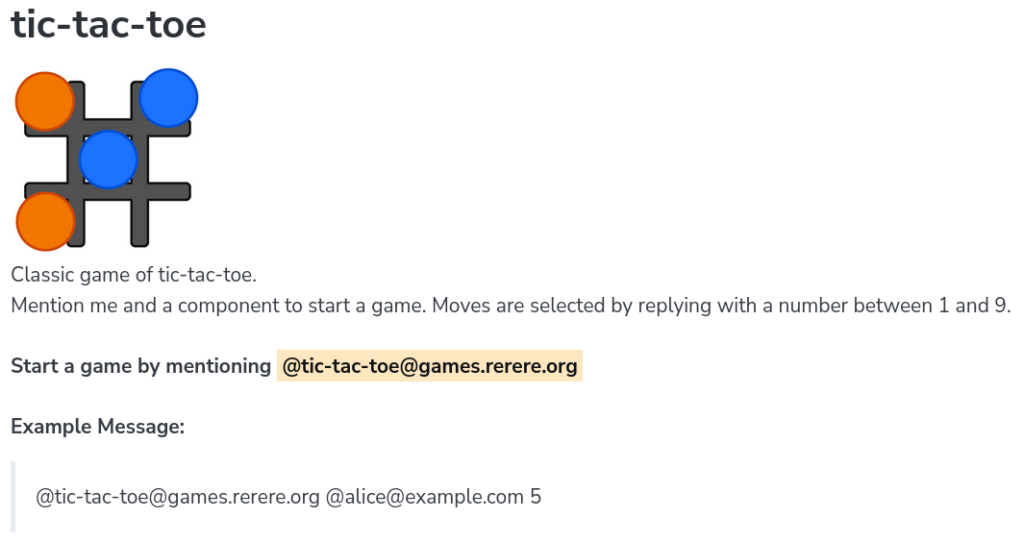
A brief post on a brief find. I was wondering if anyone thought of using the Fediverse, that nebulous internet thing that includes Mastodon, Lemmy, Peertube, Loops, Pixelfed, Hubzilla, Miskey, Fundwhale and more, and used it as an interface to game software. The main thing I’ve found so far is this site, games.rerere.org.
A very simple interface, but maybe this is only the beginning?
On this site you can start games of Tic-Tac-Toe, Rock Paper Scissors and something called Bunkers, which on quick inspection appears to be an implementation of Scorched Earth. You start a game by sending out a Mastodon message to the game’s address. I haven’t tried any of them yet, so there’s a chance that these will just catch fire and burn down your house if you try them. That’s a thing that can happen, right?
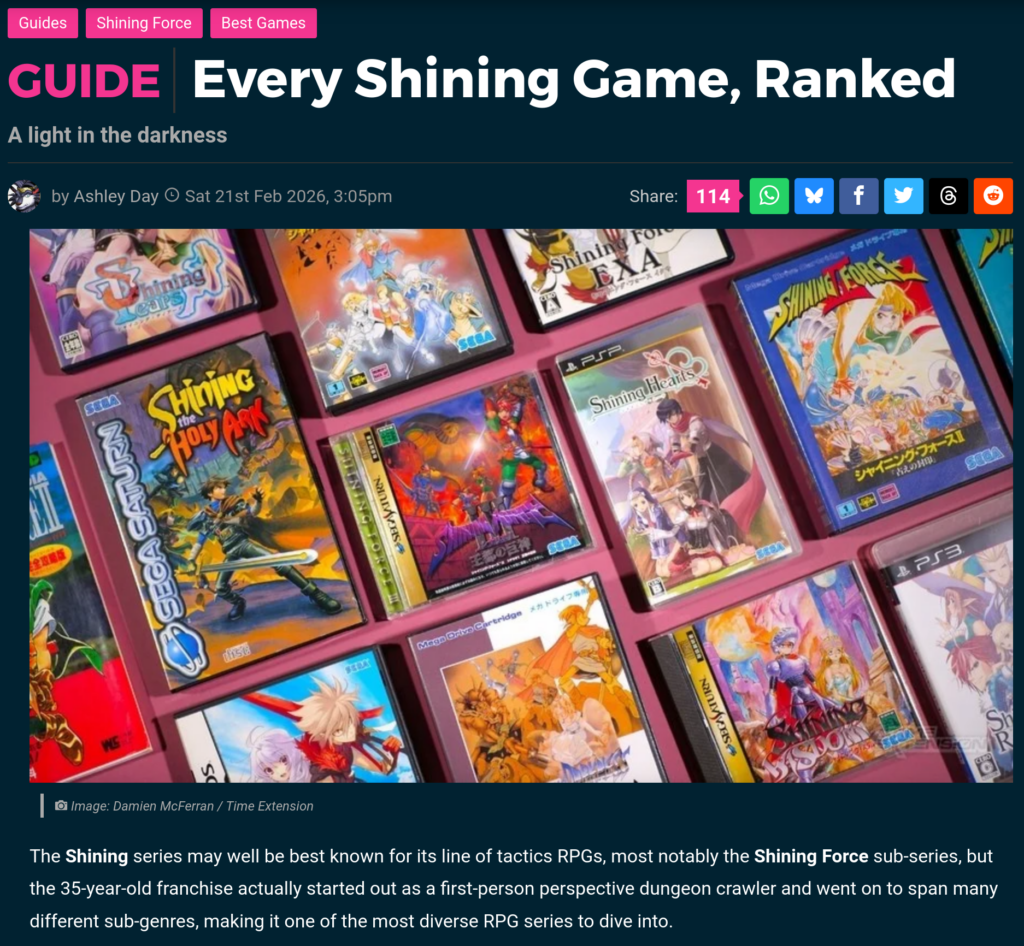
The Shining series, published by Sega but developed by lots of different people, is all over the map regarding gameplay styles. I’d say that more people have heard of the second game, the great Shining Force (it’s sort of like lighter Fire Emblem with town scenes and no permadeath) than the first one, Shining in the Darkness (a first-person dungeon step-oriented crawl with premade characters). All the games are set in a fantasy world (but not all necessarily the same fantasy world) and have a cartoony art style that helps keep things lively, but beyond the dungeon crawls and tactical battles there have been Diablo-style combat, action RPGs, Zelda-style exploration with bump combat, more general strategy and even a fighting game.
Ashley Day at Time Extension rated all 23 of them, and their opinions seem pretty decent to me. So you know, #1 was Shining Force III (the infamous one released on three sold-separate Saturn disks, of which only one made it to the US), #2 was Shining Force II, and #3 was the confusingly-titled “Shining the Holy Ark” also in Saturn. #5 is Shining Force I, and #4 is its GBA remake. Many of the lower-placed games on the list are various later installments, which is fair. The Shining games seem like they’ve fallen off lately, but it’s not like you can’t go back and play the originals… through some, um, means or other….
(Axe smashes through door.) Heeeeres… Ashley Day! Does Stephen King know of these games?