We love it when we find weird and unique indie games to tell you all about! Our alien friends to the left herald these occasions.
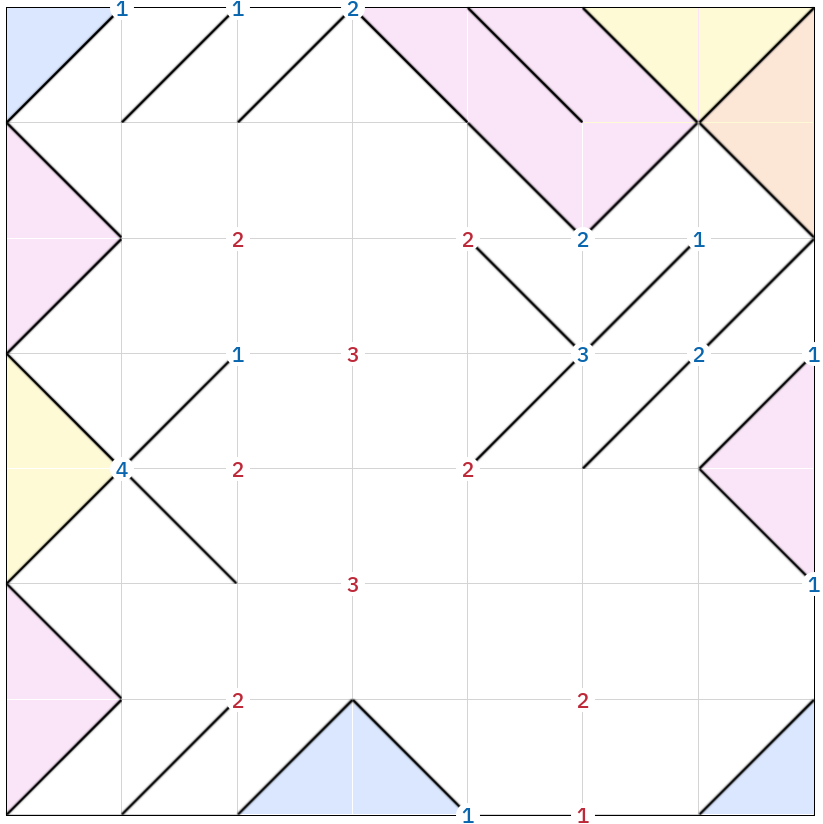
It’s a colorful implement of Slant, another puzzle from Luke Steuber, who made Galaxies which washed up previously on these shores.
Slant is a puzzle that first became well known through the Japanese puzzle magazine Nikoli. It also has a decent implementation in Simon Tatham’s Puzzle Collection (previously), available for nearly every platform including current web browsers, which will generate for you an endless sequence of them, of one of two difficulties.
This version of Slant is also browser-playable, and mostly has presentation going for it, but it is a nice presentation. It also lets you know immediately if an enclosed section of the puzzle touching the edge is solved, which makes it a bit better for newbies to figuring out Slant’s tricks.
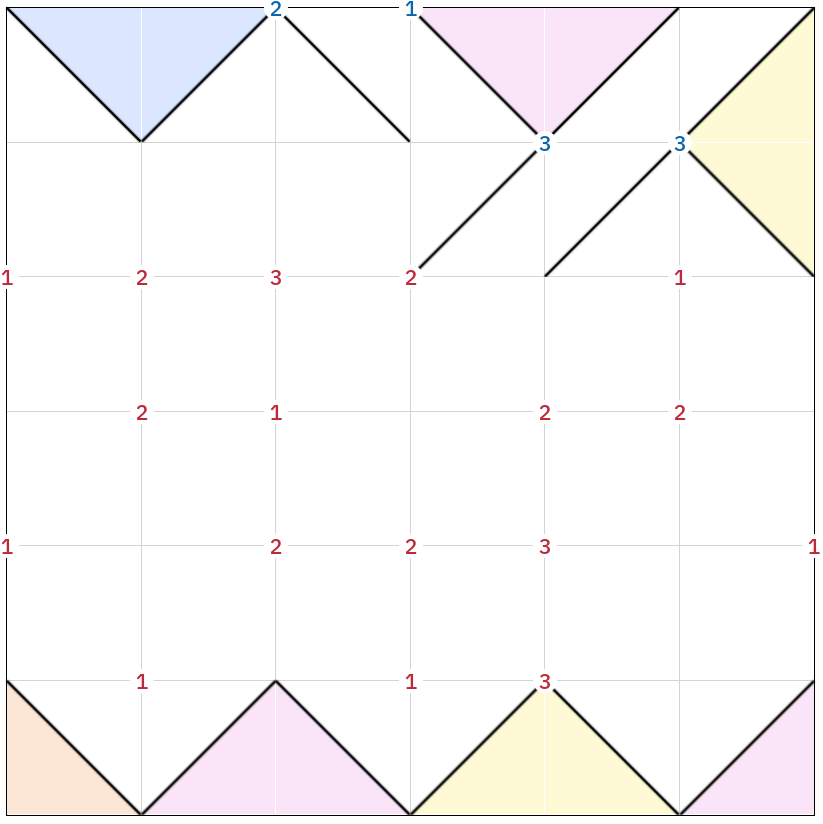
Each Slant puzzle is a rectangular grid, where every cell should have a diagonal line going top-right to bottom-left, or else top-left to bottom-right. Like, a slash (/) or a backslash (\). There are numbers in some of the grid intersections that tell you how many adjacent lines connect to that corner. In the solution there will be no internal loops, that is regions of the puzzle that don’t have a way outside its borders. Given these strictures, every puzzle has a single unique solution.
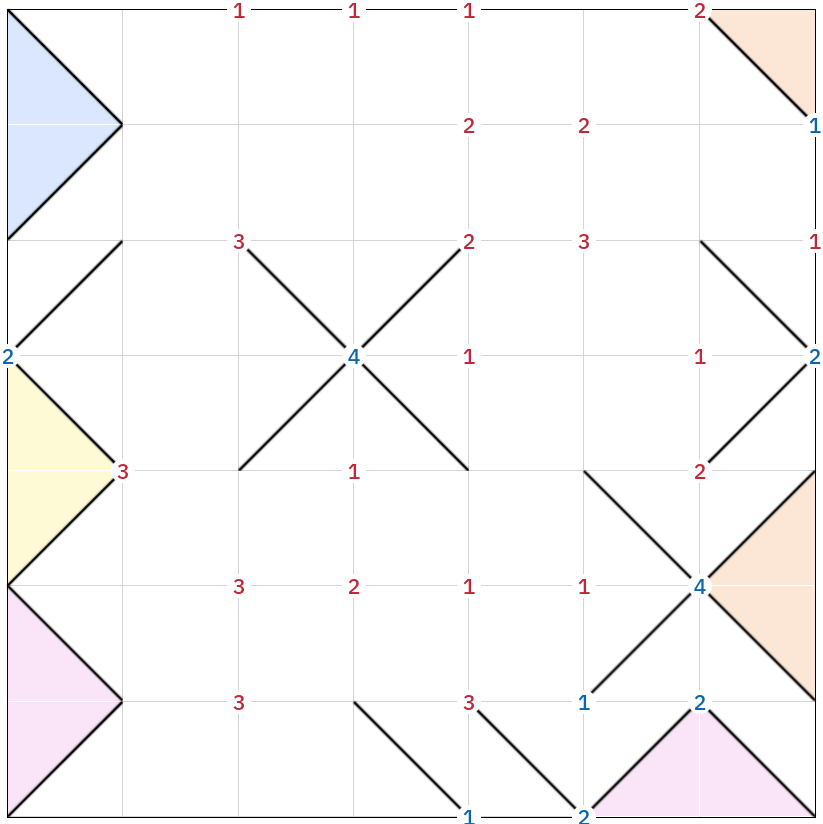
I think the true fun of this kind of puzzle is in figuring out the tricks to solving them for yourself, but if you’re a little overwhelmed by the possibilities, here are a few things to help organize the rules into a form compatible with your brain.
- Every puzzle I’ve seen has a few gimmies, obvious sections to get you started. Any number on an outer corner, either a 0 or a 1, is obvious, as is any 2 on the edge, or a 4 in the middle.
- With a little thought, adjacent 3s can tell you something immediate about the spaces around it. Adjacent 1s do too, but only if at least one of the 1s isn’t on the edge.
- There are four possible permutations around each 1, 2 and 3. Ruling out the impossible situations will help you along nicely. 2s in particular are the key to solving the harder puzzles.