Here is the page, just to get the link out of the way. It was written by sdomi back in 2023. They were also one of the people who presented the talk from a couple of days ago about turning Chromebooks into more-useable laptops.
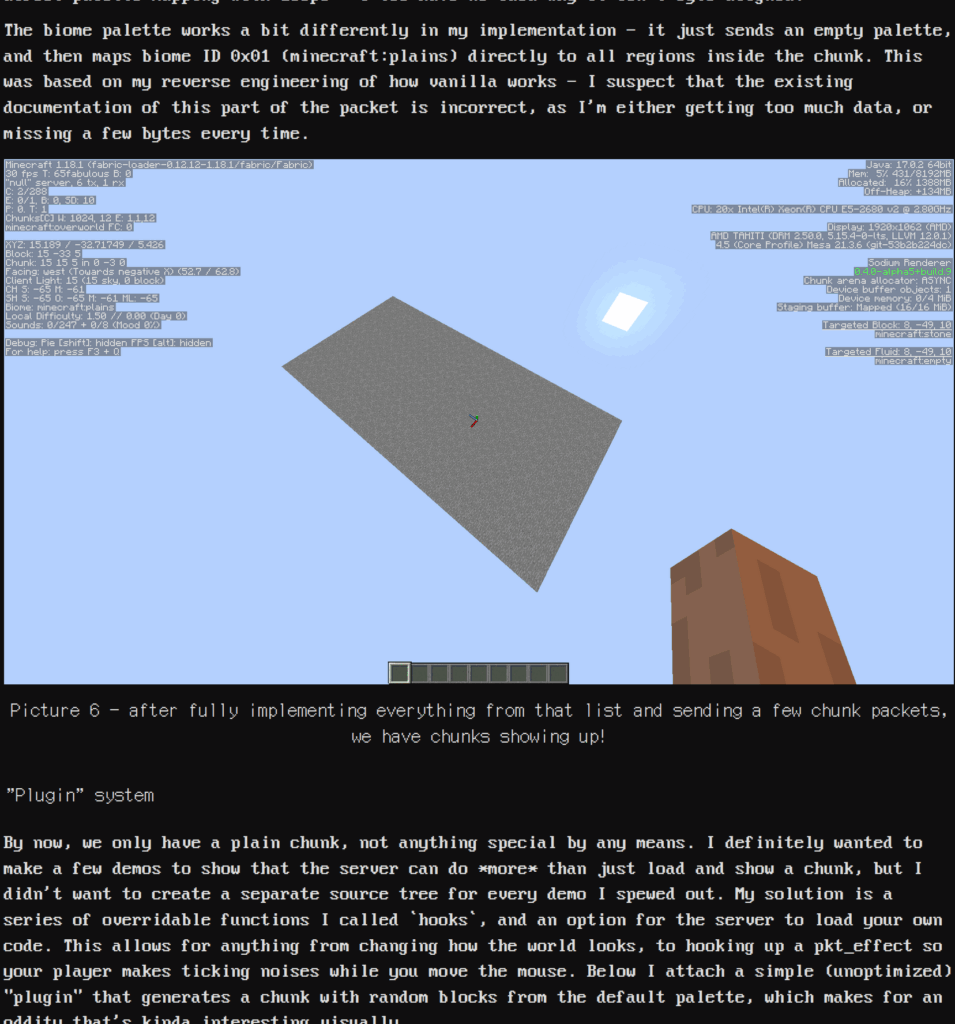
Part of the page describing the wholly-questionable project.
People who know what both Minecraft and bash are are right now exclaiming WTF. People who just know what Minecraft, of which there are very many, might be wondering why writing a server in bash is such a big deal. People who only know what bash is… well, you should remember to take your medication, and remember your gerontologist appointment on Thursday.
bash is the primary scripting language over in the Linux Dimension. Think of it as the old DOS command prompt, but much more powerful. How powerful is it? Well evidently you can write a Minecraft server in it, of course. It can do lots of other, less ludicrous things too. I use it to help get the data into shape for my Loadstar Compleat project. It is not made, to put it lightly, for things like this.
These days “bash” is sometimes used as a synonym for a range of command shells, like zsh, ksh and the like. This is a mistake of course, but to an untutored eye they all look broadly similar, and work in a similar way.
This shouldn’t be mistaken as producing a useable Minecraft server, suitable for hanging out with your friends, building blocky castles and fleeing from creepers in. As much as I can gather, it produces the bare minimum needed to connect to the game. And it cheats slightly by using awk to handle loops and some numbers. But much of the point of bash is to connect other tools together into a data flow, so I’ma allow it.
Sundry Sunday is our weekly feature of fun gaming culture finds and videos, from across the years and even decades.
Is this trying to make a point about racism? Is it arguing against it, or for it, that claims of racism are too prevalent, or not enough? For expanding the definition? For contracting it?
I’m honestly not sure if one could make a solid case for any answers to these questions, but it’s fun, so here (1½ minutes):
That’s it. That’s all for today. It’s 39 minutes though, so it should keep you going for a while. If you’d like to avoid Youtube and its various vagarities, you can also get it directly from the event website.
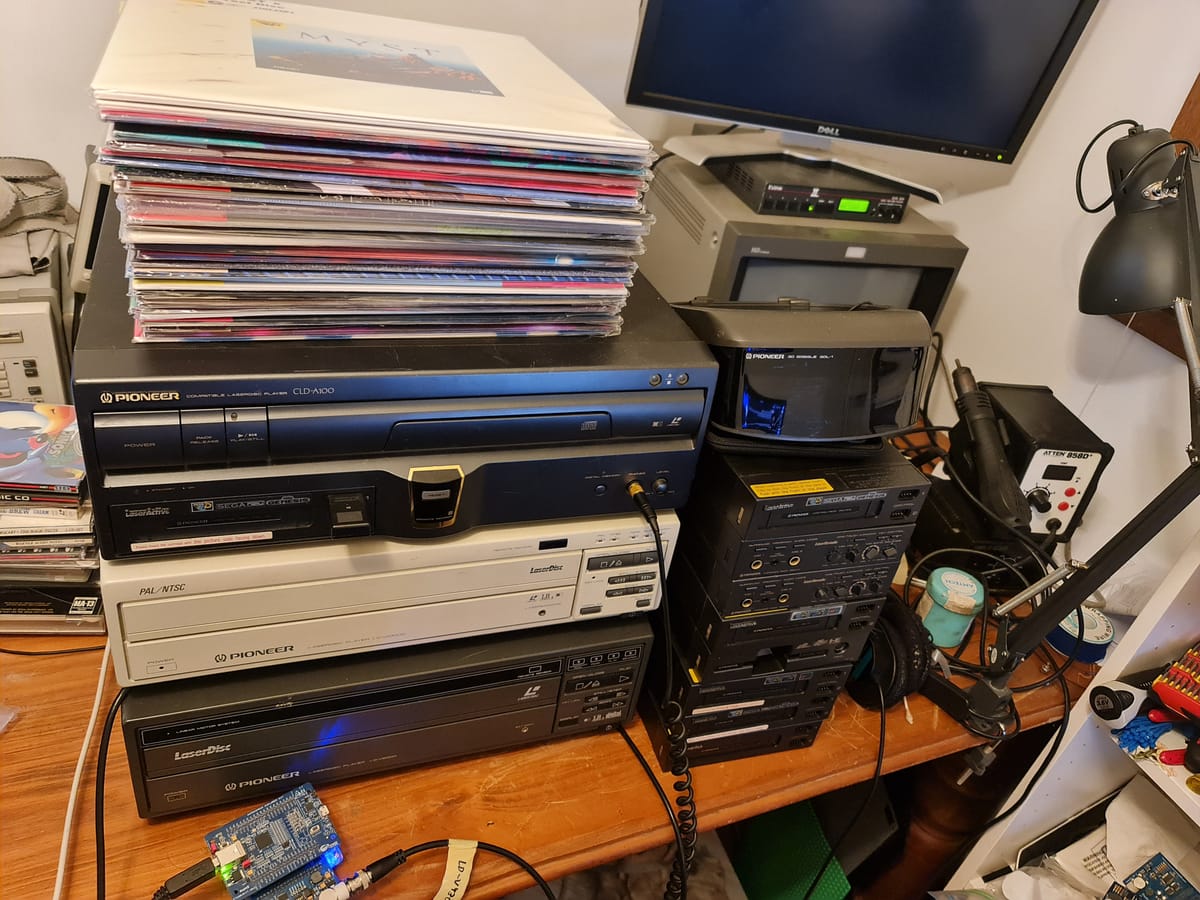
This is weird. This was around the time of the PC Engine and Mega Drive/Genesis, years after the short-lived laserdisc arcade game boom, but still within the period where some people (executives mostly) thought you could just just have a barely-interactive movie and it would rule the world. One of the attachments allowed it to play Sega CD (a.k.a. Mega CD) games, but it could also use its Mega Drive hardware to play special-made laserdisc games.
The hardware’s uniqueness, and the nature of the format, has contributed to the system’s resisting emulation. As the article tells us, laserdiscs are an analog format! So while it’s possible to copy a disc with a fidelity that would satisfy any human viewer, you couldn’t make an absolutely perfect digital copy even in theory.
The LaserActive bit is the lead-off for a substantial issue of the newsletter, which also contains news about a fan effort to translate a Cowboy Bebop game!
Pretty hard to read. Is that supposed to be AAIMAIS?
Raimais is a sci-fi-focused maze game from Taito in 1988. Ryan Oliver, writing over at Hardcore Gaming 101, has written an excellent description of the game, including why you might be interested in it. Not only is it like a kind of Arkanoid-style revision of a pre-existing genre but with powerups, in this case maze games, it reminds me a lot of the early arcade and Atari 2600 game Dodge ‘Em. It’s got multiple routes and lots of secrets, including secret endings. It pulls some Druaga-style dirty tricks on the player: without a secret item, you’re doomed to get a bad ending. Even with it, you have to complete a sequence of Quick Time Events during the ending or your character gets zapped by a laser gun and just dies, no do-overs, no continues.
Furthermore, the hardest-to-reach ending was actually impossible to get! The game’s included on Taito Legends 2 from 2006, but there’s a more-recent Arcade Archives version (Switch, Playstation Store), that gives you the option of making the impossible ending possible.
This Arcade Archives trailer gives a good sense of the play without giving too much away (3 minutes):
Here’s a recap of links at the end of the HG101 article:
Sudden Desu, where the impossible-to-reach ending was first revealed
I’ve known about Raimais for some time, and in a reversal of the usual turn of events I had already read the gaming.moe and Sudden Desu pages before HG101 covered it. This is an excellent excuse to link to them though.
I’m a bit late in announcing this, but a lot’s been going on here lately, and it’s a worthy announcement, so here’s the release video for Mega Man Maker 1.10 (2 minutes). This isn’t the last time we linked to a MMM release, and its coders don’t seem to be slowing down any time soon.
A free program, it’s got the usual array of new enemies (including favorites Guts Man and Snake Man), items and music typical of MMM. A big new feature is ability capsules, which can grant new powers if found in a level, or at the creator’s option even disable them. This can let you pull off dirty tricks like making a chamber that requires the slide to enter, but that gives you a capsule that disables the slide, making it inescapable. But you wouldn’t do that, would you?
It’s a really strange game even without the context that your protagonist, a fan-waving Japanese guy running around from sunglasses-wearing agents, and occasionally celebrities like Michael Jackson (probably his first role in a Sega game) and a barrel chasing him around mazes, is based on a real person, Kakuei Tanaka, a prime minister in Japan in the early 70s who was taken down by a bribery scandal. When he gets caught by the suits, they put on S&M garb and Tanaka gets whipped by them! Here’s Kim Justice’s report on it (19 minutes). Here’s about five minutes of gameplay.
I can vouch that it’s playable in MAME, and it’s not even that bad a game, certainly better than Abscam, a pretty terrible Pac-Man bootleg that’s probably our closest version of it.
Sundry Sunday is our weekly feature of fun gaming culture finds and videos, from across the years and even decades.
As I type this it’s about an hour and a half until my presentation on the history of Loadstar at Vintage Computing Festival Midwest 2025. I think I’m ready for it, but yeah, am I really? That’s the kind of question that sends me into a panic attack.
Since I’m so busy panicking, and because I’ve been on my feet for most of the day, I’m going to post something more random than I usually like. Sundry Sunday is themed around randomness, yes, but this is even more. This week I’m posting NATRAPS X FINAL (5½ minutes).
It’s one of those oh-so-very memeish videos where video game characters do various violent things to each other. I think I grew out of these videos… hm, I’m not sure I’ve ever been to into them. But it’s 16 years old, and both the internet and myself were a lot younger then. Maybe I would have liked it when it was new.
“NATRAPS,” if you haven’t noticed yet, is SPARTAN spelled backward. SPARTAN X was the title of the game that was released in the US as Kung Fu. Despite the name, it was absolutely not the last of these videos posted to the account of Bash4208. If you can bear it, look for more of them here.
It’s a pretty good run-down of the various weird timing issues of the Commodore 64. Machines at that time had to do all kinds of weird things to keep up the overriding priority of microcomputers of the time: building a consistent video signal that could be displayed on a television. Nearly all machines needed special hardware to do the job of keeping up the display, to give the CPU time to run user programs, or anything at all.
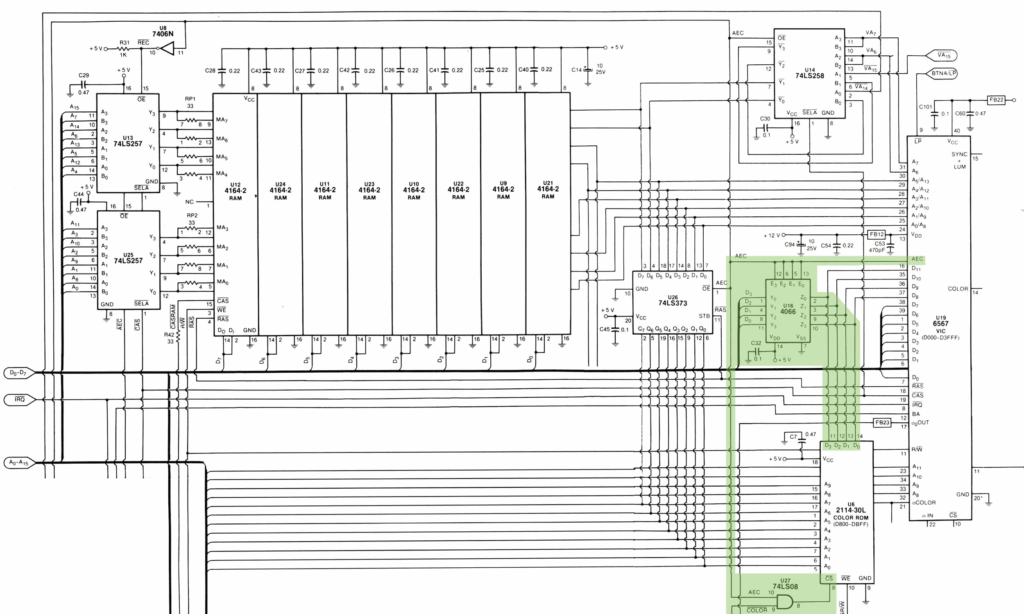
Circuit diagram from the linked article
The C64’s VIC-II video chip is a product of many compromises. The C64 could contain so much memory affordably because it used dynamic RAM, which requires periodic refreshes, and one of the tasks of the VIC-II was to handle that. It also needed access to main memory in order to build the display image.
But both of these actions conflict with whatever the processor needs to do, so the computer is designed to actually put the 6510 to sleep when the VIC-II needs to access memory. This is why, when the screen is blanked, the machine runs a little faster and more consistently, and that’s why the screen is blanked when a connected Datasette is loading programs from cassette tape.
I think it’s pretty obvious that, while the game is excellent in many ways, Super Mario World has so many extra lives that they end up almost meaningless. There’s all the traditional ways to build up your horde of Marios waiting in the wings for their chance at platforming glory: getting 100 coins, hidden 1up blocks, knocking a bunch of enemies off with shells, stomping on many enemies without touching the ground, and defeating lots of enemies with a single Starman. Then there’s those specific to Super Mario World: getting 5 Dragon Coins, finding a 3up Moon, getting a lot of gray coins generated by a gray P-Switch, having a lot of enemies on-screen when hitting the Goal Tape, and earning several in one of the bonus games.
But there’s one source of extra lives that few know about, or at least, I didn’t know about it. There are invisible triggers in some levels that, if you cross over their activation points in order, will generate a single 1up Mushroom. Looygi Bros shows off all 15 of these spots in the game here (8 minutes):
Why Nintendo decided to include these spots in a game where players will usually be walking around with double-digit life counts, I couldn’t tell you. Super Mario World is one of those Mario games where it doesn’t save progress after every level, so running out of lives is a real setback. But they could have just designed it so that it saved more often? I guess they just saw that it’s fun to earn lots of extra lives.
The decades of video gaming history there has now been have had many companies, developers and studios that have went under, due to one thing or other. Many of those names are revered, and their vanishing have left lacks in the world of vidyagaems that are felt to this day. A few of those: Atari (the current one has improved greatly lately, but it’s still not the same), Midway, Bally, Williams, Lucasarts, Rare (in its non-Microsoft incarnation), Telltale, SSI, New World Computing, and many more if I cared to dredge them out of the muck of my mind. And that’s just Western companies, there were plenty more in Japan, I just wanted to narrow the field down a bit.
One of those companies probably isn’t Acclaim. They were one of the biggest third-party publishers in the NES era, and they lasted to around the N64 era, but although they did put out some Premium Quality Entertainment (thanks Murderbot), they also put out a lot of what in Yiddish is called drek. Towards the end it felt like the drek percentage was getting pretty high, and it didn’t help at all that they kept pulling some dodgy ad stunts. They ran a context where they offered to pay couples to name their kid Turok, another where they tried to put ads for Shadowman on tombstones in cemeteries, and the less said ab0ut BMX XXX, possibly the game that destroyed the company, the better.
Well nostalgia certainly sells, even for the less savory publishers, and so it is that some people have decided one of the brands we needed to once again be subjected to is Acclaim. They released a promo video yesterday that unveils their initial releases, here it is (relevant portion 13 minutes):
The games shown:
GridBeat! appears to be a hacking-themed maze/puzzle/rhythm game.
Basketball Classics is a stylish retro-themed sports game that’s refreshing for being a new game based off of real players that didn’t come from the corpulent corporate cube of EA Sports. I’m pretty impressed they’re making this, it’s probably the game here I’m most interested in.
Ground Zero Hero is a cartoony action shooter that seems to take inspiration from Vampire Survivors and Nuclear Throne.
Pixel Washer is a retro-themed cleaning game that reminds me a bit of Powerwash Simulator, but maybe that’s because I’ve been playing that again lately.
Talaka is a combat platformer with sketchy graphics.
Toss Down I couldn’t get a strong read on, it seems to be an isometric shooting game in urban environments, with tornadoes around, maybe with a bit of classic 2D GTA in it?
The Prisoning: Fletcher’s Quest appears to be a kaizo-style 2D retro platformer. I’m sensing a theme with some of these games. I don’t have anything against retro styling myself, mind you, it’s like one third of this site’s entire reason for being.
HyperYuki: Snowboard Syndicate is a snowboarding game, obviously. It’s 3D, but has stylish and colorful low-polygon, cell-shaded graphics. I might have to follow this.
Katanaut seems to be a dark pixel-art sci-fi combat game.
The question remains, why did they feel like they needed to resurrect the Acclaim brand and logo? Having a leg-up from obscurity is enough reason I guess, but none of the new games are based on and of Acclaim’s old IP. Maybe they could revive Extreme-G, Turok or Wizards & Warriors, but they haven’t yet.