The Plush Girls Dozen is a collection of fantasy console games; that’s games for fantasy consoles, not fantasy games for consoles. 10 are for PICO-8, two for TIC-80.
I linked yesterday about an instance of the Gigantes legendary machine battle in Kirby Air Riders City Trial. Here’s a full game of it, from Gigantes’ point of view. (8 minutes) I hope this doesn’t become a frequent thing, it might be fun once in a while but not if every other game turns into a huge boss battle.
I preordered Kirby Air Riders (not much of a surprise considering how much I’ve talked about the original, and the “Global Test Ride” demo.) Am I still enjoying it? YES! It’s like a bigger version of the original. If you’re tired of all these posts on this one game, it’s likely to be my last on the subject, for a while at least. In a few days there’s supposed to be a big launch event, to kick off a year of special event content. I might report on some of that, but c’mon; yesterday I made a post about Microsoft BASIC and the Zorks going open source. I think I’m due a little indulgence.
City Trial remains the main draw, even when I have a bad game it’s still fun. You start, you build up stats over five minutes, then you get a “stadium” (which you can usually pick from now) that tests your build.
Throughout the five minutes all manner of things happen: bosses attack, minigames happen, blanket advantages or disadvantages happen to everyone. It’s chaos, but it’s FUN chaos. Sometimes it feels like you win without trying; sometimes you lose despite everything. Every game is like a little story. But good or bad, it’s over quickly, and you can do it again.
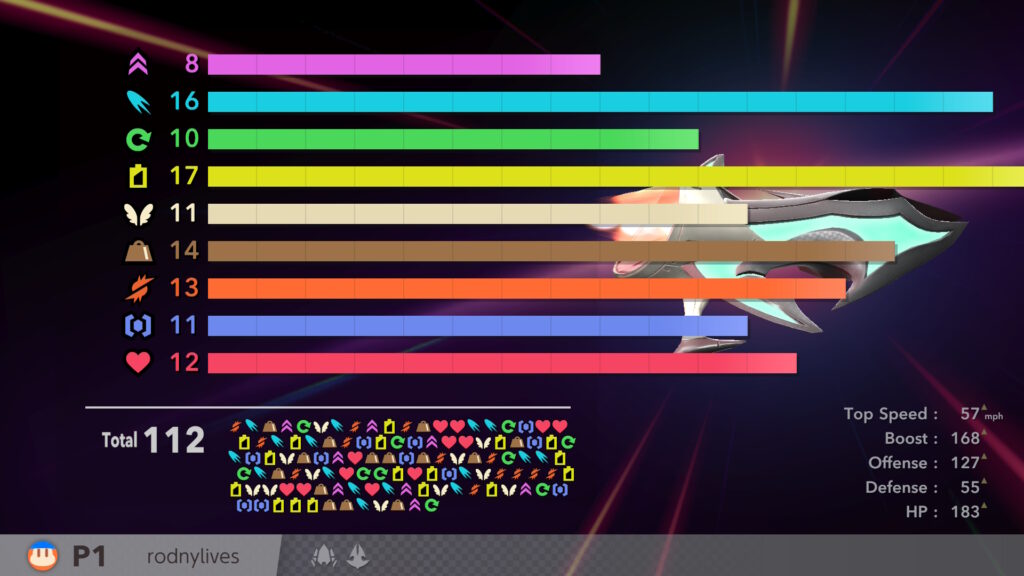
My record at collecting stats so far. I wish you could save vehicles you’ve built, but alas each only gets used for one Stadium.
Each run has a selection of special things that can happen during it. One of them is a hunt for pieces of a “legendary machine,” a vehicle with extremely high stats that is sometimes hidden in some boxes. If a player collects one, an icon appears over them during play, signifying to everyone else that they have it. If player with a machine piece is struck by another player they might drop it. If a player gets all three pieces, a notification is given to all the players, and they get to ride it. It happened to me once! Here is video (½ minute):
Other things can happen too! It’s really never the same game twice.
Now, the worst thing about the original Air Ride still applies: there is no Grand Prix mode. (Why not?? I guess the inhabitants of Dream Land don’t have it in them to hold one?)
The most pleasant surprise, besides the fleshed-out, fully online-capable City Trial mode, which feels like the game it was always meant to be, is that Top Ride, the odd mode out of the original, is now decently playable and much more fun. It doesn’t have a Grand Prix mode either, but its races are so short that it barely even matters. I’ve mentioned before that it feels like Sakurai intentionally patterned it after Atari’s ancient Sprint games, which go all the way back to 1974’s Gran Track 10, giving it a legacy that goes back to two years after Pong. It’s playable online too, as well as namesake mode Air Ride.
The new singleplayer mode, Road Trip, is okay, but it’s just a disjointed series of challenges. You do get to build up stats throughout it, giving it an RPG feel, But there’s no exploration or anything like that.
The one thing that connects all the separate modes is Kirby Air Ride’s greatest invention, returning for another go: the Checklist. A grid of 150 boxes, one per mode, with an extra one for Online play. Every one has an unlock requirement.
At first, none of the boxes’ requirements are even revealed. You’re certain to check at least one of them the first time you play each mode though, purely by chance, and the requirements for the boxes around the ones you’ve checked off are revealed to you. Most of the boxes give you a little something when you check them. Some new decals or accessories to decorate your vehicles with. Some of them unlock characters, or machines for use in some modes, or costume pieces. A scant few give you free checks you can spend, to mark off difficult challenges for free. Many (not all) have optional setups you can activate, like little minigames.
Kirby Air Riders’ biggest sin, and greatest virtue, is that it’s really different from other games. It throws out features one would have thought obvious. (Grand Prix modes!) It adds weird new ones for no reason other than the joy of doing so. (Playing with gummis in a physics engine! Customizing machines and selling them in a little fake marketplace!)
And it does unexpected things, like after spending five minutes attacking and avoiding up to 15 other players, having them each choose which Stadium to play in. There isn’t an overall winner: each Stadium has its own winner! And, if you’re the only one to choose a Stadium, you win automatically.
Yes! That’s Lolo and Lala, from the Adventures of Lolo, a.k.a. Eggerland, games, slightly renamed and playable! Their special attack is shooting familiar-looking big green blocks at the other players!
This happens much more rarely than you might assume: it’s only happened to me once, after playing a whole lot of City Trial. Even those rare times were the game randomly decides you’re all playing THIS now, players are still split up into arbitrary groups.
It’s hard to say if you’ll like it because other than Air Ride, there’s nothing really to compare it too. It’s its own thing, but I think that’s what I like most about it. Whatever Kirby Air Riders has, this is the only place to get it. And it definitely has something. It’s a shame that you have to take a seventy dollar gamble on whether it’s something you want. Ideally the Global Test Rides were when one would have tried it out and seen if it was to one’s liking. Maybe they’ll do another one some day, or you can watch Youtube videos of gameplay? (I once again humbly offer myown.) But if this is something you’ll like, you’ll really like it. Maybe use that new Switch “game borrowing” feature to bum it off a friend for a while. It should be experienced at least once.
So it’s over, and all of those Switch 2 demo apps used to play it are now useless hunks of code. If you load it up now, it’ll tell you the period is over and direct you to the eShop page for the full game. Maybe they’ll offer another one someday, they’ve been known to dust off Splatoon demo apps as a promotion from time to time, but odds are it’ll never work again.
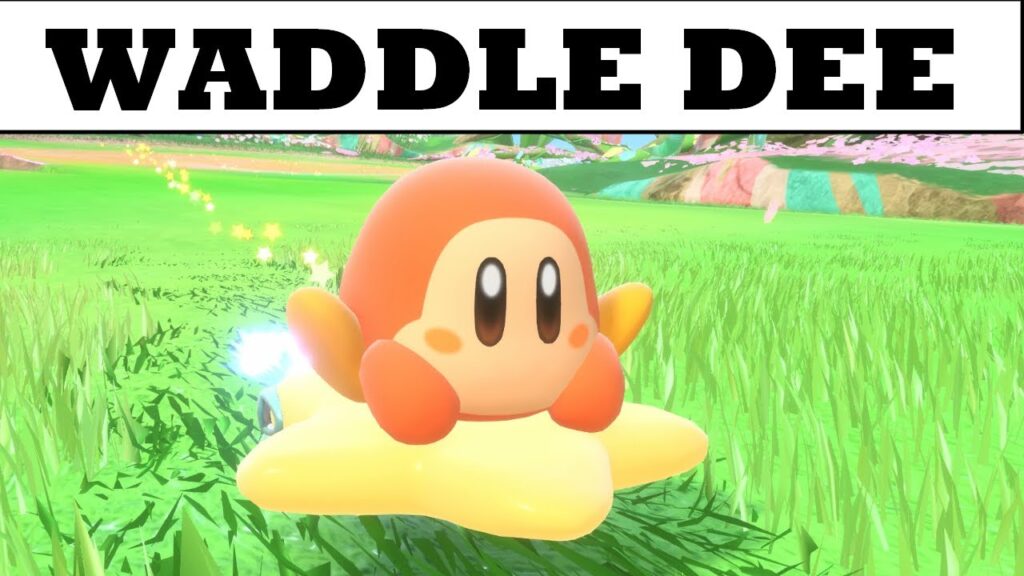
Debuting in the second demo: Regular Waddle Dee! Motto, “I have no mouth and I must RIDE!” (Image taken from a thumbnail for this video.)
It seemed to go well, and I only had a couple of disconnects, despite being saddled with rural internet. Most of my play in the second demo period was spent with the fine folks of the Kirby Air Ride Online Discord, people who are fanatical about the original game, and seemed to like the new one just fine.
I love Masahiro Sakurai’s determination to make the kind of games he wants to play, and I love that that’s so different from other games. We need lots more people like Sakurai making big games, but should remember that he can only do it because his games consistently sell well, and that he’s the creator and director of one of the biggest series there ever was, Super Smash Bros.
It’s like a last vestige from the classic age of console game development. Even if you don’t like them yourself, it’s important that these different games are being made, they help keep the gaming world viable, if just a bit, for new concepts. Without Smash Bros., it’s obvious we wouldn’t have Nickelodeon All-Star Brawl or Multiversus. Personally I have grown tired, very tired, of the idea of crossovers, but I don’t think that can be laid at Sakurai’s feet. It’s the executives that love the idea of mixing their properties together, even though it makes of their worlds and stories the same thing you get when you mix red, yellow, green and blue paint together: a big pot of gray.
Sakurai’s in a unique position, as both creator of one of Nintendo’s biggest series, but also no longer working at Nintendo. When you see his beautiful living room in his game design videos, that was paid for by the moneytrucks Nintendo must send him daily.
Let me impress upon you how weird the Kirby Air Ride games are. The “main” mode, the one the first game’s named after, Air Ride, is pretty basic. It has no Grand Prix mode, even in the sequel. Every race stands alone. The main way you play Mario Kart doesn’t even exist in Air Ride(ers). That’s a pretty strong statement that it isn’t a standard kart racer!
Of City Trial, it’s most interesting aspect is how invented it is. Most games try to follow elemental archetypes. You’re a shootyperson on a battlefield; you’re a swordperson in a dungeon, you’re in a maze, you’re jumping across platforms, you’re a commander of troops, you’re running a civilization, etc. City Trial can’t be summed up so easily.
I especially admire how each City Trial match can end so differently. You might have a fight, run a race, or participate in a vehicular version of a track-and-field event. This probably turns some people off; even the Kirby Air Ride Online people, when they run their tournaments, hold them in a customized version of the Gamecube game that disables many of the events and Stadiums. It makes for better spectating if the game doesn’t sometimes douse the game in a heavy fog, or if the Grand Finals doesn’t end up decided by whoever jumps the highest. If they hold Kirby Air Riders tournaments, how will they feel about Air Glider and High Jump returning to the event pool, joined now by Skydiving?
It became evident during the second demo period that Sakurai, despite talking about Air Riders for nearly two hours on the internet, has kept his lips shut about some substantial aspects of the game. Two vehicles that have never been seen before debuted, the Vampire Star that attacks nearby players automatically, and the Bulk Tank, which takes a heavyweight option and makes it more. We still don’t really know much about the Road Trip mode, which didn’t feature in the demo at all, not even appearing on the menu screen.
Well the demo is over now. The full game will be out on the 20th. See you on the riding fields, ya bunch of hamsters. (1 minute)
Acronyms: KAR: Kirby Air Ride, the original for Gamecube. KARs: Kirby Air Riders, the new game for Switch 2. (Note the following lowercase ‘s’.)
Who’d have thought that a Kirby game could be so vicious? If you think Smash Bros is a fun and lighthearted romp then this game will show you how perilous a Sakurai game can be. Several of the characters, even among the limited selection in the demo, are former bosses (King Dedede, Meta Knight, Magalor, Susie), so you might think of this game as them taking out their frustrations on Kirby for beating them up.
I should say that the demo was missing many items and events, this only covers elements from the Global Test Ride demo, available here. The first Global Test Ride is over, but there is another one on November the 15-16th, depending on your timezone. The full version of Kirby Air Riders is out on the 20th.
While it allowed playing Air Ride, the namesake mode, in an offline capacity, the demo focuses on City Trial, the mode everyone remembers from the original KAR. The game comes with a bunch of tutorials, and they can be played even outside of the demo period. They explain the basics adequately, so other than a bit of a recap I’ll content myself with explaining City Trial in more detail.
If you’d like to see what it was like during play, I recorded some of my adventures playing the demo and uploaded it to Youtube, here (1 hour, 22 minutes):
How it works
You and up to 15 other people are thrown onto a big sandbox map, a city on Kirby’s home planet of Pop Star called Skyah. In the demo, in practice, you’ll be playing with 15 others; I never had a match with fewer than that.
You all start out riding Compact Stars, which are maneuverable and can glide a bit, but are really fragile and have little else to recommend them.
Rapidly move the control stick from one side to the other to do a “Quick Spin.” This is an essential move! While you can damage other machines just by driving into them at a sufficent speed, Quick Spins make it easier to do damage, and you even get a brief period of invulnerability at the start of a spin.
You have five minutes to pick up “patches,” single-color icons that increase your stats a bit in one of a number of categories. Get as many as you can!
There are different colors of boxes that appear. Blue boxes are the most important, as they contain both patches and food items that can repair damage. Red boxes contain Copy Essences that give you different attacks; Green boxes have other kinds of items. Only the patches are permanent. Break boxes by either boosting into them repeatedly or using the “quick spin” move.
You can also change vehicles. Ride up to an empty vehicle and hold down the Y button (sometimes called “Special” in the game) to switch to it. You take all of your patches with you when you do this!
While you can get off your vehicle by holding Y for a while, there is little reason to do so. You can’t even pick up power-ups while unmounted.
You can attack other players. So, too, can they attack you, and as mentioned at the start 16-player City Trial can be incredibly vicious. Stay on your guard. Players who are attacked usually lose a patch or two. If your vehicle gets destroyed, you’ll lose a bunch of patches, although not as many as in the original KAR, where you usually lost half of your patches. By the way, when I say you’ve “died,” I really mean your vehicle got destroyed. Your character cannot be harmed.
The city is pretty big, and has several hidden areas. Generally, the more out-of-the-way areas are safer, and have more powerups to collect.
Throughout the time period, different random events can occur. Some good, some bad, and some are just weird. If the event has some special location, an arrow will often appear around you pointing which direction it’s in.
One kind of event is the competition event, and it’s like a minigame. You’re told a “quick race” or a “dustup derby” is about to begin, with a start location somewhere in the city. It’s up to you if you want to participate, but if you do you’ll get at least eight random patches for participating, a few more if you arrive early, and you’ll get some more if you place well. Even if your vehicle gets destroyed in the event, it isn’t permanent. If you choose not to participate you can continue to explore the city, and without the participants attacking you might come out ahead. It’s your choice.
The purpose of all of this comes after time runs out. You’ll be given a selection of one of four “stadiums” to participate in using the machine and all the patches you’ve collected. The stadiums are all very different from each other: there are races of several types, battles, combat against enemies, button-pressing competitions, jumping contests, and even boss fights. At least one will be recommended to you based upon which machine you’re riding. Think carefully: some machines are unsuited to some stadiums. If your machine is really unsuited (a wheeled vehicle in an aerial stadium), the game will even stop you and ask if you’re sure, but it’ll let you do if anyway if you tell it yes.
This bit is important. Each stadium is its own game: you’re playing to win your stadium, not the City Trial session. Due to this a large game of City Trial can have up to four first-place finishers. If a lot of players (more than eight) pick a stadium, it’ll be split off into two separate competitions with their own winners. If you’re the only person to pick a given stadium, you win it automatically.
The finer points
Machine choice You start out with the Compact Star, which is extremely fragile. I don’t know if this is still true, but in KAR it was found to have zero defense, meaning Defense patches had no effect on it!
You’ll want to switch to another machine, scattered around the city, as soon as possible, before some of the players will pick up the stronger machines. Shadow Star is prone to being taken out in one hit, with the main compensation that the rider can do the same to other vehicles. Also, Wing Star has always been notoriously killable, and Paper Star is even more frail. All of the flight-focused machines are made of paper, figuratively or literally.
The sturdiest machines are Rex Wheelie, Bulk Star, Wagon Star, Battle Chariot and Tank. Especially Wagon Star, whose health bar can extend up and off the screen.
You can choose your character too, and that can have a substantial effect on your longevity. Throughout all the vehicles and characters there’s a general theme of lighter: easier to get killed and fly, and heavier: does more damage and sticks more to the ground.
Evasive maneuvers Driving in a straight line is pretty dangerous. In fact with people riding Battle Chariots and Tanks roaming around almost anything you do can be lethal to your machine, but driving in a straight line out in the open pretty much paints a big bullseye on your back. The more fragile your machine, the more important it is to avoid open spaces and driving in obvious straight lines.
Try not to brake for too long, or drive into walls. This might seem obvious, but there are players that look for people driving into barriers.
Awareness Despite all these things, you’re gonna die sometimes. Somethings that could help: look for icons at the bottom of the screen indicating pursuers. And be aware of a red border along a side of the screen: that means there’s a big danger nearby, like a bomb explosion or a Gordo.
Machine advice If you decide to go with a flying machine, all I can suggest is being very careful. Most of them can’t take more than one or two hits. If you go with one, you’ll want to spend most of your time in the air, where it’s much easier to survive, and get your stats from the tops of buildings and flying through rings
The most important stat, as with the original, is Top Speed. Not only is it generally useful in most stadiums, but the faster you move, the quicker you can get to patches, and the faster you can grow your machine.
Unlike in Kirby Air Ride however, depending on your choice of character you might have low acceleration, a.k.a. Boost. And all drivers that have high Top Speed have low Boost, and vice versa. If you’re playing a high Top Speed character, Boost may be a higher priority for you. At least one machine, the Bulk Star, can’t move at all unless you charge it up, so the Charge patches will be more important to you.
Places – Underground mall No place is completely safe, but the underground areas tend to have a better ratio of reward to risk. The mall is tight corridors and little room to avoid conflict, but also more boxes than other places. – Crystal Caverns The crystals here can be destroyed, and contain patches. They tend to get cleared out early in each match, but it’s pretty common for one or two to be missed if you find yourself here anyway. – Shipwreck The lift pad in inside puts you on deck, where you can use the cannons to immediately become airborne – Plaza This central location has ramps for getting into the air – Rails Like the original, there’s a system of rails that goes around the outside perimeter of the city. KAR enthusiasts tend to call these “rail jail,” since getting on them tends to mean you’re stuck for a few oh-so-important seconds. Now the rails sometimes have a patch on them, and you can escape a rail by holding to the side for a second or two. Be careful now to fall off on the wrong side though. – The Volcano During the Portal event you can sometimes find a lunar landscape, which is actually beneath the Volcano! The lift pad inside it sends you way up high in the air. Is there another way into the Volcano? I’m not telling! Because, honestly, I don’t know. Sakurai says there is, but that could just be via the portals.
Events – Meteors & Gordos Both involve huge round dangerous things falling from the sky. You don’t have much vertical range of vision, so it’s difficult to avoid them while you’re out on the surface. It might be a good idea to hide underground during these events. – Bosses (Dynablade, Grand Wheelie, Kracko) Fighting the bosses is dangerous, but can be a good source of patches. As with any event that attracts lots of players to one spot, you might actually get more benefit from attacking the distracted players than the boss. – Lots of Boxes They all appear in one location. Again, attacking the gathered players feeding at the trough works well here. – Portals The game hurries you into them, but they just lead to other places in the city. As explained before though, one of them leads to the lunar chamber beneath the Volcano. – Competition events It’s usually a good idea to participate in the competition events even if you don’t have a good vehicle or character for it. There are two kinds: Races and “Dustup Derby” bouts that are kind of like vehicular deathmatch. Even if you lose, your state is restored afterward, and you get at least eight random patches, risk-free, just for participating. – Secret rooms There’s a few secret rooms in the city that are usually locked off, and only open for this event. When they open, each has several of the same powerup in it. Sometimes they’re patches, but sometimes they’re just attack items. Unlike KAR, there’s more than one secret room in the city this time. The arrow around you points to the nearest one that still has powerups in it. – UFO One of the few upsides of aerial machines is being able to get up on the flying saucer when it occasionally visits. There’s a lot of patches up there, often including an All patch, which increases all your stats by one point. – Rare boxes, and Rare boxes with fakes Rare boxes have lots of patches and few downsides. Rare boxes with fakes, though, are infuriating; opening the wrong box will inflict a lot of damage on you, and has a good chance of destroying your machine outright. If it follows a similar philosophy as KAR then there’s some way to tell them apart, but in the hectic atmosphere of the demo period I didn’t have a chance to figure out what it was. – Treasure chests Search the city for a key, then take it to a treasure chest for a prize. The arrow around your vehicle points the way, although the two times I spotted this rare event I wasn’t able to get anywhere near one of the keys. – Tiny players! Gigantic items! All the boxes contain the same items! All machines fly more easily! Some of the events are just strange happenings. At least the worst events from KAR, dense fog, fake items and bouncing items, don’t seem to occur here, or they don’t in the demo.
Priorities – In the original, Top Speed was the undisputed king of powerups. Higher Top Speed means you can explore and find more patches faster, and most of the stadiums prioritize speed. Two things challenge Top Speed’s domimance. Bigger characters and vehicles tend to already have a good speed, but are slow to reach it; for them, Boost (acceleration) might be a greater priority. Second designer Masahiro Sakurai said in KARs’s first Nintendo Direct stated that Top Speed actually reduces your Defense a bit, which as far as I’m aware is new. Now Top Speed, while still very important, is a bit more of a tradeoff. Rider/vehicle combos with lower acceleration will want to get more Boost (which should properly be called Acceleration). Weight increases speed a little and makes you a bit more durable. Flight patches on a wheeled vehicle are practically worthless, and Flight lowers durability a bit too. Look out for the gray patches though, those are powerdowns. – The best Copy Abilities are Needle and Sword. Both are excellent for attacking bosses. Plasma is also pretty good, and easier to use than in KAR. – There are also special weapons and powerups. One of them, the Firecracker, has gotten a severe downgrade since KAR, it’s only got ten automatic shots now instead of the original’s 25 and so is useless if there isn’t a target in sight right away. That’s a common issuen with the powerups, but it’s especially bad with the Firecrackers.
Stadiums Oval Course: A race around a simple course. In KAR, all of the Air Ride courses got used as stadiums, but there’s been no hint that this will happen in the new City Trial.
Drag Race: A quick trip down a straight course. While races are a bit more competitive in KARs than they were in KAR because of the new trail-of-stars catchup drafting mechanic, this still usually comes down to whoever has the best speed stat.
Beam Gauntlet: The event doesn’t mention the fact that this is a race, but through a treacherous obstacle course. If your machine gets destroyed along the way, you end up in last place.
Gourmet Race: While called a “race,” the players are actually trying to collect as many food points as they can. The winner, I think, is usually the one who knows how to get extra food on top of the buildings, instead of grubbing the ground grub with the other players stuck down there.
Target Flight: A good event for upsets, if your vehicle has enough airtime to make it to the target board you might earn up to 100 points. This event gives you two tries to get the best total score.
Skydive: Also prone to upsets, this is my favorite of the new stadiums. Use the boost button to plummet down through the target rings, and find the highest-value landing place you can. You get a time bonus for finishing quickly, so even if you somehow end up here with a non-flying vehicle, you can get a good basic score by just plummeting down as fast as you can.
High Jump: Use a ramp to jump as high as you can. This one is mostly a stat check: how good is your flying power?
Air Glider: Use a ramp to jump as far as you can. While also a stat check in essence, at least in this one you have to strike a balance between forward speed and height.
Dustup Derby: a version of the “deathmatch” event from the city. If your machine gets destroyed you get another one, letting you stay in the game (but also letting the other players kill you again for another point).
Kirby Melee: the players are put in an arena with a cloud of basic enemies, many with copy abilities, and compete to defeat as many as they can. I found the Needle copy power to be very helpful here, if you can snatch up an enemy that has it.
Vs. Boss: A co-op event where all the players work together to defeat a bit enemy. The only boss in the demo is Robo Dedede. If you don’t work hard at attacking it you won’t win, although the players get ranked either win or lose. Quick Spins won’t cut it: you’ll need to use the powerups that appear in the arena to have even a slight chance.
There was also stadium where you tried to change more buttons to your color than the other players, and another battle event where there are powerups that make you huge and extra powerful. I’m pretty sure there will be more events in the full game than featured in the demo.
NOTE: In another world, Roguelike Celebration is going on today! A lot of people worked hard to organize it, and more worked hard to present at it, including some of the coolest people in indie gamedev, IMO, just to apply a little timely peer pressure. As I write this it hasn’t happened yet, so not a lot to say that I haven’t already, but I’ll say more about this once the talks have actually occurred. In the meantime….
I overall really like the direction the news of Kirby Air Riders is going, even if I have a few mixed feelings about it. There’s a lot of cool and funny new elements, but it also feels like Sakurai might be leaning a bit too hard into the Smash Bros. style. So many of the new features are note-for-note similar to Super Smash Bros, which I can’t just abbreviate to “SSB,” because that’s the same initials as this blog.
Like the fully-voiced opening theme song. The feature of Smash Ultimate that I hated more than perhaps any other part was that stupid theme song. It’s not that it’s a bad song itself, but every time I started the game up I was greeted by a song about the most overused tropes, not just in gaming, but in current-day media altogether: light and darkness. Oh, if my griping might start a movement to take pop culture back from terrible good-slash-evil narratives I would be a pleased whatever-it-is-that-I-am. I got the Adventure Mode out of the way very early in my time with Ultimate, I didn’t need to be reminded it existed at every startup. Air Riders has one of these songs too. I’m sure it’s nicely sung and produced, but it’s the opposite of what makes Kirby music great: bright, cheery, impressively scored tunes with an incredibly quick tempo.
Other features in both games:
For starters, the interface, especially the menus, are extremely Smash-like.
Amiibo support, in the sense that both games store machine learning parameters onto the figure’s 2K of flash memory to support trainable characters. Yes, figure players are back, the feature only interesting to me and a handful of others. I wonder how the game will utilize the approximately ½K of flash storage available to game applications this time?
Uses a currency for unlocks, and a weird kind of fake economy. Smash Ultimate has gold and “SP.” Air Riders has “Miles,” which are essentially gold coins again. Is anyone annoyed that gold, a metal without a lot of industrial use, is still absurdly valuable mostly because of jewelry use and tradition?
A very similar visual style. When unlocks happen, words splash across the screen in your face in exactly the same way familiar to anyone who followed the Smash Ultimate updates eight years ago.
Sakurai says it’s different, but “Global Win Power” still looks a whole lot like “Global Smash Power.”
On top of it all it uses the Smash Announcer, who unless my ear is mistaken (it frequently is) has been with the series since Melee, at least in English.
Not that the requisite griping is over, there’s lots of really fun things unveiled too. Like the inclusion of loads more Kirby characters, some of them pretty deep cuts. My favorites have to be Lololo and Lalala, who are direct references to HAL Laboratory’s early MSX hit Eggerland, known in the US as The Adventures of Lolo. Other than an obscure Windows release many years ago now, Lolo and Lala basically live on Planet Popstar these days, with no forwarding address left to the King of Eggerland.
Do you have any blocks that need pushing? No? Well we’re just going to hang out in case you get some.
Í’m struck by the fact that, by having so many varied villains who all have become Kirby’s friends over the years, Kirby’s adorable little universe has become one of the largest and deepest in all of gaming. Among Kirby’s friends are a mischievous penguin, a mysterious knight with a battleship, a lady robot entrepreneur, a mouse thief, a spacefairing alien, a spider person, a tricky clown, and more. Most of these characters were created after Sakurai left HAL and Nintendo, but yet are fully embraced by Air Riders, and I love that.
And there are so many weird little unnecessary touches. There’s a full lobby-like “paddock” where characters can congregate between matches, and they gave everyone full walking and jumping animations just for interacting within it. Sakurai says it took a lot of effort to make them, and I believe him. Also, it seems to be fully catered. Chef Kawasaki’s been busy, I see.
The best reveal was the new game mode, Road Trip. I’ve always liked Smash Bros’ weird side game modes, like Smash Run and Smash Board. There’s no one working in big gamedev who is as free with his thinking and design atoms as Masahiro Sakurai. He takes all these design elements and combines them in a way to create these little narrative engines. Road Trip fills the biggest gap of the original Kirby Air Ride, a game that, despite the greatness of City Trial, had absolutely no Story or Grand Prix mode, and so seemed a bit light. And indeed, there’s still no Grand Prix, or other structured racing-only mode.
Back to Road Trip, I especially like that it uses the patches from City Trial, so as you play you also create customized vehicles.
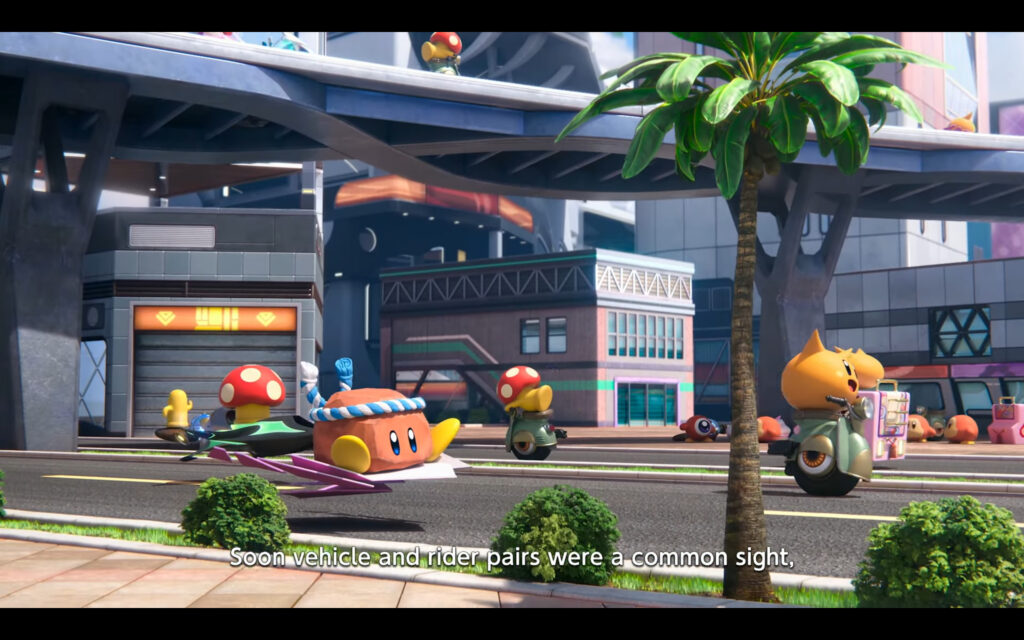
Kirby games don’t usually give you much of an indication of what day-to-day life in Dream Land is like, this is more than we’ve ever gotten.
All of the tracks from Air Ride are returning in Air Riders, although it seems the original City Trial City isn’t. Also returning is Top Ride, Sakurai’s weird homage to, of all things, Atari’s incredibly ancient Sprint series. He’s never mentioned Sprint in a Direct, but it’s so obviously a riff on Sprint. Even if he’s never heard of Sprint (given the breadth of his knowledge of the history of video games that seems really unlikely), it had to have been inspired by other games that were inspired by Sprint.
Another of Air Ride’s signature features, the Checklist, is back. To explain: each game mode has a grid of boxes, each with some feat or objective to perform. While you can unlock them in any order, you aren’t told what any of them are at first. But after you stumble upon your first unlock, the conditions of the squares surrounding that one are revealed to you, so it results in a kind of progression. Some of the squares unlock features when opened, and as you clear the board you’re eventually granted a handful of free checkmarks, to help clear out the hardest challenges.
In Air Ride, the Checklist was the only thing providing continuity between play sessions. That’s less the case with all the things there are to unlock in Air Riders, but what with Nintendo’s stubborn resistance to implementing Achievement features, as about the nearest thing to that Nintendo’s ever published, they’re welcome.
There’s a whole menu dedicated to making visual effects less jarring!
Here’s a flurry of little things I noticed:
A bespoke boss, a mecha version of our favorite emperor penguin*, called Robo Dedede. Say it quickly, it’s fun!
A special kind of collectable called gummis. They seem to have no purpose except to pile up onscreen in a physics engine and letting the player sift through them like a greedy candy miser.
A transforming vehicle, that transforms like a Transformer, metal bits shifting around into an alternate shape.
For the first time in any Kirby game, you can be nice to Whispy Woods, instead of making the old tree cry.
Some fun cameo characters revealed: Tortilding (from Forgotten Land), King Golem (from Amazing Mirror) and Computer Virus (Super Star), the funniest Kirby boss of all, where you fought it in a mocked-up JRPG-style battle.
A track only named “?” in the Direct, which uses music from the Nightmare fight from Kirby’s Adventure (the first “serious” opponent the pink blob creature ever fought), and features the Heart of Nova in the background.
For the first time really in a Nintendo game, it looks like they paid serious attention to accessibility! You can turn off screen-shake and move the camera so that motion isn’t so extreme. As time has passed I find myself more and more bothered by screen-shaking effects, though I’m not sure if that’s me, or just that they’re much more common nowadays than they were in the days of the NES.
Once of the license designs shown off uses iconography from the Japan-only Kirby Cafés.
I’d love to go to a Kirby Café some day!
* I think the official line is that King Dedede is some kind of eagle, but he’s never shown any hint of flying like a real bird, and the idea of Kirby’s first major antagonist being a penguin with royal pretensions is too much fun to reject.
I’ve heard it said that there are several different varieties of Nintendo Directs. There the Major Announcement type (Switch 2!), the Bunch of Games type (Indie World!), the Franchise Update type (what’s Pikachu up to next?) and then there’s the type that introduces an individual game. (Breath of the Wild!) This video is of that last kind, but the game it announces is not the usual kind of thing.
Why did he leave? I can’t say with any accuracy, I have no sources at Nintendo, but I do sometimes remember little things I’ve read, which may or may not be true. One of those things was that he had left under a cloud due to the perceived failure of Kirby Air Ride, which had a long and troubled development process, starting on N64 then moving to Gamecube, and not having a lot of traditional content compared to its sibling Mario Kart. But this could be false: I believe he’s said publicly it had to do with not wanting to make the same kind of game over and over. So now, let’s set this thread down, and come back to it in a few paragraphs.
Sakurai worked as an independent game designer for a while, enviable work if you can get it, and are as good at it as he is. The first game he made out of the gate was early Nintendo DS hit Meteos, a fine game that everyone should play, if they can find it now.
Meteos was an action-puzzle game that did genuinely new things in that genre, and was really good, a tricky combination. He then founded his own company Sora Ltd., which has maintained close ties with Nintendo: every game they’ve made since has been published by Nintendo. One of those was Kid Icarus: Uprising, another fondly-remembered title. And then….
Yeah, I’m getting to it. Sakurai has continued to direct every Super Smash Bros. title. It’s been said that Nintendo believes no one else can effectively make a Smash Bros. game. Super Smash Bros. Melee came out before Sakurai left HAL and was a gigantic hit; the Gamecube wasn’t exactly a stellar success, but imagine how it’d have fared if Melee hadn’t been made? People still play Melee in large numbers today; ask AsumSaus about it.
While some subsequent entries have not met with perfect acclaim (Brawl), every installment has still sold an awful lot of copies. Nintendo keeps asking Sakurai to make the next Smash Bros., and although he’s mention feeling tired and worn out (he heads gigantic teams to make them, and it’s an immense amount of work), even threatening to retire at one point, Nintendo seems to keep finding bigger dump trucks of money to leave at his houses. So as an independent agent he’s made the huge Super Smash Bros. Brawl, and the colossal Super Smash Bros. for Wii U and Super Smash Bros. for 3DS, and the utterly gigantic Super Smash Bros. Ultimate, the fighting game that contains Mario, Link, Samus, Fox, Ness, Ryu, Simon Belmont, fighting Mii characters, Cloud, Sora and freaking Steve from Minecraft, among with dozens and dozens of others, even more if you count the Mii costumes you can buy, including Shantae, Cuphead and extra-freaking Sans Undertale himself.
And now, to pick back up that thread I left back there on the ground.
A few months ago at the Major Announcement Nintendo Direct about the release of the Switch 2, there was a short section announcing a sequel what may have been the game that caused Sakurai to leave Nintendo: Kirby Air Ride.
Sakurai has been vindicated many times over since then. Does it not have much content? He’s make the Smash Bros. games, each a greater tribute to the concept of excess than the last.. He said he didn’t want to make the same game repeatedly, but there’s been six Smash Bros. titles now. And after all this time, KAR’s City Trial still has a surprisingly large and involved fanbase, and even a tournament scene.
Early in the new announcement video (below), Sakurai mentions that it was bosses at Nintendo and HAL that asked him to make a new Kirby Air Ride game, not the other way around. It had to have been quite the vindication for him. Here is that video (47 minutes); for discussion of its contents, see below.
It has the slightly confusing name, when mentioned alongside the original, of Kirby Air Riders. I’ll abbreviate it KARrs.
Where KAR basically only had Kirby as a character, with King Dedede and Meta Knight more as gimmick characters, KARrs is full of characters, including former villains (Dedede and Meta Knight of course, and newbies Magalor and Susie), allies (Gooey and Bandana Waddle Dee), enemies (Chef Kawasaki, Knuckle Joe, Cappy, Starman and Waddle Doo), and various Kirby colors too. It has most (if not all) of the vehicles, called “machines,” from the first game and a few more. And it supports up to 8 players, 16 when played online.
And it still has City Trial, which Sakurai accurately refers to as the main event. Air Ride mode is a good basis, but City Trial is why people still obsessively play KAR today. It has a new City, on a floating island in the sky, and named “Skyah” He said there’s only one map, which seems a shame. KAR only had one City Trial map too. Skyah looks more varied, but not much more varied.
The core of City Trial is the same: the search for vehicles, the collection of vehicle-upgrading patches, the player-vs-player combat, and the sometimes-faulty information on which Stadium you’re trying to optimize for. KAR is a game where you can be told prepare for a race, and 10% of the time it won’t be a race. “Mind games,” as Sakurai calls it.
There’s still random events, but now there can be random contests that take place in the time-limited City portion of the match. All the players who choose to participate join in a special minigame that can award extra powerups, but players can also choose to ignore all that noise entirely, and just keep exploring and collecting patches on their own.
What’s missing? Sakurai says at the end that there’s lots of things he didn’t have time to mention, but they might just be gone completely. One of them, Top Ride, isn’t likely to be missed; it was a single-screen racing mode kind of like Atari’s Sprint games. KAR’s Air Ride’s tracks often made appearances as City Trial’s match-determining Stadiums, but Top Ride played no part in it. It’s probably been binned.
Another thing missing is KAR’s Checklist feature, a grid of squares for each of the three game modes, and each space representing a single challenge. Clearing the grid offered meta-progression in a game that made absolutely no attempt at storytelling. The Checklist was one of KAR’s big unique ideas, and it migrated over to a couple of titles in the Smash Bros. series. It’d be a shame if it was entirely gone from the game that birthed it. But Sakurai is known to discard even prominent features if he’s bored with them; remember the “Special Bonuses” in the first two Smash Bros. games, and how they vanished starting with Brawl? Remember how its Trophies didn’t make it into Smash Ultimate?
Even without the Checklists, there’s so much in the video to be excited about. This is unquestionably the Switch 2 game I’m most excited about. It’s true, it’s a sequel to a game that Masahiro Sakurai has made before, but it’s also an opportunity to iterate on ideas that deserve to be given another chance. Kirby Air Ride was something unique, and how often do we see that these days? Kirby Air Riders may be that utter rarity here in the 53rd year of video gaming: the birth of a new genre. It’s a personal pleasure to witness.