The 1541 disk drive was infamously slow, probably the slowest of the 8-bit floppy disk drives, the result of a VIC-20 Kernal bug that was inexplicably kept in the C64 for the sake of backwards compatibility. The problem could be fixed by writing your own disk routines, which is why so many games used fastloaders.
But the bug isn’t always at fault. The 1541 disk drive takes over a minute and a half to format a disk, but as it turns out it had good reason to, and the time consumed had nothing to do with the C64’s code because the drive does all the work itself; the Commodore 64 just waits throughout the process.
Commodore History goes into considerable detail on the process here (16½ minutes). During formatting the drive wipes out all the data that had been on the disk, lays down syncing structures, writes the disk ID to every sector, puts down the directory track and sets up the Block Allocation Map (BAM), and more. It’s an interesting, if not too useful these days, exploration of what disk drives at the time had to do to make the disk’s magnetic surface usable for data storage.
Set Side B began on April 5th, 2022, a new daily text blog in a world where pivot to video had come and gone, a blog that supports RSS and posts to Mastodon, a blog that serves the most catered (not to mention pandered) to subcultures of all, the video game player person, and is thus one among thousands. Yikes!
How are we different? Although we’re given to the occasional frivolity, we’ve never tried to insult your intelligence here. If it seems like we post randomly from across the whole breadth of gaming (notably excepting the standard AAA production) that is not an accident, even if we do, admittedly, veer off to Nintendo-related topics frequently.
We already did a 2025 recap post, and a full blog recap should wait another year for the 5th anniversary, but I figured it was worth looking back on how far we’ve come, and where we are now in terms of visitor stats. All of these figures are from WP Statistics.
On the average, Set Side B gets about 435 visitors a day. Our most frequent search referral is still Google at 27,954 over the last month. We got 1,108 from DuckDuckGo, and 750 from the poor saps using Bing. Speaking of saps, Brave search brought us 93 links. Facebook brought 36, odd considering I don’t think I’ve ever mentioned SSB on Facebook. I try to avoid it generally when I can.
Device usage breakdown: Desktops at 10.4K (hooray!), Smartphones at 3.5K (eh), Tablets at 137 (huh), “Phablets” at 14 (wha), and “other” at 6. What is other supposed to mean? Game consoles? Fones? Wristtops? Cyberglasses? Compuhats? Supposiputers?
OSes. Windows at 8.8K; Android at 1.9K; iOS at 1.7K; Mac at 1.2K and others at 531. I’d like to think the Wii’s and 3DS’s old versions of Opera are in there somewhere. (The Wii-U’s browser is hopelessly modern by our standards.)
WP Statistic’s map-of-the-world showing visitor ranks through color. Gray must be places that have never visited us at all whenever. That’s us. Set Side B: unknown in Greenland!
Most visits from countries are, in order: U.S., Viet Nam (second place somehow), China (third place, I’m guessing from AI training), then Brazil (we really need to do that retrospective on the Sega Master System and the Monica games eventually), the UK, India, Singapore, Canada (why so low, canucks?), Iraq(??) and Germany rounding out the top ten. The top city, inexplicably, is Hanoi in Viet Nam. Tokyo is 4th place. The top US city for visits is Ashburn, Virginia, down in 8th place.
Four years is a long time to do anything, but we don’t plan on quitting in the near future. Of course, as happened with our friend Matthew Green and Press The Buttons, all blogs fall silent someday. I hope that, when my day comes, if Set Side B is still around, that someone will take it over and keep it going as long as possible, so long as it stays true to its three categories of Retro, Niche and Indie gaming. So long as it’s true to those focii I think it won’t soon lose its way.
We love you! Please love us back, and spread the word about us! And of course, thanks for reading.
We love it when we find weird and unique indie games to tell you all about! Our alien friends to the left herald these occasions.
There are tens, if not hundreds, of thousands of quirky little games and things on itch.io. Lots of them are worthless, some are mere cash-ins, and a few are really nice, but good luck finding them with the towering piles of meh blocking view of the horizon, or indeed anything else.
So it’s nice when you find something through the browse feature that’s a joy to play, and such a game is Emlise’s Conservation of Bass. At first glance it looks like it’s going to be another game of the type that bitsy makes it easy to construct. Nothing against bitsy or its games, but most of them are pretty simple, leaning more into the fun of exploring a little world than offering challenging gameplay.
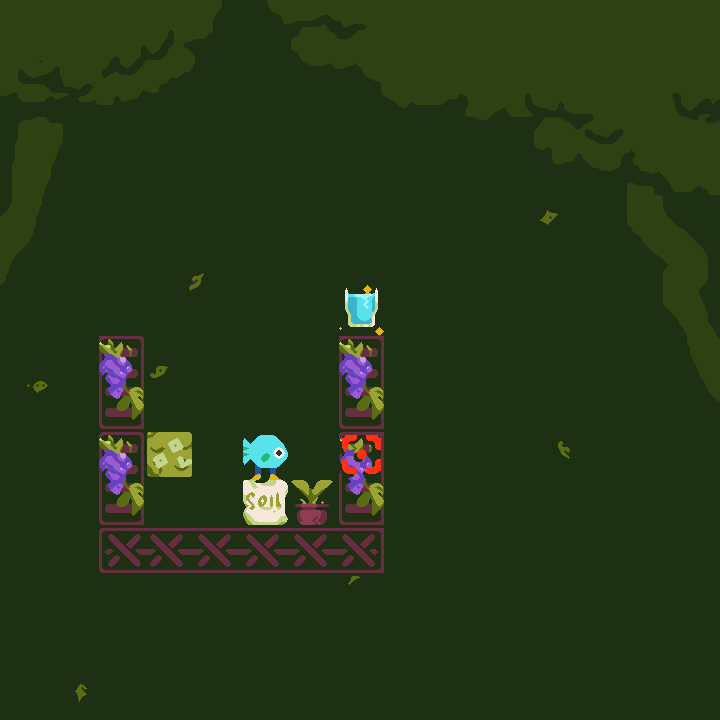
Here’s an early example level, that relies on the fact you can swap both horizontally and vertically.
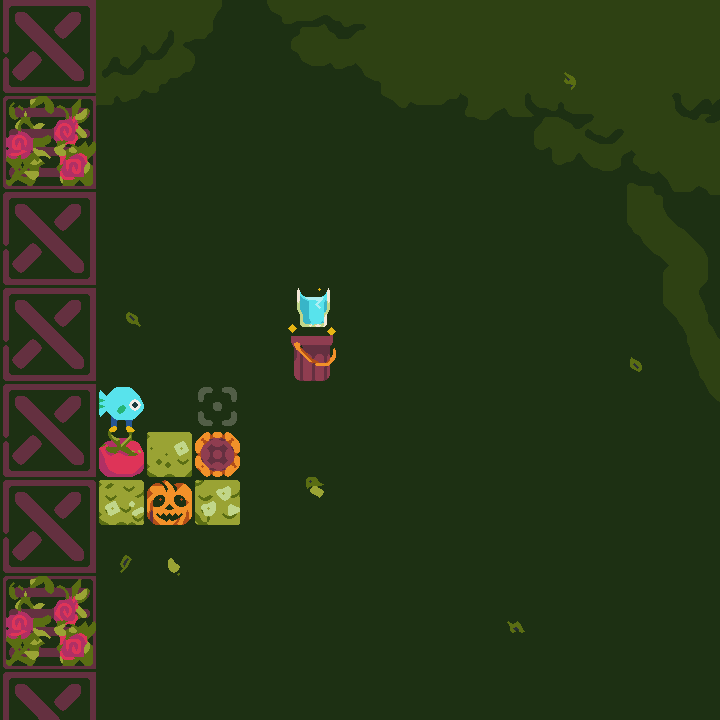
But as it turns out Conservation of Bass only looks like it’ll be an exercise in pure exploration. It’s actually a completely linear platform-puzzler, and it requires a surprising amount of skill to get far into it. Your walking fish protagonist can only jump one space high, and can’t move very quickly, so sharp jukes in the air won’t save you. As is the custom for these kinds of puzzle games now there’s no penalty for failure, it immediately resets the puzzle for another try.
The fish’s special trick is, it can swap spaces with blocks exactly two spaces away from it with the X button, if they’re the same size as it. It can do this in all for cardinal directions, by pressing that arrow key. These are the same keys that move the fish, and allow it to jump, and it can even do this in mid-air. That’s where the control skill comes in, even if you have a solid plan for how to solve the puzzle, putting it into effect may take you a few tries, as the timing window for swapping a falling fish with a block over safe ground is pretty demanding.
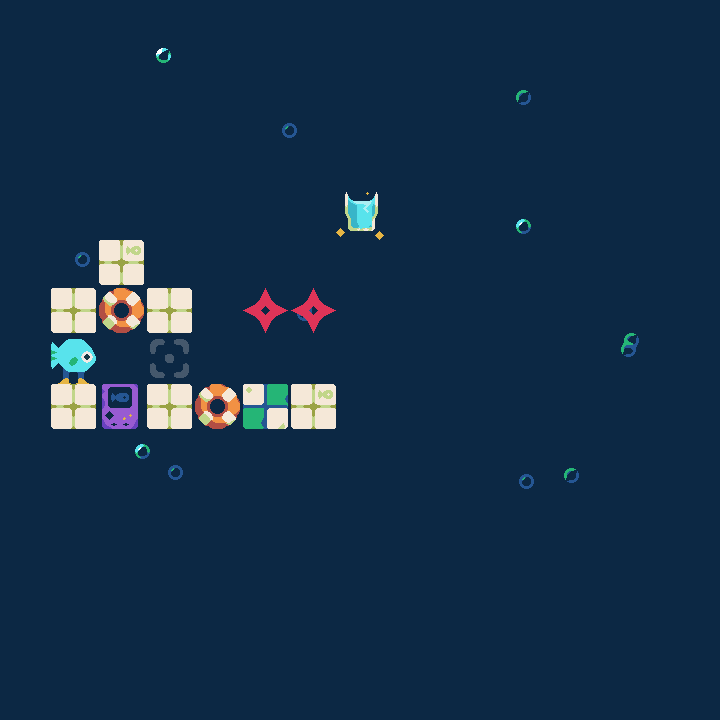
This one is very tricky! The fish can only jump one space high, and it can only swap with blocks two spaces away. To get a block into a place where you can use it to get up to the glass of water goal, it has to come from the bottom layer of the starting platform, but that’s directly over the void. How to solve it….
Helping out is a special property of that X button that’s unveiled to you a short way in: holding it down freezes time, and lets you then use the arrow keys to decide which direction you want to swap in at a bit without needing split-second accuracy, so long as you pressed X with that same accuracy to begin with.
This is another of those games where you’re introduced to its elements slowly, which is great because the puzzles get hard fast. I got to the early levels of Chapter 3 before my pending deadline forced me to set it aside and write it up. See if you can get beyond that.
Jeremy Parish, formerly of 1UP.com, currently of Retronauts and Video Works on Youtube, made an April Fool’s video, but because he’s Jeremy Parish it took the form of an interesting backgrounder on The Wizard, that big-budget Hollywood movie that’s like a feature-length advertisement for the NES and Super Mario 3. (18 minutes)
The Wizard stars Fred Savage of The Wonder Years, a popular show that you barely hear anything about any more. Like thirtysomething, remember that? I don’t either.
Many of my nights lately have been consumed with trying to play enough Caves of Qud so that I don’t embarrass myself too badly when I finally decide to talk about it. Most of my early explorations were in permadeath Classic Mode, but I have come to realize that playing it that way would mean I would need several years to finish it. I may not actually finish it before I write on it. On Nethack I had the advantage of being obsessed with it for years, had read many spoilers on it and participated on the Nethack Usenet group. These days much discussion of that nature has moved onto Reddit, which I have strong moral qualms about visiting now, not to mention that its app sucks on toast.
My play time for this game on Switch is 30 hours. I do not recommend it.
For most of the episode we try to treat the game as if all that skeevy stuff doesn’t exist, but don’t close it when it seems like it’s over….
As for the skeeve, the game’s official website has a section marked OPPAI, which I do not link to directly from here, in case it gets Set Side B on some kind of list.
I don’t make many @Play posts these days, and I’m sad that I have to drag out the tag for something like this. I am working on a lot of discussion about Caves of Qud (if I can link to Omega Labyrinth Life here I can certainly call out Qud), but the game is so blasted huge! Hopefully I can bring you something on that front soon.
It is April 1st, but I already made my silly fake post for the year a month ago. Here it is. Are we good then? Let’s move on.
I’m not happy with the clickbait title The Game Display chose for this video, claiming they found a “golden mushroom” in Super Mario Bros. 3 like it’s some actual thing. What it is is a 1-Up mushroom with a weird palette. But it’s still a video worth linking (11 minutes), and seeing, because to find it you have to learn about an unlikely secret mechanic in Mario 3 involving the map screen and the wandering Hammer Bros. You can watch it, but I’ll give you the gist down below.
Remember those map Hammer Bros. in Mario 3? They walk around after you finish a level or lose a life, adding a bit of extra uncertainty to the map screen, and giving you a stored powerup if you beat them.
But did you ever notice that sometimes the blocks in the battle arena where you fight the Hammer Bros. have powerups in them too, but only sometimes? And it isn’t something to do with the Hammer Bros. themselves, the same fight might have a powerup one time, but no powerup another. What determines whether it’ll be there or not? Is it random?
The diabolical thing is that it turns out the map intersection spaces, the little coin-like locations that Mario/Luigi can stand on but don’t contain levels, Toad Houses or anything that can normally be entered, are actually valid gameplay locations! They’re only loaded as battle arenas when you fight enemies encountered on the map screen on that spot. Although most of those locations look the same on each world, some of them have powerups in a specific block, and some don’t. The qualification for whether you can find it or not is where you fight the Hammer Bros., not which one you fight.
In the sky portion of World 5, there is one specific map screen spot where, if you can lure that area’s lone Hammer Bros. onto it and fight it there, you can find that 1-Up mushroom with the weird palette. It requires a lot of tricky actions to find it, since the Hammer Bros. icon can’t travel up one of the only two ways to that spot, and you also have to avoid clearing a couple of levels using Jugem’s Cloud, because if you clear a level normally, the M or L space that is produced blocks the movement of map screen enemies. You also have to avoid fighting and defeating the Hammer Bros. early of course, and you have to avoid turning the enemy into a Treasure Ship. That might seem like an unlikely thing to have to watch for, but it is a issue encountered in the video. Watch it and you’ll see.
It’s so cryptic and precise that it seems like it must be an intentional secret, the one non-level map screen spot with a 1-Up in it. Given how many infinite life tricks Super Mario Bros. 3 has, I can’t say that it’s particularly useful, but that isn’t the point. It’s a little nod by the developers to the obsessed player, a way of saying, we see what you did there.