Their newest pilot is heavily game-themed, so you can probably expect to see it return to Sunday Sunday eventually. Called “The Gameoververse,” it follows a team of hero-types that go out into the video game cosmos to prevent the good guys from winning, I think on the grounds that, if they win, their worlds cease to exist due to the player turning the game off or some such. Yeah, pretty much a similar premise to Reboot, if we’re honest, though there’s nothing wrong with that. (Wouldn’t the game world also cease to exist if it’s too hard and the player gives up? What about roguelike game worlds, that are generated anew whether the player wins or loses? Let’s see them make a Nethack episode, that would be something….)
Gameoververse (Wikipedia) was created by RubberRoss, and existed before as a web series from 2009, though with substantial differences. Notably the new version has music by former Rare musician Grant Kirkhope. We look forward to seeing, should the pilot be picked up, the continuation of its story.
Everyone that counts loves Pannenkoek, whose two Youtube channels pannenkoek2012 and UncommentatedPannen are probably the best, certainly the best-known, videogame internal explainers on the internet. They somehow made people care about an obscure Super Mario 64 challenge to get through the game in as few A button presses as possible. How can that even be?
Not only do they explain, I won’t say effortlessly, but effectively how tiny implementation consequences in the foundational 3D platformer, but along the way they explain a bunch of useful computer science concepts. They are a wonder, and if Nintendo ever paid attention to their fan communities for purposes other than suing them or making them pay licenses to use Their Content, they would hire them like a shot. But they don’t, and they won’t*.
Whenever Pannenkoek publishes a notable new video I usually try to draw a little extra attention to it here, but it’s been a little while since the last one. So here’s three shorter ones, all permutations of the topic of 1-up Mushrooms.
From 12 years ago: 1-up Checkpoint Locations, all the places you can go to increase your already swollen extra life count from 72 to 73 (7 minutes):
There are a few 1-ups in the Bowser levels that aren’t always there. It turns out the game can be set to make them appear only if you’ve already gotten the key from a particular Bowser fight, and that’s what’s going on there. It’s explained here: (1 minute)
And the longest one at 12 minutes, why do some 1-ups flicker before disappearing? Along the way it painlessly explains object activation, visibility and spawning, and the six types of 1-ups:
* A few more contractions, all nonsense: bron’t, fron’t, plon’t, hron’t, vnon’t.
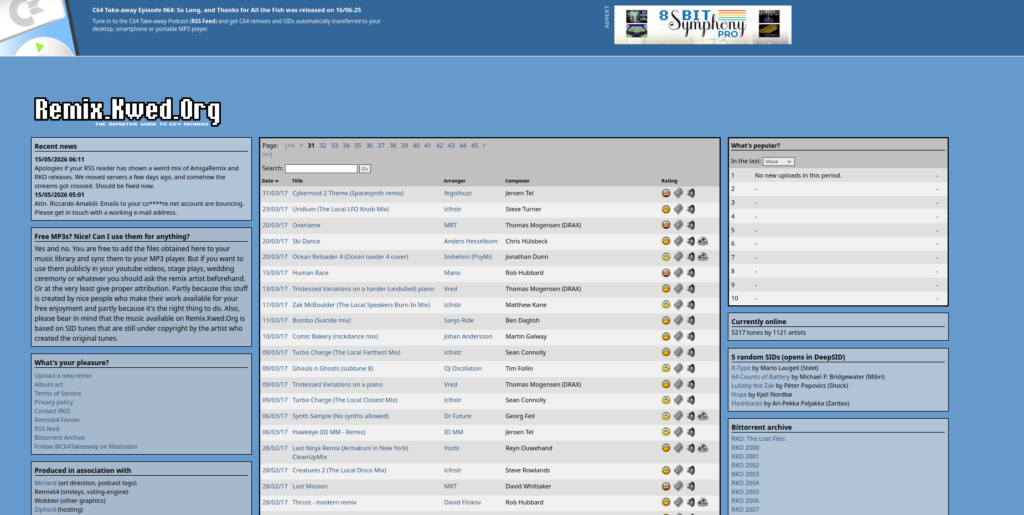
Still working on various other things, but fortunately I found out today about remix.kwed.org, which is kind of a version of OCRemix that focuses (but I don’t think is exclusive to) Commodore 64 music remixes. These aren’t also not all played by a C64, but are remixes of songs from them, so, not all chiptunes. If you need a jam to get you started, try this remix of M.U.L.E.
One of those things I mentioned is, I’m getting a table at Vintage Computing Festival Southeast 2026 in Atlanta! And they said they wouldn’t mind if I did another presentation on the history of Loadstar, so it looks like I’ll be doing that again too! If anyone reading this is in Atlanta July 31, or on August 1-2, please drop by and say hello!
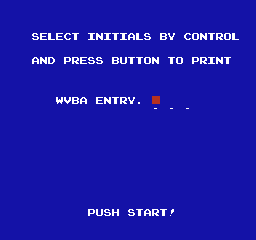
It’s a weird thing to change, but there is a slight difference between the version of Mike Tyson’s Punch-Out!! in the Playchoice-10 version than any other version of the program. As explained on the NES/Famicom game’s page at The Cutting Room Floor, when you start a game in Playchoice Punch-Out, it asks you to enter your initials.
Image from The Cutting Room Floor
It does this because of a couple of other changes: the player is identified by their initials before each fight, and it saves a high score table for each fight that’s displayed when the game comes up in attract mode.
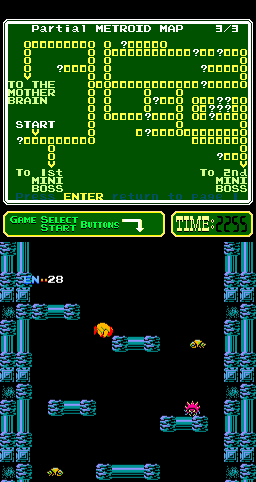
While we’re on the subject of Playchoice differences, on dual-screen Playchoice-10 machines, the top screen is used as a simple UI for selecting games and tracking how much playtime you have left, but it also displays instructions for the game. The instruction screen for Metroid contains a simple map of the first area. (Cutting Room Floor article with image)
Just a minor thing today, as I’ve been splitting my time between other projects. I may have mentioned the Punch-Out fact here before, but if I have it’s been awhile.
The weekly indie game showcases highlight the many games we check out on the channel. Please reach out if you would like to submit a game for a future one. All games shown are either press keys, demos, or games from my own collection.
Owner of Game Wisdom with more than a decade of experience writing and talking about game design and the industry. I’m also the author of the “Game Design Deep Dive” series and “20 Essential Games to Study”
We collect literally hundreds of links in compiling stuff to you, far more to give everything its own post. Here’s a scattershot collection of some of it, we hope that one or two of them might strike your discriminating fancy.
We dusted off the image editor and made the first new page header in years! It’s about time too, for it’s time to shorten our list of pages before they threaten to overwhelm our nonexistent offices.
1. Seminal official D&D blobber Eye of The Beholder got a C64 port three years ago. That’s how long this link’s been laying at the bottom of our barrel. Here’s a demonstration video. (37 minutes) If you play it on a C128 in C128 mode, it uses the 80-column screen to display a map! Something to try out in VICE.
2. Also from around that time LowSpecGamer did a video exploring the origins of the ARM processor. (18 minutes) It was created by people new to processor construction for British Acorn microcomputers, and from there expanded and grew until now it’s the most popular processor style in the whole world, backing both Apple and Android devices, by a long shot. It’s beginning to make inroads into desktop use even; I’m currently writing this on an ARM-powered Raspberry Pi 500+.
3. onaretrotip shows off cancelled arcade games in two videos, Part 1 (18 minutes) and Part 2 (32 minutes).
4. I’ve been having a distracting amount of fun on a kind of public Unix/Linux machine called a tilde lately. I plan on writing a lot more on my experiences, but in the meantime you can find out what they’re about, including finding one to sign up for yourself, at tildeverse.org.
6. A late-breaking development, the 25-year-old forums of classic gaming site Digital Press have been destroyed, apparently due to miscommunication between owners, in order to save a little bit of cash every month. As Time Extension reports, this is a gigantic blow to the retro gaming community, there was a huge amount of information that was contained there, and the Wayback Machine’s preservation of these forums is scattershot.
7. To throw in another last-second inclusion, Nintendo’s “My Nintendo” store is changing its name to just the “Nintendo Store.” This is their web shop, not their console-based digital game sales service called eShop, although you can buy downloadable games from the site too. I’d link to the announcement, but they stupidly only made it via Twitter. Get with the times, Nintendo!