
The news about this broke some time ago, but Set Side B is only a few months old at the moment and we weren’t around then. It’s still worth mentioning though!
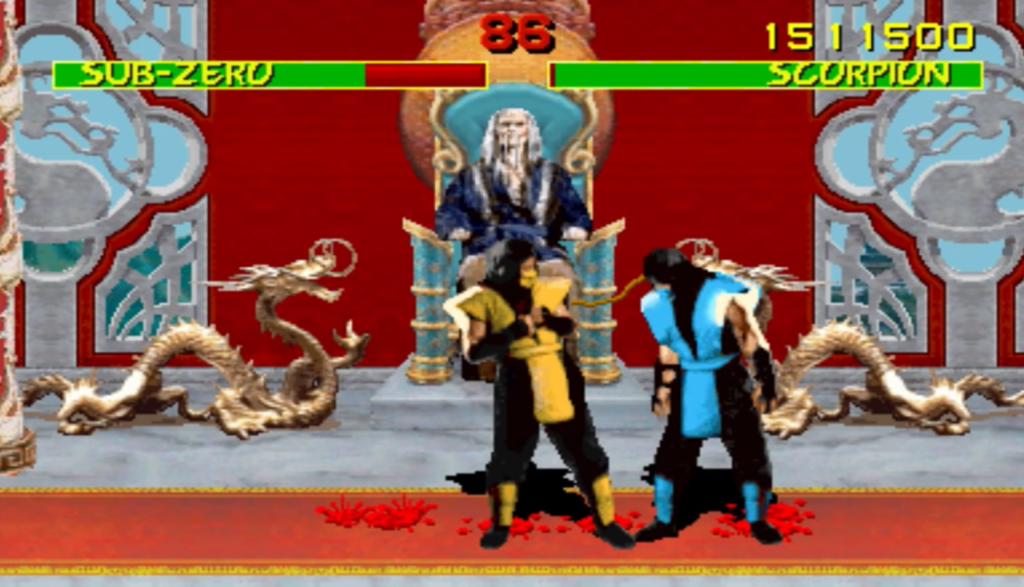
Ed Boon put secret codes in a number of his games to allow him to check on individual machines while out in the public. He revealed his code for Mortal Kombat II some time back, which is listed on The Cutting Room Floor. The code is entered entirely with the 1P and 2P Block buttons: P1 Block 5 times, P2 Block 10 times, P1 Block 2 times, P2 Block 8 times, and P1 Block 2 times. The timing is tight, so keep trying.
All image credits for this post: The Cutting Room Floor
One way to remember part of the code is in the menu’s name, the EJB Menu. The E and B of that stand for Ed Boon. E is the 5th letter of the alphabet, J is the 10th, and B is the second, and those are the number of button pressed needed for the first three parts of the code.. The whole code would thus be EJBHB. Using initials as part of a code seems to have been part of the culture at Bally and Williams at the time. A number of pinball games have hidden displays that can be called up from attract mode if you press buttons as if you were entering a developer’s initials in the high score screen.
The EJB menu offers a lot of information on how a machine has been performing on location! It’s much like the operator’s menu, but with even more options! You can even call up the ending for any character, would certainly would have made any kid who knew that code back then the star of the arcade.
Of particular note is, a couple of the items in the menus are red herrings. The developers loved taunting kids by putting fake hidden features in the operator menus. “Shawn Attacks” is one of them (there is no character called Shawn in the game); “Kano Transformations” is another (Kano is not playable in MKII).
Other EJB menu codes:
Mortal Kombat 1, it’s 1PB x 5, 2PB x`10, 1PB x 2, 2PB once, 1PB x 2, 2 PB x 3, then 1 PB x 4. The page notes that, converted to letters, this code would be EJBABCD.
In Mortal Kombat 3, it’s 1PB x 5, 2PB x 10, 1PB x 3 (it’s EJC this time!), then 2PB once, 1PB x 2, 2PB x 2, 1PB x 3, and 2PB x 3. EJCABBCC. This code also works in Mortal Kombat 3 Ultimate.
The Cutting Room Floor does not list a EJB code for Mortal Kombat 4. Smash T.V. does have a code for a developer’s menu.
Bald Bull is one of those memorable characters who’s been in several games, but doesn’t get the respect he deserves. The crowd loves the Turkish Titan! And now you can play as him! (Image credit: Mobygames)
(Note, for clarity, you have to say the SNES game Super Punch-Out!!, because Nintendo made a different arcade game that they also called Super Punch-Out!! Also, the exclamation points are part of the name. I’m not just really excited.)
To do it, Y+R must be held on controller 2, and Start pressed on controller 1. This loads a screen where any opponent may be selected
The opponent select screen. (Image credit: Unlisted Cheats)
Then, on the character info screen, hold B+Y, again on controller 2, and press Start on controller 1 to allow player 2 to control the opposing boxer.
The code even works on the version of the game on Nintendo Switch Online, so if you have an account there you can try it out without setting up an emulator or digging up an old cartridge.
It’s interesting to note the times that the big gaming sites reported on this. As of this writing (yesterday) and according to Google, Ars Technica reported on it 18 hours ago, followed by IGN (16 hours), Kotaku (15 hours), and then Eurogamer. Reddit says the post went up there 19 hours ago, and Unlisted Cheats posted it 20 hours ago. News travels fast in the videoscape.
The phenomenon of the cheat code has gone kind of out of fashion these days. They still exist, but tend to be more for debugging than anything, especially since interesting features can conceivably locked behind paid DLC gates and bring in more lucre to the mothership. I know of a particularly interesting code that news broke about some time back, but let’s give that its own moment in the sun, tomorrow….
“We scour the Earth web for indie, retro, and niche gaming news so you don’t have to, drebnar!” – your faithful reporter
We’ve been distracted here at the news desk lately. A couple of our planet’s moons regularly collide with each other, causing both to reverberate and flex in a disconcerting way that causes them to warm appreciably, and will inevitably cause them both to disintegrate, resulting in major tidal trauma on the planet’s surface that our scientists insist “is nothing to worry about.” It’s still difficult not to be concerned, but I’m sure things like that happen on Earth all the time. Let’s get to the important stuff: video game news.
This building, the Sega Sammy corporate HQ, appears to be made of glass. They’d better not throw any stones! (image from Wikipedia, owned by TarkusAB and used under CC BA-SA 4.0)
Ollie Reynolds at NintendoLife notes that Sega Sammy’s finances are looking up this quarter, due both to the release of Sonic Origins (yay) and pachinko machines (boo). Jeepers Horatio Chrysler, it’s like gambling is slowly swallowing up every aspect of computerized gaming. It’s devoured most of Konami and all of former gaming stalwarts Bally, Williams, and Midway, is responsible for gacha mechanisms in mobile, and is behind several of the most odious aspects of that whole NFT thing. At least Sonic Origins is doing well.
Owen S. Good at Polygon chimes in with this week’s legally-mandated Multiversus news, noting that it’s getting ranked and arcade modes. I mean, on one hand it’s completely obvious that the game is the result of the same kind of soulless corporate mandate that resulted in the execrable Space Jam: A New Legacy, a movie that somehow took a 90s movie based off of a series of sneaker commercials and made the concept worse, but on the other hand it’s got Steven Universe in it. With the parent company in disarray, cancelling nearly complete $90 million dollar movies in order to take a tax writeup, it’s amazing WB, now WB Discovery, can do anything right at the moment.
At Ars Technica, Sam Machkovech reports on 1Up’s new pinball cabinet, which provides emulated (well, simulated) versions of several classic Bally/Williams games in digital form. No video pinball game can hold a candle to real pinball, because of framerate limitations, because of the importance of nudging the machine, and because pinball is cool because it’s a physical ball shooting around the table. Still though, most people can’t afford to pay thousands of dollars for a real table. The unit is one of three pinball products they’re releasing, with this one offering 10 games running Zen Studio’s engine. The headliner is Attack From Mars, but most of the games are really solid, including some underrated classics like Junk Yard and No Good Gofers. Sadly, Machkovech reports that White Water suffers from stuttering and input lag, which speaking as a habitué of Wet Willie’s, is unacceptable for that game. For the record, the other games are Fish Tales, Medieval Madness, Road Show, Hurricane, and Tales of the Arabian Nights. So, no Funhouse. I dunno, for $600 you’d think they’d just include all the games they had the license for?
Not mentioned in the article: NetHack
Cameron Bald at PCGamesN was just asking for our rancorous commentary when he wrote what he claims are the best roguelikes and roguelites on PC. I mean we host @Play now, honor demands that we chime in! The list is Hades, The Binding of Isaac, Darkest Dungeon, Dead Cells, Don’t Starve, Downwell, Into The Breach, Slay the Spire, and Spelunky 2. While, yeah, they’re all good games and I’ve nothing bad to say about any of them, they’re all commercial roguelites. Nothing about NetHack or Angband or anything. Oh well.
Whew, that’s a high commentary-to-link ratio. Let’s continue the list next time. Toodles!
The always terrific 8-Bit Show And Tell shows us some secret codes for old cartridge-based C64 games that reveal they were developed by Andy Finkel. These are recent finds! I had the C64 port of Lazarian growing up, and much later I was surprised to find out I prefer it to the arcade version, the C64 version feels more polished and has better music!
Along the way we’re also taught about the super-obscure Commodore product the Max Machine, which is like a severely stripped-down C64 with a bad keyboard, no ports for storage devices, and only 2K of RAM, but including the C64’s iconic VIC-II and SID chips. It was designed solely to run cartridge software. The Max is mentioned on the C64 Programmer’s Reference Guide, where I saw it long ago and had to wonder what the heck that was about. Turns out the Commodore 64 has a compatibility mode that lets it run Max Machine carts!
The Max Machine only saw release in Japan, where it was very obscure. Just think, if Commodore had put a full 64K into that, maybe it could have supplanted the MSX? Well maybe not, but it’s interesting to think about!
The book also contains interesting information on the licensing and approval process! Some things specifically listed as potential issues for approval (page 1-2-4 to 1-2-5) are the player being able to get somewhere without hope of escape, the inability to pause somewhere during gameplay, “inconsistent scoring methods,” calling the controller or cartridge by unacceptable terms like “joystick” or “cassette,” accidentally leaving Super Famicom-style colored buttons in depictions of the controller, and whether there are vowels in the password system.
We previously offered Lore’s first video Alt Text piece for Wired Magazine, where he rated Legend of Zelda weapons, so as your reward for making it through another week of the unbridled horror of 2022, here’s another game-related bit he did, about his picks for the five most guilt-inducing games.
It’s interesting that, with video games being such an imfamously fast-moving field and all, three of the picks are just as relevant today: Animal Crossing, The Sims and World of Warcraft, and, holy cats, this was made 14 years ago. The other two are Nintendogs and Lemmings, both series that could stand to be revived.
So thanks Lore for your video, and thanks Wired Magazine for not taking these down, and thanks to you for caring enough to watch a video about video games that’s nearly old enough to qualify for a learner’s permit!
My favorite shooter of all time is Zanac on the NES/Famicom, with The Guardian Legend following not far behind. I have a softspot for the Gradius series, but Zanac is really something special. I think you can get a sense for how someone feels about shooters as a genre in general by what they think about Zanac, its powerup system, its adaptive difficulty, and above all its blistering speed. Zanac presents a lot of Compile’s greatest strengths as a maker of shooters unalloyed. It’s a great shame that its Playstation-only sequel ZANACxZANAC was never brought to the US.
It was just a couple of minutes into Shmup Junkie’s video that I realized that he gets it. He knows these are amazing games, hugely foundational and inspirational. Without Zanac the whole history of shooters would have gone in a different direction. Plenty of arcade shooters, especially the Raiden series, are obviously iterations on ideas first found in Zanac.
(BTW, my favorite shooters? Besides Compile shooters and the Gradius series in general, I also like Twinbee and 1943. I generally don’t like the modern ilk of bullet hell games, which seem to me to be more about responding to patterns than dynamically-arising situations. This is all just me, of course, but it is me, that means something I reckon.)
To find more interesting posts, please look through our well-stocked sidebar. We still need better archive browsing, I recognize, as we work to fill Set Side B full to overflowing with interesting and entertaining video game news and information on a daily basis, and most of our posts do not have an expiration date.
Thanks for reading Set Side B through the month of July! We will continue bringing you the most interesting finds from the Flipside of Gaming.
“We scour the Earth web for indie, retro, and niche gaming news so you don’t have to, drebnar!” – your faithful reporter
We’ve been busy here lately, so it’s pretty light this time, just some links left over from last time.
Ash Parrish at The Verge reports on that doorway that was found in Nier Automata: it was a hoax, a mod. The people responsible are quoted as saying, “We have been loving all the discussions and theories — it has been an amazing journey.” Ha ha yes wait you lied to us. Not forgiven. Next!
At Retro Dodo, Brandon Saltalamacchia tells about the OH WOW, a Linux-based gaming handheld from the US, not China, somehow. Power: probably enough to emulate Dreamcast games. Price: Under $200. Date: November 2022.
Just learned today from Jeremy Parish’s NES Works, Data East’s Cobra Command had an alternate title planned in case they ran with trouble releasing under that title, possibly due to its name’s similarity to that of the bad guys from the G.I. Joe cartoon show. According to The Cutting Room Floor, that title was, well, not so great:
We link to U Can Beat Videogames once in a while here (in fact, here), and this week has an especially interesting installment, Beam Software’s cult classic NES game Nightshade. It’s a weird point-and-click adventure game, hugely ambitious and largely successful. Sadly it was released fairly late in the life of the NES. Nowadays it looks amazingly prescient, putting the player in control of a Batman-like hero with no powers at the beginning of his career. It’s an engaging combination of gritty and comedic, offering a Batman-style dark graphical look to its city, but also full of in-jokes, and some of the weirder character art on the system.
It’s arguably better to play Nightshade now than when it was first released. It has no save or password function, but that’s not so much an issue with save states. It’s available on Steam and on the Nintendo Switch Online service.
It does have the standard point-and-click style of obtuse puzzle sometimes, but there’s an abundance of cool ideas. You don’t have “lives,” but instead, when Nightshade “dies,” he’s thrown into a James Bond-style deathtrap. The first four times this happens, there is a way out of the situation, and if you can figure it out in time you get to continue the game with full health. (The fifth time, the trap has no escape.) Each of the traps is unique and a situation that appears nowhere else in the game.
Apple II Wizardry. All images in this post are from MobyGames.
In @Play yesterday I mentioned a number of games that use Wizardry’s weird world metaphor. They’re sort of like roguelikes in that the world is divided into a grid of discrete spaces, but instead of viewing them from overhead, you are given a first-person view from the center of that space.
You don’t move with the same kind of smoothly-adjusting motion as Wolfenstein 3D would bring a while later, but movement instead jerks along one space at a time, and you turn in 90 degree increments. These games all disorient the player just enough that mapping them becomes important, but can be easily mapped on graph paper. Your more fiendish RPG dungeons of the type have tricks they play on you as you explore specifically to disorient you, like teleporting you to an identical-looking corridor without telling you, or spinning you around randomly. Wizardry and Bard’s Tale in particular delight in doing this.
It’s such a distinctive and immediately recognizable way to represent dungeon exploration that I’m surprised there isn’t a fan name for it, like “shmup” or “belt scroller.” I’ve calling them blobbers, but those actually get their name from the fact that, if you are commanding a party of characters, they’re all considered to inhabit that one space. The term doesn’t really apply to the mode of movement, only the atomicity of your group.
I gave a list of a good number of games that offer this kind of movement, but shortly after I thought of a bunch more, and they’re such a weird and varied bunch that I figured I’d take it as an excuse to catalogue as many examples as come to mind, and say some words about them in passing.
In the beginning there’s the Wizardry games, of course. I don’t actually know if it’s the first of the type, but it’s the earliest I can think of. Wizardry games using this format include, I believe, the first seven in the series; the 8th (and last in the core series) finally switched to a full 3D engine. There’s also some Japanese Wizardry games, and some of them use the style as well, but I can only personally vouch for one. That’s eight in total.
There’s some games that use Wizardry-style mazes as only a part of the experience. Some of the Ultima games do this. The Ultima predecessor Akalabeth uses them, and I know Ultima III does too for its dungeons. That’s two more.
Might & Magic II for Genesis, image from MobyGames.
There’s two major series of Wizardly-inspired games. The original Bard’s Tale series were blobbers in the truest sense of the term. That’s four: I, II, III and Construction Set. The hugely underrated Might & Magic series also used them for both dungeons and their game worlds up to V. That’s nine more, for a running total of 19.
On the NES there are some surprising examples of the form. I already mentioned Interplay’s Swords & Serpents, a unique and probably doomed attempt to make a Bard’s Tale RPG on a ROM-based system. There’s multiple oodles (boodles! froodles! zoodles! poodles!) of interesting things about that game, like its character-specific password system and its four-player support, but we don’t have the time here to get into that. In fact, I could say that about nearly this entire list.
Two of the most ridiculous kinds of characters to explore 1st-person dungeons are a super spy (as in Golgo 13: Top Secret Episode) and lightbulb-tonguing uncle to a weird and macabre family (as in Fester’s Quest), both also on NES. Adding them to the pile brings us up to 22.
I mentioned Phantasy Star on Sega Master System and Arcana on SNES. There’s also Shining in the Darkness on Genesis and Double Dungeons on the TG16. There’s at least one Madou Monogatari game that uses the system, but I’m only adding games that I can remember without Googling or looking anything up, so I’m only counting it once. We’re now at 27.
Xybots
There’s 3D Bomberman on the MSX, an early experiment in the Bomberman series where the mazes you’re in are 3D. In the arcade there’s Ed Logg’s Xybots, which was intended to be a Gauntlet sequel but the play ended up being different enough that he changed it to a sci-fi game. Xybots breaks the rules slightly because your character is visible, but it’s still that kind of grid-based, first-person maze. More recently there’s, hm… at least five Etrian Odyssey games? That brings the count up to 34.
Some more miscellaneous RPGs I mentioned last time: Dragon Wars, Eye of the Beholder, and Dungeon Hack. I particularly like Dragon Wars and Dungeon Hack, although for completely different reasons.
Dungeon Hack
Oh! Let’s not forget about the D&D Gold Box series, which use 1st person grid mazes for dungeon exploration. That includes Pool of Radiance, Curse of the Azure Bonds, Secret of the Silver Blades, Pools of Darkness, Champions of Krynn, Death Knights of Krynn, Unlimited Adventures, and the Buck Rodgers game made in that style. There are other computer D&D games from the time, but they didn’t use that engine. These games also had other modes of exploration, and overhead-view combat, so they aren’t as tied to the format.
Finally there are some other miscellaneous games. Blobber-style mazes were a low-resource way of immersing the player in a labyrinth, even if there was nothing else in there of interest. My first exposure to the field was a C64 BASIC game called, natch, Labyrinth. I remember seeing a shareware DOS game called 3-Demon. The game that Strong Bad poked around in the Friendlyware video I linked last time is Killer Maze, and definitely fits the discretely granular bill.
It’s a good excuse to embed the video. (14 minutes)
So, all in all that’s 48 games completely from memory! But I’m sure there’s more; can you think of any others?
Wolfenstein 3D
When Wolfenstein 3D came out this entire style of world presentation immediately fell out of favor. Wolf 3D has very much that same kind of grid-based world, but no longer is your position locked to the center of each space. You can turn in angles of less than 90 degrees, and there’s more of a real-time immediacy to the game that’s a lot more engaging.
Wolf 3D pretty easily destroyed this genre. Almost no blobber mazes show up from that point on except for some edge cases that are explicitly calling back to the old style, like the later Japanese Wizardry games and Etrian Odyssey. It is interesting that, once computers became powerful enough to render worlds in a more fluid and immediate kind of way, it made these kinds of distinctive presentation shortcuts irrelevant. It’s kind of saddening.
EDIT: One I had intended to include but somehow left out is Dungeon Master, which xot reminded me of in comments!