
Nethack 5.0 has been released

@Play‘ is a frequently-appearing column which discusses the history, present, and future of the roguelike dungeon exploring genre.

So yesterday the Devteam (it is always the Devteam) released version 5.0 of legendary and venerable rogueike compuer game NetHack. It is 39 years old.

Nethack (I am more used to writing it without the capital H) is a venerable roguelike computer game, and by some measures the greatest roguelike of them all. Long before Caves of Qud or Dwarf Fortress it was, and still is, a game of surprising depth, and for many years no other games were anything close to it. Even today, few games do.
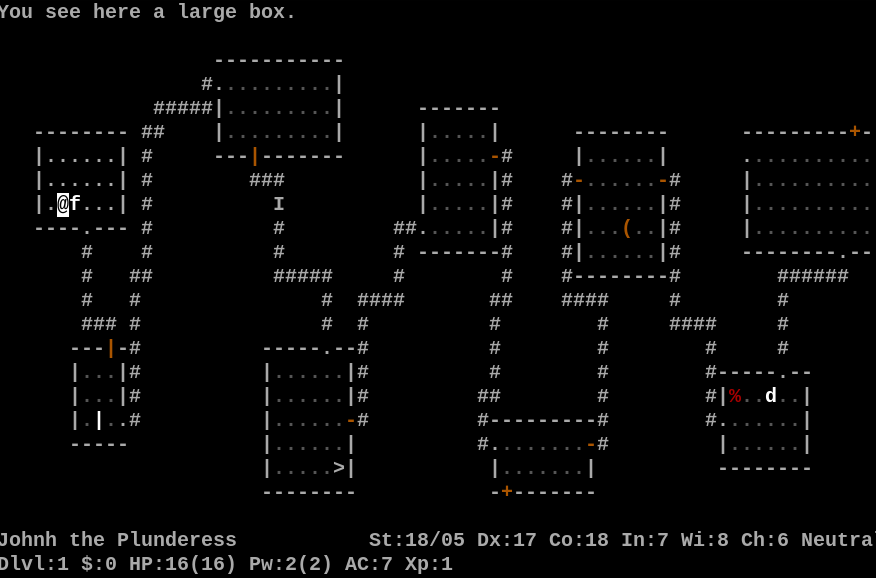
Level 1 of the Dungeons of Doom

The history of the game is recounted on the excellent Nethack Wiki. It got its start as a remake of Jay Fenalson’s Hack (1981), itself a recreation of Rogue (1980), and which was remade by Andries Brouwer (1984). The first version of Nethack, sometimes stylized ad”NetHack” was 1.3d, posted to Usenet by DevTeam leader Mike Stephenson in June 1987.

Nethack 3.0 (July 1989) saw major changes to the gameplay. Nethack 3.1 (January 1993) greatly changed the dungeon, and in large part all following versions are modifications and elaborations upon it. In the time since sometimes there have been great pauses in its history. Nethack 3.2 arrived April 1996; Nethack 3.3 in 1999; Nethack 3.4 in 2002; Nethack 3.5 in 2002; Nethack 3.6 in December 2015; and now, Nethack 5.0 on May 2, 2026.
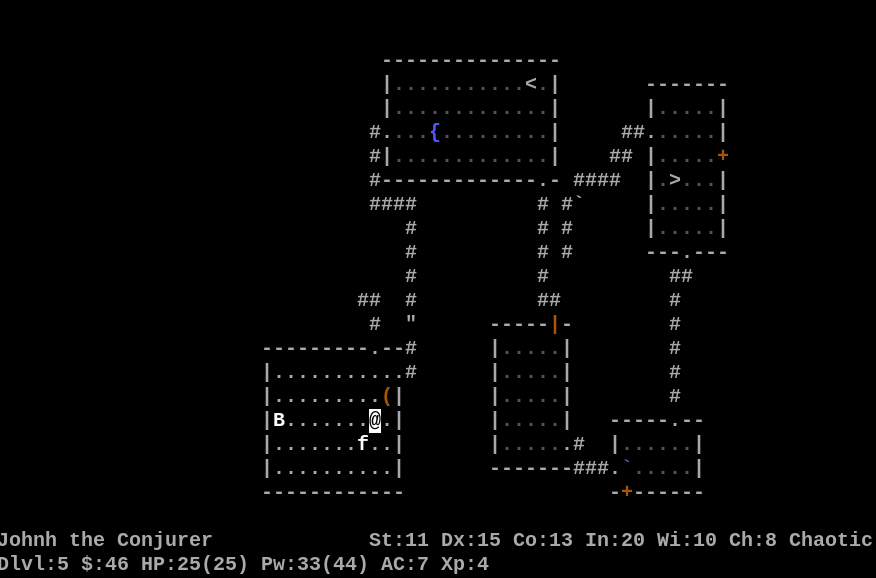
Level 5 of the Dungeons of Doom

Here is a list of major changes, though it contains significant spoilers, and a note tells us that this is a renamed changelist from 3.7. With 3.4 the Devteam switched to a Linux-style numbering system: even minor numbers (like 3.6 and 5.0) are releases for wide play, and odd minor numbers (like 3.5 and 3.7) are development versions mostly intended for work and bug testing. Even so, as with all major versions of Nethack, bugs almost certainly exist in this version. Nethack jumped past version 4.0 probably because a notable fork called itself Nethack 4.

Three major architectural changes made in this version: the code now supports C99, bringing its source to the cusp of the 21 century. Much better support for cross-compiling exists now, building it on a system it’s not intended to run on. And the old yacc/lex special level construction system has been replaced with Lua. This make Lua a build requirement.
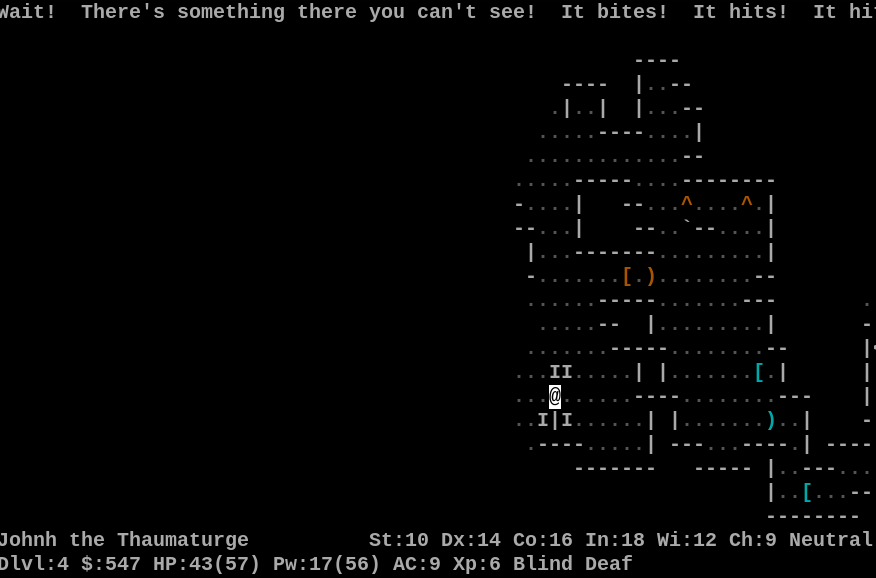
Exploring the Gnomish Mines

So, how do you play it?

For three systems binaries are provided: Windows, MS-DOS and Amiga. Yes, Nethack still supports MS-DOS, and yes, it still supports classic Amiga: it explicitly supports AmigaDOS 3.0, meaning it can still run on 68000 machines. While Atari ST support isn’t explicitly claimed, plenty of references to it are left in the code. (Does Lua exist for ST?)

That these are the only systems they provide binaries for shouldn’t be seen as an indication that these are the “most important” platforms for Nethack, it’s more that, since it’s entirely open source, building it yourself is entirely possible, and more expected than with most software. Nethack can be built for Linux, Windows 8-11, AmigaDOS, MacOS (I’m not sure if this includes classic Mac too but it might), Windows CE (wow), OS/2 (additional wow), BeOS, VMS and multiple Unixes.
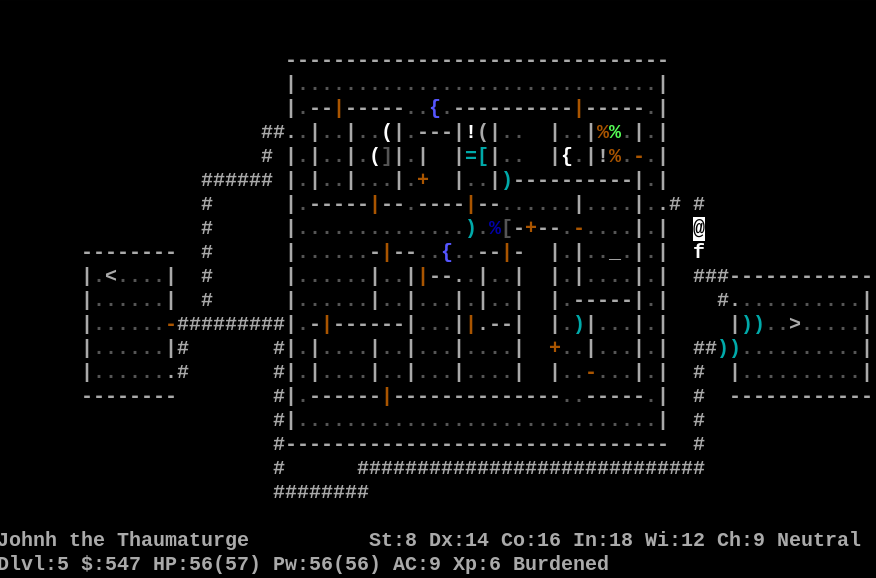
The town in the Gnomish Mines

Linux poses a special challenge for releasing binaries since there are so many distributions, so until 5.0 becomes the main Nethack in their repositories you’ll probably have to built it yourself. I have done this on two systems and can vouch that it’s doable, make sure to read the directions carefully though. After reading the README in the top level of the gzip tarball, the file you want to follow is in sys/unix/NewInstall.unx, which will tell you the manner in which to invoke sys/unix/hints/linux.500, and then ultimately, again from the top level of the source, make fetch-lua, make all, then make install. I ended up with a directory in my home called nh/install/games/, which contains a script that starts the system-installed nethack. Note that nethack supports multiple play styles: ordinary tty, curses, Windows UI, X11, Qt, Gnome and more, and configuring any of those besides the standard game will mean you’ll have to find an option to enable in include/config.h.

Another option is to play through public Nethack servers. The most popular of these are probably alt.org and Hardfought. alt.org doesn’t seem to make 5.0 itself available yet, and I’ve been able to get through to Hardfought today via ssh (possibly due to a misconfiguration on my end). If you can set them up for play then not only do you not have to build or install the game yourself, but you can even play with public bones, the remnants of other players’ games, adding an additional layer of high-stakes randomness to the dungeon.
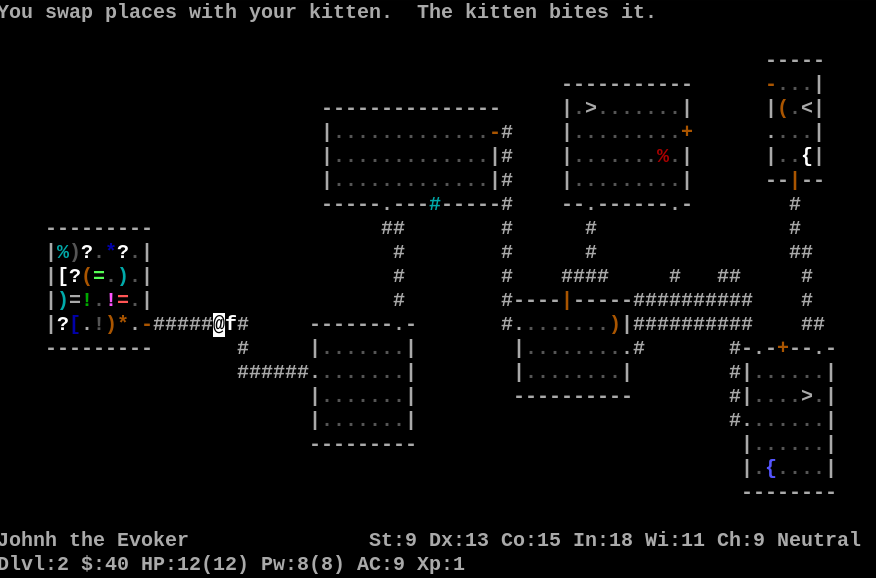
A shop on level 2

For New Players

I wish I could point you to my old @Play column on learning Nethack, but its home blog GameSetWatch has been gone from the living internet for four or five years now. My book Exploring Roguelike Games from CRC Press has it, but it’s quite expensive unfortunately. It’s still buried somewhere in the Internet Archive. I must hunt it down some day.

If you haven’t played Nethack before you are in for a bit of a learning curve. Nethack 5.0 now has an optional tutorial in the early phases of the game that might help you. You can always press ? during the game to find its help system. If your keyboard has a numpad you’ll really want to enable it, or else you’ll have to learn vi keys, hjkl, for movement, as well as yubn for diagonals. This will also push several important commands into the “extended” input system, where you either hold Alt (aka Meta) and press a letter, of if you don’t even have that, you press “octothorpe” (#) and then type a command name. This is especially annoying for the #kick (Alt-K) and #loot (Alt-L I think) commands, needed for opening locked doors and chests, and getting items out of chests. You can set options during the game with #option (Alt-O), or in .nethackrc, defaults.nh, or NetHack.cnf, depending on your platform.
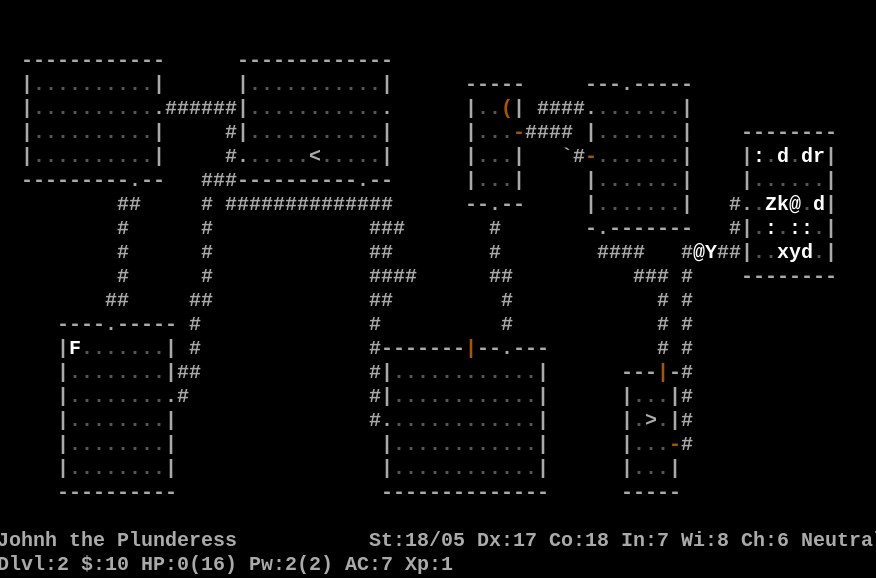
A statue garden on Level 2

I can’t impress enough how much fun Nethack still is, even after all this time. There is a ton to learn before you can play well (read the wiki if you don’t mind spoilers), but it’s mostly entertaining knowledge. What other computer game freely quotes from sources ranging from Edmund Spenser to Terry Pratchett? It plays much faster than roguelikes of more recent vintage. Every level is only one screen in size, characters advance through the early levels rapidly, and its monsters and item systems are still top class. It’s true that I do miss the days when they’d introduce huge new features (3.0 and 3.1 each made it into almost an entirely new game), but there’s still a lot of things to discover. Gehennom, the deeper areas of the dungeon, has been changed greatly, and I look forward to reaching those hellish climes once again.

Happy hacking!

Weird CC Values in Mario Kart 7

Interesting fact about Mario Kart 7 (the one for 3DS). You might expect the CC values for the traditional three speeds/difficulties in Mario Kart games to be more of a name than a value the game tries to actually simulate, and usually you’d be right.

But MK7 actually means them. The vehicle speeds are actually derived from the CC number in that game. 100 CC is actually twice as fast as 50 CC, because the acceleration multiplier is double, and 150 CC is triple.

Meaning, if you hacked the game, or else made a mod, like CTGP-7, that let you set the CC number, by changing that one value you could affect the whole game, and try ridiculously fast, or slow, game speeds never intended by the designers.

But there is no need to stop there. CC is just a float. PabloMK7 hacked the hack and tried weird floating-point values for CC that shouldn’t rightfully work, like infinity, and NaN (“Not A Number”) , just to see what would happen. (5½ minutes) And then very high finite CC values, and infinitesimally small CC values, like point-lots-of-zeros-then-one CC, causing the engine to break in amusing, and somewhat frightening, ways.

So then, what would happen? Take a look for yourself:

Garfield+

I posted links to this elsewhere to so-so-reception, but darn it the idea is amusing enough to me: take an old 3D game that got really poor reviews, hack it to make it better (not to mention playable on current Windows), and post the hack online.

The game involved is a Garfield game for PS2 and PC that I hadn’t even heard of before. The person who did this objectively silly thing is a Youtuber, and they uploaded a 20 minute video on the game and their modifications. You can even download their modification to play yourself.

No one was clamoring that they do this. They themselves admit the game isn’t really that great. But they love it, for irrational reasons, and that’s fine by me. It’s not really terrible, they surmise that the egregiously poor reviews (0/10!) were part of the Internet Pile-On Effect, where the reviewer finds something it’s okay to hate, and proceeds to do so as much as they can. In this case, the game’s greatest sin is being a licensed game, and those are always the absolute worst, aren’t they?

Anyway, here’s their video in an embed. Again, it’s 20 minutes long, so it might not fit into your schedule. That’s okay.

The November Nethack Tournament!

The replacement for the old dev/null tournament, the November Nethack Tournament is on! Get yer armor and weapons, read your spellbooks and start testing those items! Maybe you’ll find a Wand of Wishing on the first floor? Probably not, but there’s all kinds of crazy D&D-ish adventures to be had this month, so get ‘hacking!

The November Nethack Tournament (tnnt.org)

Investigating Bootleg Battletoads

The Youtube channel of chirinea mostly hosts cover songs, but they just posted an interesting short video (about 13 minutes), both explaining the Brazilian NES game scene and figuring out why the author’s Battletoads cart skips level 2.

During much of the NES’s life, Nintendo has no distribution deal to release consoles or games in Brazil, leaving the market open for a legion of bootleg cartridge manufacturers. The video author had some of these games, which were usually straight dumps of the originals, but their version of Battletoads was not.

It had been slightly localized, with its intro text translated into Portuguese. But there were some other minor changes too. Players started with an extra life, and had infinite continues. But also, for an unknown reason, the game completely skipped the second level, the one right before the game’s infamous Turbo Tunnel.

Was it a change in the game’s code, or a malfunction caused by his NES hardware? chirinea had a bit of an adventure in figuring out how to get the code off of his cartridge into an emulator so it could be compared with the official release, and ultimately found out that yes, the code was different, and it was probably done to avoid problems with Brazilian bootleg NESes crashing on level two.

It’s an interesting journey, and worth the fairly brief runtime to find out how he did it.

What’s wrong with this Brazilian bootleg Battletoads? (Youtube, 13 minutes)

EDIT: Pronoiac offers this logo for the post and video, from the Teenage Mutant Ninja Turtles Logo Generator! You see, the internet is still full of things!

Galakong

Another LUA-based game hack from 10yard! This one’s a mashup of two perennial arcade favorites, Galaga and Donkey Kong. Each level has a chevron powerup somewhere in it. When Jumpman picks it up, he’s joined by the spaceship from Galaga. The jump button is also the fire button! Further, the ship’s shots are piercing, and can destroy more than one enemy with a single blast.

You’d think it’d make the game much easier, but the difficulty of the game has been subtly increased to make up for it, plus controlling the ship as well as ol’ Jumpy is a distraction, so it’s still pretty challenging.

In addition to Donkey Kong, the hack’s github page notes that it works in Donkey Kong Jr. as well!

Galakong (github)

Romhack Thursday: Advanced NES Rom Utility

Edit the Frog would like you to know that he has no relationship with that meme frog going around.

On Romhack Thursdays, we bring you interesting items from the world of game modifications.

We’re starting another weekly feature on Set Side B, where we try to regularly bring you news on new romhacks and romhack-related items. Big websites sometimes seem like they try to appease publishers, whose good graces they rely upon for news and review copies, by not mentioning hacks too prominently, at least if they’re of console games. Whether this happens, or if it merely seems like it may happen, we don’t ask big publishers for review copies so we don’t have to avoid talking about them, and are free to tell you about the most interesting of these game edits that we can find.

To start us out though, something you’ll find you’ll need if you make heavy use of hacks, are good rom patchers. To shield themselves from legal liability, hack authors usually distribute their modifications through the use of patches, which are in essence lists of modifications that can be applied in an automated way to a source rom file, which you’ll have to source by some other means.

Two good such utilities are Floating IPS, which can apply IPS patches, and (the sadly departed) Near’s beat, which can apply BPS patch files. IPS is the most commonly-used utility, and functions mostly as a kind of binary diff, but it’s limited to source files of a maximum size of 16 megabytes, and doesn’t offer any error detection features, so if the file you’re patching isn’t exactly what the patch expects (which happens frequently, as bad dumps or headerless roms often turn up), not only will you end up with a corrupted file, but you won’t even have any indication something has gone wrong-in most cases, you’ll still be told the file patched successfully. BPS is a more intelligently-designed system, and has some error detection built-in.

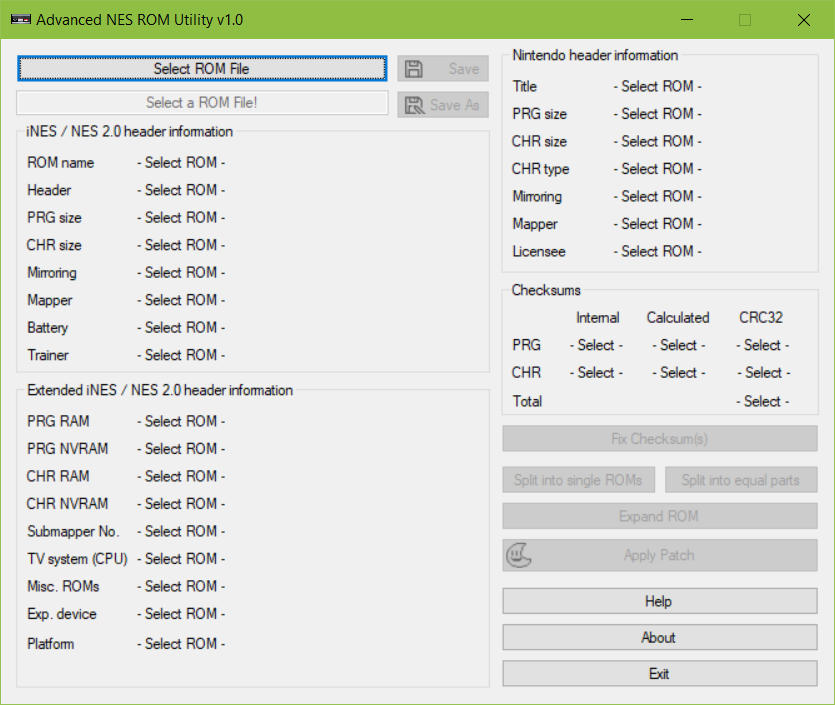
A new utility that can be of use is “Advanced NES Rom Utility,” a program that can not only apply both IPS and BPS patches but several other types as well, and can also fix many common problems with NES dumps in particular, including fixing checksums and metadata. But patches are usually source platform agnostic, so you might get some use out of it even if NES romhacks are not interesting to you.

Romhack: Elvira’s Monster Party

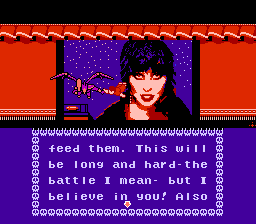
Someone worked hard to make that pixel art.

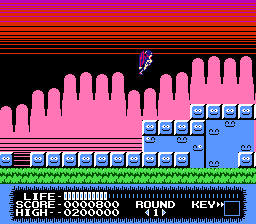
Most, maybe like 90%, of romhacks are pretty dumb. Of the remaining 10%, nine out of ten are somewhat intersting. Then you have that last percentile that achieves greatness. The jury is out, but this one could be in that category.

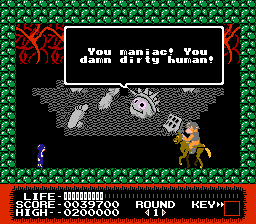
This hack changes the cult NES classic Monster Party and repurposes it as an episode of Elvira’s B-movie show! It also changes game graphics to make the main character Elvira, and many of the bosses and their text to make them into classic horror movie monsters. It seems like it should be worth a look from that pixel art image of Elvira alone.

Beyond that, the patch file’s ZIP has some other bits of artwork in it, including a poster, and box art:

I should point out that this is not actually a hack of the release version of Monster Party, but of the prototype of the Japanese version that showed up a few years ago. So you’ll have to hunt that down if you want to try it. And it is worth noting that that version had been held by some time by collectors who were unwilling to let it be dumped. So the construction of this particle of greatness was effectively blocked for an age by their greed. Please remember that.

In monster form, Elvira’s black gown switches to something rather more revealing, which is kind of keeping in character honestly.
Monster Party’s collection of B-movie goofballs have been replaced, with a new series of B-movie goofballs. I love the Statue of Liberty’s face in the background.

One of the folk responsible for this patch is Garrett Gilchrist (Twitter), who as it turns out was also one of the people behind the Raggedy Ann and Andy patch we reported on a few weeks ago. They’ve made a number of other patches hosted on Romhacking.net that, if you have an interest in such things, you may want to take a look at.

It wouldn’t be Elvira without a heaping helping of playful innuendo.

Elvira’s Monster Party, at romhacking.net (via Frank Cifaldi’s Twitter feed)

Nethackathon 2022

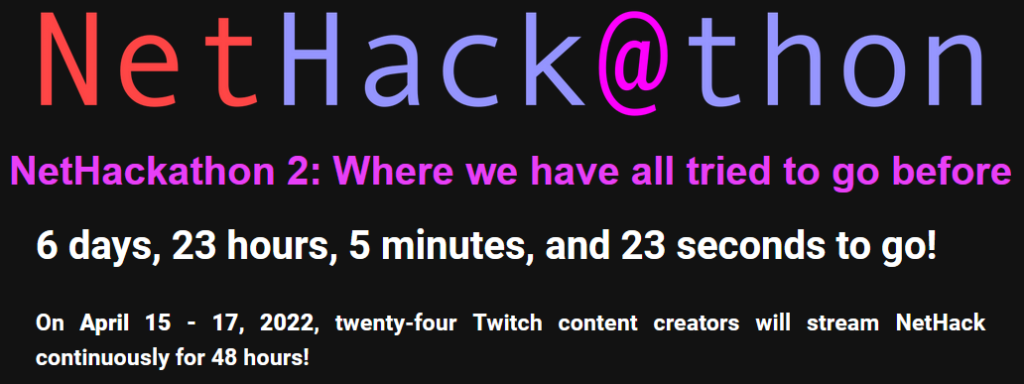
April 15th through the 17th, a group of 24 streamers will be playing classic roguelike NetHack for 48 straight hours on Twitch! Their site is at nethackathon.org, and they’re on Twitter. Last year’s marathon can be found archived on YouTube.

They did a similar stream last year in the month of September, but this year they’ve moved it to April in order to space themselves better around the two major NetHack tournaments in June and November.

What is that? You don’t know anything about NetHack? Oh boy, I get to explain it again-it’s a venerable roguelike game that’s been in existence for 34 years! The first version of NetHack is older than the Super Nintendo Entertainment System. It began during the presidency of Ronald Reagan! While there have been lulls in its development, and at least one major member of its dev team, Izchak Miller, passed away years ago, it’s still going, and it’s still being worked on. It’s notable for its high difficulty, the large amount of information a player must assimilate to be successful, and for its high degree of fairness (although sometimes it doesn’t seem fair)

NetHack comes across as like a solo adventure in an old school first-edition AD&D megadungeon. It’s full of monsters with weird properties, you have to figure out what your items do, and every game is randomly generated.