Sundry Sunday is our weekly feature of fun gaming culture finds and videos, from across the years and even decades.
This week it’s simple. It’s easy. I won’t say it’s pure, I won’t insult your intelligence by going that far, but I will insult your intelligence with a video game music done in the Seinfeld theme song style round up. Let’s go.
Note that these are game music compositions done in the style of the Seinfeld theme. A different category would be the Seinfeld theme done in the style of different games. That I will leave for some other time.
We love it when we find weird and unique indie games to tell you all about! Our alien friends to the left herald these occasions.
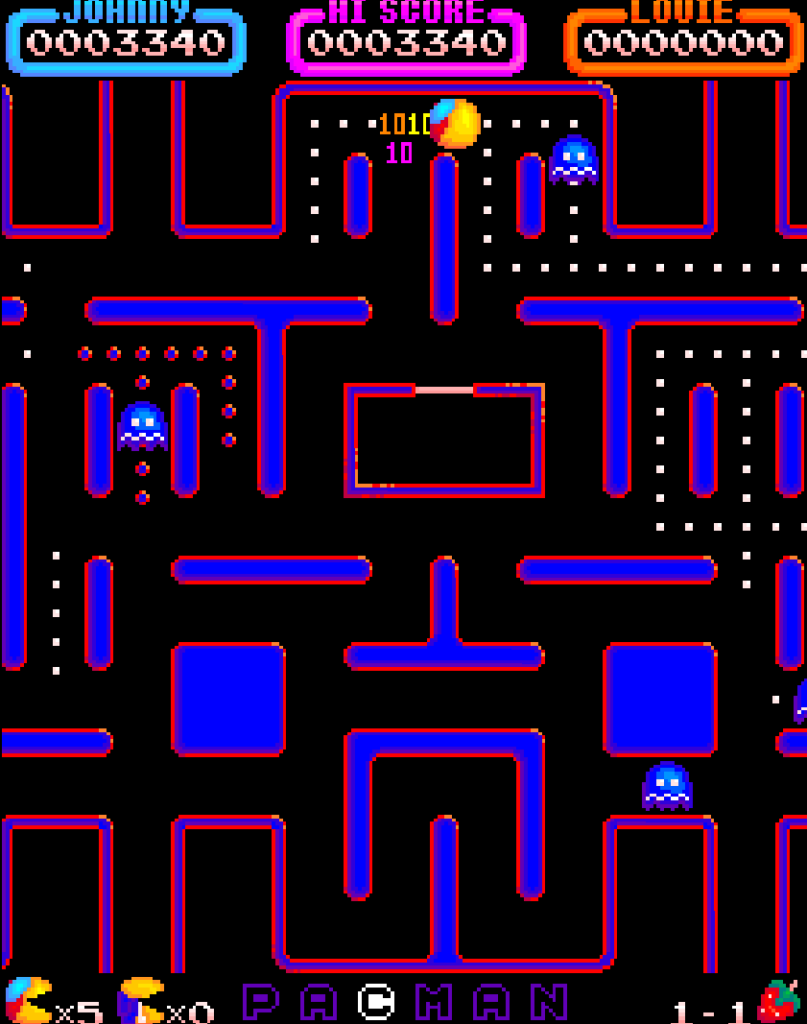
Three finds on consecutive days. This is another in a particularly beloved genre for me, the elaboration upon Pac-Man, which I like so much I wrote one myself back in 2013.
This one’s interesting in that it takes the most after Jr. Pac-Man, the last of the Pac-Man versions in the old style in arcades. Like Ms. Pac-Man, Jr. Pac-Man was made by GCC and released by Bally-Midway, and like his mother isn’t recognized by Bandai-Namco, though his circumstance is different because Namco never really supported him, while Ms. Pac-Man sold so well that Namco themselves sold Ms. Pac-Man/Galaga arcade units for a long time.
Jr. Pac-Man differs from prior Pac-games by having large scrolling mazes. Most Jr. Pac-Man mazes have six energizers instead of the usual four, but if their wandering fruit reach an energizer it could potentially destroy it. Jr. Pac-Man is also much more difficult that most other arcade Pac-Man titles, actually it may be the hardest of them all.
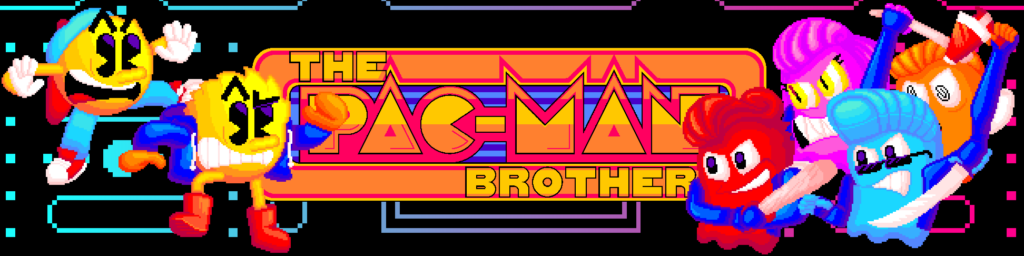
The Pac-Man Brothers starts from Jr. Pac-Man and gives him a sibling, makes them both greasers, and arrays the four (or five) ghosts against them, making them greasers too. It’s kind of if the Fonz, or maybe Kunio-kun, ran around a haunted maze eating dots.
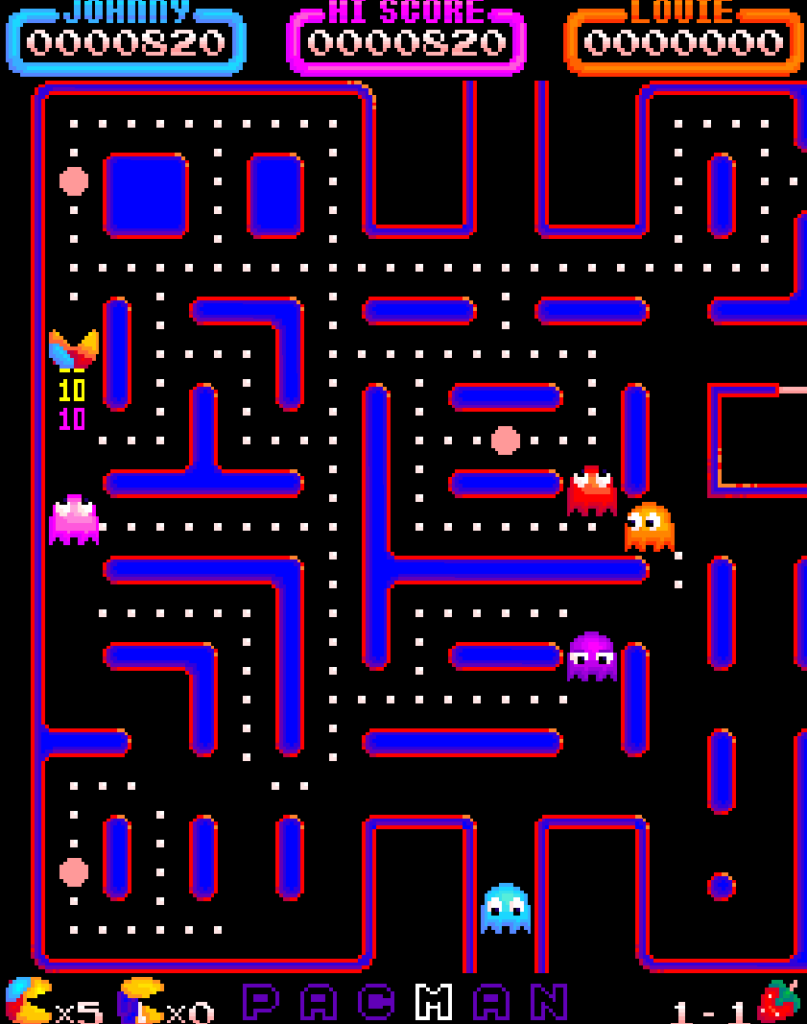
Pac-Man Brothers can be played either in one or two player modes. It’s not as difficult as Jr. Pac-Man, not only is it more forgiving in its ghost chase routines (they go into scatter mode more often and reverse direction when it happens as in Pac-Man), but they have a dodge move. Pressing the button causes your Pac-kid to rush ahead. When dodging no dots or energizers are eaten, but you can also pass through ghosts. If the ghosts are vulnerable dodging still still eat them, and it still eats fruits, so it’s a good way to catch up with a fleeting morsel. If a dodge runs your Pac into a wall, he’ll bounce backwards, which can easily cause you to rebound into a pursuing ghost. That can be frustrating, but it’s an acceptable balance for such a powerful ability.
The ghost behavior, as I said, is a lot more forgiving than Jr. Pac-Man. They seem to scatter more often, and for longer times. The scatter phase at the beginning of a board seems quite long.
One of the coolest aspects of Pac-Man Brothers is that the mazes are randomly generated. Random mazes have their drawbacks; they tend not to contain the one-way routes that made Pac-Man a much fairer game, and even if they did, if the mazes are different every time the player won’t know where they are, and can’t make effective use of them. But they do make it resistant to patterns (although Pac-Man Brothers seems to use Ms. Pac-Man’s random scatter periods anyway), and help to enliven the early game by giving a player who might be playing through level 1-1 for the hundredth time some different terrain to wind through.
One more interesting difference here from Pac-Normal is that Pac-Man Brothers uses a Universal-style extend system, where sometimes a vulnerable ghost will bear a letter in PACMAN, and if you collect them all you get an extra life. The update log gives the history of this feature, mentioning that it went through some revisions. Now the ghosts only generate PACMAN letters sometimes, at random, making them an unreliable way to earn bonuses.
While The Pac-Man Brothers is made for Windows, I played it on a Linux machine through WINE and it seemed to work okay. It requires Mono, but WINE prompted me to install it automatically. However, keyboard input didn’t work at all. I had to use a USB Xbox controller to play. I also found using the joypad to move caused Johnny Pac-Man to control a bit stiffly. Using an analog stick allowed J.P.M. to move with more smoothness. My high score so far is a little north of 100K, and my game ended on the eighth board. You may consider that a challenge score to aim for.
We love it when we find weird and unique indie games to tell you all about! Our alien friends to the left herald these occasions.
Another little fun indie puzzle game! And it’s based on Sokoban too, and it was also pointed out on Metafilter, this time by user Cogito in a comment. So let’s get our warehouse gloves on and get back to pushin’. It’s Samuel’s Sickoban!
It’s implemented in Pico-8, and should run wherever it runs. As typical in this burgeoning puzzle genre, you have a pusher character (of boxes not drugs), whose job is to set objects in the right places. Here the objects you move are round spheres, a fact that becomes important later on….
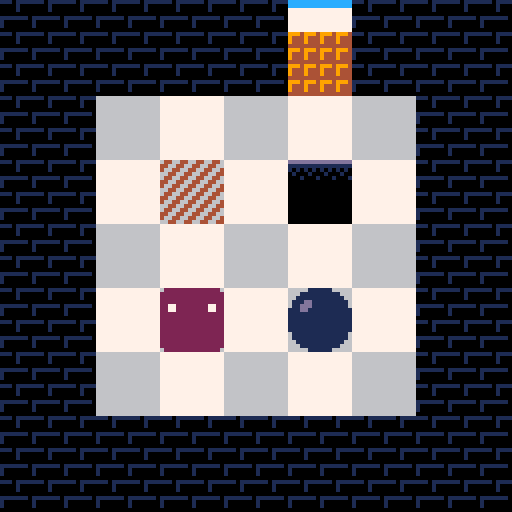
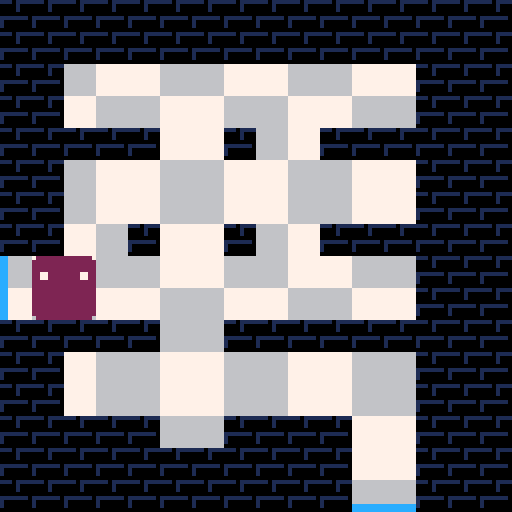
In the screenshot above, the striped spot is a button, of the video game type with a broken spring, that must be held down in order to keep being pressed. The black square is a pit. You shouldn’t step on that part. Holding down the button with the ball causes the wall to the north to vanish, allowing you to move into the next room.
Already Sickoban seeks to earn its name. This might seem like a simple room to pass, there isn’t even anything to push. But something is amiss… there are walls that don’t line up with the checkerboard. The exit is half off your movement grid vertically. You’ll have to find a way to get yourself off of it too, by pushing against a half-aligned wall.
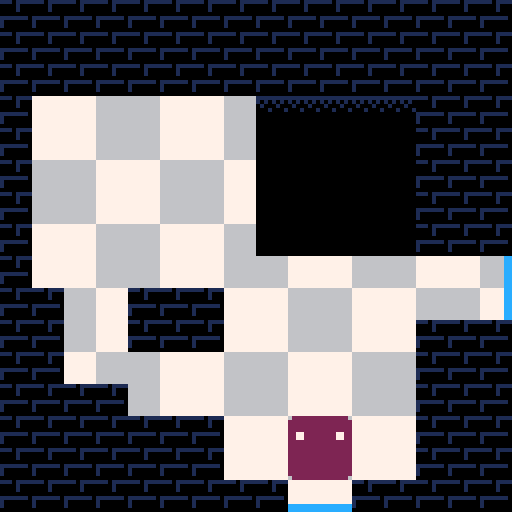
Actually, you’ll have to do that more than once to compete this puzzle, and the large pit won’t help in that. Fortunately, you only fall into a pit if you’re completely over it. You’re allowed to hang on by just a sliver of your square, if your movement allows for it.
Figure that one out and you’ll probably feel pretty pleased with yourself. But Samuel’s Sickoban wants to make sure you’re learned your lesson, so this horror is next. And that’s only room three! What will follow after this? I won’t tell, but it’ll probably make you break out in tears. “Happy” solving!
We love it when we find weird and unique indie games to tell you all about! Our alien friends to the left herald these occasions.
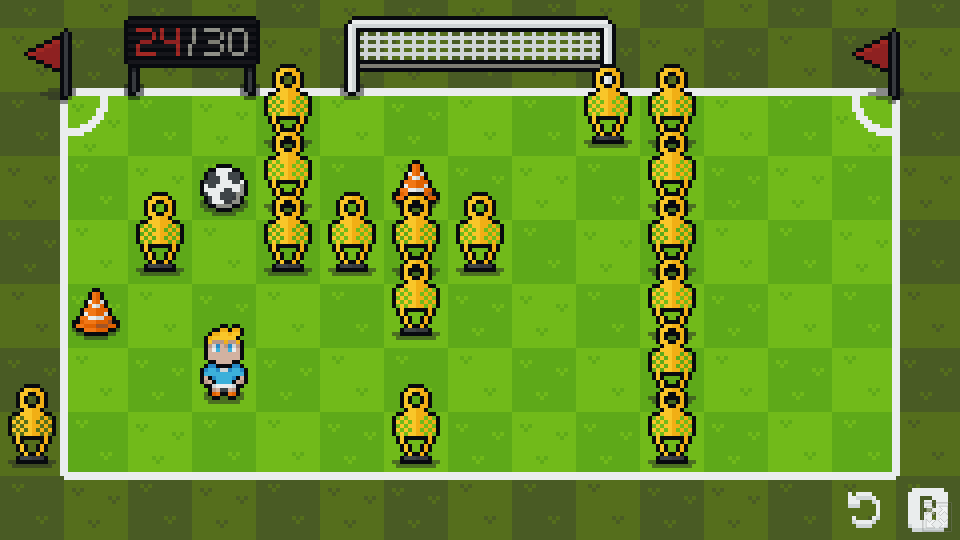
Pointed out in a post on Metafilter by long-time user pwnguin, Soko Striker is fun, and not excessively challenging, free Soccer-themed Sokoban game by Axylaric on itch.io.
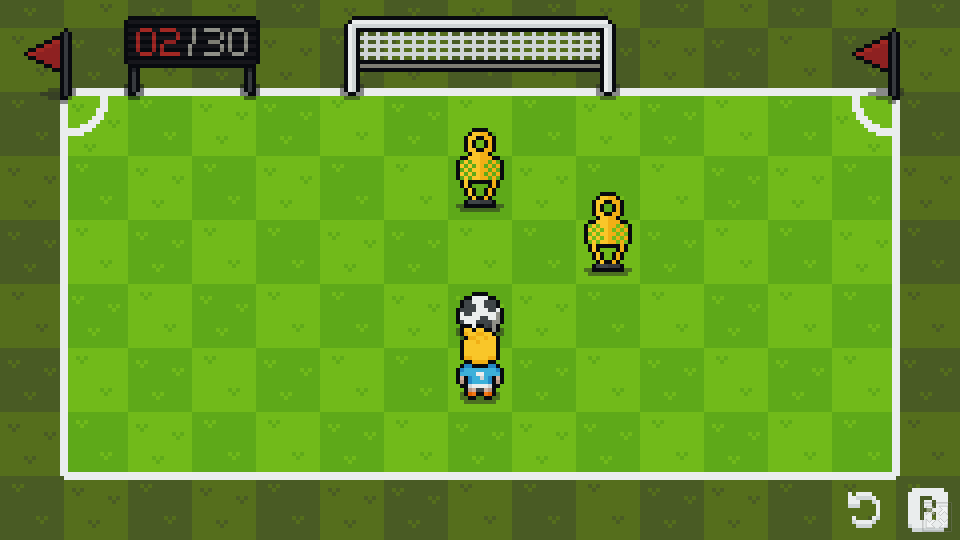
The idea is to get all the balls (up to three in a level) into the goal net. The ball slides when you kick it, continuing to move until something interacts with it. We could call these “ice block” style Sokoban pieces. One wrinkle in this is that the balls can’t cross the white lines at the edges of the board, or it’s a foul and you have to start over. There is no undo command, only a retry, so think carefully before making a move. You yourself can walk outside the line freely, and will often have to.
Those yellow barriers in the screenshot above are simple blockers, mere walls that the ball will collide with and come to a halt.
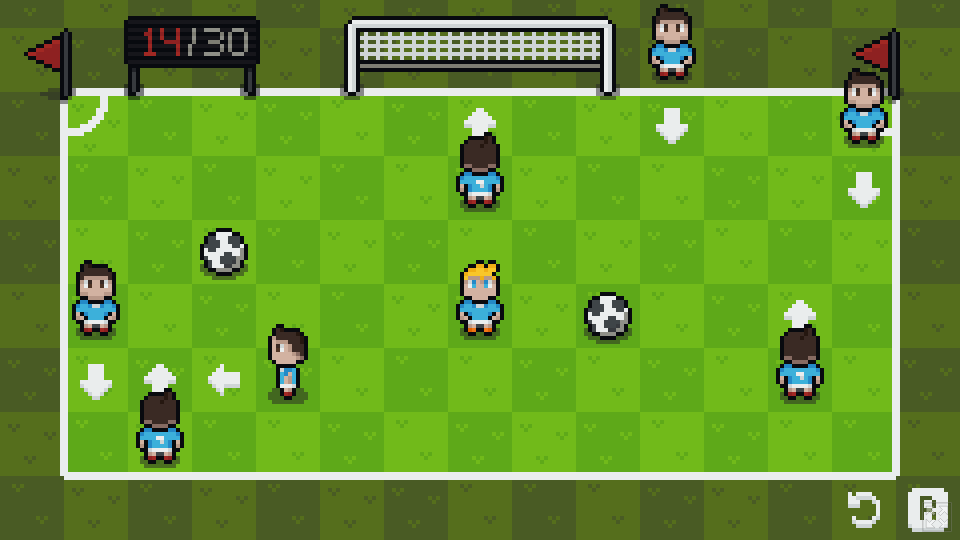
Later on you find these other players on the checkerboard pitch. If the ball rolls into an arrow, the player will automatically kick it in that arrow’s facing direction. You can adjust the direction a player faces by kicking them, a trick you’ll have to use a lot.
Near the end of the game’s 30 puzzles you’ll find these traffic cones. You can push them a single space at a time by kicking them, much like how one would move a Sokoban crate. Other players can kick crates too. A cone can block a ball and stop it a single time.
There’s a few other tricks you’ll have to learn too, but Soko Striker introduces them to you itself fairly gradually. Many of its puzzles are simple tutorials, and the difficulty doesn’t get very high until near the end. The last puzzle will take you at least a few minutes to figure out, but I think you can probably handle it. One note that might be helpful: the scoreboard that shows you the level number looks as if it might be solid and block soccer balls, but it doesn’t. You can even walk through it! That’ll be helpful to you eventually.
Displaced Gamers‘ Behind the Code series, and its companion Talkin’ Code, are probably the best technical examinations of NES games on Youtube. They take games that were the bread and butter of the Famicom/NES in its heyday, products of skilled programmers some of whom had gotten started working on arcade games, and disassemble them, revealing both their the tricks of their trade and the quirks, and sometimes glitches, that made their work unique.
Their most recent examination is the best NES basketball game, Double Dribble. If you’re not familiar with it, it plays and feels an awful lot like it were an early version of NBA Jam, without the teams or players or personality sure, but it does play a mean arcade-style game, which makes sense since it was a port of an arcade game (one that plays, I should say, a hideous vocalized version of the Star Spangled Banner at game start).
Here is the video. (32 minutes) Discussion of the discussion is below it.
Okay, the first surprise is that it that whether the ball goes in or not depends entirely on physics. The game takes the angle of the player to the basket (gotten from the X and Y position of the shot on screen) and sends the ball towards the basket using a lookup table to tell how the ball should move. When the ball arrives, whether it goes in depends on whether the ball is close enough to the center of the basket.
Double Dribble actually just sends the ball towards the basket, and if it’s close enough to the hoop (less than four pixels away), it goes in. Basically, the spot on screen the ball leaves from is what determines whether it scores. Affecting that is that there’s a limited number of discrete angles the ball can be thrown at. Displaced Gamers runs through the math, which is fairly involved, but in short, if you throw at the wrong combination of angle and distance, the ball just won’t go in.
More than that. The big discovery made by Displaced Gamers is that the two hoops aren’t the same! Due to flaw in the math, both hoops’ centers are essentially shifted to the right slightly, and both are also easier to hit when shots are made from the top of the screen, above the basket.
This is only a couple of points from the video. It’s full of the kinds of shortcuts that time-pressed programmers from the age of 8-bit consoles often had to use to make their code work. If you’re allergic to discussions of math (especially trigonometry) you might want to skip this one, but I think it’s worth a look.
The World Wide Web is now over thirty years old. In that time, more content has vanished from it than remains now, but some of it can still be dredged up from the shadowy archives of the Wayback Machine. This is the latest chapter in our never-ending search to find the cool gaming stuff that time forgot….
We here at Set Side B do everything we can to encourage the kind of unhealthy obsession with video game ephemera that is epitomized by these sites. And carrying a torch for a novelty song dating back to the height of the arcade era, that sounds even crazier (“It’s drivin’ me cray-zee!”) than my own obsession with Rampart.
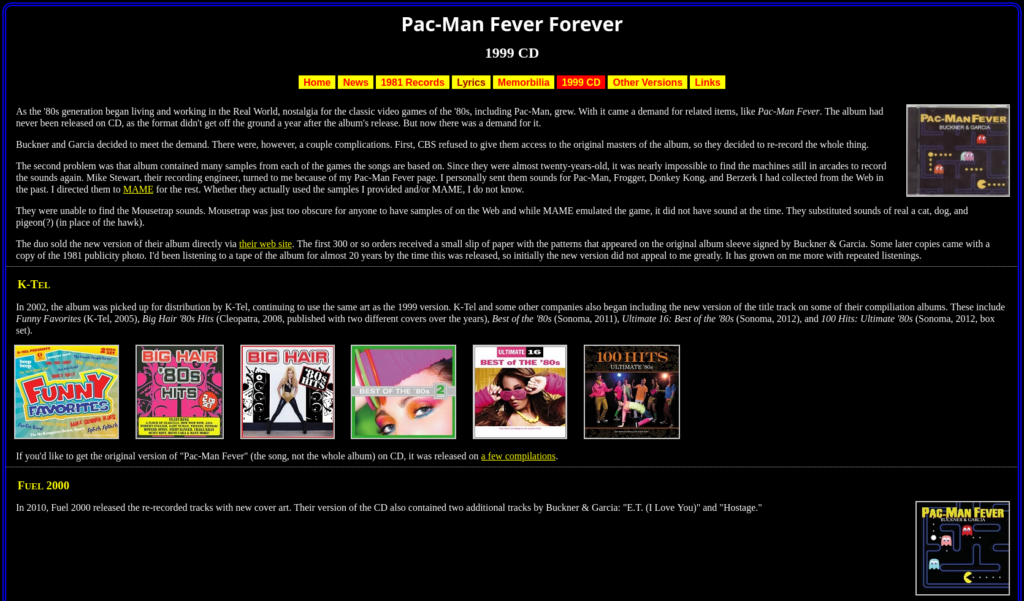
Started in 1994, when readers would have had to browse the page in Mosaic, the length of the site Pac-Man Fever Forever’s legacy now begins to rival that of the song itself. Like all good websites it refers to other pages on this Widest of World Webs, but alas most, if not all, of the sites it refers and links to are defunct now, saddest being that of the song’s creators, Buckner and Garcia themselves.
As countless kids on social media remind me nearly every minute, I am old, and yet I still dimly remember 1981, the year of Pac-Man’s release, which now might as well be the Stone Age. Social Media, the Web, the public Internet and, I seem to remember, electricity didn’t exist back then. But people still listen to Pac-Man Fever, and they still play Pac-Man today, and Bandai-Namco continues to squeeze the hungry lemon-wedge for every final drop of its juice. I maintain that Bally-Midway, R.I.P., was at least as responsible for its worldwide success as Namco was, and it would have been them who’d have sub-licensed the game’s sounds for a novelty song, as they would have for the Pac-Man Saturday morning cartoon show, a whole landfill of tatty merch, and most of the other instances of Pac-mania from the classic age of arcades. (But not Pac-Mania: Atari published that in the US)
We know Gary Garcia has since passed away. Jerry Buckner (IMDB) continues to roam the neon-blue tunnels of the Earth, and he wrote a song for Wreck-In Ralph. We here hope he continues giving breath as long as he wants. Thanks for the tunes, and to Lee Seitz, thanks for remembering them.
Owner of Game Wisdom with more than a decade of experience writing and talking about game design and the industry. I’m also the author of the “Game Design Deep Dive” series and “20 Essential Games to Study”