That’s the title on the video. Here’s a link to it. (4 minutes) It’s played by “The 8-Bit Big Band,” and it’s pretty snazzy. Even if you haven’t heard the Mii Channel theme since your Wii left service, it’s a pretty popular piece of game music even now. The channel doesn’t post often, but they have a lot of bangers, relatively speaking.
Their video just before this one was a Klezmer version of Bonetrousle, Papyrus’s theme song from Undertale (5 minutes), with animation to boot, and that description is intriguing enough that I’m going to embed it here too.
Skawo over on Youtube explains a lot of early 3D Zelda weirdnesses well, and they have a new video (8 minutes) explaining a great strangeness in Ocarina 3D on the 3DS. Here it is, a basic summary follows:
The scene: Lon Lon Range. The time: Adult Link’s period. The event: rescuing Epona from farm usurper Ingo. To do it, you have to beat Ingo in two races, each two laps, around the pasture.
The basic gise is that, in the 3DS version only, for some reason walking away from the race while it’s still going on can allow you to still win. Skawo demonstrates the phenomenon in their video.
So, how? In the N64 version, race progress is tracked by checking for Link and Ingo passing through three spheres in order, then a finish line. Both games contain a provision to prevent Ingo from despawning when far away, so Ingo does go around the track twice. In both versions a horse’s position is tracked by the center ground point of its model. In the 3DS version, however, for just the final finish line check, the game instead checks the draw position of each horse’s front-most hoof instead, to avoid cases where a horse’s front leg and its center point might disagree on which crossed the line first.
The issue is, if Ingo isn’t on screen, his horse isn’t drawn, and its legs’ position isn’t updated, so Ingo can’t win the race if he isn’t on camera. He can still win by default, if Link takes more than three minutes to finish.
The full details are in the video. It is interesting how unintended consequences like this can sabotage a programmer’s best intentions. I’m left wondering, now that terrible “AI” coding agents are being allowed to program things on their own, how many such bugs will creep into programming of all times? My own coding experience make me sure it’s going to be many.
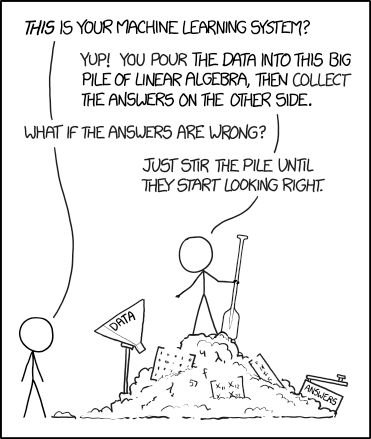
I also wonder how many silly errors like this are going to sneak into the Switch 2 remake of Ocarina of Time, whether it’s coded by a human or a big pile of linear algebra?
DidYouKnowGaming posted a video in 2021 with the provocative title “The Japan Only Metroid Game That Changed The Series,” (8½ minutes) and as is usually the case with clickbait titles like that, it’s leaving out important information: the game in question is a gamebook, not a video game at all.
I don’t often like rewarding clickbait, although doing it to some extent is largely unavoidable now. Here is the video embedded, if you want to see it for yourself.
The gamebook is called Metroid: Zebes Invasion Order, an example of gaming ephemera of the same stature as the Worlds of Power series of books. The video enthuses about how it foreshadowed elements that would appear in later games, although both the games and the book would have been inspired by the same pop cultural elements, the Alien movies, so it makes sense they would vibrate with a similar frequency.
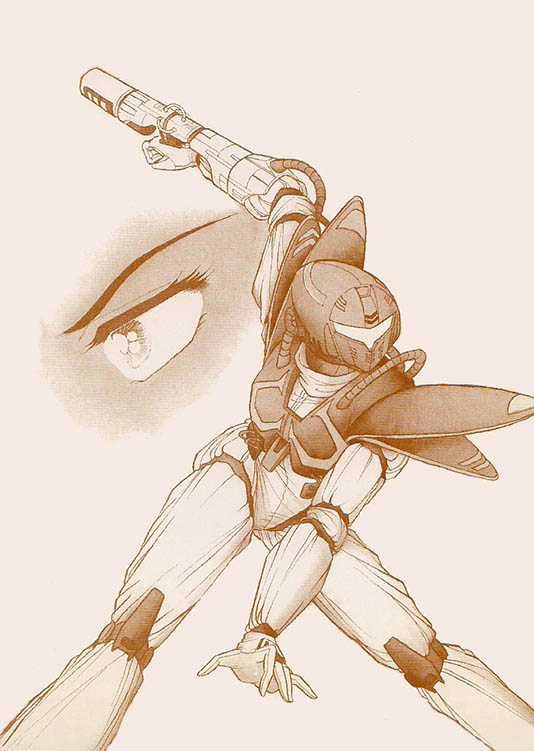
Illustration of our hero, Samus Aran, from Twinetroid, ultimately from the gamebook
You can watch the video if you want to know more about it. Here are some salient facts.
The gamebook is roughly of a type with the Fighting Fantasy books from the UK, giving you various situations to overcome and a basic battle system for fighting enemies.
Also like Fighting Fantasy, it’s pretty difficult.
The battle system uses dice, and asks that you record your exploration with a hand-drawn map, and record your inventory on a sheet of paper.
Secret rooms were handled in a novel way. As a gamebook in the same ballpark as Fighting Fantasy and Choose Your Own Adventure, you would sometimes be given a choice and a page number to turn to. Secret rooms would tell you only part of the page number, leaving you to search through the book for the right page. Important items were hidden this way.
The book has ballooned in price, with copies selling, in 2021 when the video was made, for around $2,000.
Yet scans of the book can be found online, and Devin Monnens used them to assemble, using Twine, a kind of play-like of the book, called Twinetroid and hosted at Metroid Database. It changes a few things for the format, automating combat and changing the mechanics of the secret room search. The instruction page mentions hidden hyperlinks, which is an interesting solution.
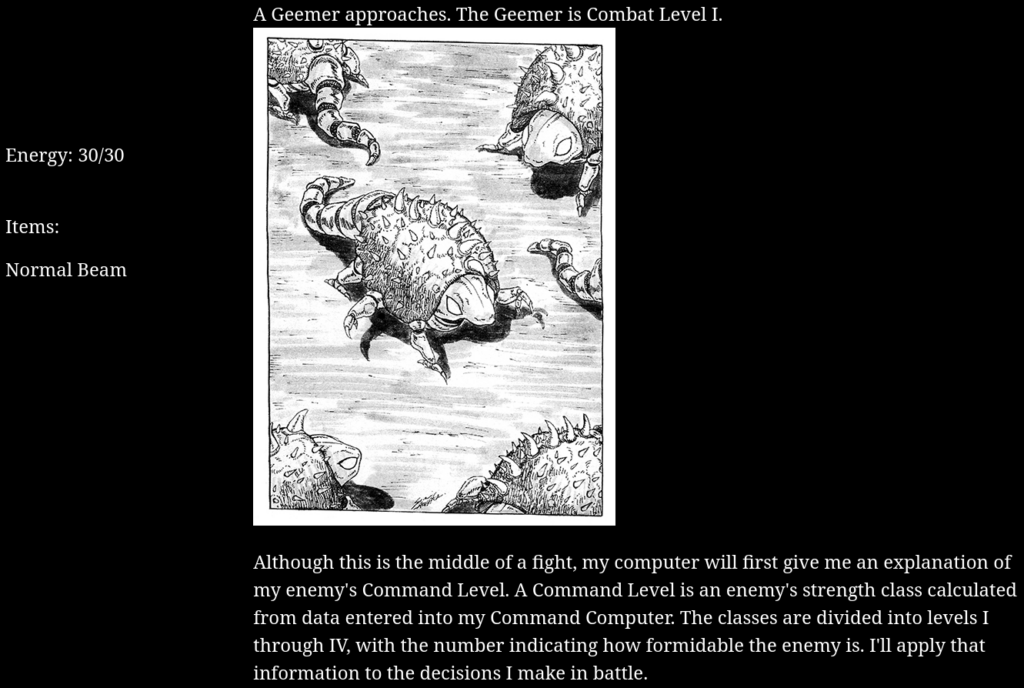
Combat example from Twinetroid
One interesting aspect of the game is that it largely recreates the play structure of the original game: the game world is divided into three major sections, you find items that increase you exploration ability, and you backtrack into earlier rooms to use those items to access new paths. There is an automap, but it doesn’t record anything about what’s in each room. You’ll probably need to take notes.
If Samus “dies,” you can still restart from a checkpoint with all the items you’ve found. Once you defeat the Mother Brain the game isn’t over yet though, becoming more of a traditional text adventure from that point, with a variety of endings. Give it a try, and experience an obscure piece of Metroid history.
Twinetroid (Twine-based text adventure, from Metroid Database)
There’s three events that I always hype (or try to, if I remember them), the charity speedrunning events AGDQ and SGDQ in January and July, and the two-day online conference Roguelike Celebration in October.
We already announced Roguelike Celebration’s preview event a couple of weeks ago, but the main event is Saturday the 171h and Sunday the 18th. They’ve posted their lineup for this year. Just to remind you, you’ll need a ticket to attend, which cost $30, but you can usually get a free ticket if you ask nicely. I encourage you to pay if you can however, since it allows them to pay for their human-provided text transcription, to pay their speakers, and to keep the server running.
A interesting thing about Roguelike Celebration is that while it’s mostly about roguelikes, naturally, they also have other interesting talks, and they always seem to find good subject. A few highlights this year, Andrew Plotkin is giving a talk about mazes in games, there’s a talk about randomness in a Fire Emblem game, and “stealing roguelike mechanics from Microsoft Word.” There’s one about recovering and modernizing one of the original Hack games (I suggested that one!) and one about cellular automation in roguelikes. Oh, and the Caves of Qud people are talking about localizing their procedurally generated texts.
There’s always a bunch of interesting talks each year, and although they go online after the conference, if you show up you can offer questions to the speakers, talk with them yourself in a MUD-based conversation space, and talk with the other attendees, who tend to be crazy intelligent types themselves. It’s all a lot of fun, and if you’re reading Set Side B, there’s a good chance you’ll enjoy being there, so please consider giving it a try!
You wanna know something? I think everyone should learn to program. I don’t mean using some, the word I usually use is cockamamie, “AI,” that will produce brittle, inefficient, unmaintainable code if it doesn’t mess it up, but actually code. I think most of the difficulty with coding is actually in the languages. Woe betide the person trying to learn to program in C++ from scratch these days. C is much better, but still obtuse. Python is better, but also not great for systems or performance work.
The solution? Why, learn to code in assembly of course!
Aaaaand 90% of readers just clicked away. Hah.
But the funny thing is, for many languages, assembly is actually a little easier than them I’d say. When you’re working directly with the hardware, all the weird abstractions you have to learn fall away. It does mean you have to do everything, and I mean everything, yourself. But on the other hand, programming is largely the process of connecting building blocks together, tiny routines comprising larger ones. It takes longer to do it in assembly, and working with a lot of current-day hardware is trickier because you have to jump through more hoops to use it. But its difficulty, I think anyway, is a little overblown.
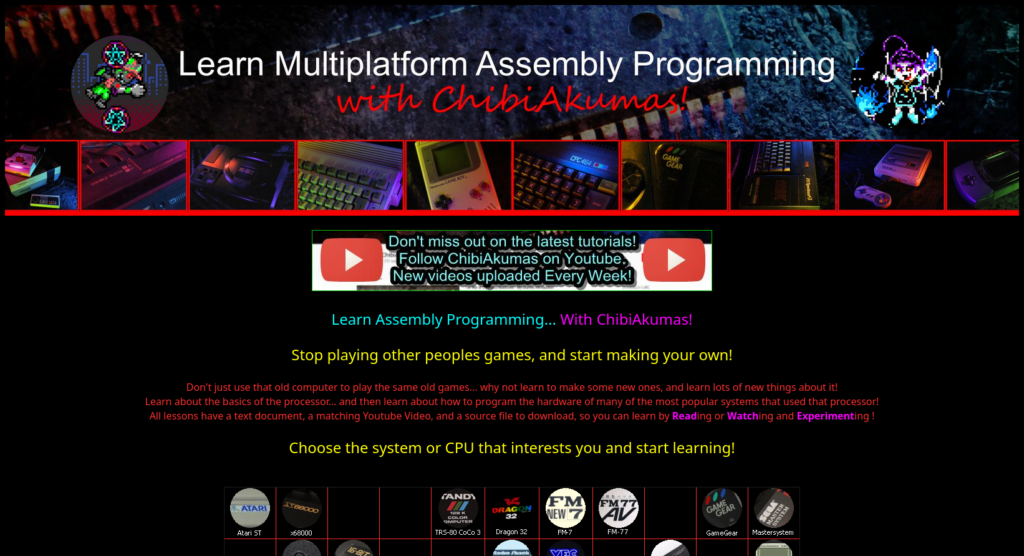
There’s a wealth of material to peruse, including videos walking you through coding a bunch of different architectures, including 6502, 8086, Z80, 6809, 68000, and even ARM, among others. Even if you have no interest in actually coding for these multifarious* chips, just knowing out they work may be very interesting to you, if not be actually useful someday.
Here, to get some idea of how understandable this will be to you, take a look at his series on assembly coding for the C64 (Youtube playlist, 13 videos, about 170 minutes in all), beginning here:
* That’s 17 points with no bonuses, but 67 if a bingo
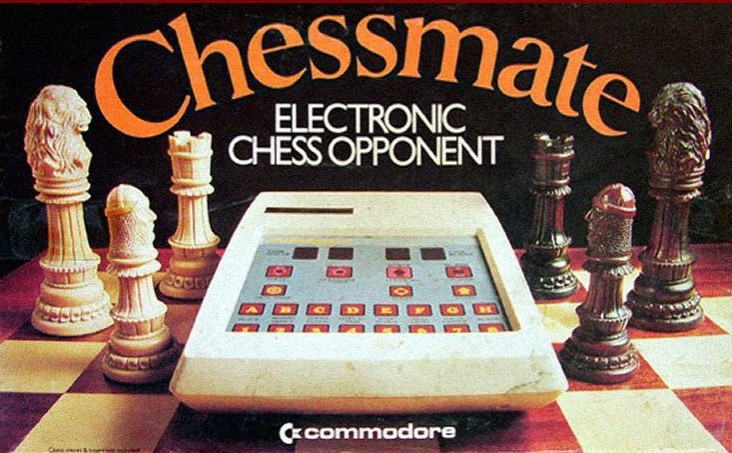
It was brought to my attention by <b>scruss</b> over on Metafilter (Mastodon) that Peter Jennings, not the newscaster but an oldschool hardwre guy, has a long and great page on the creation of a standalone chess-playing computer for Commodore in its early days, we’re talking between the creation of the KIM-1 and the VIC-20.
It’s a terrific article that covers far more than just Jennings’ experience making the device, covering among other things a pitch to Mattel, meeting with 6502 designer Chuck Peddle, a story of Bobby Fisher, and the unfortunate news that Jack Tramiel, then the boss of Commodore, rarely paid vendors what they were due. Seems about normal for the man.
There’s even a long list of interesting links about the Chessmate at the end. I can’t recommend it enough!
For this critical thought, there are plenty of games that feature inverted difficulty — starting very hard to becoming easy, and I (Josh Bycer) wanted to talk about why this often leads to frustration and imbalanced design.
Owner of Game Wisdom with more than a decade of experience writing and talking about game design and the industry. I’m also the author of the “Game Design Deep Dive” series and “20 Essential Games to Study”