Sundry Sunday is our weekly feature of fun gaming culture finds and videos, from across the years and even decades.
Did you know there was a Parappa anime? It was released in around 2001, around the time Parappa the Rapper 2 for PS2 was released.
Parappa creator Rodney Greenblat said, in a Gamasutra interview in 2005, that other than character designs he wasn’t allowed to be involved with producing the anime. I it shows, especially with the focus on the new characters Matt and Paula. They feel like the writers included them because they wanted to write to their personalities, maybe because they didn’t want to step on the toes of the developers of the games by writing for their characters. It’s not an awful show, but it’s not what a Parappa show should have been.
An episode that ties in with the games a bit more than usual is Episode 13, which involves Parappa’s karate teacher Tamanagi-sensei, known to English speakers as Chop Chop Master Onion. He sounds a lot like he does in the game, even speaking Japanese, and it’s great to hear him get more lines.
This would ordinarily go into a Sundry Sunday post, but it’s interesting for historical value. Unlike the Switch’s spartan interface, the WiiU took some of its UI design inspiration from the 3DS, which was a bit more playful. The 3DS supported theming the main menu, which is a feature that never came to the WiiU, but they both did support StreetPass, with the WiiU still having its little-noticed StreetPass server settings among its rainbow-colored settings menu options. And of course both systems supported the Miiverse, Nintendo’s failed attempt at its own gaming-focused social media service, which let users make text and drawing posts, tied in with their Mii feature (still in the Switch although much declined in prominence), and allowed Nintendo to send users information directly to players. Miiverse is gone now, has been for years, but some people I hear are working on a fan-led revival. I shudder to think of what will get posted there without Nintendo’s moderators.
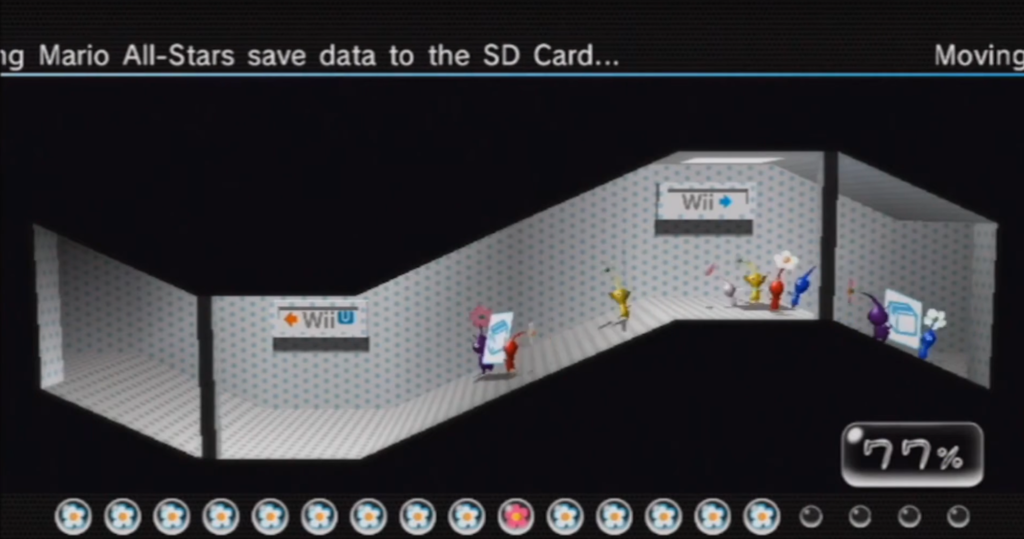
Back to the interface. Probably the quirkiest of Nintendo’s UI creations was an animation that went with the tool, downloaded fro the Wii’s Shop Channel, that transferred system and shop data from the Wii into an SD card package to be transferred to a fresh WiiU system. It could have been a simple progress bar, but they had their developers create a charming (gee I use that word a lot) sequence where Pikmin, at that point only those from the Pikmin 2 game that had last been seen on Gamecube, visually bundle up all of the transferable software, use a walkway to carry it into a waiting rocketship, and jet off to a nearby sun marked with the WiiU logo. At that point, the user would be prompted to move the SD card to the WiiU, where after installing a corresponding tool from the WiiU’s eShop, the process could continue, with a matching unloading animation.
If you never had the chance to see this sequence (easily possible given the WiiU’s low sales), or just want to relive the process, here it is, both of the Wii to WiiU data transfer animations, at about eight minutes:
This video only shows the animation. If you’d rather relive the whole process, including system menus, instructions and warning messages, here is a 15 minute video that records it. It also seems to have a couple of scenes that aren’t in the above video, including the one depicted in the head image.
A brief personal story. When the WiiU came out I got one. The WiiU’s fate was already sealed by that point, and I got it pretty cheap from a local Target. By that time my much-played Wii had been suffering from some serious issues. It had been hacked many times, the Homebrew Channel installed and its boot software replaced.
People will tell you that doing this is only for the purposes of piracy, and that’s really not true. We put the Wii to use as a general media player. It lived mostly at a friend’s house, and whenever I would go over we would use it to watch movies and things from SD cards. We even watched a DVD or two that way; while the Wii had a DVD drive installed, Nintendo didn’t spring for the licenses to play DVD movies, so it was purely intended as a data drive. You could bypass that restriction with the right homebrew software, although it wasn’t great and didn’t seem able to do menus, so we almost never used it.
My Wii had put into heavy use for game and media playing, and I put on and removed a lot of software over time, in addition of course to hacking it several times. As a result, it had gotten quite glitchy. Sometimes it wouldn’t boot, sometimes it would boot okay but wait until getting some ways into a game and freezing, and sometimes, weirdly, it’d show the opening Health warning screen, but the letters in the font would glitch out, individually. It was really a sight to see.
As a result I was really glad to get the saveable data off of that system and onto hardware that was reliable. I had to go through the whole sequence more than once, as the console froze along the way a time or two, but fortunately I got it, and our large Mii collection, all off and onto the WiiU, where it still lives today.
Collecting and saving Miis, from friends and the nearly-forgotten Check Mii Out Channel, and the Mii Parade of random Miis sent from Nintendo, is an aspect of the Wii that has not survived to the Switch. I hope whatever successor the Switch gets has something like it. And bring back StreetPass too!
This editorial doesn’t necessarily reflect the views of this blog. However, blogs don’t have views anyway, so what would that even mean?
This is a slightly edited version of a diatribe I emitted on mefi.social. I really want people to see it and think about what it means though.
A dismaying thing is how much of current gaming culture is locked behind Discords, and/or is revealed to the world only through Youtube videos.
These two phenomena are the result of the Myth of the Benevolent Corporation, which was largely started by early Google and their “Do No Evil” policy, which sustained the early web for a good while but itself did huge damage to online culture, and yet promises to do much much more, when they decided that profits mattered more.
When Youtube started, everyone saw it as a kind of miracle. In the early days videos were limited to 10 minutes, but even so they began attracting a huge amount of material. When they switch to just letting people upload anything for free, that exploded.
It’s not just gaming stuff that I’m talking about really, although as a popular fixation for people it’s kind of a hint of things to come. Lots of information is currently exposed to the world through Youtube videos and minidocs.
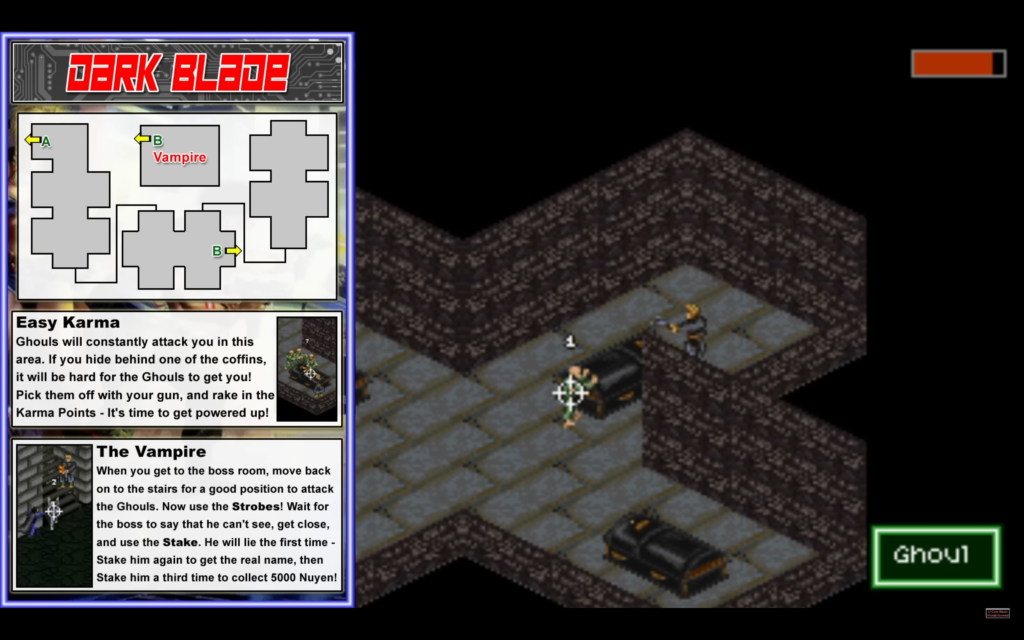
From U Can Beat Videogames’s video on Shadowrun. It’s great, but some day it’ll be gone. How will people beat an ancient obscure SNES game like this then?
But Youtube has always been a time bomb for all this content. It’s inevitable that Youtube will someday begin deleting things. If not sooner, then later. Yet there are few entities capable of preserving all of it, or even most of it. All of this will [get destroyed] like [crying] in [a downpour].
Of course, it’s not like videos like these have any other hope as it stands. A collection of the incredible size of Youtube’s is so big that only a government could realistically do it, and most of those have their own issues when it comes to continuity of mission and funding.
But combined with Discords as a means of communication, and (bizarrely) information, a lot of online culture is currently a black box to outsiders, unless they sign up to dozens of miscellaneous Discords. And there is a limit to the number of servers you can follow, which is reputed to be 100. (It used to be that Google could get you a quick answer to a question like how many Discord servers can one user follow, but now I’m not sure.)
Social media companies, who all seem to be racing each other to make their services as crappy as possible to non-paying users, are no solution either.
There used to be a Mastodon search engine, at search.noc.social. This is what remains of it. (Yes, it’s just a white page with the text “project has been removed.”)
Fediverse to the rescue! But no, a lot of it is transitory, sometimes intentionally so! In some circles even suggesting that Mastodon be just searchable, let alone preservable, will subject you to a storm of criticism. It’s true that being opaque to general search helps protect vulnerable users, a noble cause, but it also makes Mastodon’s discoverability very low. (One solution, which I think I mentioned here before, is an opt-in search solution called tootfinder, but it currently only goes back three months.)
And I don’t see many other people talking about this, even though the sudden decay of Twitter and Reddit has made this essential problem more visible than its been for a long time.
I feel like going onto every Discord I follow, gaming research ones in particular, and ringing alarm bells, but it’s a task just to find them out, and really what good would it do. People use Discord because it’s free and easy and they even maintain the server for you. These kinds of spaces have always relied on some patron to uphold them; the only real differences are before they were visible to search and the Wayback Machine, and now, it’s a single company that will increasingly hold access to these places obscured behind a storm of pleas to subscribe to Nitro, and someday will delete them entirely.
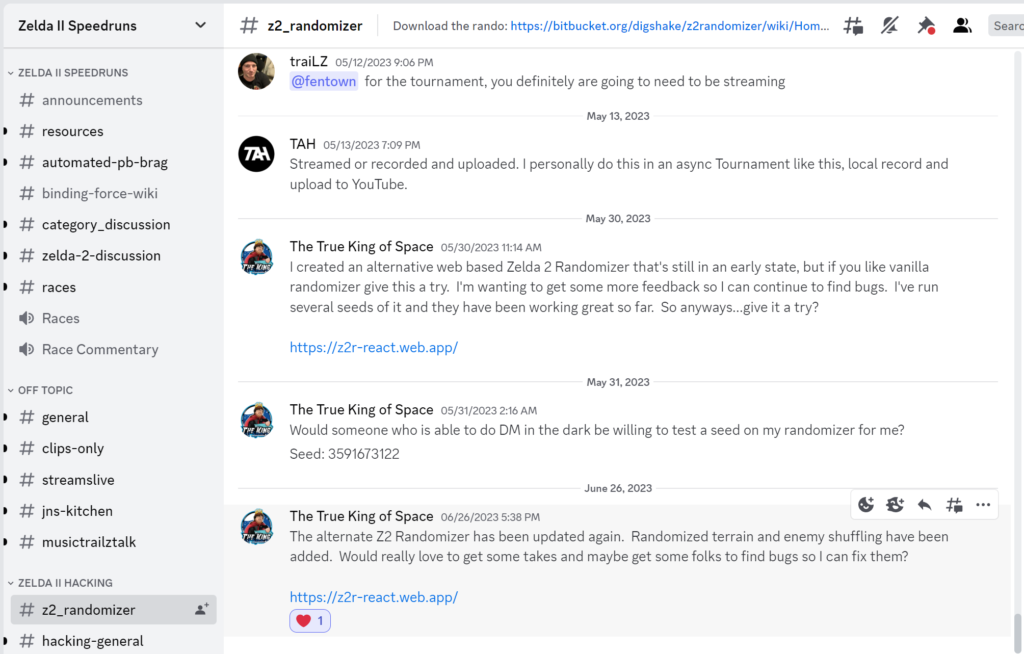
The Zelda II Randomizer Discord. As a community, it works okay. As a way of storing information, well, it sucks rocks. As a way of preserving everything, it’s DOOOOOMED.
If you think I’m being hyperbolic, there are vast swaths of online culture that are already lost permanently: the Compuserve forums of the era immediately preceding the rise of the web. Compuserve was once the biggest online presence. And AOL, which grew to eclipse it in size, likewise holds (still? I don’t know, it’s on AOL!) a vast amount of early internet culture.
Newsgroup archives are a bit better off because of their openness, although nowadays it’s mostly seen as just a way to enable piracy.
Still, essential web services are at least preservable. The Fediverse resembles those, at least in principle, so it’s immediately better off than Discords and Youtube, for making old information findable, even if it’s currently really hard to do it (and some people are outright opposed to it).
It is time to wrap this all up. I say things like this frequently these days. Maybe someday someone will listen. The power and reach of the internet doesn’t have to rely on big companies. I also have qualms about the ability of a even a horde of individual servers to keep things going, mind you. All those dead links on all those surviving old websites, they once represented living projects too.
I think what we ultimately need is an independent organization that can keep up old sites and communities, and provide a place for new ones, maybe supported by donations, without the explicit profit motive of the bigcorps. Something that looks like the Internet Archive or Wikipedia. There’s places where you can host plain websites even today, like the Tildeverse (but its individual pieces, like Fediverse servers, always feel like they could vanish at any time), ancient-yet-still-here Angelfire (of which, like the Lycos it’s a part of, it’s amazing still survives), or the newer, enthusiast-focused Neocities (which too has no guarantee of longevity).
Companies can live longer than people, or their interest cycles. It doesn’t feel right that something like a website require someone to dedicate their life to maintaining it, but due to the dysfunctional way our economic has come to see companies (involving the hateful words fiduciary duty) are also vulnerable to the winds of change. It feels like a non-profit, or at least a durable privately-held company that isn’t pushed by rapacious groups to chase every profit lead no matter how disastrous, may be a solution. I don’t know if it really is, though. I’m just watching this, mostly from the outside. I hope someone can do something though, to overturn the cold tides of entropy. I really do.
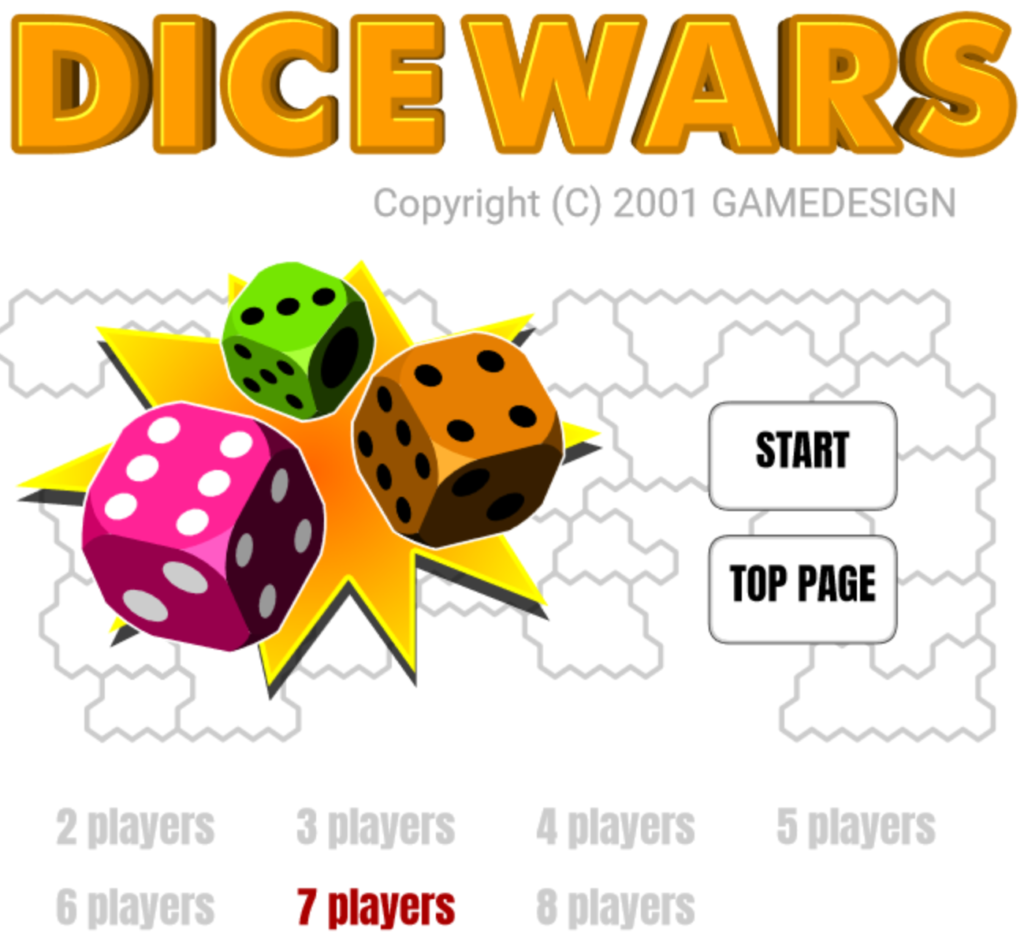
The Japanese person (or people) behind the website www.gamedesign.jp are mysterious to me. I know nothing about them, except that they’ve been making games, first in Flash, then more recently using the Ruffle runtime, since at least 2001.
DICEWARS
While the title under which they put up their efforts may not be memorable, if you’ve been playing web games for a while you probably know some of their work. Possibly their best-known game is DICEWARS, which is like a version of Risk that plays much much faster, most games over in minutes, instead, as with the people I know who have played it, of days.
In DICEWARS (several of GAMEDESIGN’s games are stylized with allcaps), you have nation whose territories are represented as colored areas, each containing a stack of from one to eight six-sided dice. Each nation gets a turn to act, during which they can use a stack of dice to attack the dice of a neighboring country. Fights are resolved by rolling all of the dice in the two stacks. If the attacker wins, they move all of their stack save one into their conquest and take over (the enemy dice are lost), with that single die remaining in the stack’s previous home to keep the lights on.
If the defender rolls higher, or there’s a tie, the attacker loses all of their dice in the stack except one and the defender loses nothing. A stack of one can’t attack, and is generally pretty easy to slaughter by other nations; a good element of strategy is figuring out how to keep high-dice stacks near the front, between enemies and your single-die lands, since you can’t manually move dice around between your territories. When a nation is done acting for a turn, they receive extra bonus dice relative, I think, to the largest contiguous group of regions they control. They are placed randomly among all their possessions.
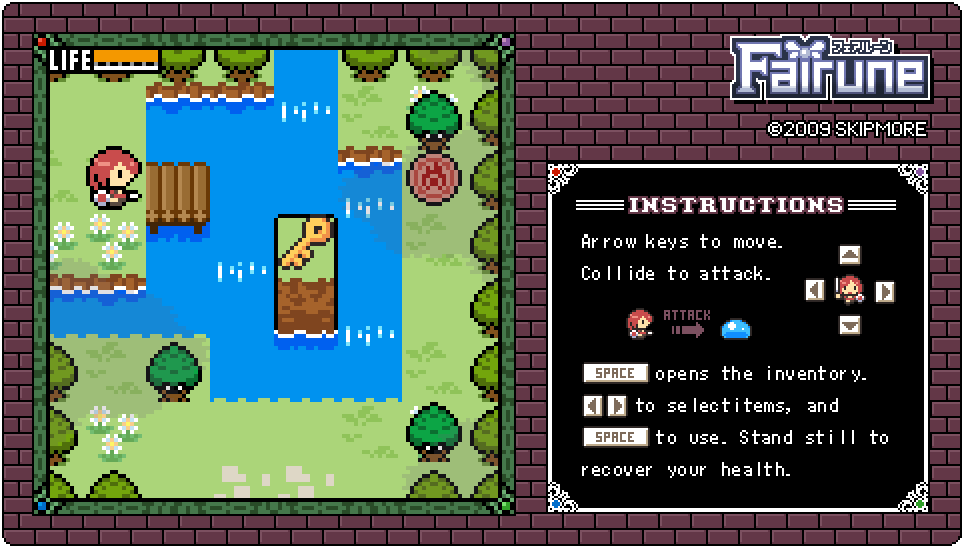
Fairune (Flash version)
Various versions of DICEWARS can be found on mobile app stores, although I don’t think any of them are officially blessed, and they tend to disappear after awhile.
It turns out they have a lot of other games that you may know of. One of particular note is Fairune, which is a capsule, very much simplified JRPG. Fairune and sequels made it to the 3DS and Switch eShops, where they are very inexpensive and enjoyable. Fairune is copyrighted by SKIPMORE, which may be a different entity. It’s still a nice game, worth looking into.
EDIT: SKIPMORE has their own website, which now mostly presents their downloadable console and mobile games.
ZoomZike on Youtube has been working for years on a comprehensive series of videos going through all the Mario Party games, and breaking down what parts of each are a matter of luck, and how many are of skill. Along the way, they also serve as fine guides to winning at them, at least as far as you are able.
They’ve gone through the series, trending longer with each one, for each game from Mario Party 1 through 7 (with an April Fool’s stop over at Advance). Even the shortest is at least an hour, and the most recent one is over five hours. That might seem like a whole lot, but imagine how long it took to construct! These are really deep videos, often with odds figured out through exhaustive, and exhausting, trial and error.
Mario Party 7 is the last of the four Mario Party games that came out for the Gamecube, even beating out the N64 portion of the series by one game. The early MPs were notorious controller destroyers, often resulting in the dreaded white dust of death, a result of ground plastic, emerging from the controller after heavy play. The Gamecube had controllers that weren’t as susceptible to wearing out, and so were better suited for the demanding play that Mario Party provides.
Anyway, here is the video, all five hours and 25 minutes of it:
From the recent trove of preserved video from Noclip Game History Archive, here’s a look through Nintendo Of America’s internal employee-only museum/store, circa 2006, on Youtube. There is very little sound in the footage, so you might want to increase the playback speed to double.
For context, it was near the end of the Gamecube’s life, immediately before the release of the Wii, and the early years of the Nintendo DS. Objects glimpsed during the stroll include various consoles, records of Nintendo’s collaboration with the Starlight Children’s Foundation, Pokemon merchandise, Nintendo awards, some arcade units (including a glitched Mario Bros. cabinet), a Virtual Boy, various character statuettes, old playing cards, a capsule timeline of Nintendo history, and various games for sale at the time. It seems that the museum also functions as a retail space for employees.
Sundry Sunday is our weekly feature of fun gaming culture finds and videos, from across the years and even decades.
I’ll admit it, there’s this cable that goes into my brain directly from Youtube, and I use it to cut the number of game-related things I have to post daily on this site by a full seventh. I know you all suspected it, I’m just confirmin’ it. I’m like a vermin, for confirmin’. I’m a squirmin’ vermin for confirmin’! In German! No, no let’s not write Shecks my language skills cannot kassieren.
Record scratch you know who does fun cartoons sometimes? Doobus Goobus. Like that other person, Pringus McDingus. I’d understand if you mixed them up from their names. But DooGoo posts more often, and longer things! Just a little less polished. Pringus has a really appealing art style, while Doobus traffics in the internet’s default art style: purposefully ugly. Nothing against that as a style, just calling a misshappen spade that thing that it is.
The requisite preamble now complete, please enjoy five Sonic the Hedgehog characters using profanity at each other in an entertaining manner.
The New York Times doesn’t add new games to its stable, alongside the daily crossword puzzle and Wordle, often. Spelling Bee is one I enjoy a fair bit when I think to look at it.
A newcomer to their game collection that’s in beta testing that seems interesting is Connections. It’s not a word game, at least not in the sense that a game involving manipulating letters is. It’s more a game of categorizing.
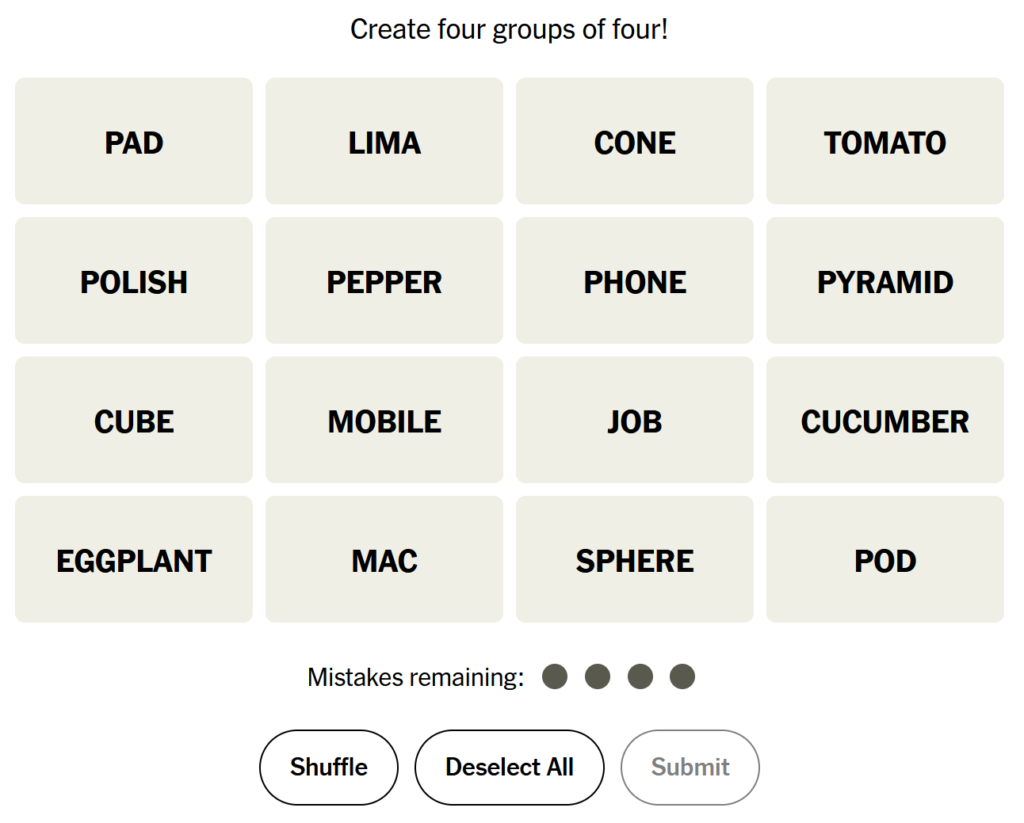
The puzzle from June 12, 2023
You’ve given a field of sixteen cells in a grid, each containing a word. The words relate to each other in four distinct groups, each containing four of the words. They’re all scrambled up so their positions in the grid don’t relate to their connections. To solve the puzzle, you must figure out which words connect with each other.
To help you, if you manage to pick four words that belong together and click the Submit button, the answer will be confirmed and the category identified, and the words will be removed from the grid, leaving only the words yet to be sorted, making it easier to deduce the remaining categories.
In the first puzzle I did, the words, mixed up here to preserve for you the opportunity to do it yourself, were:
OKLAHOMA HIP PACKER THEM
COWBOY ELBOW SPIRAL WRIST
AIRPLANE RAVEN MOTHER SHOULDER
SHELL KNEE BOWTIE BRONCO
There is only one solution to each puzzle, where every category has four members. Following is the solution and one way to arrive at it, so skip past this paragraph if you don’t want to be spoiled:
NFL players: BRONCO, COWBOY, PACKER, RAVEN
Pasta shapes: BOWTIE, ELBOW, SHELL, SPIRAL
Joints: HIP, KNEE, SHOULDER, WRIST
Movies with “!”: AIRPLANE, OKLAHOMA, MOTHER, THEM
The categories seem to be chosen so that some of the words could possibly be part of more than one, so you’ll have to use the fact that each only contains four to narrow them down. In this case, ELBOW is a joint and a pasta shape, but there are four other joints and only three pastas. If you don’t categorize clearly, you might figure that OKLAHOMA might fit in with the NFL players, but Oklahoma doesn’t have an NFL team, and anyway the category is composed of singular versions of sports team names that are plurals, and OKLAHOMA doesn’t fit that pattern. The hardest category here is Movies With “!”, which is very hard to get without eliminating the other categories first. This is what makes it a proper puzzle: solving one part of it helps narrow down the rest. If you got the other three categories correct first, the remaining one is handed to you. I got this one by first picking out the NFL players, which is pretty simple as there aren’t many ways to use the word BRONCO; then the pasta shapes; then from what remained the joints; then I was left with the movie titles with exclamation points.
If it’s like the others, the NYT will be making a new Connections puzzle available daily. I look forward to trying out more of them.
Connections (New York Times link, a subscription is probably necessary to play, alas)
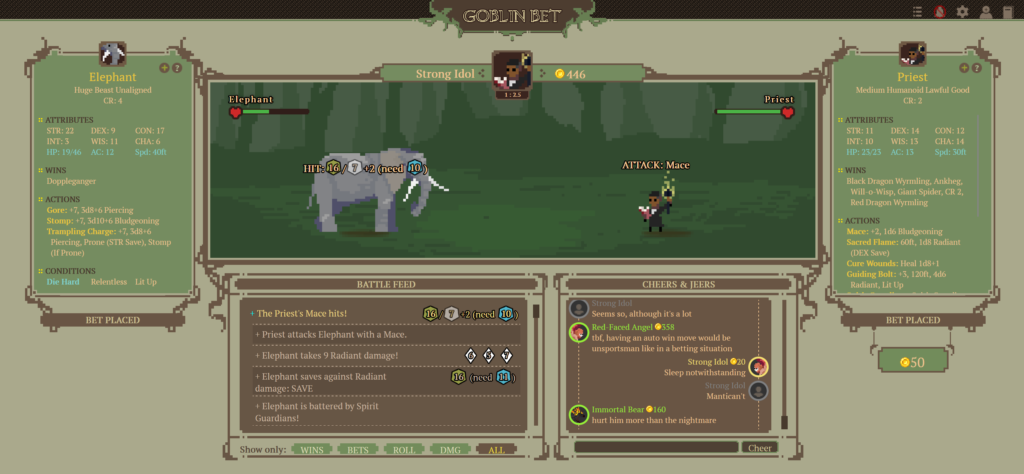
Goblin Bet is a website that presents an endless sequence of D&D 5th edition monsters fighting each other one-on-one. You bet pretend gold pieces on the outcome. Like the similar-in-concept Salty Bet, none of the money is real, you can’t pay for extra currency and it can’t be exchanged for anything. In fact, the game won’t let you drop below 50 gold, so you might as well bet all-in if you get to that point.
The game follows a rough tournament structure. It starts with eight low CR creatures 1/8th to 1/4th, that fight each other in a branching kind of format. (There is nowhere to view the bracket, this has been determined largely through observation.) The winner gets to advance to the 1/2 CR round, where it might die quickly, but it might not. Most monsters are granted one added advantage randomly from a variety, and some of them are pretty powerful.
The brackets continue: 1 CR, 2 CR, 3 CR, and up and up, until around the 16 CR range. The higher the Challenge Ratings, the harder it is to figure out the winner of each match. A few abilities, in the combat system the site uses, are ludicrously powerful. We watched a Giant Crab stop over two complete brackets, at one point taking out a lion, because it had an ability, Stong Grappler, that was basically inescapable, so once its opponent was grappled, it just got advantage on all its attacks, and the opponent had disadvantage. In 5th edition D&D terms, “advantage” means, when you roll, roll two dice, and use whichever value is higher, and “disadvantage” means roll two dice and take the lower value. It’s a huge factor.
A lot of the fight outcomes come down to things like this, which you have to pick up by watching many matches. Flight, to give another example, is pretty strong, because it lets a creature keep attacking and retreating, forcing opponents without missile attacks to sprint sometimes to keep up, wasting turns. Often there will be fights where the outcome will be decided by whoever rolls better; it’s best to save your pretend money when that happens, and wait until there’s a fight with a clearer outcome.
It’s surprisingly addictive, and there’s an included chat that’s often pretty entertaining. I’ve enjoyed it anyway.
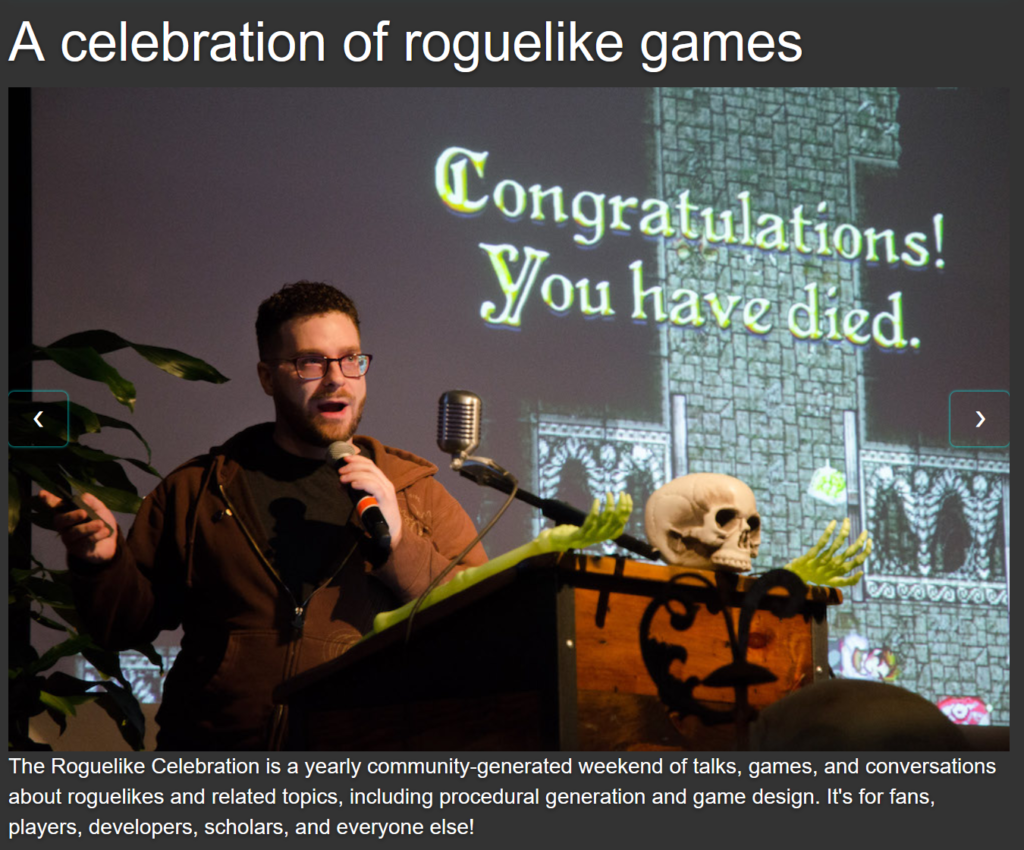
This is just to remind people that the (extended) deadline for Roguelike Celebration 2023 is coming up on us very soon, July 15th! If you have an interesting story to tell about roguelikes, a roguelike game to show off, or even just something involving procedural generation, please consider giving them a pitch! The conference has been virtual the past few years, and it is again this year, so you can stream your talk from wherever you live!
I’ve presented twice, may do so again this year although frankly my talks have always run over, I always have so much to say and the time is over before I’ve even gotten to a literal tenth of it. They do a lot to keep roguelikes in the public mindspace. If you have something to say there, I hope you’ll consider applying.
Time Extension has come up here a lot lately, hasn’t it? It’s because they so often do interesting articles! This one’s about the propensity of Japanese games to use medieval European game worlds, the kinds with a generally agrarian society, royalty, knights, and their folklore counterparts elves, dwarves, fairies, gnomes and associated concepts.
They often fudge the exact age they’re trying to depict, with genuine medieval institutions sitting beside Renaissance improvements like taverns and shops. Nearly of them also put in magic in a general D&D kind of way, sometimes institutionalizing it into a Harry Potter-style educational system.
Notably, they usually choose the positive aspects of that setting. The king is usually a benevolent ruler. It’s rare that serfdom and plagues come up. The general populace is usually okay with being bound to the land. The Church, when it exists, is sometimes allowed to be evil, in order to give the player a plot road to fighting God at the end.
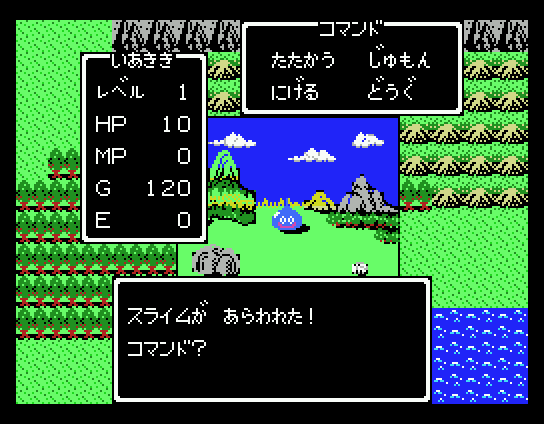
Hyrule of the Zelda games is likely the most universally-known of these realms, which I once called Generic Fantasylands. The various kingdoms of the Dragon Quest games also nicely fit the bill. Final Fantasy games were among the first to question those tropes, presenting evil empire kingdoms as early at the second game.
Dragon Quest (All images here from Mobygames)
John Szczepaniak’s article at Time Extension dives into the question by interviewing a number of relevant Japanese and US figures and developers, including former Squaresoft translator Ted Woolsey. I think the most insightful comments are from Hiromasa Iwasaki, programmer of Ys I and II, who notes that this Japanese conception of a fantasy world mostly comes from movies and the early computer RPGs Wizardry and Ultima, that the literature that inspired Gary Gygax to create Dungeons & Dragons (which in turned inspired Wizardry and Ultima), especially Lord of the Rings and Weird Tales, were generally unknown to Japanese popular culture. Developer Rica Matsumura notices, also, that there is a cool factor in Japan to European folklore that doesn’t apply, over there, to Japanese folklore.
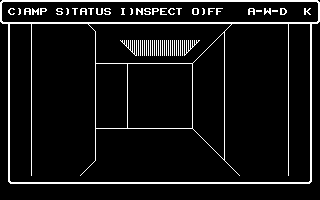
Wizardry: Proving Grounds of the Mad Overlord
It’s a great read, that says a number of things well that have been bubbling up in the back of my head for a long time, especially that JRPGs recreated both RPG mechanics and fantasy tropes at a remove, that they got their ideas second hand and, in a way similar to how a bunch of gaming tables recreated Dungeons & Dragons in their own image to fill in gaps left in Gary Gygax’s early rulebooks, so too did they make their versions of RPGs to elaborate upon the ideas of Wizardry and Ultima without having seen their bases.
Reddit has been severely wounded. I’m sure it’ll keep going for a while, there’s still a lot of people who use it, but it no longer feels like an unalloyed good, it’s obvious that its owners care more about profits than their unpaid mod staff, and a lot of the best users, the ones who produce the really interesting posts and comments, are leaving for other climes.
And… I’m glad. Even though I used Reddit, and Twitter too, I felt bad for doing so. Single websites should not be such a large part of the internet. These are ultimately reimplementations of older ideas of course, community discussion sites go all the way back to Usenet, which predates the World Wide Web by nearly a decade. The main reason anyone cares about them is that there’s already lots of people there, and their value grows as more people are involved with them.
Anything that breaks the hold of bigcorps over substantial pieces of the internet is a positive thing, IMO. All those people who are leaving Twitter for Bluesky or Threads, I feel like I need to warn them, it’s only a matter of time before you’ll be put back into this situation again, no internet site of service run by venture capital, or put under the gun by shareholders and “fiduciary duty,” can escape being ruined. It is an impossibility, the drive for ever-greater profits will inevitably ruin them. This ends the editorial portion of this post.
The most promising alternative to corporate ownership and control at the moment is the “Fediverse,” a collection of sites that all talk to each other and interoperate. Whether it’ll be the solution to the capitalist internet remains to be seen, there’s lots of challenges ahead for them, but one small current win is a post on lemmy.world’s Games board, asking users for their favorite obscure games. It’s got rather a lot of comments of people, all reminiscing about their favorites. It’s worth a good look, for you’re both certain to find people who love the same neglected titles that you do, and a whole bunch of games to investigate that you’ve never heard of before. It’s a marvel.