This video seems to imply the two versions of pretentious penguin King Dedede have different designs, but honestly all I see is one of them has bigger irises than the other? (2 minutes)
Thirteen seconds about the dangers of being a pedestrian in Sky City Place Location Zone:
Finally, this isn’t an animation, but something that can actually happen in game. This is a major spoiler, so some space….
For the solid of mind and stout of body who has braved this far down….
There’s a new legendary machine that relates to events near the end of Road Trip, KARs’ story mode, called Gigantes, with stress on the middle syllable: Gigántes. Imagine saying it like SoulCalibur’s narrator says Cervantes. It’s an incredibly huge thing that takes up almost half the city! Immediately the remaining time becomes about defeating it, sort of how like, in Strange Adventures in Infinite Space, certain games get randomly chosen to be Mission Games, where in addition to turning a profit you have to save the universe.
If Gigantes is still active when time expires, then the Stadium automatically becomes Vs. Gigantes, the Gigantes player against all the others in a big dire battle. Like this (3 minutes):
I preordered Kirby Air Riders (not much of a surprise considering how much I’ve talked about the original, and the “Global Test Ride” demo.) Am I still enjoying it? YES! It’s like a bigger version of the original. If you’re tired of all these posts on this one game, it’s likely to be my last on the subject, for a while at least. In a few days there’s supposed to be a big launch event, to kick off a year of special event content. I might report on some of that, but c’mon; yesterday I made a post about Microsoft BASIC and the Zorks going open source. I think I’m due a little indulgence.
City Trial remains the main draw, even when I have a bad game it’s still fun. You start, you build up stats over five minutes, then you get a “stadium” (which you can usually pick from now) that tests your build.
Throughout the five minutes all manner of things happen: bosses attack, minigames happen, blanket advantages or disadvantages happen to everyone. It’s chaos, but it’s FUN chaos. Sometimes it feels like you win without trying; sometimes you lose despite everything. Every game is like a little story. But good or bad, it’s over quickly, and you can do it again.
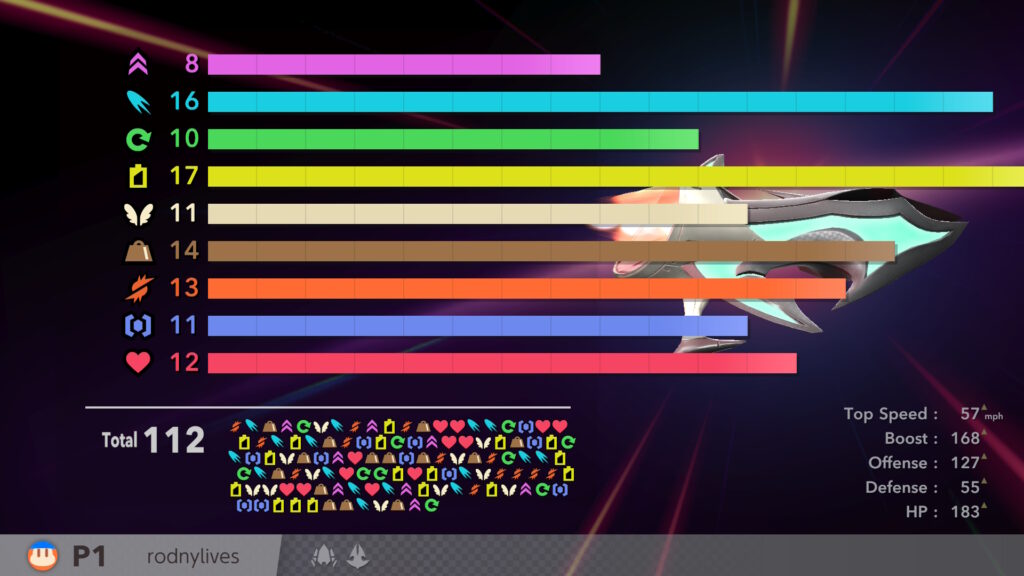
My record at collecting stats so far. I wish you could save vehicles you’ve built, but alas each only gets used for one Stadium.
Each run has a selection of special things that can happen during it. One of them is a hunt for pieces of a “legendary machine,” a vehicle with extremely high stats that is sometimes hidden in some boxes. If a player collects one, an icon appears over them during play, signifying to everyone else that they have it. If player with a machine piece is struck by another player they might drop it. If a player gets all three pieces, a notification is given to all the players, and they get to ride it. It happened to me once! Here is video (½ minute):
Other things can happen too! It’s really never the same game twice.
Now, the worst thing about the original Air Ride still applies: there is no Grand Prix mode. (Why not?? I guess the inhabitants of Dream Land don’t have it in them to hold one?)
The most pleasant surprise, besides the fleshed-out, fully online-capable City Trial mode, which feels like the game it was always meant to be, is that Top Ride, the odd mode out of the original, is now decently playable and much more fun. It doesn’t have a Grand Prix mode either, but its races are so short that it barely even matters. I’ve mentioned before that it feels like Sakurai intentionally patterned it after Atari’s ancient Sprint games, which go all the way back to 1974’s Gran Track 10, giving it a legacy that goes back to two years after Pong. It’s playable online too, as well as namesake mode Air Ride.
The new singleplayer mode, Road Trip, is okay, but it’s just a disjointed series of challenges. You do get to build up stats throughout it, giving it an RPG feel, But there’s no exploration or anything like that.
The one thing that connects all the separate modes is Kirby Air Ride’s greatest invention, returning for another go: the Checklist. A grid of 150 boxes, one per mode, with an extra one for Online play. Every one has an unlock requirement.
At first, none of the boxes’ requirements are even revealed. You’re certain to check at least one of them the first time you play each mode though, purely by chance, and the requirements for the boxes around the ones you’ve checked off are revealed to you. Most of the boxes give you a little something when you check them. Some new decals or accessories to decorate your vehicles with. Some of them unlock characters, or machines for use in some modes, or costume pieces. A scant few give you free checks you can spend, to mark off difficult challenges for free. Many (not all) have optional setups you can activate, like little minigames.
Kirby Air Riders’ biggest sin, and greatest virtue, is that it’s really different from other games. It throws out features one would have thought obvious. (Grand Prix modes!) It adds weird new ones for no reason other than the joy of doing so. (Playing with gummis in a physics engine! Customizing machines and selling them in a little fake marketplace!)
And it does unexpected things, like after spending five minutes attacking and avoiding up to 15 other players, having them each choose which Stadium to play in. There isn’t an overall winner: each Stadium has its own winner! And, if you’re the only one to choose a Stadium, you win automatically.
Yes! That’s Lolo and Lala, from the Adventures of Lolo, a.k.a. Eggerland, games, slightly renamed and playable! Their special attack is shooting familiar-looking big green blocks at the other players!
This happens much more rarely than you might assume: it’s only happened to me once, after playing a whole lot of City Trial. Even those rare times were the game randomly decides you’re all playing THIS now, players are still split up into arbitrary groups.
It’s hard to say if you’ll like it because other than Air Ride, there’s nothing really to compare it too. It’s its own thing, but I think that’s what I like most about it. Whatever Kirby Air Riders has, this is the only place to get it. And it definitely has something. It’s a shame that you have to take a seventy dollar gamble on whether it’s something you want. Ideally the Global Test Rides were when one would have tried it out and seen if it was to one’s liking. Maybe they’ll do another one some day, or you can watch Youtube videos of gameplay? (I once again humbly offer myown.) But if this is something you’ll like, you’ll really like it. Maybe use that new Switch “game borrowing” feature to bum it off a friend for a while. It should be experienced at least once.
Microsoft’s Evil Quotient (EQ) has fluctuated over the years. On the average it was trending down for a while, but their sponsorship of OpenAI, and their ruining of Windows 11 and forcing many people to buy new machines to use it, have caused it to shoot right back up again.
But they have made two significant historical contributions to open source software recently. Back in September they open-sourced the original version of Microsoft Basic, which was partly written by Bill Gates himself as a teenager. Here’s the announcement on Microsoft’s Open Source blog, and here’s the GitHub repository with the code. It’s worth noting that Bill Gates was long vocal against the principles of free code sharing, and his arguments in favor of commercialization of computer software are partly responsible for our current capitalist hellscape, but I guess better very late than never, eh what?
More recently, as in the 20th of this month, Microsoft announced that they were officially opening the source code for the three Zork games. The copyright for them passed into their holding by their acquisition of Activision. If you have a time machine, it’d be a fun trick to go back to the founding of Activision and tell them about the later history of their company, although in doing so you might cause them to give up their efforts in despair.
It must be said that Microsoft didn’t publish the source code to the Zork games; instead, they gave their official blessing to Jason Scott and the Internet Archive’s efforts to preserve it. They did that by adding documents to the GitHub repositories for Zork I, Zork II and Zork III. The source code takes the form of ZIL files, code written in the Zork Implementation Language to be compiled into object files compatible with Infocom’s Z Machine interpreter, so if you want to understand what that means, I suggest Andrew Plotkin’s introduction, What Is ZIL Anyway?
(Edit: changed stylization of the name of the system so it’s not all-caps.)
I was sure I had posted about this before, I mean I had to have. It’s such a cool bit of gaming history, never less than a bit obscure, but still, incredibly, has multiple websites devoted to it today. While waiting to binge on Kirby Air Riders, I figured I’d work off some of my indie KARma (heh) with this post about something that could not possibly be more different.
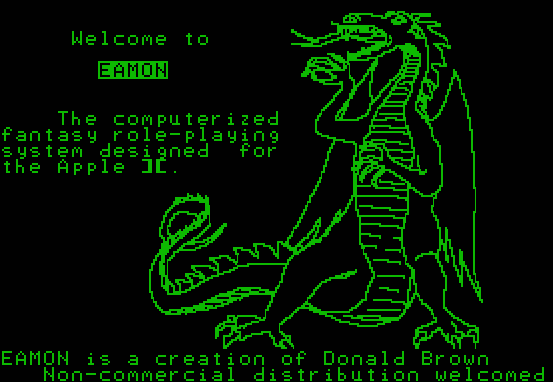
I’m talking about Eamon, an Apple II text adventure/RPG system with ports to other platforms (there was a not much used C64 version, and a PC/MS-DOS version with a bit more uptake), but was biggest on Apple II.
Eamon itself isn’t a single game, but is more like a family of games, each created to a certain specification. The closest thing that Eamon has to being at its center is the Master Disk, which is a character creation tool and a starter adventure. The idea is, you create and customize a character using the Master Disk, which saves your character and allows you to take them into other adventures, written by others.
If you remember me talking about Dungeon (from Loadstar issue #74 and others), it’s the same kind of idea, but from far earlier, and a lot more freeform. Dungeon had creation tools and a game engine. Eamon adventures were BASIC programs written from scratch, that modified the character file. Your in-game surrogate was really at the mercy of whatever horrors the adventure writers had in mind. If you feel a mild chill of existential horror at the idea, that’s because you live after decades of internet culture has trained you to recoil in fear that a software author could do just anything. It requires a degree of trust on the part of the user. Of course, Eamon adventures varied in quality and fairness. You have to expect that even your best characters could get pasted by a level 1,000 Tarrasque right as an adventure begins. Of course, smart people made backups of their character disk; in a chaotic realm like this, it’s a lot less cheating than basic prudence.
I promised links to websites. Here they are.
There’s Eamon Remastered, which is a web-based recreation with many recreations of classic games. With it, you can create a character which is saved to the website, then put it through the options on the Master Disk, and then can send them through the adventures, without having to get an emulator working or anything. If you just want to try it, that’s probably the best.
First off, you should probably try the Eamon Remastered web-base recreation, which has a fair number of adventures to play. Here is its manual.
After you create your character (if you’re playing the Apple II original, make sure to follow directions in town, as the game is positively gleeful about killing newly-made characters), you’ll want to buy a weapon and some armor. Advancement in Eamon is not of the level-based D&D style, instead characters advance by doing. When you attack with a weapon, you might improve in your ability to use it. When you’re struck by an attack, you might improve in your use of armor. It lacks the “dopamine hit” (I hate that term) of gaining a level, but I think this is quite a more realisticm, and dare I say, better, method of character advancement. It’s more like the Runequest/Call of Cthulhu/Basic Role-Playing system, where most of a character’s ability is encoded within a number of individual skills. Though it’s a lot more gradual, it also means that characters are a lot more individual.
When you play it, you’ll find that it works basically like Infocom adventures did. Since each Eamon game is a program to itself, things could work very differently between them, but I think most of them tried to adhere to some shared conventions.
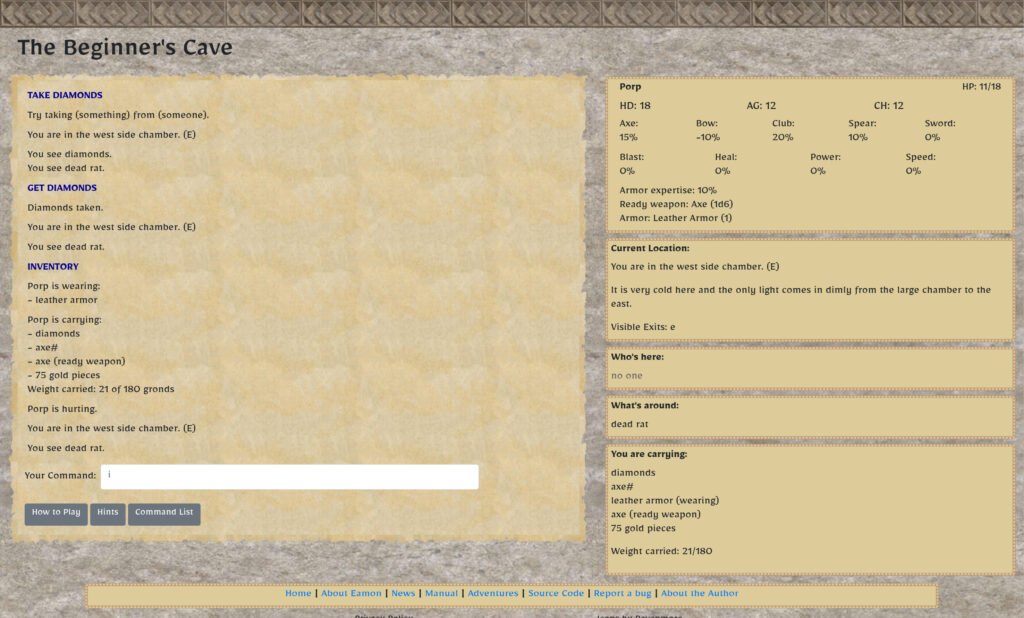
The “Beginners Cave” adventure is the intended first experience with EAMON. It provides you with some basic treasure, opponents and advancement. It is quite possible for a new character to die there, so treat this adventure with care. I found that there’s some quirks. “take [item]” tends not to work; “get [item],” however, does. “attack [monster]” can be used to attack in melee. There is a button, by the input box, that you can click for a list of available commands.
I don’t know if this is true of every adventure, but to get away from a battle you’re currently in, it won’t do to move out of it, if you don’t want to fight you should use the “flee” command, although monsters can follow you anyway if they choose. Flee sends you to the previous room you were in. If the monster that was menacing you chooses to follow, then I don’t know what else to do than just keep attacking and hope for the best.
I don’t have a lot of experience with Eamon myself, so I must leave you to your own devices for furthering your adventuring career. Good luck!
Warning: while the creator says it isn’t sponsored, there is a distracting review segment over two minutes long. You can just sit through it, try to skip past it manually, or you might try the open-and-crowdsourced browser extension SponsorBlock, which shows segments like that one on the Youtube timeline in green.
Owner of Game Wisdom with more than a decade of experience writing and talking about game design and the industry. I’m also the author of the “Game Design Deep Dive” series and “20 Essential Games to Study”
So it’s over, and all of those Switch 2 demo apps used to play it are now useless hunks of code. If you load it up now, it’ll tell you the period is over and direct you to the eShop page for the full game. Maybe they’ll offer another one someday, they’ve been known to dust off Splatoon demo apps as a promotion from time to time, but odds are it’ll never work again.
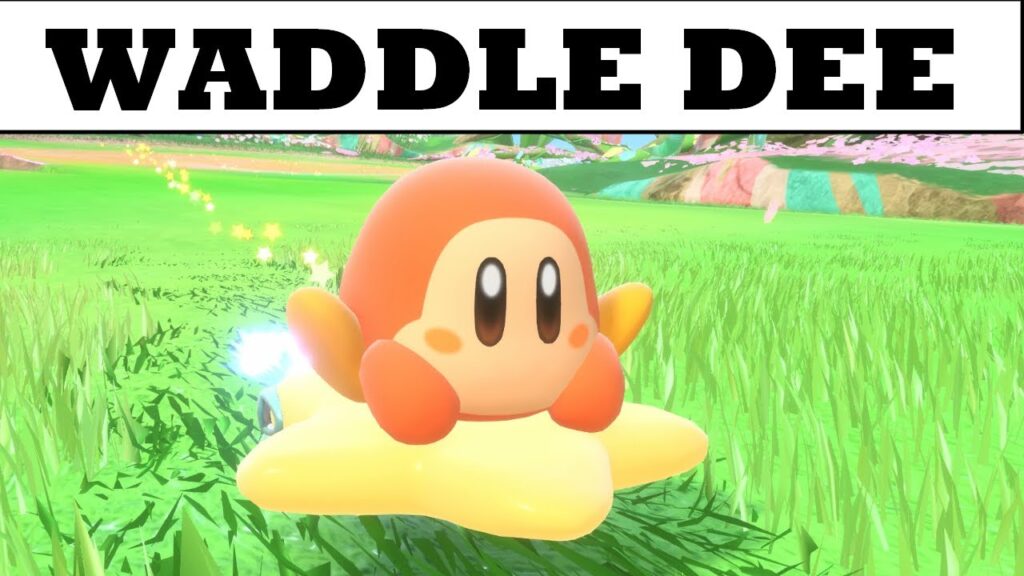
Debuting in the second demo: Regular Waddle Dee! Motto, “I have no mouth and I must RIDE!” (Image taken from a thumbnail for this video.)
It seemed to go well, and I only had a couple of disconnects, despite being saddled with rural internet. Most of my play in the second demo period was spent with the fine folks of the Kirby Air Ride Online Discord, people who are fanatical about the original game, and seemed to like the new one just fine.
I love Masahiro Sakurai’s determination to make the kind of games he wants to play, and I love that that’s so different from other games. We need lots more people like Sakurai making big games, but should remember that he can only do it because his games consistently sell well, and that he’s the creator and director of one of the biggest series there ever was, Super Smash Bros.
It’s like a last vestige from the classic age of console game development. Even if you don’t like them yourself, it’s important that these different games are being made, they help keep the gaming world viable, if just a bit, for new concepts. Without Smash Bros., it’s obvious we wouldn’t have Nickelodeon All-Star Brawl or Multiversus. Personally I have grown tired, very tired, of the idea of crossovers, but I don’t think that can be laid at Sakurai’s feet. It’s the executives that love the idea of mixing their properties together, even though it makes of their worlds and stories the same thing you get when you mix red, yellow, green and blue paint together: a big pot of gray.
Sakurai’s in a unique position, as both creator of one of Nintendo’s biggest series, but also no longer working at Nintendo. When you see his beautiful living room in his game design videos, that was paid for by the moneytrucks Nintendo must send him daily.
Let me impress upon you how weird the Kirby Air Ride games are. The “main” mode, the one the first game’s named after, Air Ride, is pretty basic. It has no Grand Prix mode, even in the sequel. Every race stands alone. The main way you play Mario Kart doesn’t even exist in Air Ride(ers). That’s a pretty strong statement that it isn’t a standard kart racer!
Of City Trial, it’s most interesting aspect is how invented it is. Most games try to follow elemental archetypes. You’re a shootyperson on a battlefield; you’re a swordperson in a dungeon, you’re in a maze, you’re jumping across platforms, you’re a commander of troops, you’re running a civilization, etc. City Trial can’t be summed up so easily.
I especially admire how each City Trial match can end so differently. You might have a fight, run a race, or participate in a vehicular version of a track-and-field event. This probably turns some people off; even the Kirby Air Ride Online people, when they run their tournaments, hold them in a customized version of the Gamecube game that disables many of the events and Stadiums. It makes for better spectating if the game doesn’t sometimes douse the game in a heavy fog, or if the Grand Finals doesn’t end up decided by whoever jumps the highest. If they hold Kirby Air Riders tournaments, how will they feel about Air Glider and High Jump returning to the event pool, joined now by Skydiving?
It became evident during the second demo period that Sakurai, despite talking about Air Riders for nearly two hours on the internet, has kept his lips shut about some substantial aspects of the game. Two vehicles that have never been seen before debuted, the Vampire Star that attacks nearby players automatically, and the Bulk Tank, which takes a heavyweight option and makes it more. We still don’t really know much about the Road Trip mode, which didn’t feature in the demo at all, not even appearing on the menu screen.
Well the demo is over now. The full game will be out on the 20th. See you on the riding fields, ya bunch of hamsters. (1 minute)