Presented largely as a curiosity, but an entertaining one. An itch.io user named The Great Foohachi went through the trouble of converting background and character graphics from beloved SNES Squaresoft JRPG Chrono Trigger to Gameboy format, and from there put them to work as window dressing for a fairly rudimentary single-player Othello clone, a.k.a. Reversi, using GB Studio, which is rapidly becoming a go-to tool for this kind of monkeyshine. I would expect that 90% of the 256K ROM space goes into the art, which is really only there to give it some prologue cutscenes.
How does it play? Once you get to the game portion, fairly slowly, but it works. I played a round on Normal difficulty and won pretty easily. The thing to remember is, try to look ahead a move or two, don’t set up your opponent for huge moves, and if possible don’t let your opponent get a corner spot, while trying all you can to get them yourself.
Here’s a few screenshots. P.S. If you try this, you’ll want to turn the sound off.
This bit of dialogue should give you some idea of how seriously this is taken.It’s a nice conversion of the SNES game’s graphics at least.
You can’t play as Robo because he’s the opponent, natch.
Othello Trigger (by The Great Foohatchi, Gameboy ROM on itch.io, $0)
It’s a busy day for me coming up, so here’s one from my list of Youtube links: the Ultimate Gameboy Talk (1 hour 1 minute) by Michael Steil, but you don’t have to watch it on YT, as it’s also hosted on the website of Chaos Computer Club in various formats. The embed below is from Youtube though, since they usually have pretty good embedding:
This “ultimate” talk is ultimately about the hardware, its internals and quirks, and tricks that can be pulled off in it. Sure, it’s very technical and extremely geeks, but that’s pretty much the standard around these parts. Enjoy!
We’ve linked them before, and more than once, but they’re one of a small number of Youtubers who consistently does great work. Here they look at the effects in a number of games and reveal how the programmers coaxed surprisingly complex effects out of the hardware for each of them. (25 minutes)
The games and effects covered this time:
Art of Fighting on the PC Engine, zooming in and out from the fighters as they approach and draw away from each other
Road Rash on the SMS, which created a startling effect of a road undulating and going over hills for 8-bit hardware
Ranger-X on Genesis/Mega Drive, artillery shots firing into the distance in the background and multi-plane parallax scrolling
The Lawnmower Man on Genesis, SNES and Gameboy, fast 3D virtual reality scenes (well, slower on Gameboy)
Donkey Kong Country 3 on SNES: vertical stretching of a boss
Contra 3 on SNES: rotating both a large boss, the background and the player on the screen at once when the SNES only had one hardware scroll background layer
White Pointer Gaming is another excellent source of retro game hardware information, and a few days ago they uploaded a dive into the specifics of the real time clock used in Pokemon Generation 2 (14 minutes), and as an encore discussed Gameboy mapper chips, a related topic. It seems the clock hardware is on quite a few other GB games as well, as it’s built in to a common mapper chip, but it needs extra power to run the clock, and an oscillator to keep the time accurate. Another game that uses the same mapper, but doesn’t have the oscillator? Pokemon Generation One. Hmmm!
The video mentions that powering the clock and oscillator causes Pokemon Gold, Silver and Crystal cartridges to run out of battery power, and lose their saved game data, much faster than other Gameboy carts with save game battery. Sorry to break it to you; your Pokemon are probably gone by now. Poor out a health potion for Pikachu.
Another interesting fact revealed is, the clock works by recording raw time since the game was last powered on, and the actual date and time are fully updated when the game is started up. If you wait a long time between plays, over 511 days, the timer can wrap around and lose track of how long it’s been.
The scenario: you’ve made a homebrew NES, Game Boy or Game Boy Color game, maybe by using a paid tool like NESMaker, or a free tool like GBStudio. Or maybe you used an assembler. Or maybe you hand-forged it yourself out of elemental bits with the chip documentation laid out on a table beside you? (Don’t laugh, I used to write 6502 code like that back in the day, when I didn’t have an assembler! The Commodore 64 Programmer’s Reference Guide was a godsend.)
The problem: you’ve made something you think is pretty darn great. Maybe you’d like to distribute it for people to use easily without having to set up an emulator, like it were some kind of native application? Maybe you’d even want to sell what you’ve made, and participate in the equatable exchange of goods and services you’ve heard people talk about in huddled whispers, but never thought you might engage with yourself?
The indicated programmacalities* take a supplied rom image (even if said image never came from actual ROM chips) and erect a software box around it. Then you can distribute that package to other people, and they can double-click it to run it, just like it were a standard desktop executable, and it’s even rumored to be Steam Deck compatible.
A pre-built version is supplied for Windows. For Linux you’ll probably have to compile some code, if just because there’s so many distributions. For Mac, you’ll have to compile it yourself as well, but the process is rumored to be pretty simple.
* Feel free to use this word in your own conversations! People will love it!
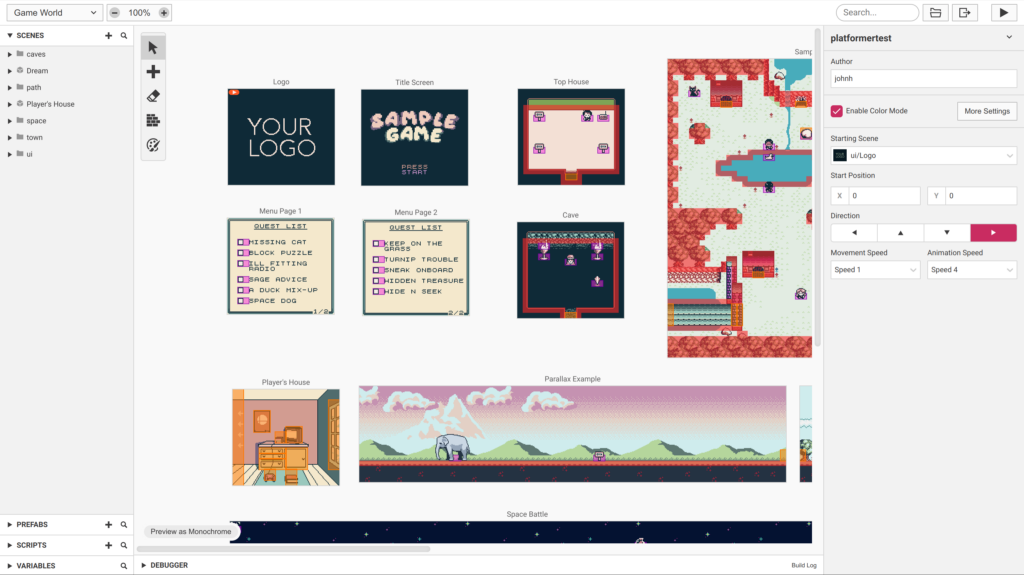
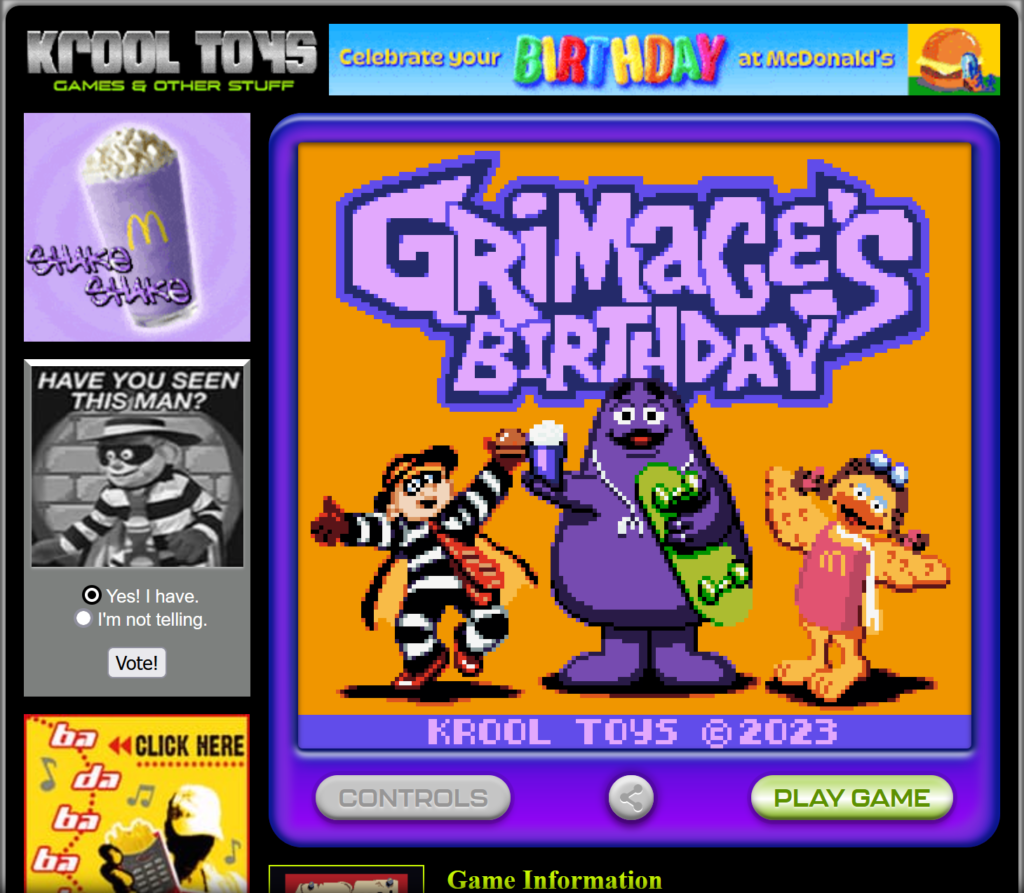
GB Studio, by Chris Maltby, is fairly well-known now, isn’t it? It’s a free and open source solution to fairly easily making Gameboy roms on your own, that are properly termed not romhacks but homebrew. It has its own website and it’s available on itch.io. It was what Grimace’s Birthday, which we linked to last year, was made with.
GB Studio, from its platformer template
Now there’s a heavily-modified version of GB Studio, called BB Studio, that produces NES roms in a similar manner! It’s made by Michel Iwaniec, and can be gotten from Github here. It’s recommended that you be familiar with GB Studio first, and to read the list of caveats on the page. Particularly, the NES supports fewer sprites per scanline than the Gameboy hardware does, and runs at a slower clock speed. BB Studio is also “early alpha software,” meaning, it might or might not work well for you at the moment.
While we’re on the topic I should also mention NES Maker, which isn’t free, but it also isn’t “early alpha software,” and at $36 isn’t expensive either, and is custom-built for generating runnable NES games.
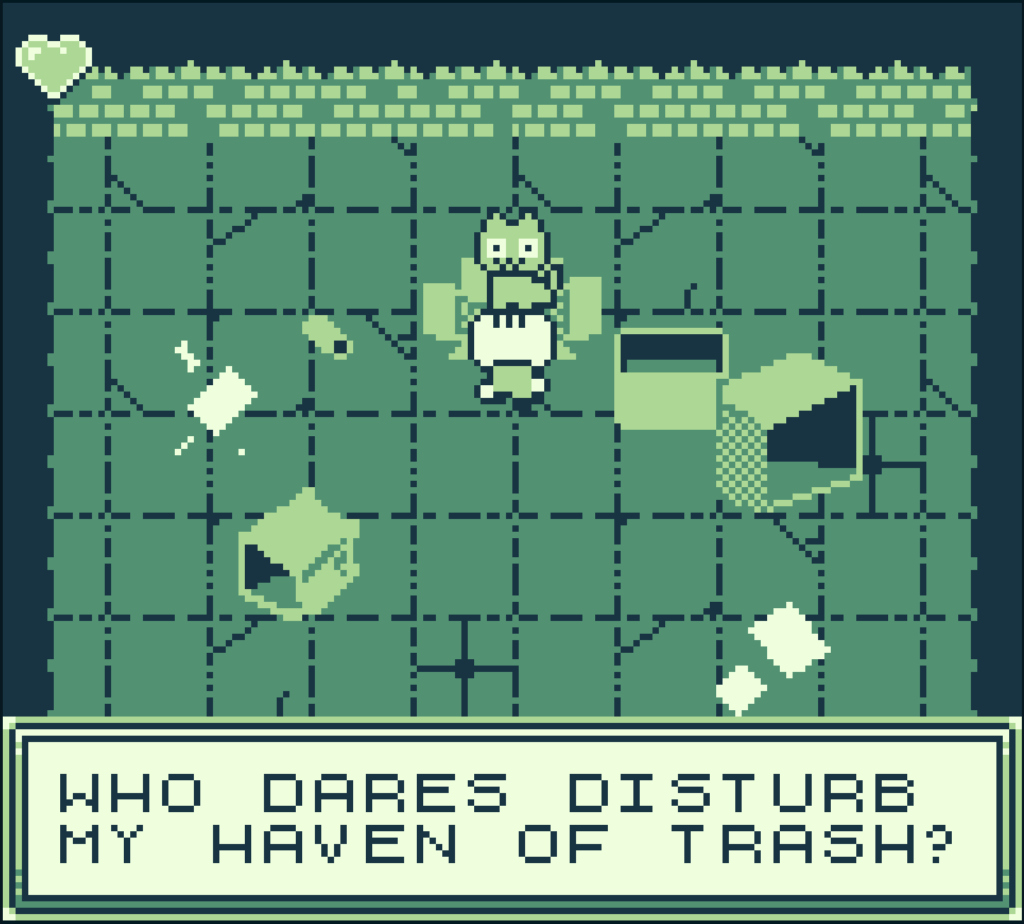
It won’t take you more than a few minutes to play Marlowe Dobbe‘s Dungeon of Hank, a short and free homebrew Game Boy game made with GB Studio, and it’s not challenging. But it does have a lot of cute cat pictures, and is funny, and that’s enough. It’d probably be enough even without the funny. Cat’s cute, just sayin’. The cat’s name, you should know, is Hank Stuart Bastard. It doesn’t sound like one that T.S. Elliot would bestow, but then, what the heck is a Rumpleteaser anyway?
All the gaming bigsites have been talking about Grimace’s Birthday, a promotional Gameboy Color game sponsored by McDonalds and made by Krool Toys. Here it is on IGN, and here it is on Kotaku. And, here it is on Gizmodo, and here it is on Retro Dodo.
Ars Technica linked to it as well. I love their title. It reads, “For reasons no one can fathom, McDonald’s has released a new Game Boy Color game.” Well, I think I know why. It’s an advergame. Judging by how many websites have stories about it, I think the why is freaking obvious. It’s so obvious that I would be surprised if an ad agency weren’t behind this flurry of interest by half the bigweb.
ima grip and sip
Some notes. I’ve seen people say it’s the first “official” Gameboy Color game since the system died. I suppose that’s true, but that’s really tricky language. It’s official in that McDonalds sponsored it, and it uses the McDonaldland characters with their blessing. It’s not official in that it’s supported by Nintendo. It doesn’t have the “Official Nintendo Seal,” and it’s not being released on physical media. Although it was made as a Gameboy Color rom, and can be played on actual hardware using a flashcart or if someone put it on chips (in such a way as to get past Nintendo’s hardware check) and made a cartridge of it, but nearly everyone will play this as a webgame, on maker Krool Toys’ website.
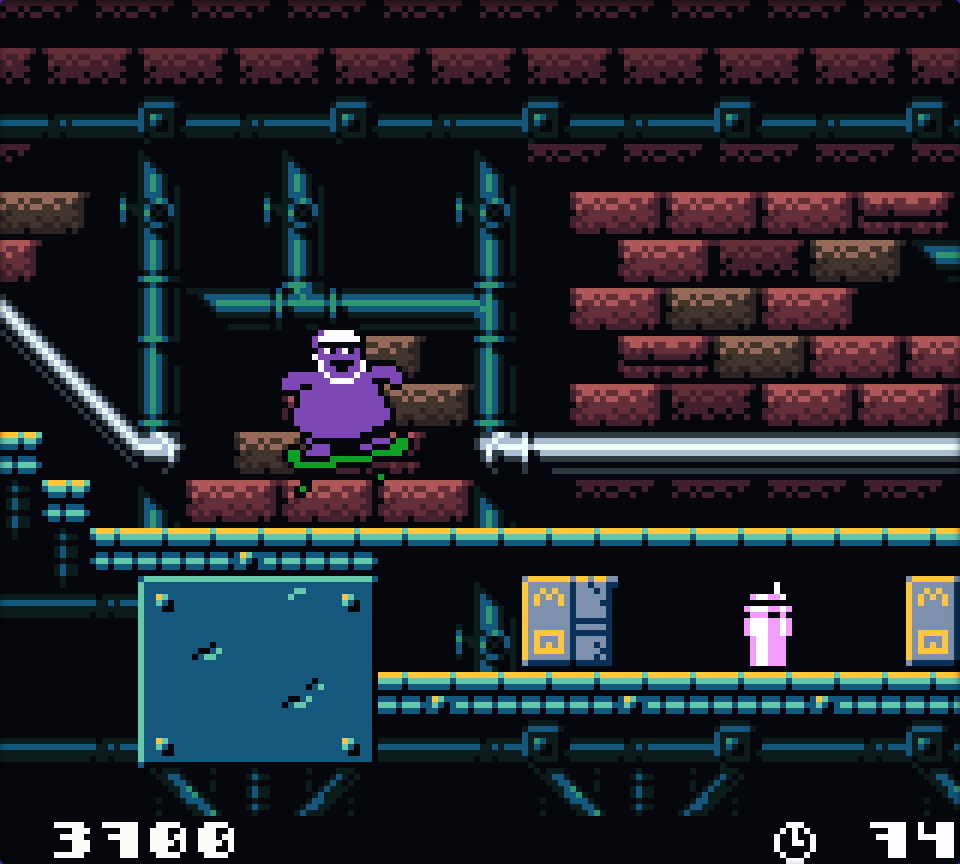
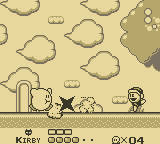
What the game actually looks like. It’s a platformer with heavy inertia.
(Why the bay, take a look at the site design on both of those pages, they’re totally earlyweb relics! I am not complaining; in fact, I love them fiercely. Do not get between me and those sites!)
All of this is of course part of McDonalds’ promotion where they’re cerebrating the Grimace’s birthday, an affair that involves purple milkshakes. In a whole post of surprising revelations, the biggest one is that they remember they have McDonaldland characters to begin with, as they’ve been gathering dust for over a decade.
Anyway, it’s not a bad game. It’s mostly interesting for the novelty value. It won’t win any rewards, but it’s a perfect ordinary timed GBC inertial platformer. It’s mostly notable for McDonalds’ temerity in sponsoring it, but I suppose Nintendo doesn’t much care anymore about the integrity of their (oh frog) twenty-five year old hardware’s library.
Boo the hey: no one paid us for this post, but we’re not against making thousands of dollars. McDonalds, call us.
It looks like Jupiter’s Great Purple Spot! Two Earths could fit inside that vaguely violet blob! The whippede creme is mostly frozen methane! Drink it before it undergoes gravitational collapse and becomes a star! ALL THESE SHAKES ARE YOURS EXCEPT EUROPA
St1ka is an interesting Youtuber from Portugal who often covers the Brazilian gaming beats. I should link to him more often when he does videos on his standard beat, as the gaming scenes outside of the US, Europe and Japan don’t get nearly as much exposure as they should.
This time though he is looking at retro gaming with a more general focus, pointing out interesting titles from decades past. They’re not making nearly as many 8-bit titles as they used to, so finding a cool old game you’ve never tried is almost as good as if they were making them now!
The games covered are:
Konami’s Getsu Fuuma Den, Japanese horror for the Famicom,
Rod Land, a single-screen arcade platformer with a good Famicom port,
Kickmaster, a deep combat action game for the NES,
Lunar: Walking School for Game Gear, a Game Arts-produced spinoff JRPG of the main Lunar series that doesn’t have much to do with its origin, and has a happy slice-of-life anime feel,
Psychic World for the Sega Master System, a neglected platformer where you pick up magic-like powers as you progress, which got a Game Gear port with unexpected differences, and both deriving from a Japan-only MSX version with its own differences,
Power Blade and Power Blade 2 for the NES, and the Japanese version of the first one, Power Blazer, stylish action platformers akin to Mega Man, but staring an Arnold Schwarzenegger clone who wields boomerangs, except in Japan where you play as a serious-looking little kid,
Cave Noire, a roguelite game for Game Boy that I’ve written about in the past, and personally vouch for,
Daikatana for Game Boy Color, a 2D and rather improved version of the infamous 3D PC game,
Power Strike II for the SMS, or its Game Gear remake that’s completely different, but they’re Compile shooters so you know they’re going to be awesome, and really you can’t go wrong with any Power Strike/Aleste game, or ZANAC or The Guardian Legend on NES come to mention it,
Queen Fighters 2000, a bootleg game for Gameboy Color that outright cribs the style from Gals Fighter for NeoGeo Pocket Color, but also includes a bunch of random characters from other properties for the hell of it, since being a bootleg game anyway why not,
Aliens Neoplasma is a 2019 release for the Spectrum that makes excellent use of that system’s graphical quirks to increase the game’s atmosphere,
the action RPG Dark Arms for the NeoGeo Pocket Color,
early survival RPG Survival Kids for the Game Boy Color,
Phantis, a cross-genre sci-fi game for the Spectrum,
Shatterhand for the NES, which feels inspired by Batman on the same system, and
Kabuki Quantum Fighter, also for the NES, which also seems inspired by Batman in its play style, and was also developed by Hal Laboratory.
“We scour the Earth web for indie, retro, and niche gaming news so you don’t have to, drebnar!” – your faithful reporter
Welcome shlorbs and foobs to our mostly-weekly text-based internet news program! I hope you enjoyed our techno/bicycle horn fusion theme song! It’s the number one chart-topper on my homeworld, but admittedly my species doesn’t have ears. Images includes in this post are ultimately from Mobygames.
Emily Olson at NPR (swanky!): Google’s shares dropped by $100… (holds paper in front of eyes, reads twice to make sure I see it right)…billion after a disastrous AI demonstration. As a wise cartoon butler once said, “You people have too much money!” I guess we see where everyone’s looking for the next unsupportable tech bubble now that crypto’s in what I understand humans call “the crapper!” I never understood that saying personally. It isn’t the thing that craps!
Kotaku. Luke Plunkett. Sony claims before court that Microsoft’s request for documentation goes so far that it’s “obvious” harassment. I mean I am at a point in my blobular life that I don’t see anyone representing a corporation as saying a single syllable that isn’t mathematically calculated to four decimal places to improve their balance sheet, so who the hell knows if it’s true. Maybe it is? I am staying neutral in this fight. Acids and bases hurt my cell wall.
Will Shanklin of Engadget tells us that a “Minecraft mad scientist” has recreated The Legend of Zelda in Minecraft, and in true mad scientist fashion is holding the work hostage, refusing to release it unless a video demonstrating it hits 5,000 Youtube likes. The article said it was at 500 likes; at our own press time it was up to 4.5K, so by the time you read this it should have enough. I will pass it along to Editorial as possible blog fodder (“blodder”) for Set Side B!
Ron Amadeo brings us the news that with the switch to monthly updates of Android 14, Google will begin just blocking apps on it made for versions of Android before 6. The reason given is security, but bah to that, old software and its preservation simply isn’t a priority for megacompanies like Google. Does anyone remember the days when it seemed like they might be a different kind of tech company? Me neither.
Thursdays here at the moment are the domain of Edit the Frog, so we put off our overview of the Nintendo Direct until today.
While most sites have already regurgitated the news into your waiting beaks, this time we’re recounting the release dates chronologically, so you’ll know what order to expect everything. Specific games of possible interest to a hazy mirage that I imagine to be our readers are in bold:
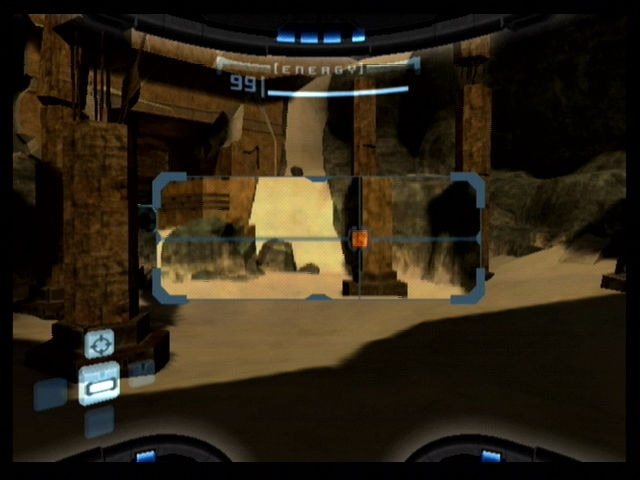
FEBRUARY 8th: Nintendo Switch Online Gameboy & GBA Support, Fire Emblem Engage Expansion Pass, Metroid Prime Remastered 15th: Xenoblade Chronicles 3 Expansion Pass DLC volume 3 22nd: Metroid Prime Remastered on cartridge 24th: Octopath Traveler II, Kirby’s Return to Dreamland Deluxe
MARCH 6th: Dead Cells Return to Castlevania DLC 17th: Bayonetta Origins: Cereza and the Lost Demon 20th: Spring begins. Releases for Spring: Splatoon 3 Expansion Pass, Mario Kart 8 Deluxe DLC Wave 4,
MAY 12th: The Legend of Zelda: Tears of the Kingdom
JUNE Some time in June: Harmony: Fall of Reverie 1st: Etrian Odyssey Origins Collection 2nd: We Love Katamari REROLL + Royal Reverie(what is it with the word “reverie” this month?) 21st: Summer begins. Releases for Summer: New Samba de Amigo, Ghost Trick: Phantom Detective, Baten Kaitos I & II HD Remaster
JULY 21st: Pikmin 4 28th: Disney Illusion Island
AUGUST 29th: Sea of Stars
Some time in 2023: Fashion Dreamer, Decapolice, Fantasy Life i: The Girl Who Steals Time, Professor Layton and the New World of Steam