Sundry Sunday is our weekly feature of fun gaming culture finds and videos, from across the years and even decades.
Two items this week. One is this simple yet charming video of someone who made a crank organ (festooned with plush parrots and a decorative octopus) and configured it to play the ending music, titled simply “Staff Roll,” to Super Mario 64. It’s very nice to listen to, and it’s only about three minutes long. Please enjoy!
The other thing? Oh, the final episode of The Amazing Digital Circus, which released to theaters a couple of weeks ago, finally hit Youtube. Everyone probably knows that already! It didn’t to badly in theaters (I saw it there myself for the first time), but now that it’s on Youtube the saga Pomni and her friends in their weirdly video game-like world is over. There’s laughs, quite a bit of sadness, and a hopeful tone at the end. I greatly enjoyed it! If you haven’t seen it yet here it is (58 minutes).
Will we ever see the Circus and its denizens again? Who knows? Creator Gooseworx has said she’s tired of working on it, but she seemed to leave open the possibility that production company Glitch could do something. The characters are interesting and unique, and we should be happy with what we have. But who knows?
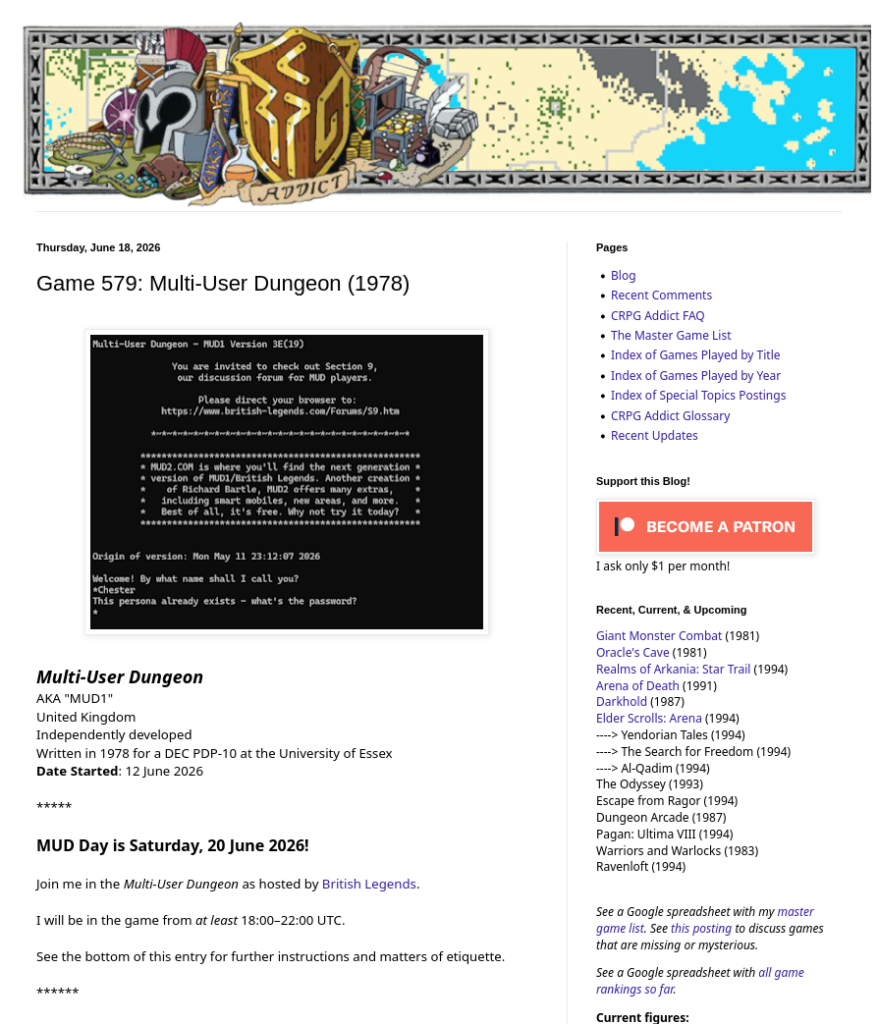
MUDs, and their sibling games MUCKs and MOOs, now almost forgotten except among a rapidly-aging userbase, used to be the biggest gaming draw on the internet. When MMORPGs became big, it was largely by using the lessons of MUDs and applying them to a 3D graphical world with action gameplay. Everquest (admit it, you haven’t heard that name for a while) and World of Warcraft would never have become big if it hadn’t been able to stand on the shoulder of MUDs. And now, with WoW’s memory receding in the minds of many users, I think it’s well time to go back and find out what the originals were all about.
That Antiquarian article is pretty amazing. In the original MUD, if you got enough experience points you could become a wizard, basically a moderator yourself. If you killed another player they had to start over from scratch, and you got 1/24th of their experience points. Other ways to gain points was to find treasure and drop it into the swamp. Once treasure was swamped it was gone until the next server reset, which only happened when nearly all the treasure was so disposed. While you could find and use weapons, there was a limited number of most of those in the game so most players had to be satisfied with basic stick weapons.
But despite these limitations, players managed. Wizards could crash the game easily (there was a command specifically for doing so!), so mostly they didn’t. Customs were decided on; it was improper to kill a player more than two levels below yours. The game continued, and players largely came up with their own solutions to social problems.
The CRPG Addict explains that the original MUD is still in operation at british-legends.com, and that you can even join him there to play today! Times are in his post.
I was just looking through Hunter S’s video on the holiday glitches of Gamecube Animal Crossing (11 minutes). By “holiday,” it means the winter holiday, and the various weird things that are possible during this season, like using snowballs to get pushed out of bounds into the ocean, getting a dummy item due to a data error when playing games with villages camping in igloos, and others.
I think the most interesting thing however has to do with GC’s Animal Crossing limits. Although the system clock extends out to 2099, the calendar of the game itself only supports dates up to 2030! When the date rolls on at midnight, December 31st 2030, the game will advance to 2031, apparently as normal, but on saving and reloading the year will become 2030 again.
The video was made two years ago in 2024. It’s now 2026, so you only have about four-and-a-half years to play Gamecube Animal Crossing in the intended way. All the AC games have date limits like this. The Switch version, New Horizons, is said to be able to even open save files from 2061 and later, so that’s one edge the Gamecube version has over it.
If you’ve been reading us for a while, you’ll know that I have an inordinate fondness for the early days of this here World Wide Web. I have become disenchanted with social media, the infinite scroll, and not just Web 3.0, but even Web 2.0. React.js and other frameworks. Gimmie that good old HTML religion. You can have some CSS if you promise not to go crazy with it.
You might wonder how many of these websites can be left. It was just in April that the long-decaying webhosts Tripod and Angelfire finally and suddenly went dark. How many of these old pages remain? Well, going by the link count at Early Web Links, at least 12,000 of them.
There’s actually many more than that out there, but they’ve been neglected, abandoned by the money web. Good luck finding sites like these in Google, they’re much more apt to send you to Reddit or Youtube. All the big social media sites actively downrank sites with the temerity to include links in them, for if you follow them, you’ll be leaving the lucrative walled gardens of Facebook, or the fascist-supporting castle walls of “X the everything app.” The rise of more healthy social media like Mastodon and Bluesky is a counter to that, but they’re still dwarfed in size by the likes of Instagram and Threads.
If you want to find interesting, independent Web 1.0 sites like these, your best bet is a directory like Early Web Links. Despite the name not all of these sites are old ones, many are quite new. They’re “early web” links because the sites are done in the style of the oldweb, and presented from a link directory not dissimilar to the fertile environment that, decades ago, was the mulch that supported the roots of Yahoo and its improbably-lasting multimedia empire.
Of course, that was decades ago. If you’re looking to make a fortune now then these sites aren’t going to provide it to you. But what they can give you is honest, earnest enjoyment, not tied to an algorithm or funding billionaires. Go have a look! We’ll be here when you’re done.
The Game Display tells us of an interesting kind of secret in Super Mario World that few know about. Once in a while in that game, a 1-up Mushroom just randomly seems to appear, flung into the air, sometimes in such a way as to seem to encourage you to leap off a cliff to go after it. Here is their video explaining what’s going on with those (9½ minutes):
There are some locations in a few levels that have four invisible spots in the background that can detect your presence. If you touch the four in order, the extra life appears. They’re found throughout the game, and they’re supported in code to the extent that, if you find one in a level, the game sets a flag for that level so it won’t appear again in that play session. You have to exit your game and load it back up again before you can get another extra life by this means from that level.
Many of these locations are arranged so that to trigger them in order, you’ll have to move in a loop around some location. This is similar in concept to the stakes in Super Mario 64 that, if you run around them a few times, cause them to generate coins to collect. Another kind of weird secret in a Mario game. I feel like Shigeru Miyamoto must have been lying awake at night brainstorming ever more obscure things to put into them.
We collect literally hundreds of links in compiling stuff to you, far more to give everything its own post. Here’s a scattershot collection of some of it, we hope that one or two of them might strike your discriminating fancy.
As often happens, I find out about something cool right as it ending, and so it is with Good Internet Magazine. However its archives are still up at the moment! There’s cool things to find there like Build The Web You Want To See. I found out about it from this post on brennan.day, which is announcing an upcoming site called Long Horizon.
Along those lines, for three years now Robert Birming has been organizing Junited on his blog, which is just an excuse for bloggers to link to each other. I think people should link things all the time, for any excuse, at the drop of the hat (that’s largely what I do over on Metafilter), but if some people need an excuse to do it for a month I can get behind it!
Returning to the subject of cool things ending, it didn’t get mentioned much in my online circles, but both Tripod and Angelfire, two of the biggest remaining free/low cost webhosts from the early days of the web, have called it quits. Parent company Lycos continues to soldier on, free of one more of those pesky legacy services they couldn’t be bothered to preserve. Bah.
On Mashable, Chris Taylor has a piece about the backlash against generative AI. I’m glad it’s being noticed how much people detest it! Let the anger flow through you! It’ll give you cool lightning powers!
One of the most defining characteristics of W&G is its gentleness, and it’s a feel that smooshes into the fields of Hyrule fairly well. Wallace is Link of course, though a more verbose Link that we’ve ever seen in the games. It means the silent Gromit is Navi, so it’s like the roles were mixed up. Wallace is more concerned with finding his breakfast cheese than saving the princess, but at least his quest ends with him finding three golden triangles.
It’d probably have been too much to ask for it to have been made in stop-motion clay, but neither was it made using AI video generation either. The description tells us that creator “Tommy” spent seven months in Blender working on it. Wallace’s voice is pretty close to the shorts and movies, and I found the slight differences there are easy to overlook. Make sure to pause a few times to catch the many in-jokes scattered throughout, like the various objects in Wallace’s house and the titles of the books on his shelves.
I’ve talked here before about my efforts to preserve and make available the archives of the long-lived disk magazine Loadstar. Please forgive me for linking to that once again, but sales of it help me obtain food: Loadstar Compleat. If you want to see more past posts on Loadstar, you can check the helpful Loadstar tag.
Loadstar and its side project Loadstar 128 were made for the Commodore 64 and 128 home microcomputers. They were disk magazines, a niche of publisher Softdisk, distributed by mail, and for a while even on newsstands. Even after it became untenable to keep distributing by retail Loadstar managed to retain enough subscribers to keep going for a while longer.
Loadstar lasted 22 years, from 1985 to 2007, an amazing run lasting well into the Internet Age. It hasn’t been 22 years since 2007 yet. In that time they published more than 6,700 items. Sure, it had its ups and downs, and towards its end its last editor, Rev. Dave Moorman, had to struggle to find things to fill its four disk sides with. Its last year only saw two issues, but Dave was determined to keep it going, aiming for 256, the number of possible values in a byte. Sadly a tornado hit his home and destroyed his issue-making setup. (We talk sometimes about reviving Loadstar and making the last six or seven issues ourselves to fulfill Dave’s ambition. We have most of the tools, and it’s much easier to find new Commodore software now than in 2007.)
Loadstar wasn’t Softdisk’s only product. I can legally distribute Loadstar because of a special carve-out for it. Loadstar is still owned by its longest-running editor, Fender Tucker, who used to sell physical CDs of the issues, with an old version of VICE on it to run them in emulation. I have one of those CDs myself, and it serves as the base of the version of Loadstar Compleat we sell with Fender’s permission.
The company that originally published Loadstar was called Softdisk Publishing. Founded in 1981 by Jim Mangham, it was a similar product to Loadstar but for computers in the Apple II line. It was also successful, lasting (I believe) for 166 issues (Loadstar went for 249), and given the popularity of Apple IIs could probably have lasted a bit longer, but for a lamentable fact: Apple IIs were refreshed several times during the series’ life, as Apple II+s, Apple IIes. Apple IIcs and then Apple IIGSes. Early issues don’t even run on Apple IIs after the + line; later machines, especially the GS, have much greater capabilities than the original, so a stock II owner would have to upgrade to get the most use out of the final issues. Unlike Commodore 64s which cost $200 for most of their life, Apple IIs were always pricey, and eventually an owner would have to decide whether to invest more money in a line of computers even its manufacturer didn’t seem too interested in anymore, or switch to one of the teeming IBM PCs types that were everywhere by then.
I’d like to tell you more about Softdisk the magazine, but I’ve never used it! Just now, today, I’ve finally been able to obtain a mostly complete set of issues from the Internet Archive, in Softdisk Supreme. Doing so was an adventure involving an ISO using the Mac HFS filesystem (so standard ISO-manipulation tools proclaim the disk image to be corrupt), the website Infinite Mac, and having to dodge several annoying quirks of both Infinite Mac and Classic Mac OS itself.
Softdisk Supreme was the product of a company called Syndicomm. Distributed on CD much as Loadstar Compleat was, Syndicomm was owned by Eric Shepherd, who transferred it to Tony Diaz in 2011. Diaz passed away in 2021 (source), leaving ownership of Softdisk’s properties uncertain.
Or are they? There is a note in a PDF supplied with Softdisk Supreme that tells us that Syndicomm didn’t own Softdisk the Magazine, but just licensed it from the company:
According to Wikipedia, “Softdisk, LLC” is another name for the company of Softdisk Publishing, probably adopted after they stopped making disk magazines and settled into their late life as an ISP.
Softdisk made more magazines than just Softdisk and Loadstar. For the PC they made Big Blue Disk and Gamer’s Edge. I’ve found a mention online that parts of Softdisk’s legacy were sold in pieces to other companies. My Abandonware doesn’t distribute several notable games from BBD’s issues that were made by the id Software people, like Catacomb 3D, pointing people (but not directly) to GOG. Here is a direct link. It’s $6 for six games, and in the style of GOG retro releases they’re packaged with an emulator capable of playing them out of the box.
Catacomb 3D is listed as made by “id Software, Softdisk Publishing” and “Catacomb Games.” It’s the only product by Catacomb Games on GOG. They have a website. They’ve opened the source code to the whole series and uploaded it to Github. While their website doesn’t list a point of contact, their Github account page has an email address, which I sent a polite request to just a few minutes ago. I hope they can clear up the question of ownership, and if they can, that it’ll illuminate a path towards offering a package similar to Loadstar Compleat for Softdisk’s other products.
I believe that all software has value, but Softdisk’s output easily exceeds that low bar. The Catacomb games don’t need my pitiful efforts at preservation, but Softdisk published lots of other stuff that’s in serious danger of being lost forever. In addition to the work of their in-house programmers they accepted submissions, and bought software from a wide range of programmers. Many of those coders are aging, or are no longer with us. Attention must be paid! They cared about their work, and so must we. Wish me luck.
Over on the site vale.rocks Declan Chidlow has written up a complete rundown of every console web browser, and it’s certain to spark memories in many of you. Including web browsers in consoles used to be a useful way for a company to distinguish their system from others, but as they admit at the end of the article, now the web is with us constantly, on phones and tablets, and people are more likely to turn to game consoles to escape from it. I’m sad about that, there’s still a lot to like about the World Wide Web, it’s mostly the social media elements of it that suck.
Probably the first console web browser, on the Phillips CD-i. (image from the site)
The systems listed are the CD-i, the Sega Saturn, the Apple Bandai Pippin (wow really?), the Nintendo 64 (only in Japan with the 64DD add-on), the Game Boy Color (through the Mobile Trainer cartridge), Sega Dreamcast (I remember it well), the Wonderswan, Playstations 2-4, Portable and Vita, Nintendo DSes original, I, 3 and New 3, Xboxes 360, One, S and X, the Wii and Wii U (the Wii U had quite a cool browser, as the article explains), and technically speaking the Steam Deck (which can run lots of other software too). But please click through and read all about them!
Proclaiming something for sure in the realm of vidyagaems is just asking to be challenged and possibly humbled. Yet it seems likely that the first true video RPG, as pointed out by -Eclipse14- in this video (10½ minutes), is the Atari 2600/Supercharger game Dragonstomper.
I have played Dragonstomper, in fact I wrote about it in an ebook on 2600 games here, and it’s quite an interesting game. Defining an RPG these days is rife with complication, but then it a bit more obvious: statistics, character building, equipment, exploration and turn-based combat. Dragonstomper has all of these things and more.
The Supercharger was a peripheral that allowed games to be loaded off of cassette tape. The unit itself housed an amount of RAM that held the games that the system would run. The Atari 2600 didn’t have write lines leading out to the cartridge, so the Supercharger had to load the code itself, which looked like normal inflexible ROM to the Atari. But the Supercharger could handle multiload games, making it much easier to make large games for the console. Dragonstomper was stored on the tape in three segments, corresponding to three stages of the quest.
The first section, and the most open-ended, involved exploring the kingdom, fighting monsters, finding items and trying to build your character’s power. A complication to this is that five magic items, a Charm, a Cross, a Potion, a Ring, a Staff, have randomized functions that change every time you begin a game. (There is no saving; the Atari has no way of writing to the tape.)
To get to stage two, you must get past the guard to town, either by showing him an ID, by bribing him, or by defeating him in combat. (They have more health than the dragon!) Town is kind of a break area where you shop for items to help you in the final part of the quest: the tunnel to and fight against a dragon waiting for you in its cave.
There’s all kinds of interesting things you can do, that helps give the game a lot of replayability. For example, you can hire fighters in town to accompany you against the dragon. There are traps around but also items that can reveal their locations to you. You can fight the dragon in melee, or by firing a longbow at it, or you can even avoid fighting it all together by figuring out how to get the gem its guarding without fighting it. There is a GameFAQs guide to it (contributed as late as 2023) that gives a good rundown of how to play and win.