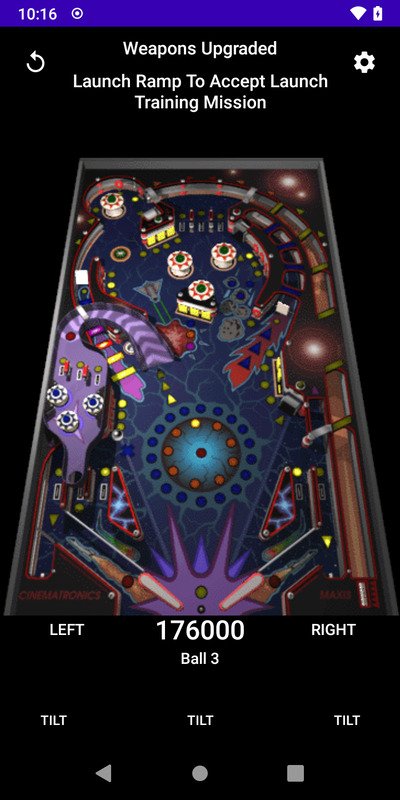
If the algorithms that drive the ad servers of social media sites have you pegged as a casual gamer, you will be given a little window into a world of madness. Searching for “mobile game ads youtube” will turn up a fair number of YouPotatoes pointing at that madness and saying, “Look! Isn’t it crazy! How can that be allowed!”
Those kinds of videos themselves are their own exploitative little world, but they have a point. One such video recently made the Blue (that’s what Metafilter users call their main site), and it’s a prime example of both worlds, accurately calling out a lot of mobile gaming ads for being batshit insane, while also having the dismissive, hyper-edited, sound-effect-laden style all too illustrative of the problems with YouTube’s own engagement algorithms. It’s a crappy thing, making fun of a very crappy thing.
Edit: Here’s the video itself, which might be useful, it’s about 13 minutes long:
The thread is interesting, arguably more interesting than the video. Two MeFi users currently in the industry had a conversation there, and after a somewhat rancorous beginning, it was fairly civil by internet standards. Jilder is a writer in the mobile games space, and Ryvar works as a dev in more traditional computer gaming.
Here are some selected quotes:
[…]the ads aren’t aimed at children. Children don’t have money. The game developers want whale tier players – so people who can drop thousands of dollars a year on a game without blinking. There is a whole industry dedicated to building games to find and catch these sorts of players and the game developers are very much not interested in children – the ethics of that not withstanding, the legal implications are expensive.
[…]boy, hes got no idea how wild ads can get if he’s only seeing the Dude Ads. Lily’s Garden ads are a whole ass thing all on their own and one of the grande dames of the genre, along with Merge Mansion, which is I suspect the game Alison mentions above. Merge Mansion’s most recent crop of ads full on have Oscar Award winner Kathy Bates starring as sketchy grandma Ursula (which, I must stress, are basically a tv mystery series only very loosely connected to the game).
Jilder (same comment)
The basic model for mobile game profitability is to release several dozen lightly reskinned clones of the exact same game and invest continued development into the handful that attract a sustainable population of whales. It’s grift, all the way down.
When mobile exploded the market and dropped financial barrier to entry by an order of magnitude, both game dev and game consumer culture were considerably thinner on the ground and even the best things to come out of the resulting environment (Genshin Impact, Lineage 2 Revolution) are still exploitative as shit. […] Part of the reason devs and gamers alike fucking hate Diablo Immortal is that it’s an extremely public beachhead for the tentacles of pure capitalist greed into a culture that has until now been moderately successful at keeping this avalanche of bullshit at bay.
All competitive online gaming has a pay-to-win element, it’s just not easily seen a lot of the time – it’s just that you pay for a decent gaming rig, and in my case you pay for having a decent internet connection. Like I’m in Australia, so lol how’s my ping bruh?
But the gatekeeping around AAA rated gaming is huge – gamergate bros are just the most visible manifestation […]. As I mentioned in my first comment here, I’m a middle aged woman, so you know, I’ve been dealing with gatekeeping shit around gaming my entire gaming career.
The Gripe Monster lives in a cave on the premises, and hates everything. In its mind, nothing has ever been great, but it always used to be better. It has demanded the opportunity to vent its three spleens here every once in a while. We have agreed, in order to shut it up, and so long as it confines its rantings to occasional Sunday evenings. Take it away, Gripey!
Don’t call me Gripey!
Rarr! I am the Gripe Monster! Fear me! I will talk your ear off if given the opportunity! Do you know how much a doctor charges to reattach an ear? And you can’t sue me for injury, judges think I don’t exist!
But I do exist! I’m not just a piece of pixel art! And I am displeased. This time the object of my formidable ire is a dumb listicle!
In particular my woeful focus is fixed upon an article on a website, titled 10 Games You Probably Didn’t Know Started As Arcade Games! It makes my bile boil, and my blood clog! It upsets all of my monsterly fluids!
Three of the series listed are Tetris, Super Mario Bros., and “Space Wars!” This article, it makes me breathe FIRE! None of these series started in arcades! It doesn’t even get the original name of Space War right! My sensibilities are agitated! They cannot even claim defense due to Mario starting in Donkey Kong, for they list that as a separate series!
I do blame the author, for my anger is indiscriminate, but my wrath is tempered with the understanding that writing is difficult and research is time-consuming, although the histories of these series are by no means secret! Much more, I blame the site that let it pass without question. Grar, I say! Grar and grar again! I swipe at it with my mighty claws, and I bite it with my awful tusks!
If you do not wish to suffer my wrath in the future, please edit your articles with greater care! And get off my lawn!
Management wishes to express that we bear no ill-will towards either the author or the site, although the points Gripey brings up are technically accurate. Mistakes happen!
It’s Sunday once again! You crossed, not a finish line, but a significant leg of the race. You deserve a reward. Here is one.
Orson Welles’ hilarious high-brow yet earthy tone, presented both as actual quotes and adapted, twice, have made the rounds lately. (Note: Welles had wide-ranging opinions of various degrees of cultural suitability, and so his posthumous imitators imagine he would now.) Here is a video of a pixel Orson Welles (no word on if he is also pixelated) trash talking various game characters. He is especially dismissive of Cool Spot.
Friday night at SGDQ 2022 the TAS Block show demonstrated something special. After a recording of a Portal 2 run that predictably demolished that game, they moved on to a rather more esoteric show.
In past shows, TAS Bot has some off some pretty ridiculous sights, using something called Arbitrary Code Execution (ACE). Essentially, using certain well-understood exploits, the runner (usually, but not always, a set of scripted inputs) writes a sequence of instructions into the machine’s RAM, and then transfers the code execution to that sequence, allowing for “arbitrary behavior,” meaning, almost anything that can be written into that RAM. TAS Bot at AGDQ 2014 wrote Pong into memory during a run of Super Mario World and ran it (6 minutes):
This technique has also been used to run a variant of Flappy Bird, and even a bona fide hex editor into the save RAM of Super Mario World, without even needing scripts, entirely by a human player. But this is beside the point.
There’s several of these videos, which I leave it to you to search out. They’re pretty easy to find on YouTube with the search terms “games done quick” and “tasbot”.
The point of this post is to bring you news of how players finally “obtained” the Triforce in Ocarina of Time after 23 years. The video of the show has yet to be uploaded to YouTube (it has been since I wrote this! scroll to the end), but until it shows up, Retro Game Mechanics EX has a video explaining how it was done (34 minutes):
Our policy to only link each site once per news post sometimes produces difficulties. This time our Nintendo Life post is by Ollie Reynolds, about the news that Zelda: Wind Waker was at first going to have a playable theremin. The news ultimately comes from a Do You Know Gaming video, which also mentions that Nintendo design guru Shigeru Miyamoto hated Wind Waker‘s cel-shaded art style at first, which in retrospect is one of the aspects of the game that’s held up the best:
I saw on Metafilter a post from The corpse in the library (an unfortunate user name in context) that the popular streamer has passed away. Technoblade is one of the few channels to have reached over a billion views. He is remembered for his playing skill and his friendly rivalry with fellow Minecraft Youtuber Dream.
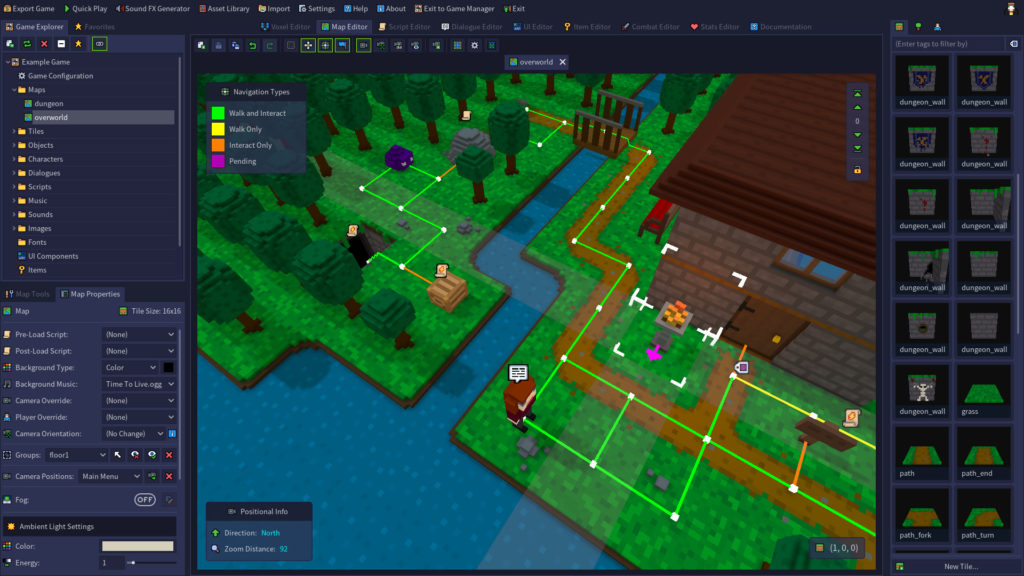
Lots of players are also armchair designers, so we like to present interesting tools as they appear. One that recently went up on Steam is the voxel-oriented RPG In A Box ($29.99). It has that interesting 3D-yet-8-bit vibe that make the Dragon Quest Builder games so appealing.
There are a lot of interesting tools out there for a variety of skillsets, and greatly differing levels of flexibility. Some considering are RPG Maker MZ and MV (who knows what the letters are meant to stand for), Zelda Classic for action games, and for more flexible tools it might be worth checking out Godot, or maybe creating something with Python and Pygame.
At VentureBeat’s subsite GamesBeat, Dean Takahashi sadly reports that Bernie Stolar, former President at Sega of America, has passed away at the age of 75. Alana Hauges of NintendoLife notes that his early career was in co-op, before joining Atari and working on their Lynx portable system. Later at Sony, Stolar helped shepherd the Playstation and franchises such as Crash Bandicoot and Spyro the Dragon, before leaving to help Sega launch the Dreamcast.
After going free-to-play, the player base of popular battle royale hit Fall Guys‘ has ballooned to 20 million! But Eric Van Allen at Destructoid tells us that there is some tension among long-time players over changes to its currency model. At GameRant, Rory Young has more, including an observation made by one of the players: under the new system, a player who loses five matches in the first round ends up making more than a player who wins a match after five rounds!
Space Bob vs The Replicons
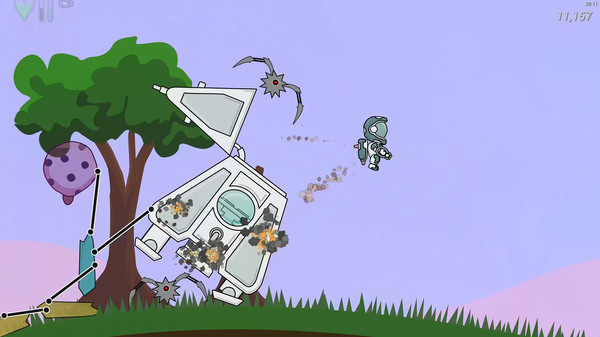
Graham Smith at Rock Paper Shotgun tells tales of the 2018 indie game Space Bob vs The Replicons (Steam), described as like a 2D No Man’s Sky, but didn’t do well on its initial release. Its creator had a heart attack a week after it hit Steam, then left the games industry. But he’s back, and has announced a big update. Its developer is Intravenous Software, and they’re on Twitter!
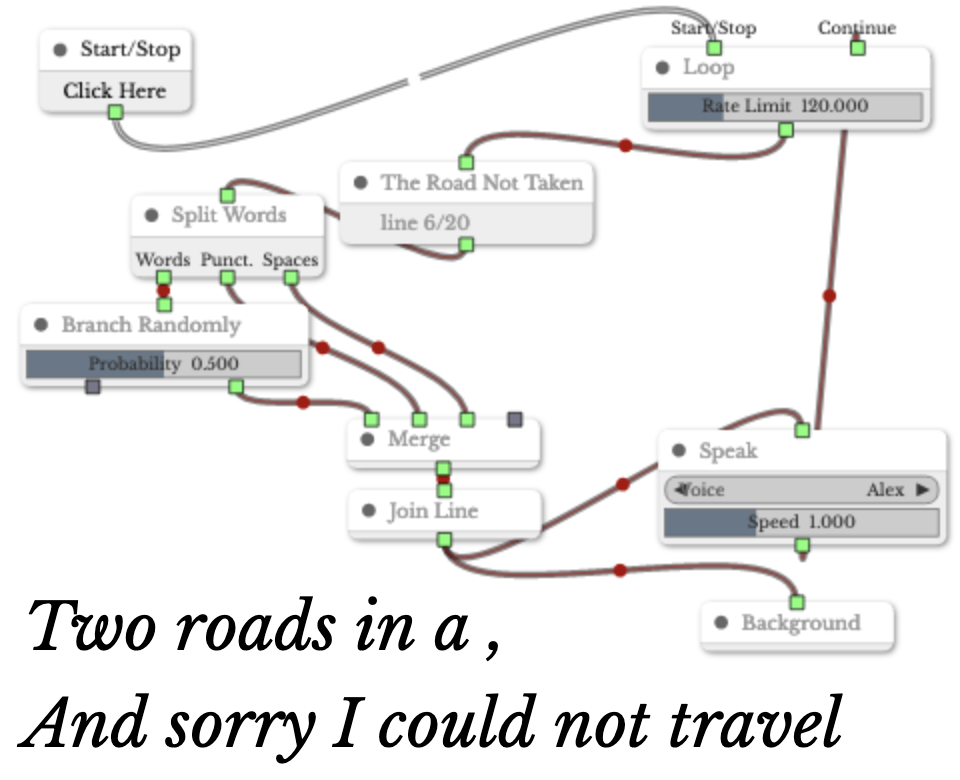
Pangur is a text processing system that works entirely through visual code. People familiar with systems such as Scratch or Nintendo’s Game Builder Garage should be at home with it. Its workings are adjusted by creating and connecting a number of nodes, with both input and output connections. You can try it out directly in your browser (Firefox and Chrome are known to be supported), or read the guide to learn how to use it.
Scattered throughout the World Wide Web (which, I remind you, is not the same thing as “the internet”) is a wealth of game information, although as old sites die out increasing this info is really hosted on the Wayback Machine. I previously presented the Bubble Bobble Info Pages, which are among my favorite game sites of all.
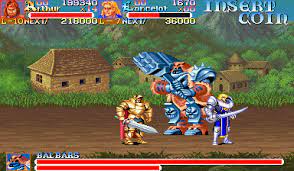
Image from hardcoregaming101
A relatively recent addition is this description of the great nuance in Capcom’s 1991 fantasy brawler Knights of the Round by Sebastian Mihai. It should be remembered that at that time Street Fighter II was already out and making it harder for games that weren’t one-on-one fighters to succeed. Capcom had a lot of experience with belt scrollers at that time, having made Final Fight and Dynasty Wars by then. A few years after they’d make the (IMO) even better Dungeons & Dragons brawlers Tower of Doom and Shadow Over Mystara, which I think are probably the pinnacle of the genre.
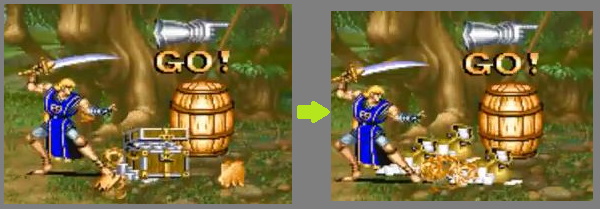
Image from site
As just one example of the thought that went into Knights of the Round, most of the pickups in the game can be struck with your character’s weapon, and this splits them up into multiple smaller treasures, that are both usually worth slightly more than the original, and if desired can be shared with other players. It’s the only brawler I know of that does this!
If you’ve followed the speedrunning scene for a while, you’re probably familiar with fcoughlin‘s Zelda Randomizer. It’s a program that can take a rom file of The Legend of Zelda and “scramble” it, in ways that the user can specify, in order to make it playable afresh, even for people who have played through it dozens of times already. It can move dungeon entrances, dungeon layouts, item locations, enemy placements and much more. And its changes can be encapsulated into a seed value so multiple people can be guaranteed of playing the same version of the game.
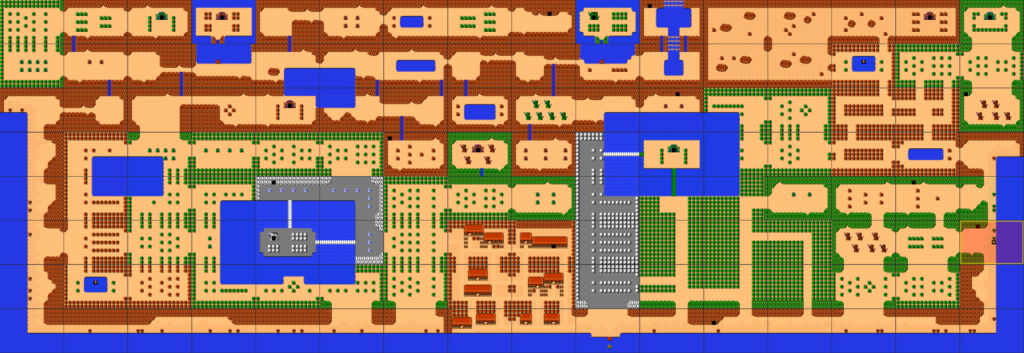
But for everything Zelda Randomizer can do, one thing it cannot do is change the game’s overworld. All of the familiar Zelda landmarks, the Central Lake, the Lost Woods, Spectacle Rock, and the rest, will be present and in the same places. That is where Infinite Hyrule (forum post, BitBucket) comes in. It’s a program whose purpose is to randomly create new overworlds for The Legend of Zelda, and to insert those into a rom file.
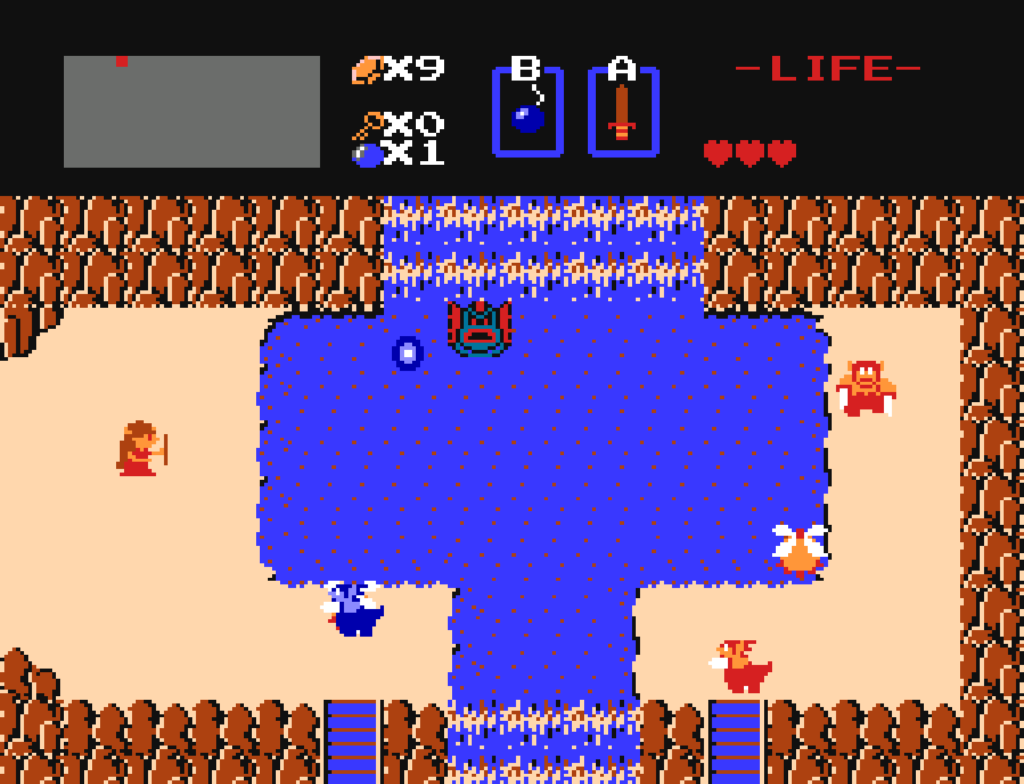
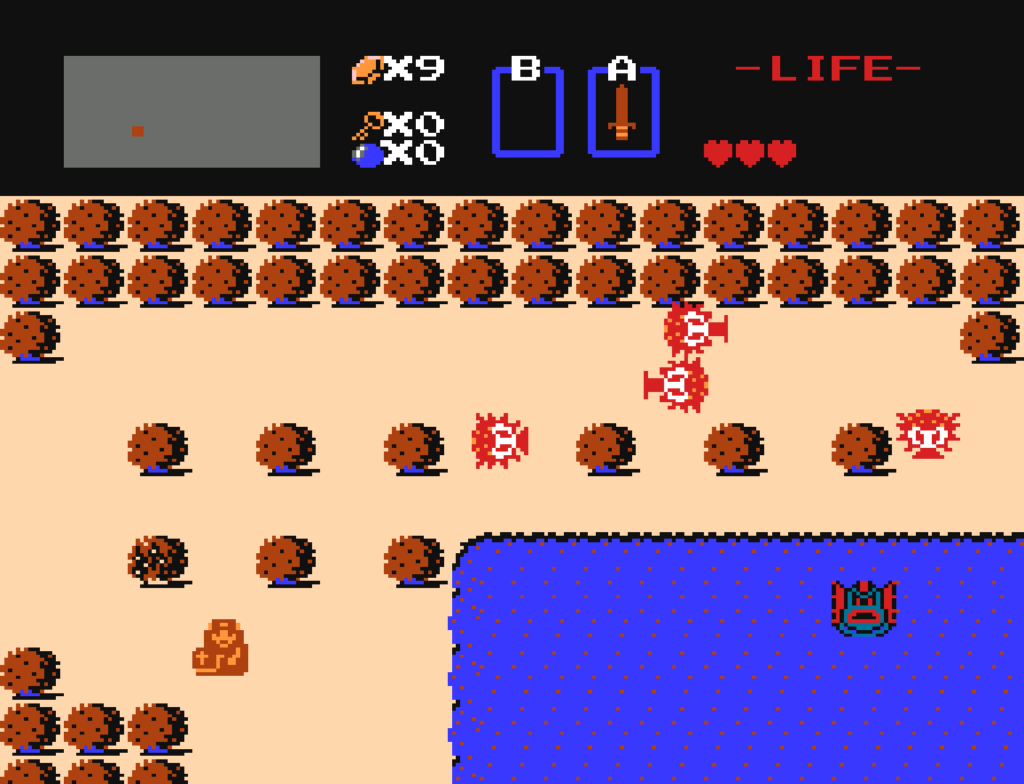
Gah, Lynels! Nice waterfall though.
I should take a moment to impress upon you how difficult that job is. There’s a good reason fcoughlin never built an overworld randomizer himself. The Legend of Zelda doesn’t store its game world in an obvious format. To get around this, Infinite Hyrule actually expands the rom file, so it can avoid the original game’s convoluted system, which stores each overworld screen as a set of links to vertical sets of tiles.
This partially explains the unusual structure of Zelda’s landscape, and why a number of structures, like the round boulders of Spectacle Rock and the dungeon entrances, are reused in multiple places: there is only room for so many vertical strips of surface tiles in the game’s ROM chips. To create a program capable of generating new overworld, a programmer must not only keep this limitation in mind, and work within its stricture, but must also follow the usual checks to ensure the game is still winnable.
Note that tree in the bottom-left
But it’s not even necessary to combine the two tools into one, for Infinite Hyrule can work work with Zelda Randomizer! You just have to make sure you use Zelda Randomizer first, and that you restrict yourself to only using certain flags. I personally find the flag string cHBRDMIhioEeNCb14OPhBo useful for mixing things up acceptably.
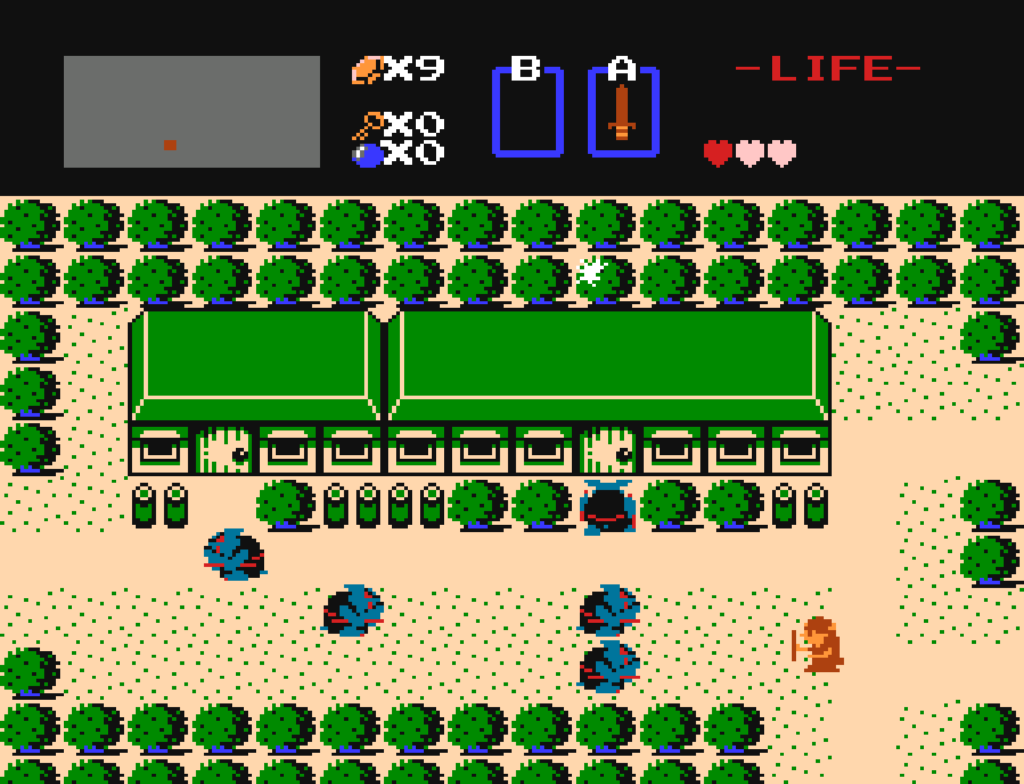
In addition to mixing up the overworld and maintaining the unique feel of The Legend of Zelda‘s map, it implements a few new kinds of screens, including a village with houses, and can produce a map of the generated world too. That should keep you going for quite a while. And, if you’re not 14 any more, it can even be set to reveal LoZ‘s infamous secret caves with graphical tells of their location. That’s such a nice feature if you want to explore a map in a reasonable time frame, instead of resorting to the original game’s technique of testing every square. Since, after all, none of us are 14 anymore.
Showing off the new village biome
If for some reason you want a similar treatment for Zelda II: The Adventure of Link, you sadist, there is no need. The randomizer for that game can generate new overworlds without need of a separate utility. I’ve played quite a bit of that, and will tell you, if you thought the original game was hard, the randomized version can be ludicrous.