Pretty dry today, a tale on the blog Retro365 about the creation of Apple Galaxian, early action gaming hit for the Apple II, and how it helped establish classic computer publisher Brøderbund, who’d licensed it from the Japanese company Star Craft. It was sold in Ziploc bags, and was an immediate hit.
Here’s what Apple Galaxian looked like in action:
Brøderbund would go on to release many more wonderful programs for home computers, eventually publishing Lode Runner and Myst. Star Craft was still in operation in Japan until 1995. Anyway, please follow the link, it’ll help make up for me having to enter the crossed-o in Brøderbund’s name so many times!
We love it when we find weird and unique indie games to tell you all about! Our alien friends to the left herald these occasions.
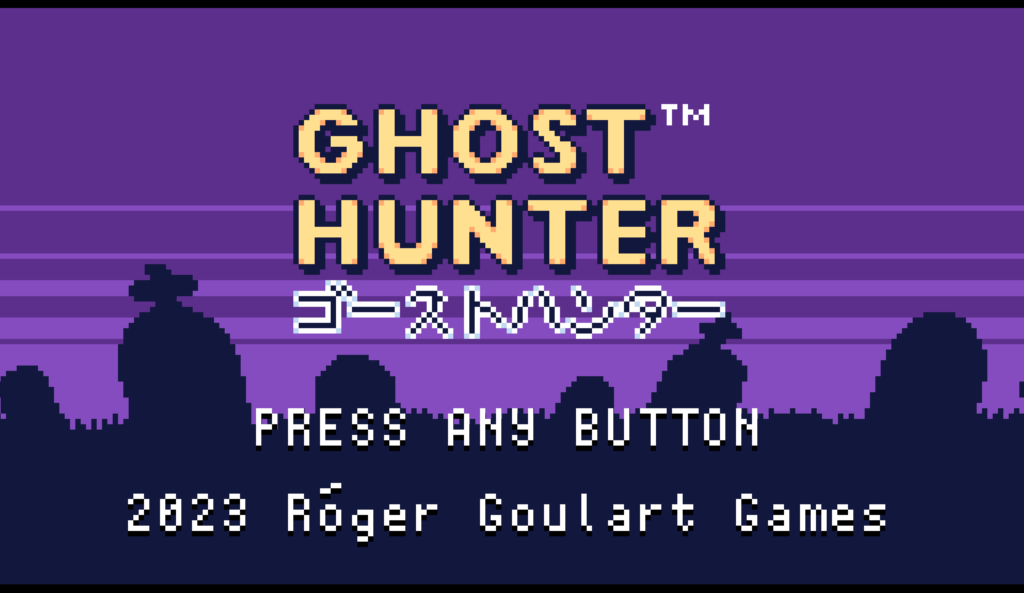
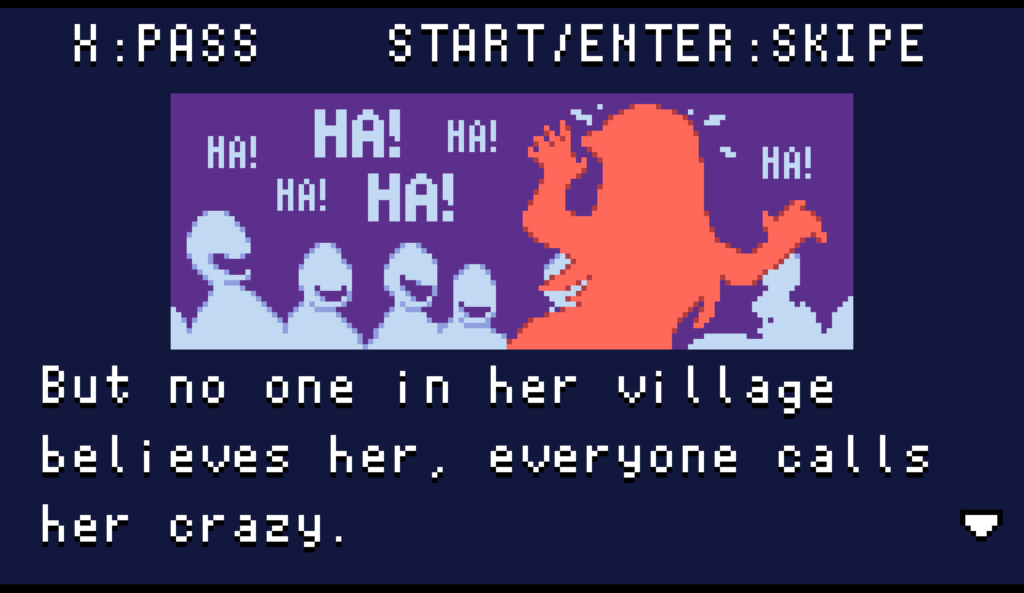
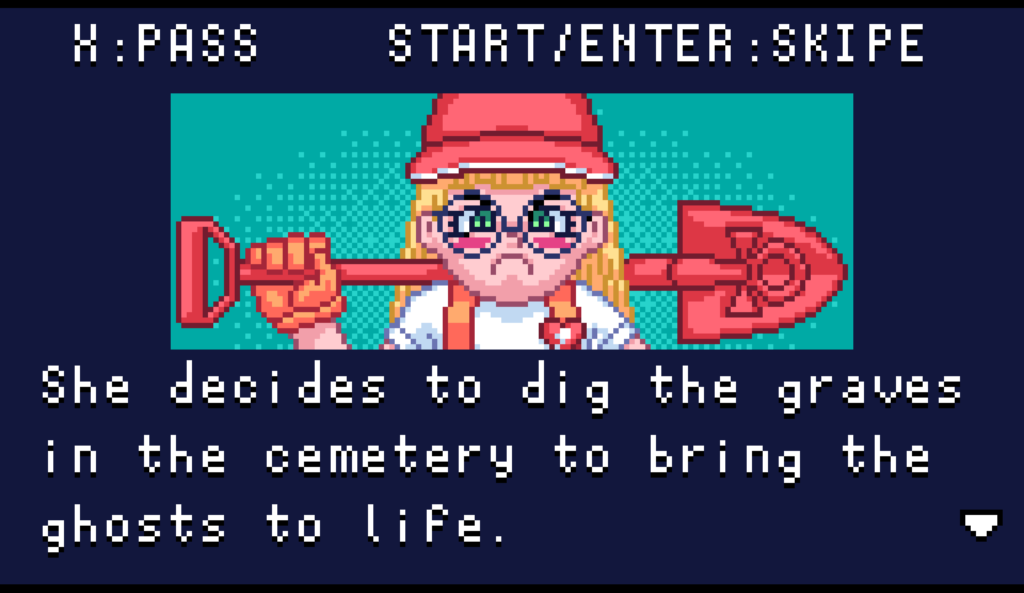
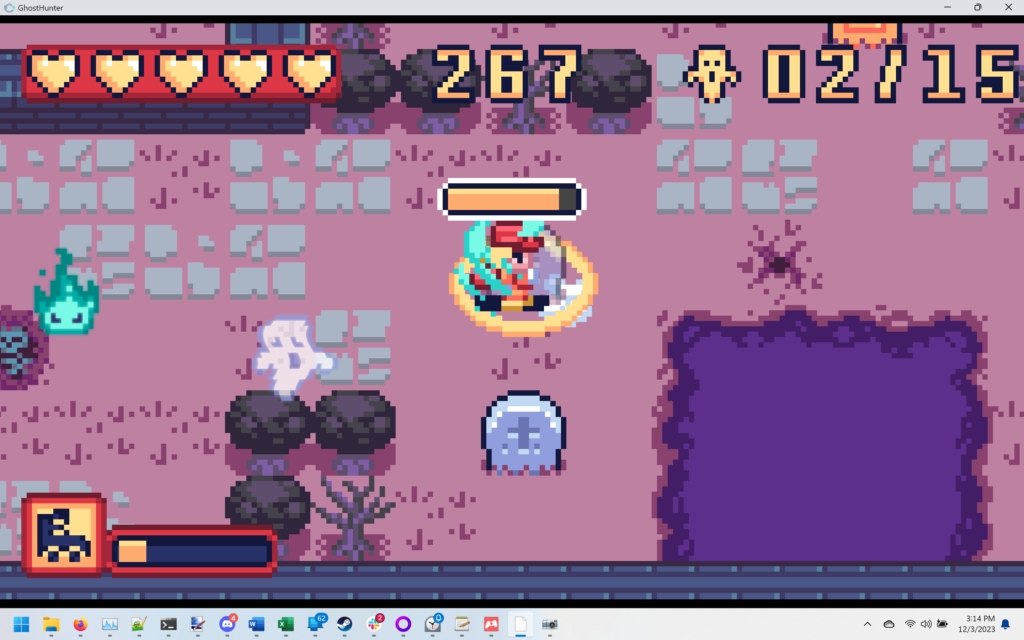
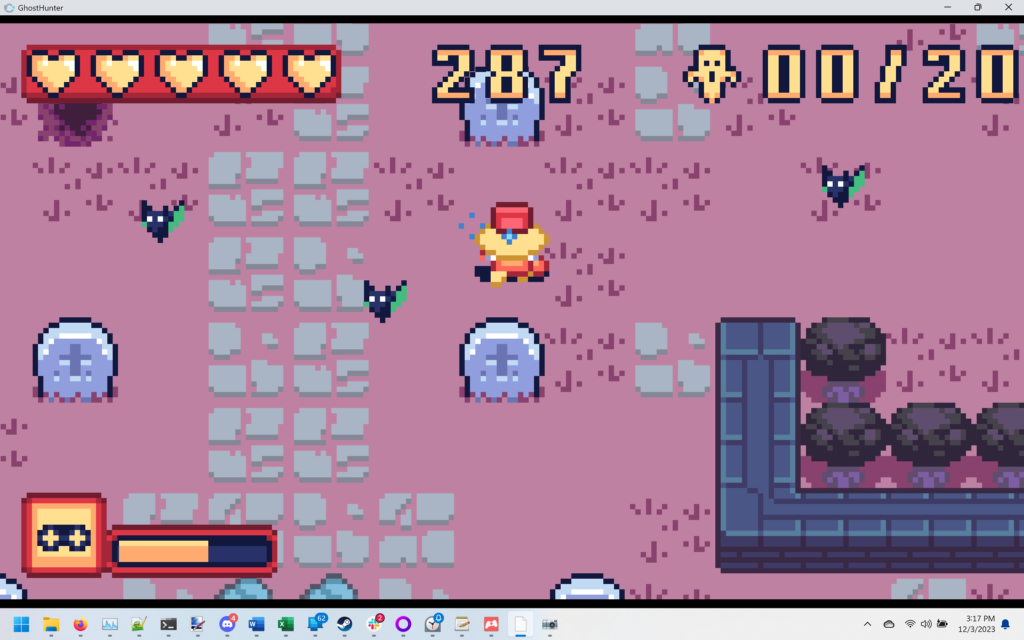
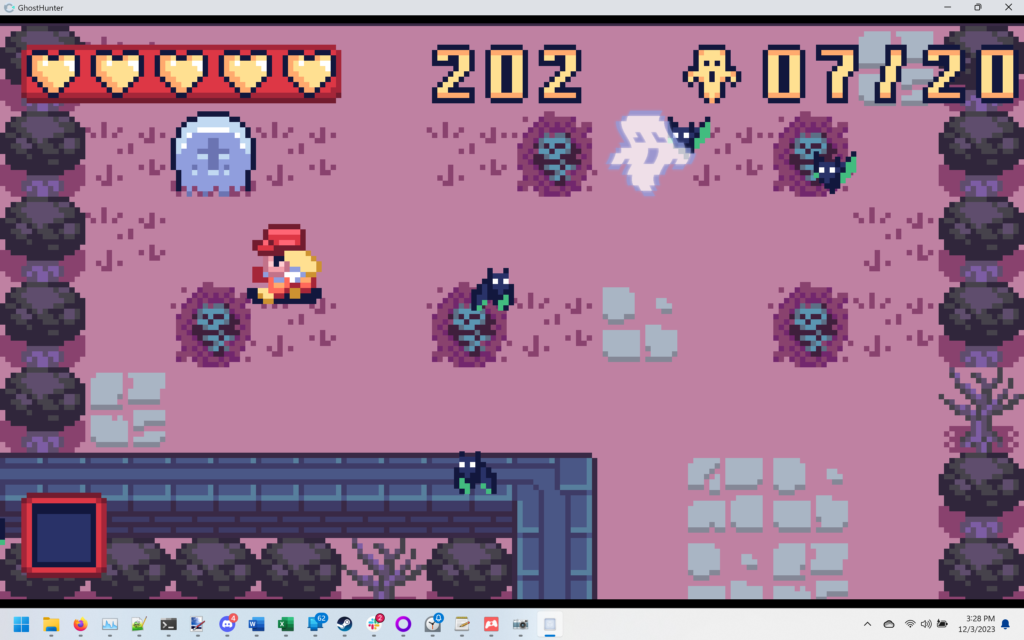
Another game jam entry, Róger Goulart’s Ghost Hunter is a short and silly game about a young lady who loves ghosts, maybe a bit more than she should.
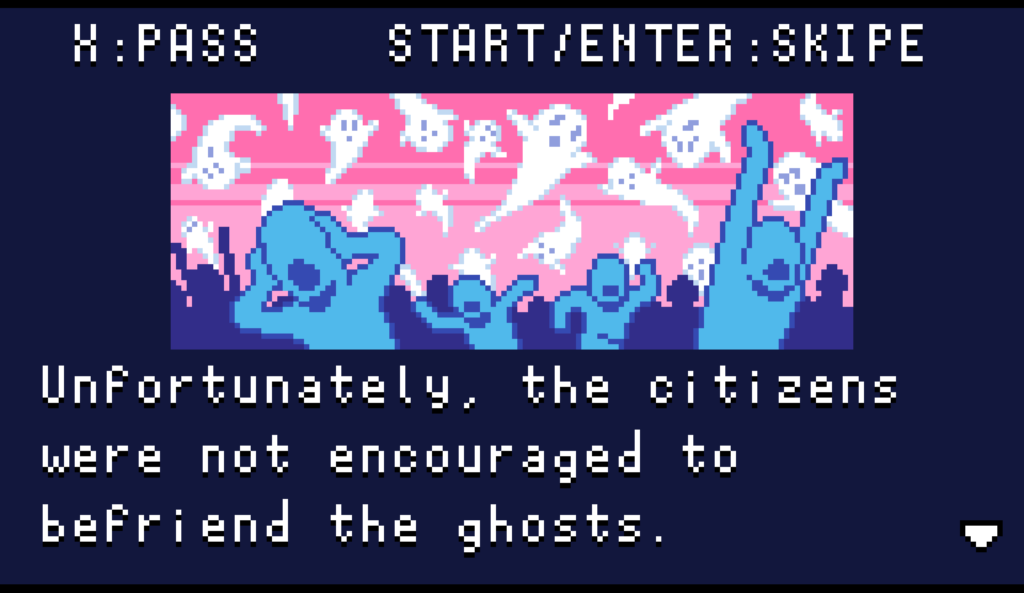
Here are some opening screens:
Take a moment to enjoy this screen.They may have a point.And a new unholy quest begins.
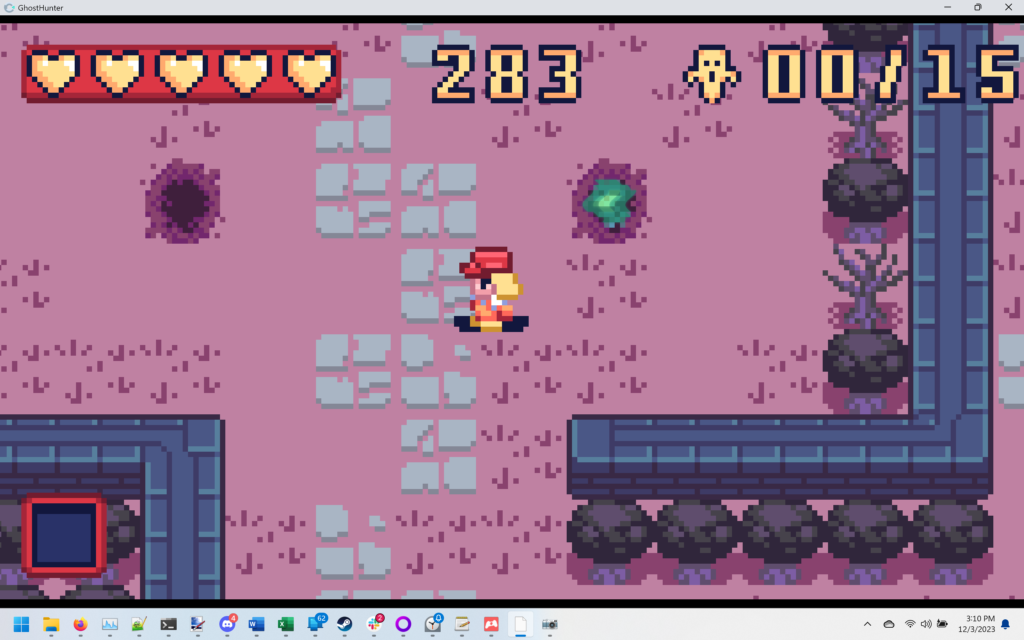
Most of it is a kind of guessing game. Each of three cemeteries has tombstones arranged around it. You go to each one and dig it up with your Shovel of Resurrection. If it’s a friendly ghost, then it emerges and you get one credit towards your quota. If it’s a cursed tomb however, an angry ghost comes out and chases you for a bit. If it catches you, you take a point of damage.
How do you tell the difference? Well, usually you can’t. But there are these orange tombstones placed around each level, and when you dig one of those up you get a random powerup for a short time. (Usually: once in a while you’ll find an angry ghost in one instead, but that’s rare.) One of the powerups shows you whether a tomb has a friendly or angry spirit in store. Other powerups slow angry ghosts, disguise you so they don’t chase you, refill your health or make you walk fast for a short time.
Level 2 has periodically appearing sludge ghosts that must be destroyed by digging up waterspouts to block them. Level 3 has annoying bat enemies that must be avoided, and a higher quota than the other levels.
My tips:
When you stop digging up a grave in the middle of the process, the digging you did before isn’t forgotten. You can sneak in a little extra digging when running from angry ghosts this way.
You tend to lose a whole letter grade at the end of a level from taking damage, so be safe.
The best powerup is the one that reveals the cursed graves. When you get one, I suggest just wandering around for a bit, looking for the mean ghosts, and remembering where they are so you can dig up friends in piece.
Spoilers for the ending are after the download link!
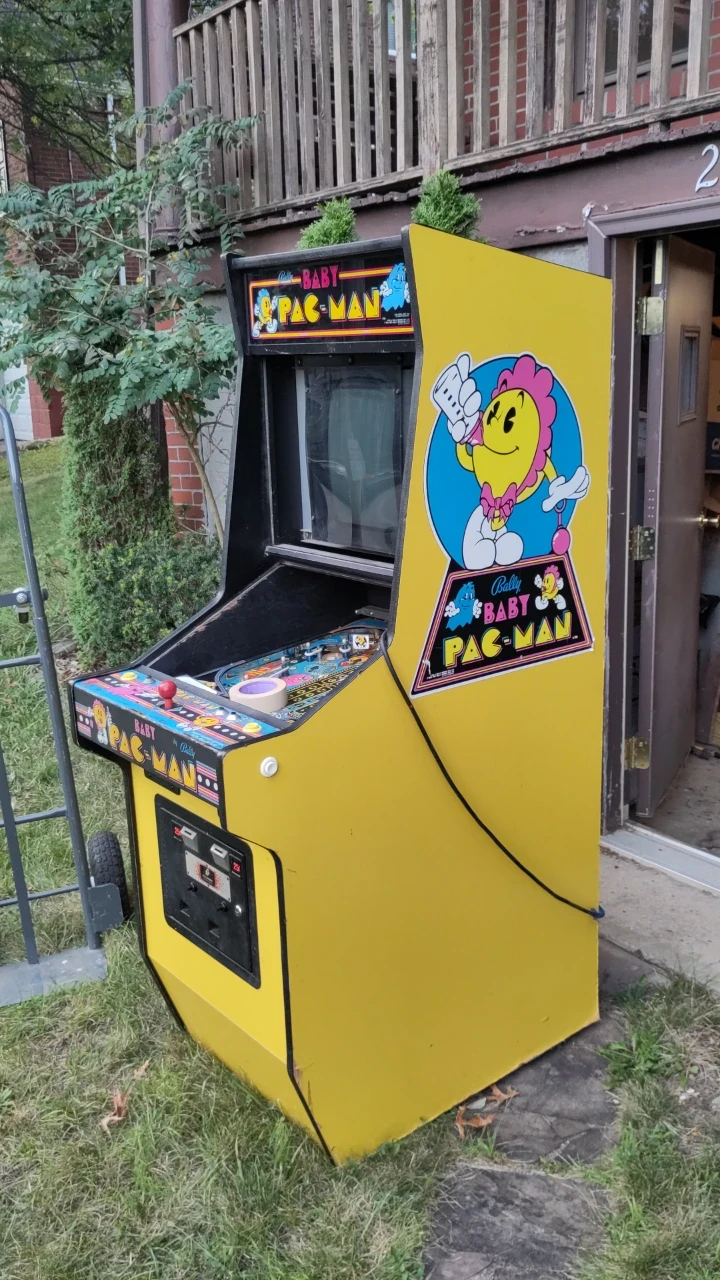
Over on Mastodon, Dan Fixes Coin-Ops has been documenting an epic quest: the repair of a Baby Pac-Man machine.
It’s one of the non-Namco Pac-Man spinoffs that Bally/Midway released in the wake of the original’s extremely high popularity. I’d like to remind readers that while Namco has been the sole beneficiary of Pac-Man’s heights lately, the original game, at first called Puck-Man in Japan, was not popular there. The spin-offs, console ports, handheld games, trading cards, stickers, clothing, cartoon show, Christmas special, breakfast cereal and unnumbered other items, that was all Bally/Midway’s doing. Toru Iwatani created and designed it, his team made it into a game and cabinet, Namco released it in Japan to middling success, and from there Bally/Midway got behind it and turned it into one of the most gigantic video game hits there’s ever been, a machine that at one point had one hundred thousand units.
Now, I’m not going to deny that their effort led to some erasure of knowledge of Namco’s existence at the time. All those Pac-Man machines and spin-offs mentioned “Bally Midway Mfg. Co.,” with nary a mention of Namco. But it’s undeniable now that erasure is happening in the other direction: a search over the History page on official Pac-Man website has no mention of Bally at all, even though the page acknowledges that the game was “a major hit in the United States.”
Some of that success leaked back to Japan and fueled some Namco-made sequels: Super Pac-Man, Pac N Pal, Pac-Land, Pac-Mania, Pac-Man Arrangement and eventually Pac-Man Battle Royale and Pac-Man Championship Edition, and more recently things like World’s Largest Pac-Man and Pac-Man Battle Royale Chompionship.
Bally/Midway made their own sequels. One of those, Ms. Pac-Man (created by GCC), came to eclipse the original in popularity, but in addition to their licensing of Super Pac-Man and Pac N Pal they made Jr. Pac-Man (also from GCC), as well as Professor Pac-Man and this game here. The one Dan Fixes Coin-Ops repaired. Baby Pac-Man.
Baby Pac-Man is a game that only could be made by Bally, because it’s a video game/pinball hybrid.
Bally, together with the company that would buy them, Williams, is arguably the greatest pinball maker there’s ever been. Up until around 2000 (a heartbreaking year) they made wonderful machines like The Addams Family, Twilight Zone, Attack From Mars, Star Trek: The Next Generation and quite a few others. In 1982 though pinball was in a slump while video games had reign over arcades. The decision to make a game that connected one of the greatest arcade games of all with pinball must have seemed obvious. (It wasn’t their only attempt to capitalize on their golden license with a pinball table, witness Mr. & Mrs. Pac-Man, which I’m informed was released eight months before Baby Pac-Man.)
The combination of an arcade video game and pinball makes for a unique experience. It also makes for a game which breaks down even more often than your standard arcade game, as the thread notes: there’s three computers in the thing, and it’s subject to all the typical arcade game problems, all the typical pinball problems, and special problems with the portions of the machine that connect the two halves together.
The thread begins memorably:
In case y’all were tired of hearing about popular Fediverse people making bad decisions, just thought I’d let y’all know I bought a 1980’s hybrid pinball/videogame tonight
Like this isn’t for a client, I’m not working on it to earn. This game COST money. This is my game now, I paid for it and it lives in my house. I’m not gonna get to give anybody a bill.
This is such a perversion of the natural order of things. I’ll probably route it one day, but for now this is an arcade machine that I SPEND money on!
It’s taken me a little while to get it into the house and have a chat with the mate who sold it to me and let the littleun have a go and put her to bed and fix a couple things and have a go myself so I’ve not been catching up on my notifications, I saw some questions so I’ll do a little thread on it over the next couple of days
I cannot stress enough that you should not buy one of these things
Folk who like 80’s pinball want stuff like this or Haunted House and you shouldn’t buy a Haunted House either
These are games for pinball techs or people with money to hire pinball techs or very close friends of pinball techs
Except Baby Pac-Man needs you to be friends with an arcade tech too.
He finally got it working after three months of work, and what a journey it is. He did it for love of the game: while Baby Pac-Man is dissed in some circles it’s a genuinely interesting game. But to like it, you have to abandon the relatively lenient expectations of classic arcade video games. Pinball is inherently unfair, and that unfairness oozes out and coats even the video portion of Baby Pac: the ghosts don’t waste time in coming after you, and you start with no Energizers: you have to earn them in the pinball portion, which for the most part you can only visit once per life/board. You can return to the video portion temporarily though by locking the ball in a scoop.
Here is the full thread (to date) in Masto Reader, which is a Mastodon version of Threadreader. It takes maybe half a minute to collect the posts and present them though, so to read the whole saga you’ll have to be a little patient.
An interesting video about Baby Pac-Man (although with some bad sound) District 82 Pinball’s here (12 minutes), which covers the tech and gameplay:
Sundry Sunday is our weekly feature of fun gaming culture finds and videos, from across the years and even decades.
Did I post this one before? An archives search doesn’t turn it up. It’s been in my topic list for a long time, but it seems I never actually post it it. Here it is! It was created by Doctor Octoroc, who still has a website, for CollegeHumor, which doesn’t!
The video is 11 years old, and doesn’t present all of the events of the series, I think because it hadn’t concluded at that point. Still, it may be entertaining.
A long time ago, there was a radio series called The Hitchhiker’s Guide to the Galaxy. It was about a man named Arthur Dent, who with the aid of his friend Ford Prefect managed to escape from the Earth when it was demolished to make way for a hyperspace bypass, after which he went to have increasingly weird and ridiculous adventures.
At the center of the story was an electronic book named, like the radio series itself, The Hitchhiker’s Guide to the Galaxy, which was like an iPhone and Wikipedia combined into one device, only Douglas Adams somehow thought of them in 1978, which was the same year Space Invaders was being manufactured. It was written by a brilliantly funny man named Douglas Adams. Adams also wrote some scripts for Doctor Who, and some other books, including The Meaning of Liff, Last Chance to See and Dirk Gently’s Holistic Detective Agency.
Before he wrote those other books though, he wrote some more about the Hitchhiker’s Guide. He wrote a TV series based on the radio series. There was also a vinyl recording, which was simply called an album then because CDs hadn’t been invented yet. Each of these versions of The Hitchhiker’s Guide to the Galaxy has substantial differences from all the others. Then Douglas Adams met Steve Meretzky, and the two of them did a computer game version of The Hitchhiker’s Guide to the Galaxy, itself with major differences from the other versions.
They made the game for a company called Infocom. Infocom was one of the first great successes in computer gaming. They wrote what they called interactive fiction, but could more generally be called text adventures. They presented the world of the game as text on a screen, like you were reading a book, and you expressed what you wanted the protagonist character to do by typing commands. Sort of like those things some inaccurately call AIs, and are more properly called Large Language Models, or LLMs, except a person actually wrote everything that can happen, and there’s a point to them.
The Hitchhiker’s Guide to the Galaxy was the second best-selling game that Infocom ever did, after Zork. It sold over a million copies, a gigantic success at the time, and still pretty good today. So everyone was keen to do a second Hitchhiker’s Guide game. The game even says, at the end, that an incredible adventure was about to happen, but you’d have to buy the next game to find out what it was.
Time passed….
Infocom tried to get Douglas Adams to create a sequel. He did co-write Bureaucracy with the staff of Infocom, a lesser game with some brilliant ideas in it. Later he wrote Starship Titanic for a different company, which was fairly well-received. Douglas Adams was, as said, a brilliant person, but his was a whimsical and capricious intelligence, fixating on things that seized its fancy, but that made it difficult to focus on mundanities.
Infocom’s games sold steadily fewer copies as time passed. Eventually, they were bought by Activision, and functionally shut down. They made some Zork games themselves, but eventually Activision forgot that Zork or Infocom even existed.
Some more time passed….
Douglas Adams wrote some more Hitchhiker’s books. At the time there were already two, The Restaurant at the End of the Universe and Life, The Universe and Everything. He soon followed it up with So Long And Thanks For All the Fish, and then Mostly Harmless.
He never did write that sequel to the computer Hitchhiker’s game. Then, sadly, Douglas Adams, who in Last Chance to See wrote movingly about animals on the edge of extinction, went extinct himself, dying on May 11, 2001.
Time continued to pass. Disney, the least-suited company for such a thing, made a big movie version of The Hitchhiker’s Guide to the Galaxy. It wasn’t too bad, all told, but it wasn’t Disney-level popular, probably because it didn’t have space magicians or superheroes in it.
Lots of people, not the least of which his old friends at Infocom, were saddened that Adams never followed up with that second Guide game.
Then in 2023, a person with the nom de net of Max Fox wrote their own version of what a sequel to The Hitchhiker’s Guide to the Galaxy might have been. It’s called Milliways: The Restaurant at the End of the Universe.
It adheres to older trends in adventure gaming: you die sometimes just from trying things out. Puzzle solutions can be a bit cryptic. But it also has a simulation of Infocom’s “Invisiclues” built in, where you can pick the area you’re in and problem you’re having from lists and get a series of more specific hints for getting past your problem area, which is still a pretty good way to provide play help without giving away the whole puzzle like a walkthrough might.
No, it isn’t the sequel that Douglas Adams would have written. But that thing will never be. It’s possible that someday a different sequel will be written that matches Douglas Adams’s voice a little better. But in the meantime, we have one idea of what it could have been like.
It doesn’t make it a happier galaxy to live in. But it does make it marginally less sad, and that’s the best we can hope for.
(Note: following images have spoilers for the very early phase of the game. If you want to play this game, you’ll need a program that can play Z-machine files. I suggest Windows Frotz.)
The beginning, after the endingAn unsettling landscapeFive points, and a sudden demise
Events often resist efforts to package them up and stamp a Convenient Narrative on them, but it’s really tempting to me to say the history of the internet in this era is that of many people rejecting the hegemony of large corporations and doing things for themselves.
Social media has seen the rejection of Twitter, for reasons I really don’t want to hash out again here, and while some ran directly to Threads or Bluesky, a good number realized it was eventually just going to happen all over again, and that helped to increase the update of open source, federated work-alike Mastodon.
Another piece of this narrative vase that we might be able to fit into place, with creative thinking and a whole lot of glue, is the downfall of Unity and how it helped the effort to create the free open source gamedev replacement Godot. And lo, after a fairly recent release of 4.0, yesterday they already released 4.2. The changelog is here. Here is GDQuest’s rundown of the changes (22 minutes), and here are Lukky’s five favorite new features (3m), which are:
FSR 2.0 support (upscaling higher resolution output from lower resolution rendering)
Color-coding of folders in the file hierarchy within Godot’s UI
The ability to “bake 2D navmeshes”
When resizing 3D objects, the UI no longer resizes symmetrically around the object’s origin by default, but instead only the side you’re changing is modified
And, within the code editor, you can now create special comments to define a code region, which can be independently collapsed to reduce clutter, and expanded when you need access to its contents. And the Ctrl-K Comment Out feature works better now.
To get back to talking about software philosophy…. There are unique problems with using fully open tools to create games. Console manufacturer devtools are still locked in a mode where the maker hands you proprietary libraries, which they are unwilling to make freely available because of their economic desire to preserve trade secrets and control their platform. Most developers get around this by going through a third party, who has independently created a system of working between the open development framework and the publisher’s libraries, and then licenses it to a studio so they can get their project working on consumer hardware.
Godot is subject to this limitation, with 4.2 being no exception. But there is a sense, with it, that it’s the brightest hope for free and open game development going right now. They don’t ask for any license fees, they don’t try to count how many installs you have and they don’t track user behavior. But because they don’t try to claw in income through direct means, fair or foul, they must survive off of contributions. If you find Godot useful to your work, please consider using their donation link and signing up for an entirely voluntary plan.
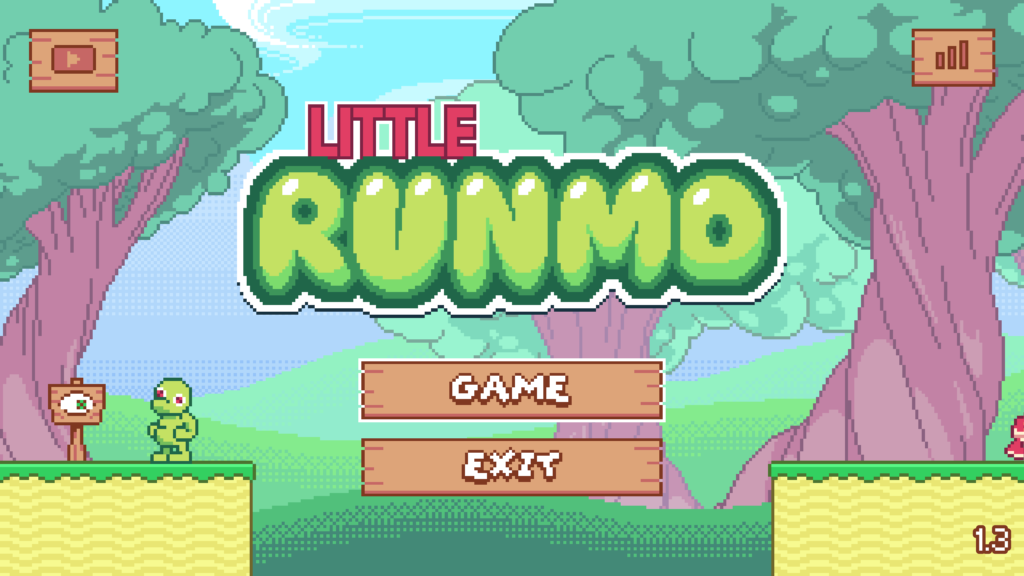
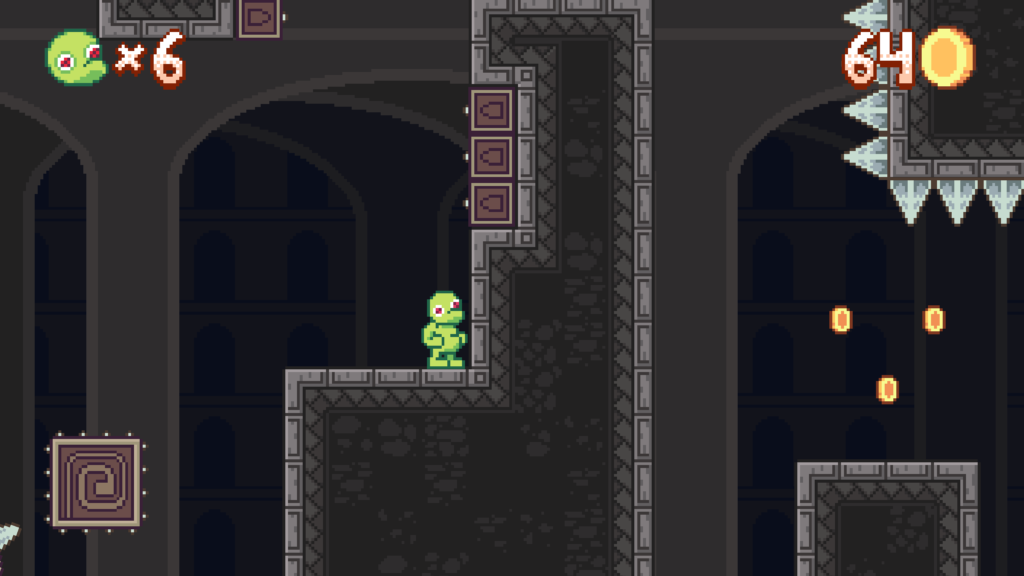
Last year for Sundry Sunday we linked to Gooseworx’s video game-inspired cartoon Little Runmo. In summary: a platforming character discovers that the peril-filled world he’s tasked with traversing is part of a system designed to support the life of a grotesque ruler. They turn it off, but other circumstances happen, and in the end things don’t go too well. Here’s the video, again (16 minutes).
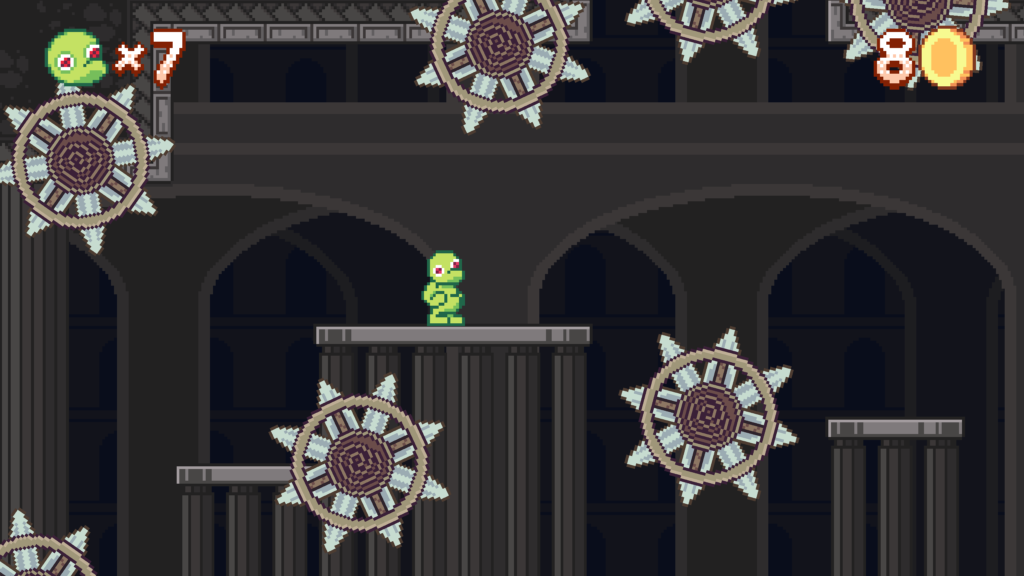
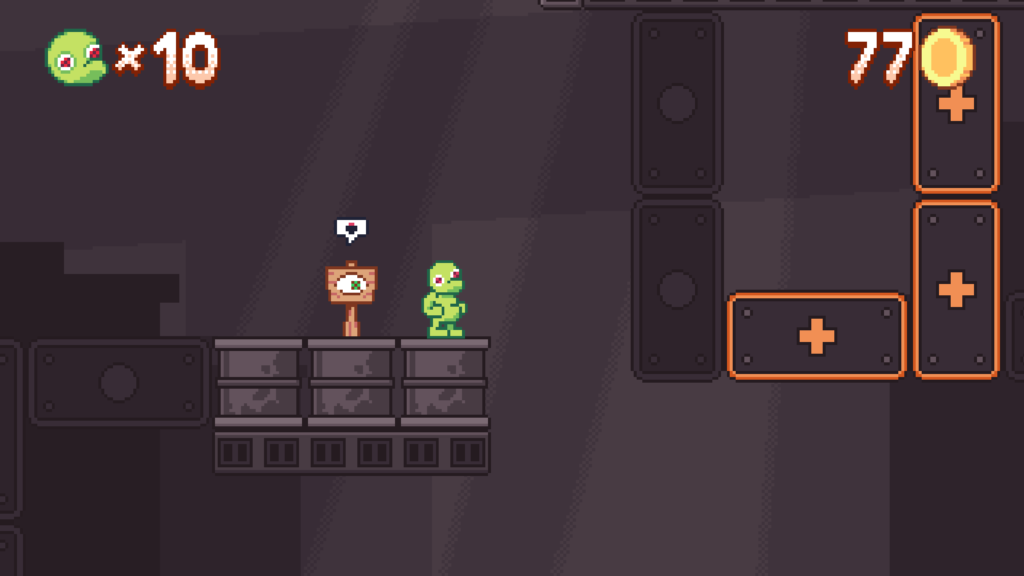
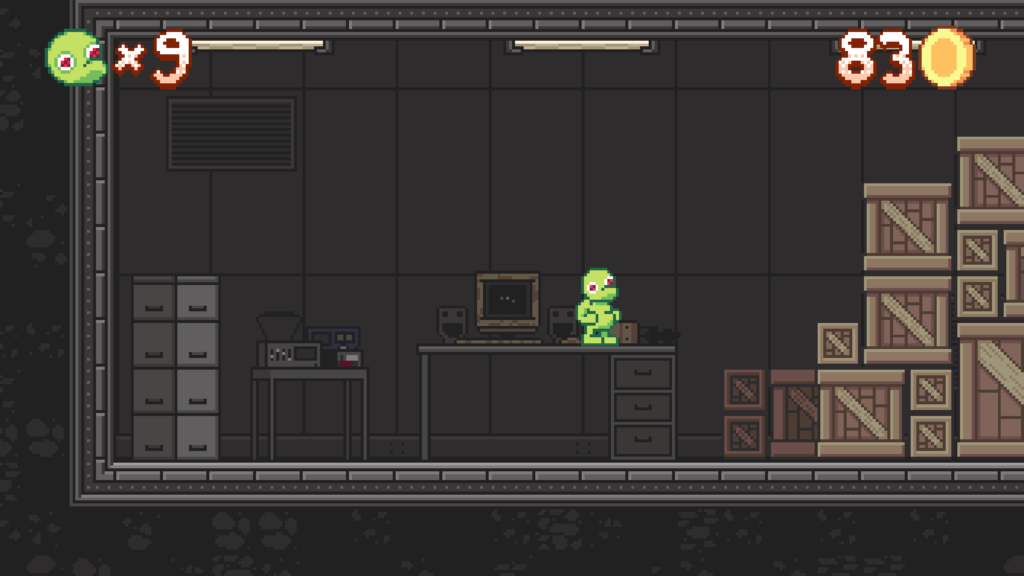
A little green person off on a dangerous journey.
Little Runmo was made four years ago and has amassed 30 million views. Much more recently, a month ago Gooseworx made a pilot for a show to be called The Amazing Digital Circus, which in that short time has gotten an incredible 147 million views. Presumably it’ll get a series, but who really can tell these days? We have one major media company that thinks it’s worthwhile to make complete expensive productions then purposely kill them before release for a tax writeoff, but these are not the pages to discuss that.
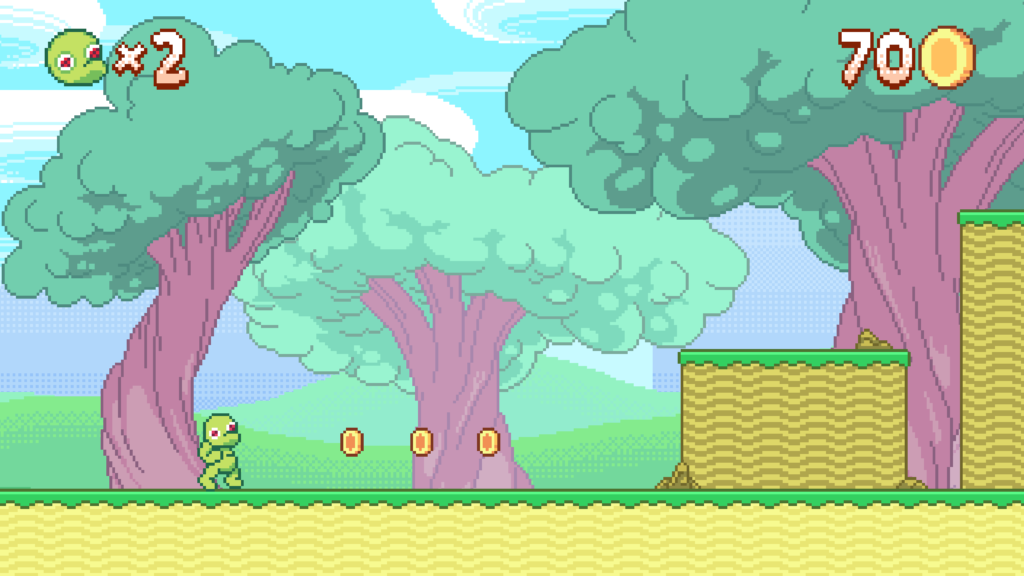
You might think it’d be a simple recreation, in game form, of the original, but it’s got its own things going on! Its platforming is pretty sharp. In addition to basic running and jumping, pressing an action button in the air gives Runmo a forward dive that gives a slight bit of extra height and some forward distance. On the ground while ducking, this move turns into a forward dash that can get through low ceiling passages.
Even with all the thematic deconstruction happening in Little Runmo, we never find out why Runmo has to traverse dangerous worlds. Presumably the evil king their deaths supports has set up some social pressure to convince his people to traverse spiky obstacle courses. Maybe the local rulers are in cahoots with him. BTW, it’s fun to say “cahoots.” Cahoots!
The game is divided into levels, but they aren’t clearly announced, and to a limited extent you can explore the areas as you wish, in a different order than as presented in the cartoon. The game world isn’t exactly as the cartoon presents it either, with the areas much larger, and containing a decent number of secrets to find! It’s usually worth it to poke around out of the way places if you can figure out how to get to them.
There’s a section with Mario-style timed alternating blocks, although here, if you’re inside a block when it appears, you just die.
The game starts out fairly chill, but gets pretty difficult. It doesn’t seem like an unfair level of difficulty, although it may take you a few plays to build up the skills to conquer it. Here is some advice to playing it:
If you haven’t seen the cartoon, you should know that the above ground area is only a small part of the game. The wide pit, the first one with the alternative spike wall over it, is the entrance to the rest of the game. Pikit’s message hints that that’s the way to go (press up to listen to it).
Unlike as seen in the original cartoon, you have to use the midair dive move to get past the pit, it’s too wide to cross with wall jumps alone.
Get used to hugging walls on the way down, to slow your descent. This can be used to scout out pits for secrets, to see if the scrolling continues.
If you press towards most walls but keep jumping, you can climb them easily. Get used to doing this all the time.
If a ceiling has a one block overhang, you can get around it with a jump off the wall and a dive back towards it.
Watch the cartoon, and think about ways to explore regions that the animated Runmo doesn’t go to.
There is at least one place where there are extra lives hidden off the top of the screen.
While running out of lives doesn’t erase your metaprogress, it just sends you back to level 1, the game does not save its state when you exit it. If you quit out and reload, you’ll be at the very beginning.
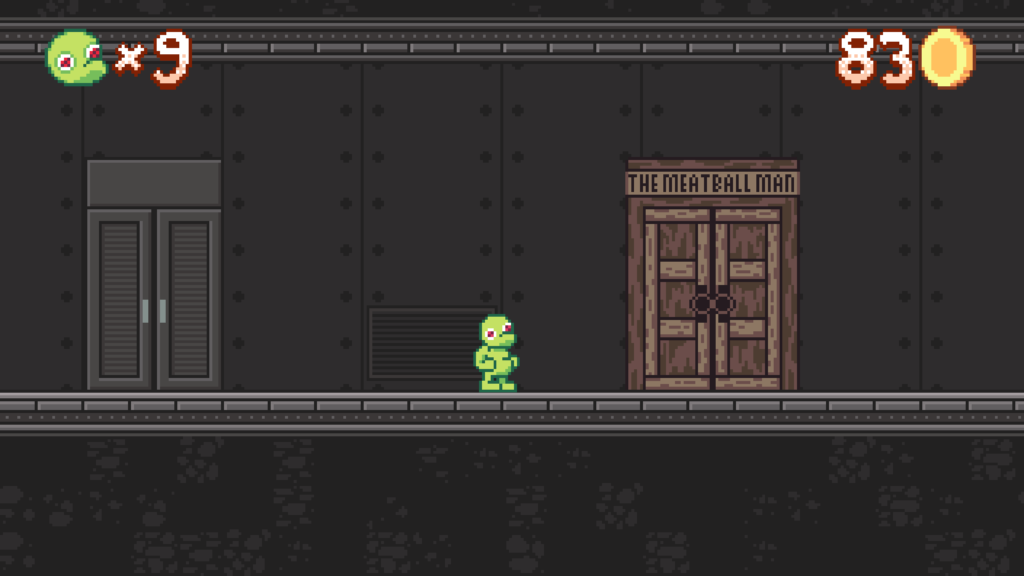
The Meatball Man is one of the funniest parts of the cartoon. It is possible to complete his room, but it’s optional in any case.
If you don’t care to see the game yourself, this 100% completion speedrun shows off the locations, although of course it doesn’t waste time talking to Pikit or exploring unnecessary places. There don’t seem to be any unnarrated longplays around yet, so, best to sharpen those skills if you want to experience it all.
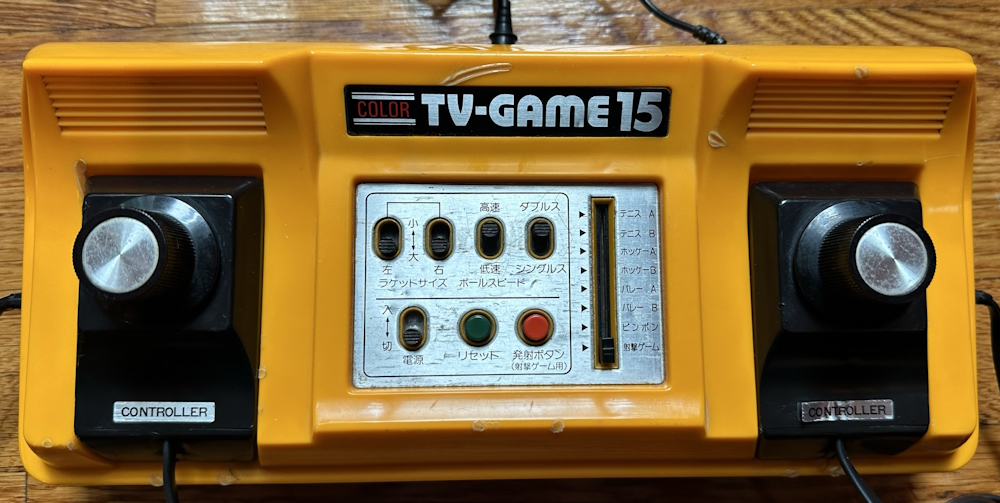
Long long before the Switch, Wii-U, Wii, 2DS, 3DS, Gameboy Advance, Gamecube, SNES, Super Famicom, Gameboy, NES or Famicom, there were Nintendo’s Color TV Game 6 and 15.
Nintendo’s second console – the Color TV Game 6, released a week earlier, was the first (Image from Nicole Express)
These were what are now called dedicated game consoles, that can only play games that are built into it. It used to be that these were the only kinds of consoles there were. They’ve made something of a comeback recently, for this is essentially what units like the NES Mini and Atari Flashback are.
The Color TV Game 6 and Color TV Game 15 use the same system-on-a-chip design. As sometimes happened back then, the 6 is electrically capable of playing all the games the 15 can, but doesn’t make the 15’s extra game’s selectable.
The paddles don’t use potentiometers, like nearly every other paddle controller does. They’re switches, meaning no analog control. When your paddle moves up or down, it’s always at a constant speed, making the included Pong-style games play much than on practically every other system.
All of Nintendo’s game consoles have used a three letter designation. The Switch’s is HAC. The Wii was RVL (Revolution), the DS was NTR (Nitro), the Gamecube was DOL (Dolphin) and the Famicom was HVC. This system may have originated way back here with the Color TV Game: it’s code was CTG.
In this video from four years ago, top-level Galaga player Jordan Dorrington gives us advice for how to get far into the venerable arcade classic.
Some of the tips given:
On the first level, enemies never shoot as they enter. Shoot as many of the bugs as you can as they enter the screen.
Boss Galagas never try to capture your ship if there’s only one remaining.
On the first two Challenging Stages, if a double ship is positioned exactly in the center of the screen, you can stay there to shoot the bugs fairly easily and get an easy Perfect.
Starting from Stage 4, some extra will be among the ones that will swoop around entering formation, and will leave the attacking ranks to rush you.
After the first three stages, the game settles into a pattern of four stages. The first three stages of each set have distinct patterns, followed by a Challenging Stage.
The first stage in each set of four has the bugs entering in two mirrored processions from the sides of the screen. The second stage has them entering from one side in double rows. On the third stage they enter from the side in one long string.
Galaga kill screens are difficulty dependent. There’s a game-ending screen on difficulty levels (or “ranks”) A and C. The other difficulty levels loop and continue indefinitely
Basic strategy for cleaning up the remaining bugs is to start at one edge of the screen, and as they fly down at your ship, to move towards the other side a tiny bit at a time, to avoid the shots coming at you, and shooting to eliminate as many of the bugs as you can in the process.
If you survive a long time on a single wave, there’s a well-documented bug in the code that causes the enemies to shoot less and less, and eventually cease firing completely. In casual play that’s great, but Twin Galaxies rules are that you cannot take advantage of this bug intentionally.
If you get really good at Galaga, it’s best to play as Player 2, as the first player’s score rolls over after six digits, but the second player’s score records seven digits.
The game’s difficulty stops increasing at Stage 31.
If you’re playing on a difficulty without a kill screen, after Stage 255 you’ll progress to Stage 0. It throws many players off in that the bugs travel at the slowest speed, but their shots are extremely rapid.
The hardest part of the game is recovering from losing a double ship. The game is much harder in single ship play.
The history of computers is filled with great transformative ideas that never took off, or sometimes, were even actively sabotaged.
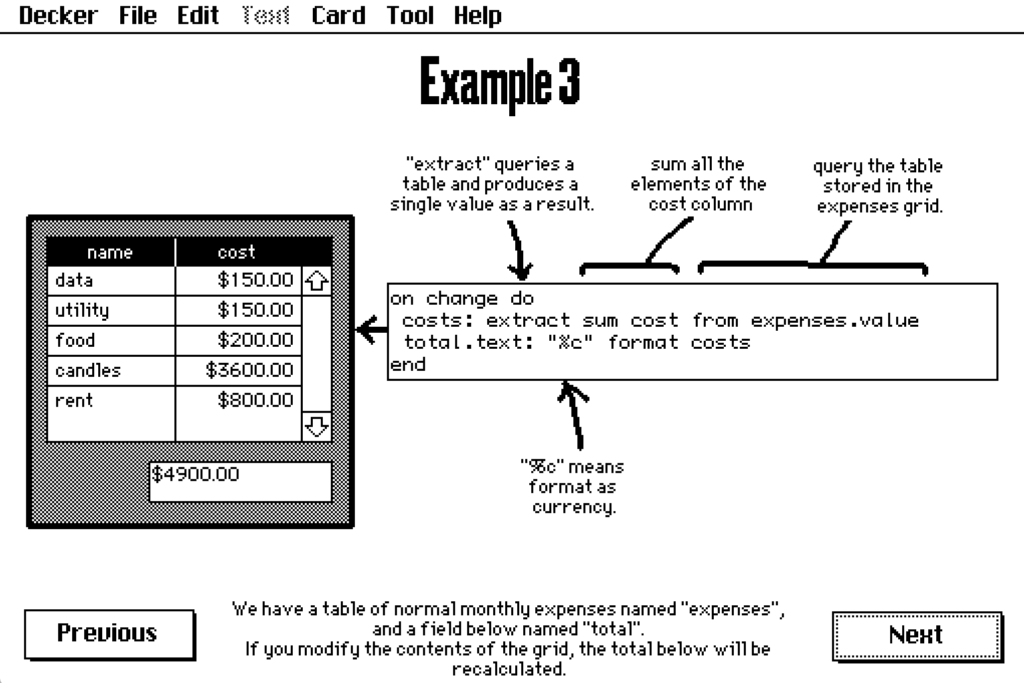
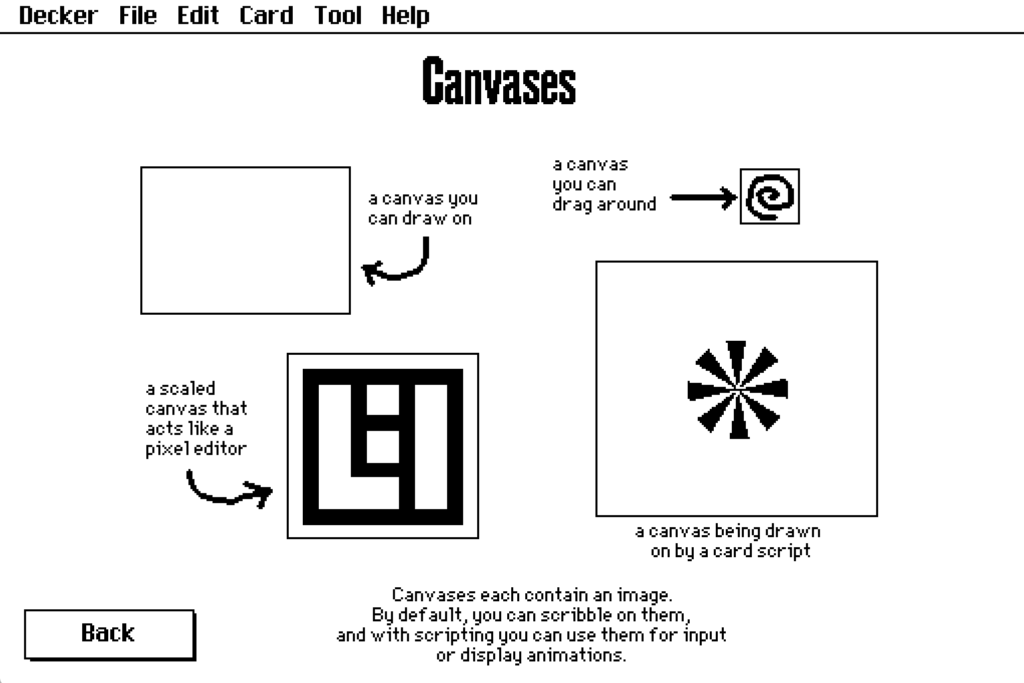
One of those ideas was Hypercard, a “multimedia authoring system” for Mac OS Classic. One way to describe it is like an individual website, contained within a file on your computer, that you could click around and explore. Unlike websites, instead of learning a special language to create documents in it, it has its own creation system that allowed users to wield the Macintosh’s powerful UI to make things.
Hypercard was an early version of several different things. Of course its concept of linking between different “cards” of information was influential to the design of the World Wide Web. Its method of placing controls onto cards and attaching code to them is reminiscent of RAD development environments like Delphi and Visual Basic. And its multimedia capabilities allowed for the creation of full games, the most prominent example of which, of course, is Cyan’s Myst. Hypercard also could be seen as the inspiration, with varying degrees of directness, of a swath of creations ranging from TWINE to alienmelon’s Electric Zine Maker.
But wait! Don’t we live in something rich people call the “free market?” Aren’t superior products supposed to make their creators (and, of course, investors) billions of dollars? Why aren’t we all making Hypercard stacks now, on our Macintosh System 29 computers? Of course: it’s because good things are not necessarily profitable, that corporate politics matter much more than the intrinsic worth of a technology, marketing is grotesquely powerful yet also somehow overvalued, and finally, the World Wide Web came out and essentially did it one better.
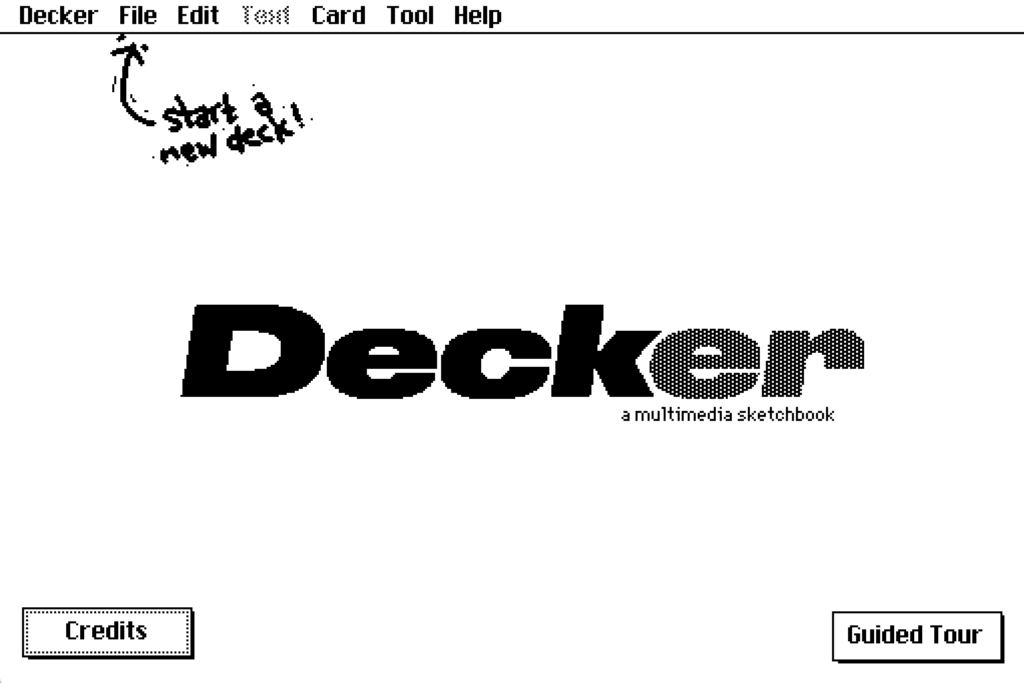
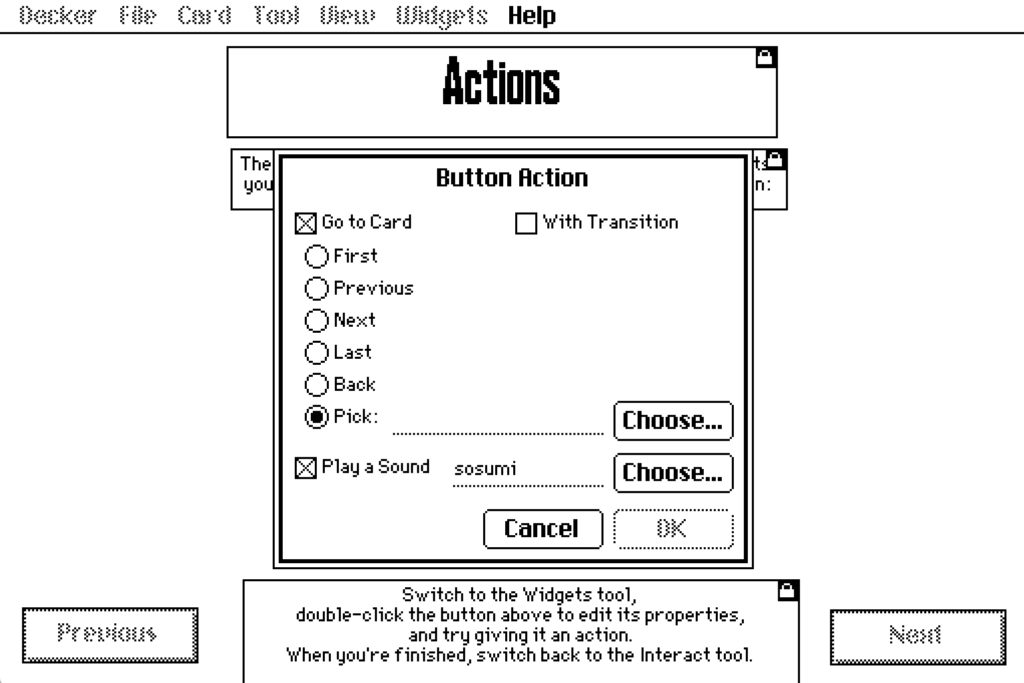
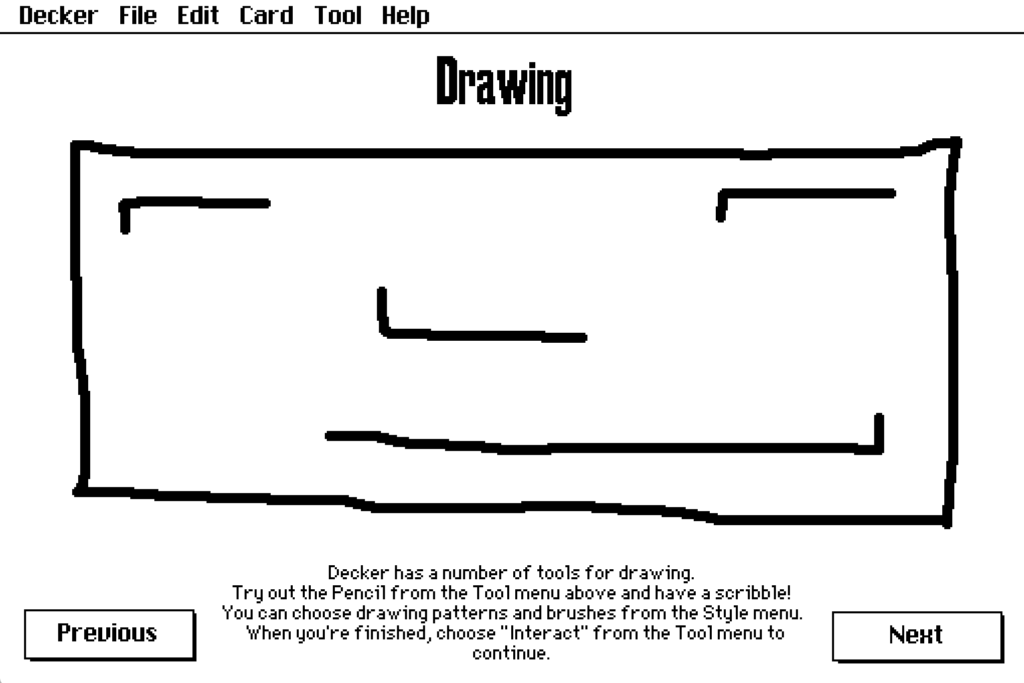
Yet Hypercard still has its fans even today. Decker (not Docker), the subject of this post, is a kind of homage to Hypercard made for current OSes. It looks, on purpose, like it’s a program for early versions of Classic Mac OS, with 1-bit graphics and copious use of dithering. Yet despite that it’s still reasonably powerful. So, rediscover the promise of computing circa the late 80s, with Decker.
Pringus McDingus’ recent video “Kirb” makes me hope he’s okay. It’s a more realistic take on Kirby, but not in the sense of showing us their skeleton, figuring out their digestive system works or giving them human feet. You’ll see.
Infocom text adventures in the classic style have this interesting thing they do where you explore interesting locations and solve puzzles in the rooms, but there’s also some miscellaneous things you have to do to keep yourself alive. Resource management.
Later Infocom games tended to go much easier on this kind of puzzle, but they were, then and now, a source of frustration to players, and that kind of difficulty termed friction by some, isn’t currently in fashion and can be excluding to new players.
Zork I in particular had two such elements: the need to keep a light source going in the underground at all times or else stumble around in the dark and soon get eaten by grues, and its carrying limit, which forced players to ascend to the White House frequently to deposit their treasures in the Trophy Case.
Similarly Planetfall, that game what has Floyd the robot in it, requires your character keep themself fed to stay alive, which is something of a distraction from the game’s mysteries. It also removes some ways the player can block themselves from winning, and removes some of the ways to die, in the name of fairness.
There are a couple of Github projects that took the publicly-released source code and removed these portions of the game. All of the rooms are still there, but the lamp has so much energy that it probably won’t run out, the player can carry much more and won’t fumble with the items they’re carrying unless they carry a huge amount, probably more items than there is in the game.
Just to let you know, I’m not yet aware of any such project to make the Babel Fish puzzle in the game of The Hitchhiker’s Guide to the Galaxy less infuriating.