
This is not some fan game made to play like Marble Madness, but the real deal, a legendary lost prototype from the Silver Age of Atari Games! Cancelled because of the great arcade fervor at the time around fighting games, meaning little Atari released in that era performed well on test.
Word is that the rom has been released somewhere on the internet, although I do not know where. It had been known that all the surviving Marble Madness II cabinets were owned by old Atari staff or collectors who were averse to allowing the rom images to be released. Whether one of them had a change of heart or, as has been speculated with Akka Arrh, another legendary prototype, they may have been obtained through nefarious means.
Technically the rights are still owned by Warner Media, I believe. I’ve long been amazed that the current rights holders haven’t seeked out the owners of these prototypes and offered them a big payday to dump the roms and release something like a Midway Arcade Treasures 4. Sure, it’d only be a matter of time before someone broke the roms out of such a package, but they’d still sell a ton of units and the prototype owners would be properly rewarded for both maintaining their machines and for lost collector value, and importantly, the games would be out there among people who would enjoy them and be protected against further loss and obscurity.
The long-running Atari fansite AtariAge sells a number of carts that run on classic Atari VCS systems that make it do things you might not expect that system could do. Some of the most impressive of these are remakes of classic arcade games that go far beyond what was possible at the time. A number of these were developed by Champ Games. Here are links to a number of videos showing them off, although sone of the may not currently be in their store:
Arcade Mermaid is a recurring feature where we look at weird classic arcade games. The word weird has many meanings; sometimes it means bizarre or ludicrous, but sometimes it means of a really unusual design.
Our game this time easily fulfills multiple senses of the word. Konami’s Amidar was released in 1982, putting it near the end of the arcade boom in the US. It still came out early enough to get an Atari VCS/2600 port from Parker Bros., the source of many of the better arcade ports of the time that didn’t come from Atari or Coleco.
Odd Boards: Gorilla and Spearmen
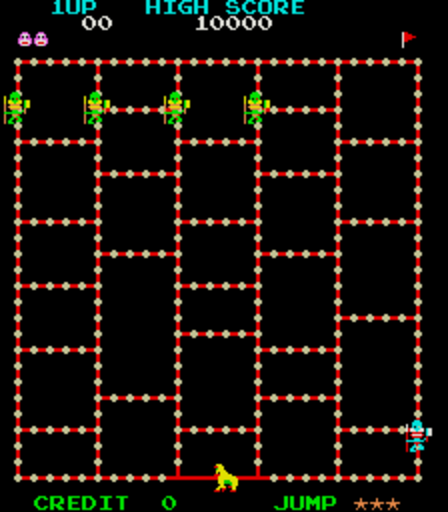
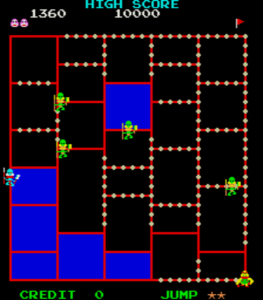
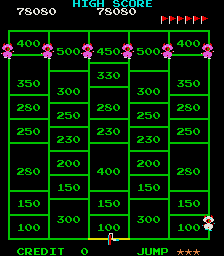
Amidar‘s game world is both abstract and evocative. You’re a gorilla, tasked with collecting all the dots on a board made of lines, while evading hostile spearmen called “Amidar” (plural) and “Tracer.” Unlike as in Pac-Man, the playfield isn’t a maze as it is a bunch of adjoining boxes, with you and the enemies walking along their border lines.
People who have played a lot of Mario Party might find something oddly familiar about this layout. We’ll get to that.
When you collect all of the dots around one of those boxes, it fills in with a solid color. These boards you can play somewhat like Pac-Man. There are differences, though. The “turn the tables” mode that lets you attack your pursuers activates when you fill in the four squares in the corner of the screen. You only get one such period every level, and it takes a lot of effort and some foresight to achieve it. If the last box you fill in is one of those corners, you complete the level immediately and don’t get any bonus points for chasing down the enemies.
Even Boards: Paint Roller and Pigs
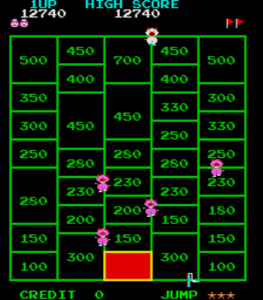
There is another kind of level in Amidar, however, that plays similarly, but with a significant difference. In these, for some reason, you’re not a gorilla but a paint roller, and you’re avoiding not natives but bipedal pigs. No reason is given for the change of graphics, although they’re still called “Amidar” and “Tracer.”
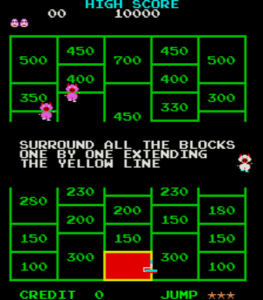
In these alternate boards, each of the rectangles has a number in the middle, which is a bonus score you earn for filling it in. On the gorilla boards, you only get points for collecting dots and capturing enemies during the attack period. Here, you get points for surrounding boxes and capturing them, so these score a lot better.
The trade-off, that makes these boards a lot harder to complete, is that you can’t just collect dots however and expect your progress to stick. There are no dots.
Instead, you have to extend the colored border away from already-colored lines, surrounding boxes one at a time. If you leave the border of the box you’re currently coloring, your progress will disappear! You’ll have to go back to one of your established lines and start over. Because you can’t just color them at any time but instead have to extend your territory out to them one box at a time, it’s a lot harder to take advantage of the attack phase granted by coloring the four corner boxes. It’s a lot harder in general. Most games end on Pig boards.
You have final aid to help you get through each level. Each board and each life, you get three uses of a “Jump” button that allows you to slip by the Amidar and Tracer. But, in keeping with a game where you alternate playing as a gorilla and a paint roller, the Jump button doesn’t allow you to jump over enemies. Instead, it causes the enemies to all jump, allowing you to pass beneath them.
Amidakuji
After you’ve played a couple of games of Amidar, you might catch on to an unusual property of the enemies. They don’t chase you. The have a specific route they follow through the board. Pac-Man may have patterns you can use to evade its ghosts, but Amidar makes the pattern followed by the enemies explicit, and the whole point of the game.
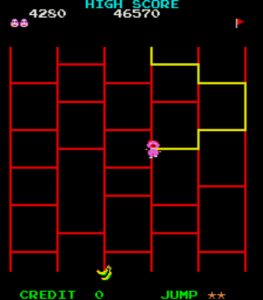
The motion of the normal enemies is entirely deterministic and uncaring of your location. Instead, they move in a specific, meandering pattern. They actually follow the routes of the Chinese “Ghost Leg,” or as it’s called in Japan, Amidakuji lottery. (You see? Amidakuji? Amidar?) They move down along vertical paths until they reach a horizontal intersection, which they will always take and then continue downward. When they reach the bottom of the board, they reverse their vertical progress, going up to reach the top again, still taking horizontal paths when they encounter them.
This is where Mario Party players might find this familiar. The Amidakuji lottery is simulated in the minigame Pipe Maze. In this, the four players are randomly arranged at the bottom of a network of pipes, and one of them must drop a treasure chest down one of the entrances at the top. The treasure travels down in the manner of the Amidar, and whichever player it reaches at the bottom gets the treasure.
The Amidakuji lottery has some interesting characteristics. It matches up each of the vertical paths at the top with exactly one path at the bottom. It doesn’t matter how many side connections there are, there will always be one way through for each path at the top.
To emphasize this, between each board of Amidar there is a bonus round that works more directly like the Amidakuji. You pick one of the routes for an Amidar to begin winding down, trying to guide it to a bunch of bananas at the bottom. Once you learn the knack of these stages it’s not hard to get the bananas most of the time. With your eyes, try to quickly trace the path in reverse, starting from the bananas.
The key to success at Amidar is focus and practice. With experience you’ll get better at figuring out where the Amidar will go in real time, and can avoid them more easily. Later levels increase the number of Amidar. Also, since a player can avoid the Amidar pretty consistently, there’s a failsafe timer in play. If you take too long to finish a level, the Tracer, which usually only moves along the outer boarder, will leave its patrol route and start following your prior movements through the level. This really starts to be a problem with Level 4. It’s good to save the corner blocks for when this happens.
Once you internalize the rules to Amidakuji, you may find yourself progressing deep into the game. I’ve been as far as Level 6! The game also has charming, melodic music in the style of Frogger. At the time of its release it was a minor hit for Stern, its licensee in the U.S., and now can be seen as a highlight of its genre.
Level 6! Notice how all the lanes at the top are blocked off. You have to squeeze by when they’re taking horizontal routes or use the Jump button to get by them.
A post-script. I searched for information on Parker Bros. Atari VCS port of Amidar, the only one made during the classic era of arcades, and found a page on the fandom.com wiki that gets many key facts wrong. It mentions coconuts: no version of Amidar has coconuts in it. It mentions the Jump button making enemies jump and not you: this is not at all evident in the VCS version. It mentions a bonus stage after every round: this doesn’t exist in the VCS version. This is one of the reasons I hate fandom.com!
“We scour the Earth web for indie, retro, and niche gaming news so you don’t have to, drebnar!” – your faithful reporter
Greetings to all humans down there on planet Glorb-III, also known as Earth. Let’s get started, drebnar!
A lament from Reddit on how Streetpasses are impossible to get now. If only Nintendo had thought to include them on the Switch. Probably it’ll take another ten years before they realize what a good idea they had.
Chris Friberg of Den of Geek tells us his picks for the 15 best NES RPGs. #1 is Dragon Quest III! (What do you mean, don’t spoil it? I’m an alien, I spoil everything drebnar!) He also ranks Wizardry pretty high, he has great taste!
We’re back for another Sundry Sunday! Congratulations for making it another week into our technological hellscape! Your reward is another catchy tune and some information from the old days of arcades.
Gradius is a long-lived and storied series of shooters, full of interesting details and traditions, but my favorite part of it all is something not a lot of English-speaking fans may be familiar with.
The first arcade releases of Konami’s Twinbee and Gradius were produced using “bubble memory,” a type of storage that had to warm up, literally, to be read reliably.
It would work effectively if it had been running for at least a couple of minutes. So, to prevent anyone from playing the game too soon after the machine had been turned on in the morning, it would display a countdown on the screen. It would also emit a digitized voice, saying “Getting ready!” and then after a few seconds, it would play the MORNING MUSIC, while the computer warmed up, as in the video embedded above. I kind of think of it as the national anthem of arcadeland.
One of the quirks of Gradius‘s bubble storage is that it was read sequentially, from a starting point. Its stage layouts were stored in this memory. Dealing with this hardware quirk required the game, when the player lost a life, to return back to the last starting point they had passed. This was the source of one of the Gradius series’s major characteristics, having to return to a previous part of the level, which could then be read into memory going forward once again.
I forget where I heard this factoid, but I think I saw it in the supplemental material in the Gradius Arcade Collection, out on Steam and Switch, and no doubt other platforms. Hey, it’s Sunday, I’m not supposed to be stressing out about these details!
Games from the classic (Space Invaders onwards) and later eras of arcade machines tend to be preserved fairly well, or at least have MAME watching their backs, but there was a whole era of arcades before that time, that pose special challenges for preservation. Atari/Kee’s early release The Quiz Game Show, for instance, their first game using a processor, read questions off of special data tapes that may not even exist nowadays. Many games from that era had no processor, and were constructed out of discrete logic components.
When I wrote part one of We Love Atari Games, I was surprised by how many games from this era are so little known now. Atari’s Football, for example, sold extremely well, even keeping up with Space Invaders for a little while (until Super Bowl season that year ended), but I barely even heard of it before I started working on the book.
These games are important to preserve too, but the difficulty in emulating them, their great rarity, and the inescapable arrows of time and entropy present huge challenges. Please listen to the podcast for more information, from people who know much more about them than me.
It’s Sunday! You made it through another week. Your reward is this wonderful bit of ephemera from San Francisco Rush. With the death of Midway and Atari Games, arcade aesthetics have largely been ceded to Japanese studios which, nothing against them, but sometimes it feels like we’ve lost something fundamental.
What’s Your Name, the high-score name entry music from San Francisco Rush, is a favorite example of this. In the twenty-six years since the game was released to arcades, I find it shocking that this catchy little ditty isn’t remembered by more people. It makes me happy just to hear it. “Starts with a C… starts with a G… starts with a Z… nothing nasty now!”
Sundry Sunday is a little feature I’m doing to post something silly and fun, related to the world of gaming, once a week. I hope you’re ready for some weird….