Owner of Game Wisdom with more than a decade of experience writing and talking about game design and the industry. I’m also the author of the “Game Design Deep Dive” series and “20 Essential Games to Study”
Owner of Game Wisdom with more than a decade of experience writing and talking about game design and the industry. I’m also the author of the “Game Design Deep Dive” series and “20 Essential Games to Study”
The decades of video gaming history there has now been have had many companies, developers and studios that have went under, due to one thing or other. Many of those names are revered, and their vanishing have left lacks in the world of vidyagaems that are felt to this day. A few of those: Atari (the current one has improved greatly lately, but it’s still not the same), Midway, Bally, Williams, Lucasarts, Rare (in its non-Microsoft incarnation), Telltale, SSI, New World Computing, and many more if I cared to dredge them out of the muck of my mind. And that’s just Western companies, there were plenty more in Japan, I just wanted to narrow the field down a bit.
One of those companies probably isn’t Acclaim. They were one of the biggest third-party publishers in the NES era, and they lasted to around the N64 era, but although they did put out some Premium Quality Entertainment (thanks Murderbot), they also put out a lot of what in Yiddish is called drek. Towards the end it felt like the drek percentage was getting pretty high, and it didn’t help at all that they kept pulling some dodgy ad stunts. They ran a context where they offered to pay couples to name their kid Turok, another where they tried to put ads for Shadowman on tombstones in cemeteries, and the less said ab0ut BMX XXX, possibly the game that destroyed the company, the better.
Well nostalgia certainly sells, even for the less savory publishers, and so it is that some people have decided one of the brands we needed to once again be subjected to is Acclaim. They released a promo video yesterday that unveils their initial releases, here it is (relevant portion 13 minutes):
The games shown:
GridBeat! appears to be a hacking-themed maze/puzzle/rhythm game.
Basketball Classics is a stylish retro-themed sports game that’s refreshing for being a new game based off of real players that didn’t come from the corpulent corporate cube of EA Sports. I’m pretty impressed they’re making this, it’s probably the game here I’m most interested in.
Ground Zero Hero is a cartoony action shooter that seems to take inspiration from Vampire Survivors and Nuclear Throne.
Pixel Washer is a retro-themed cleaning game that reminds me a bit of Powerwash Simulator, but maybe that’s because I’ve been playing that again lately.
Talaka is a combat platformer with sketchy graphics.
Toss Down I couldn’t get a strong read on, it seems to be an isometric shooting game in urban environments, with tornadoes around, maybe with a bit of classic 2D GTA in it?
The Prisoning: Fletcher’s Quest appears to be a kaizo-style 2D retro platformer. I’m sensing a theme with some of these games. I don’t have anything against retro styling myself, mind you, it’s like one third of this site’s entire reason for being.
HyperYuki: Snowboard Syndicate is a snowboarding game, obviously. It’s 3D, but has stylish and colorful low-polygon, cell-shaded graphics. I might have to follow this.
Katanaut seems to be a dark pixel-art sci-fi combat game.
The question remains, why did they feel like they needed to resurrect the Acclaim brand and logo? Having a leg-up from obscurity is enough reason I guess, but none of the new games are based on and of Acclaim’s old IP. Maybe they could revive Extreme-G, Turok or Wizards & Warriors, but they haven’t yet.
Owner of Game Wisdom with more than a decade of experience writing and talking about game design and the industry. I’m also the author of the “Game Design Deep Dive” series and “20 Essential Games to Study”
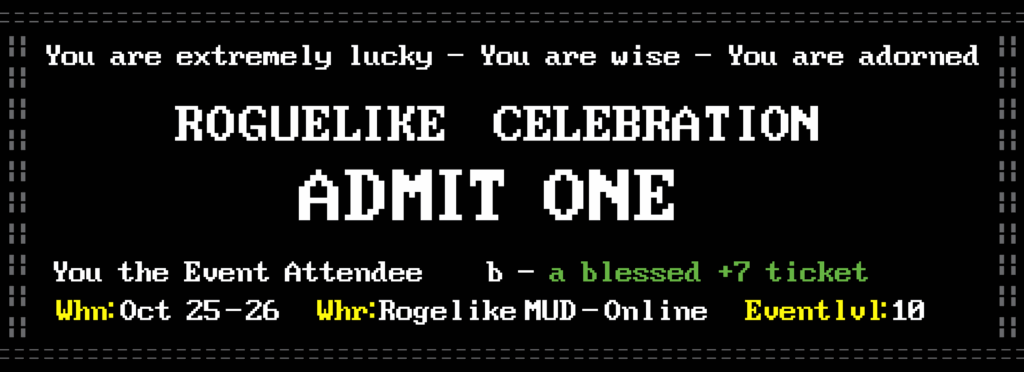
This snuck up on me, and in fact I had thought I’d missed it, but it turns out it’s tonight! Roguelike Celebration‘s main event isn’t until October, but they’re having a preview event tonight with two long and one short talk. The schedule is here. It kicks off at around 3:00 PM Pacific time, which to convert is 6 PM Eastern, around 10 PM Greenwich, and Midnight CEST.
(EDIT: I had the Eastern times too late by an hour. The event will begin at 6 PM Eastern time.)
Tonight’s show is being done for free, but you still need a (costless) ticket for it, which you can get here. As has been usual the past few events, there will be a live MUD-like chatroom to participate in during the show, for interacting with other audience members, for submitting questions to the queue, and just for bumping around and exploring. The doors open a little before the talks begin, to let people get used to the space, and as a buffer against lateness.
I hope you can make it! Tonight’s talks are:
3:15 PM Pacific / 6:15 PM Eastern / 10:15 PM GMT / 12:15 AM CEST – 45 minutes
Fireside chat with Jon Perry: Host Alexei Pepers and Jon Perry will chat about game design and his contributions to UFO 50 such as Planet Zoldath, Party House, and Mini & Max! (Personal note: this is not one to miss. I have been obsessed with Party House, enough to write a gigantic strategy guide for it.)
4 PM Pacific / 7 PM Eastern / 11 PM GMT / 1 AM CEST – 30 minutes
Building Synergy Networks for better Roguelike Deckbuilders, with Ezra Szanton: Roguelike Deckbuilders live or die on the quality of the drafting decisions they present. When a player chooses between 3 cards, what is going through their head? This talk is about how to achieve deep but accessible drafting decisions which result in memorable games that excite players. Synergy Networks are a helpful lens for creating sets of cards that achieve these aims. Modeling the synergies between cards as a network allows us to use ideas from network theory like path length, density and hubs. Digressions will include characteristics of synergies, broad types of synergies useful for brainstorming, and why anti-synergy is just as important as synergy itself. This talk is informed by my work designing Hellscaper and Mr Magpie’s Harmless Card Game, two roguelike deckbuilders.
4:30 PM Pacific / 7:30 PM Eastern / 11:30 PM GMT / 1:30 AM CEST – 45 minutes
Designing for System Suspense, with Alexei Pepers: The host will give a talk which she gave at GCD and had previously been trapped inside the GDC Vault.
There’s this Youtube video (SHOCKING, I know) about “The Only Impossible Seed in Balatro*.” (49 minutes) The asterisk is their way of saying, “It’s not really impossible, but that wouldn’t have nearly as much impact as a title.” Yeah, unfair.
The video is interesting, if you sift through it, for an interesting fact: a bug in Balatro’s seed-based randomness generation code sometimes produces a situation where one of its many number sources will get bugged, and produce the same number over and over again. This is the cause of the now-infamous seeds where, if you’re playing the Erratic Deck, all your cards end up as the 10 of Spades, as well as seeds that affect which cards you draw, and one where all the Jokers generated are Rare. The video is most interesting, I think, for describing that mechanism, and that is why it is offered here:
To get to the meat, it turns out there is GitHub out there that explains much about these bugged seeds, here.
Owner of Game Wisdom with more than a decade of experience writing and talking about game design and the industry. I’m also the author of the “Game Design Deep Dive” series and “20 Essential Games to Study”
Owner of Game Wisdom with more than a decade of experience writing and talking about game design and the industry. I’m also the author of the “Game Design Deep Dive” series and “20 Essential Games to Study”
Owner of Game Wisdom with more than a decade of experience writing and talking about game design and the industry. I’m also the author of the “Game Design Deep Dive” series and “20 Essential Games to Study”
Owner of Game Wisdom with more than a decade of experience writing and talking about game design and the industry. I’m also the author of the “Game Design Deep Dive” series and “20 Essential Games to Study”
Our own Josh Bycer isn’t the only source of indie recap videos out there. Nintendo themselves released a new Indie World video yesterday with a number of new games listed, as well as an upcoming free update to one of my favorites, Little Kitty Big City. (I interviewed its creators for Game Developer some months ago!) Here’s the video (15 minutes):
The biggest surprise is, at the end, the news that both Caves of Qud and UFO 50 are coming to the Switch platforms at last! UFO 50 is out now! Please forgive my breach of decorum when I say, yippie, and besides that, wahoo. Thank you. (sips tea)
Founder of Digital Eel and friend of the blog Rich Carlson sent word that they’ve released a number of albums collecting their music on Bandcamp! I’m not much of a music-knower, admittedly, but the songs on their games always stuck in my ear, and I think there’s a good chance they’ll stick in yours too!
The Midway Sessions: I’m fondly recalling MIDI, the dawn of digital audio, the Macintosh, Windows for Workgroups, the Pentium, DAT, Mark of the Unicorn, Windows 95, the Proteus, Sound Canvas, Cakewalk, the Roland D-50, the Kurzweil K2000, the Roland RAP-10…. It was an astonishing, revved-up and magical era in music; we were spoiled with innovations. And this was when, at a modest studio in an industrial park in Midway near St. Paul, Minnesota, the music-making period that I call the Midway Sessions occurred.
The Midway Sessions: Short Stack EP: These three tunes were recorded at the same time and place, and were rescued, last minute, just after the Midway Sessions compilation was released. Note that most of the music on the Midway Sessions album as well this EP was created for commercial purposes but, for one reason or another, were never used.
Hidden Cookies: This final installment of the “Midway Sessions” features a mix of newly uncovered tracks and original versions, rescued from the vault, dusted off and revived using old tyme tools and methods.
Sea of Stars: The Symphonic Score (Evelyn Sykes): In 2015, indie game makers Digital Eel (including yours truly) decided they (we) wanted fancy theme music, like the Star Trek TOS theme, for their (our) third space game, Infinite Space III: Sea of Stars. Enter UK composer, Evelyn Sykes, an instrumentalist, recordist and creator of music for radio dramas, videos, films, and live performances.
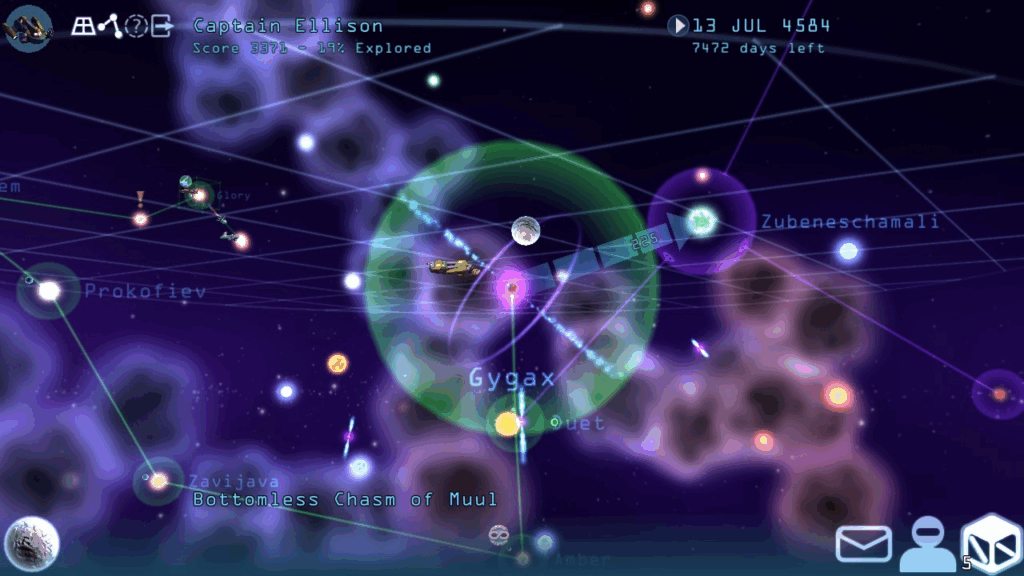
The Weird Musical World of Digital Eel: This compilation offers a wholly unique and eclectic mix of musical and music-like material from nearly 15 years of Digital Eel games. […] These “suites” feature a diverse collection of sounds and mayhem from Plasmaworm, Dr. Blob’s Organism, Big Box of Blox, Weird Worlds: Return to Infinite Space, Brainpipe: A Plunge to Unhumanity, Data Jammers: FastForward, and Infinite Space III: Sea of Stars.
Plasmaworm: This album contains the level music from the 2001 Cheapass Games/Digital Eel computer game, Plasmaworm. […] Out of context (and in, for that matter) many of these pieces–extended loops really–are rather hypnotic and trancy, so get comfy and enjoy!