Sundry Sunday is our weekly feature of fun gaming culture finds and videos, from across the years and even decades.
In memory of Blaseball, that awesome star that burned brightly for less than three years, it seems like so much longer. An animatic from the time of its height, about players seeing the future and choosing to get incinerated by the Rogue Umpires so they could come back to play against and beat The Shelled One’s Pods. If none of that makes sense to you I’m sorry, it’s too late to understand, all you can do now is enjoy.
The indie showcases highlight the many games we play here on the channel. If you would like me to play your game for a future one please reach out. All games shown are either demos or press key submissions.
Owner of Game Wisdom with more than a decade of experience writing and talking about game design and the industry. I’m also the author of the “Game Design Deep Dive” series and “20 Essential Games to Study”
Indie Retro News reported recently on this cool run-and-gun game made by Division 六 the style of Metal Slug. Here’s a promotional video. Note that some of the sound effects are taken directly from Metal Slug, but are intended as placeholders. The final version should have no outside assets.
We love games made for unlikely hardware, and PETSCII Bros. fits that bill like a duck’s dentures. Like we explained in the post about that PET demo from a while ago, the PET didn’t have changeable graphics characters and no bitmap mode at all, and so it wasn’t what we’d consider a games machine. But it did come with a set of interesting graphics characters that, among other things, had a set of 16 characters that let programmers use the screen as a super-low-res 80×50 pixel display.
PETSCII Bros is a PET action game that uses those characters (long called “PETSCII” as a cheeky reference to ASCII) for an actual game, that plays similarly to Nintendo’s classic Mario Bros. arcade game. Of course you’ll need a PET, or an emulator (such as the one that comes with VICE) to play it. Or if you’re just passing interested, you could watch this video to see how it works:
Owner of Game Wisdom with more than a decade of experience writing and talking about game design and the industry. I’m also the author of the “Game Design Deep Dive” series and “20 Essential Games to Study”
Warning: slightly NSFW for depiction of sheep birth.
You’re watching the video and it seems like standard 90s kids whimsy and then woah did that sheep just come out of its mother?
What are the Dazzeloids? They’re characters created by Rodney Alan Greenblat, the character designer of Parappa the Rapper! They were made for a multimedia Playstation game released in 1994, two years before Parappa. I call it a game, but it seems more to have been one of those early multimedia products that’s mostly video clips given a loose connecting story, only in Dazzeloids case, the clips are very weird. The Dazzeloids (not Dazzleoids, as you might expect) have as their mission the liberation of minds and use creativity as a tool to that end. It’s all very nineties kids TV. The Dazzeloids are very obscure now, and don’t even appear on Rodney’s website, which is kind of a shame.
Does Lammy wear Stinkabod merchandise?
All of the Dazzeloids have a dream sequence on the disk that introduces them and tells you what they’re like, and the video above is the one for Stinkabod the Sheep, who might be the character on Lammy’s shirt. The video is very weird, but engaging, and definitely a Rodney Greenblat creation. The characters are of the same style as Parappa, and it doesn’t seem impossible that Stinkabod and his friends could exist in the same world.
Rodney’s creations are a bit more popular in Japan than in the U.S., where Parappa got an anime series and a line of merchandise. While you’re diving down this internet rabbit hole, you might also check out Rodney Greenblat’s personal site Whimsyload!
Sadly, it seems the struggle to update Blaseball for a new era was too much effort and not enough income to keep The Game Band, the game’s creator and maintainer, going with it, and they’ve made the decision to end it.
It’s a shame, but it could be that it was something of its time. It got started during the big lockdown period of COVID (as opposed to the long haul, pretend-it’s-not-happening period we’re currently in), when everyone was obsessing over this strange fake horror-themed baseball sim and Animal Crossing New Horizons.
I’m sure in the decades to come people will look back fondly at that time, as a moment when we could afford to be so focused on a small number of particular cultural monoliths instead of our regular diffuse fixations. Maybe a moment such as that will come again someday. But it’s not now, and Blaseball has ended.
It’s worth noting what a cultural phenomenon Blaseball was for awhile. They made a number of Youtube videos for the second era of the “splort,” called The Blaseball Roundup, that are worth watching for their own sake. And the Seattle Garages was a seriously good band that arose out of Blaseball’s pandemic enthusiasm.
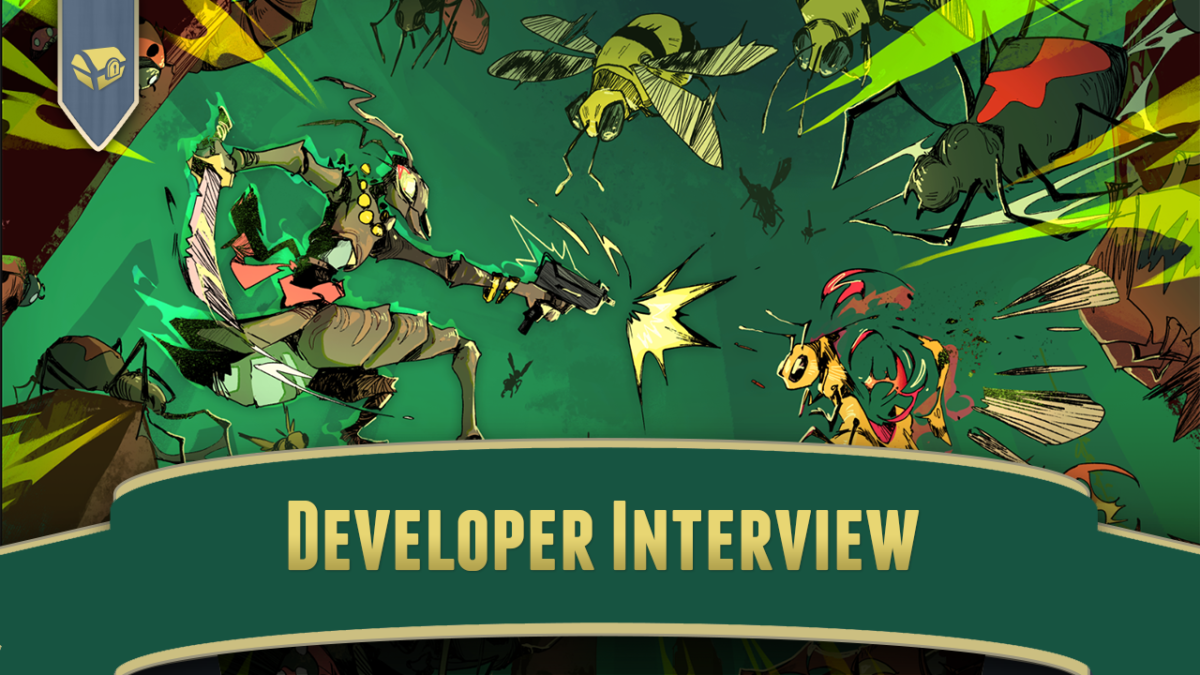
For this developer interview on the Perceptive Podcast, I caught up with Nicholas McDonnell from Samurai Punk to talk about the studio celebrating its 9-year anniversary, how they have grown over time, and its next project Killbug.
Due to OBS issues, the audio and video are not properly syncing, unfortunately.
Owner of Game Wisdom with more than a decade of experience writing and talking about game design and the industry. I’m also the author of the “Game Design Deep Dive” series and “20 Essential Games to Study”
They’re not out yet, but the Brothers Chaps, creators, maintainers, and sometimes even makers of Homestar Runner stuff, have some remakes of their old Dangeresque Flash games in the works, now with updated (in some cases completed in the first place) content, and full voice acting! Have some strong & bad Strong Bad:
Nothing says awesome earlyweb goodness like Homestar Runner, even though technically he’da say “awesome eallyweb goodness,” because he doesn’t do Rs too well. Here’s the itch.io page, where it’s still listed as only “in development.” Looks like (we’re gonna have to jump) it’s set for Steam as well!
Owner of Game Wisdom with more than a decade of experience writing and talking about game design and the industry. I’m also the author of the “Game Design Deep Dive” series and “20 Essential Games to Study”
‘@Play‘ is a frequently-appearing column which discusses the history, present, and future of the roguelike dungeon exploring genre.
It’s been a while since we had a look at the roguelike space. I’ve been waiting to make @Play’s return a review of some of the games of 7DRL 2023. Scoring is finally done, so we have a solid top-ten, or rather top 11, since there’s a three-way tie for 9th place.
7DRL stands for Seven-Day Roguelike, a game jam where people try to complete a roguelike game in one week’s time. While you don’t have to participate strictly during a specific week, people who participated this year from March 3rd to March 13th, and made their projects available through the popular and wonderful indie game distribution platform itch.io, could have their games rated by the community and included in the 7DRL 2023 itch collection.
Long ago when @Play was on GameSetWatch (R.I.P.), one year we reviewed every game that completed 7DRL. That I think was in 2011 or 2012? There were a bit over 60 games that year, and doing it nearly broke my silly head. This year there are 235 games in the itch.io collection, so I won’t be doing that. Also, since the jam doesn’t forbid the use of libraries that take a lot of the grunt work out of making a roguelike out of the process, there are entries from all across the game development and design skill spectrum, and the dregs of that barrel…. I won’t speak ill of them, since making any game is an accomplishment, let alone in a week’s time. But it isn’t always easy to find something to write about them that’d be interesting to read.
So I figured though that it might be interesting to have a look at the games that were rated mostly highly. This time, we’ll look at the three games that were tied for 9th place: Animal Party, Snapdragon and Totem of Seeding. I checked these games out on May 23rd, and they may not be in the state they were at the end of 7DRL’s challenge period. I’m more interested in telling you about fun things to look at and play than strict observation of the 7DRL time period.
9th Place tie: Animal Party
Animal Party, by Ethan’s Byproducts, with music by Kai Keys. For Windows and HTML5 (playable in-browser). Made with Gamemaker Studio.
The definition of a roguelike game has drifted a lot since the days when the term was coined, as an umbrella term for discussions, on Usenet, for a variety of games that were playable on terminals. It was fairly obvious what a roguelike was then. Now, it often gets used for any game with a procedural element in its level generation, and a vaguely arcadey setup where losing means failure, forcing the player to start again if they wish to keep playing.
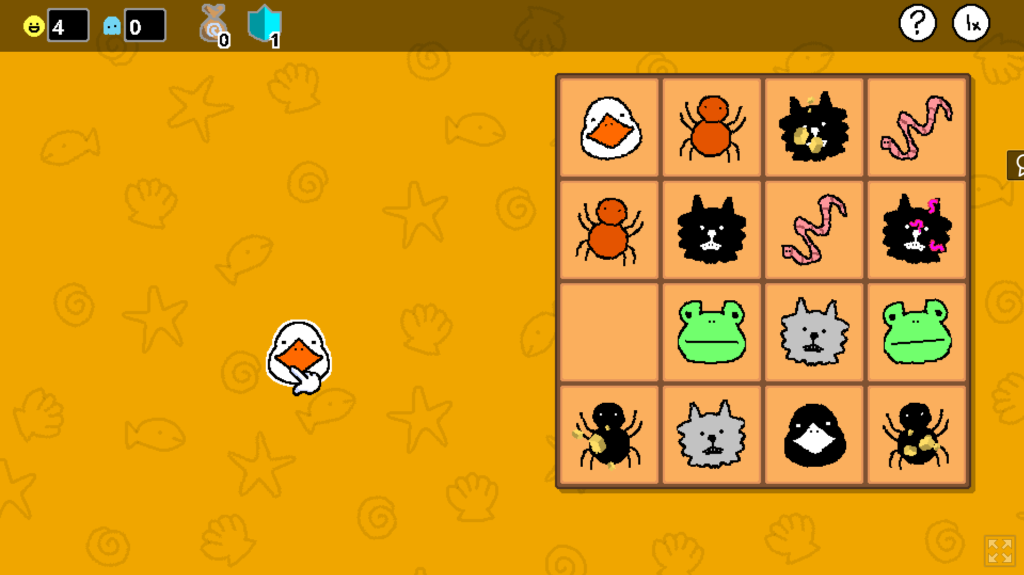
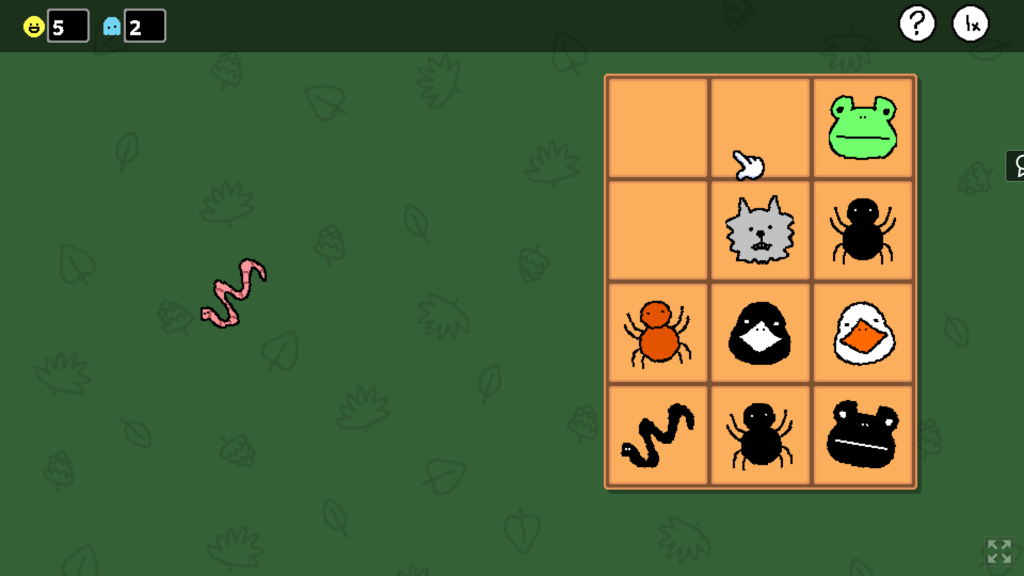
I use the term roguelite to refer to games that aren’t strict turn-and-grid-based tactical games, but that’s mostly my usage. 7DRL casts a wide net in their entries. Animal Party, for example, is mostly just a puzzle game sort of along the lines of the old Adult Swim-sponsored Girls Like Robots. Your task is to place a collection of friendly animals on the empty spaces of a grid, to defeat as many “evil” animals that are already there, while losing as few animals yourself. It’s not a tactics game at all, and so ranks very low in “Roguelikeness” (116th place), but high enough to tie for ninth in overall quality for the jam.
The rules are: Wolves attack Geese, Geese attack Frogs, Frogs attack Spiders, Spiders attack Hookworms (how?), and Hookworms attack Wolves (obviously through parasitazation). For every evil animal you destroy, you earn one ghost, which you can use as currency in a between-level shop where you can earn special powers to use to make later boards easier. For every friendly animal you lose, you lose one point of morale. Lose too much morale and the Animal Party is over, and I guess everyone goes home sad.
Complicating things is, while you don’t have to eat all the evil animals, you must place every animal you’re able. Earlier this means just placing one of each, but later it means filling every empty space on the grid. Your group gets bigger at two places along the way, and the grid sizes also increase. Eventually you’ll have more animals than spaces, which affords you a bit of leniency since you can choose which animals go in the spaces. You’ll notice pretty soon that, when your own animals get eaten, you don’t really lose them. Nothing decreases your party’s size, it only gets bigger.
In later boards you’ll probably have to sacrifice a few animals to fill each grid. Your animals are friendly to you but not to each other, and they’ll happily munch on their colleagues, so keep in that mind. Some of the evil beasts get random modifiers as the game continues. To find out what a given animal’s deal is, press the Tab key while hovering the mouse over it. There are animals that take two hits to defeat, animals that sate their attacker so that attacker can’t attack other animals after they’re eaten, animals that attack diagonally instead of in the cardinal directions, animals that attack two spaces away, and animals that explode when defeated, taking out all animals adjacent whether friend or foe. It must be something in the water.
One thing that may turn out to be important to playing well: animals get their turns in a process that goes row by row, with each animal being resolved on a row from left to right. You can take advantage of this to defeat an enemy animal from above, and depriving it of its own turns when the resolution order gets to it.
Most of the powers you buy in the between-level Ghost Shop, it should be remarked, are not one-time-use ever, but can be reused once per purchase on every level, so the things you buy early on have a great influence upon the whole game. My recommendations are the one that lets you move one enemy animal one space, and morale boosts, which give you a big five extra points. Using them, I was able to finish this game on my first attempt.
It’s a fun use of a few minutes of your time! It’s also browser-playable on its itch project page, and has chill music to jam to while you play.
9th Place tie: Snapdragon
Snapdragon, by sarn, vaalentines, Duckonaut and Oroshibu. For Windows and HTML5 (playable in browser). Made with Gamemaker Studio.
Another game with really nice music! Maybe that’s going to be a theme this year. A good soundtrack adds so much to a game, even if it’s not a traditional roguelike feature.
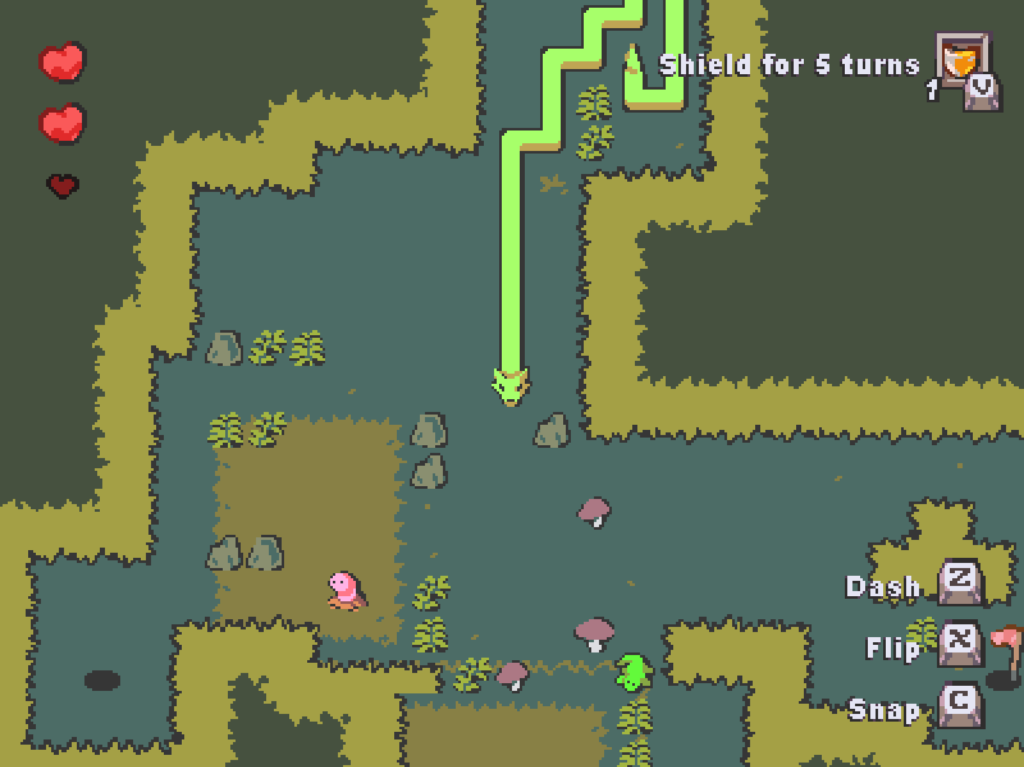
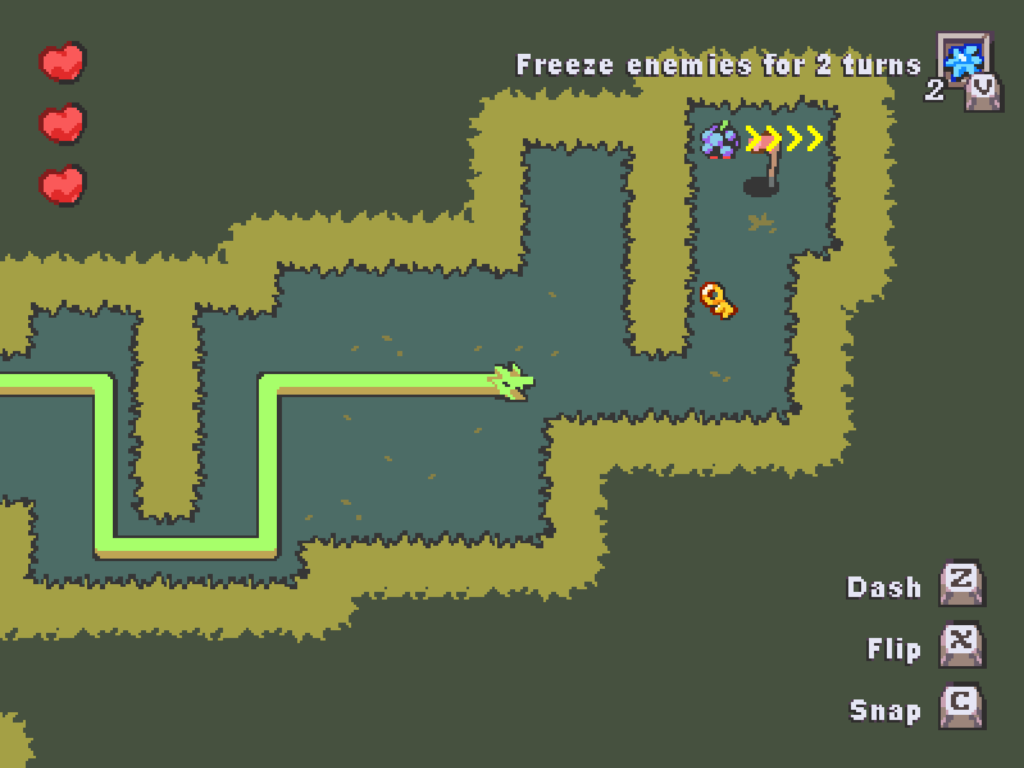
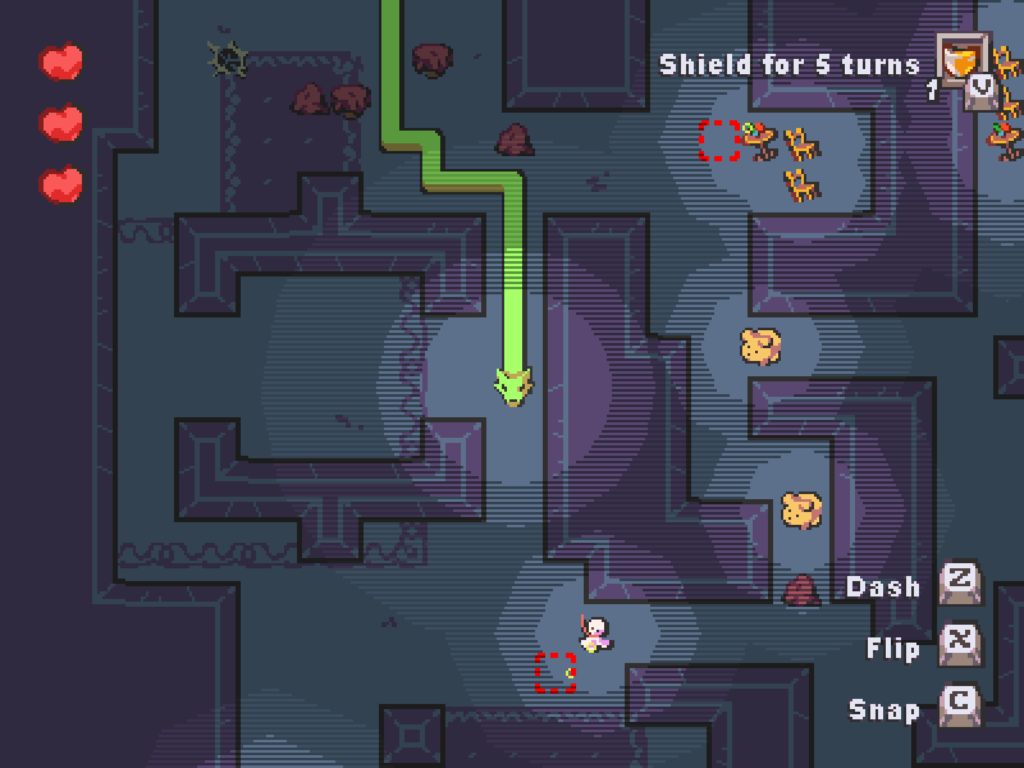
From the screenshots it looks a lot like the classic game Snake, but running into your own tail doesn’t result in losing. You can shrink your length down to two spaces at any time by “Snapping,” with the C key, and you can also switch your head and tail with the X key, and dash by pressing Z before you move in a direction. All of these acts take one turn, so your enemies get to respond after each.
This is a lot more like a traditional roguelike than Animal Party was, following the classic rules of one move per turn, then the enemies all get to act. The enemies all have different movement patterns, with many of them able to move multiple spaces in a turn. It takes a while to learn their movement patterns and health. As a player aid, the game provides a warning of what each enemy will do, by showing its planned movement in yellow, then red on the turn before it moves.
Attacks are roguelike standard: you attack enemies by moving into them, and they attack you by moving into you. The enemies all seem to be various animals, including the likes of squirrels and crabs. You get three health units, but they’re all replenished at the start of every level.
Each level also has at least one key (you can only carry one at a time) and a treasure chest. If you can get the key to the chest, you’re given a special item. You can only have one item at once, so you should use it before you get another one. An unused key can be carried between levels.
Snapping slows you down by one turn, but if you’re not fleeing enemies you could probably just do it every turn. If you can evade enemies without worrying about them attacking your tail (you’re vulnerable all the way down), it’s a good idea to just get away, there are no experience points, or other game benefit to attacking enemies other than increased safety.
The description page says the game was actually finished in just two days, which was accomplished by narrowing its scope. I’d like to know what had been planned before, because Snapdragon is rather complex even in this feature-limited form, with multiple regions each with different monsters, graphics and gimmicks.
The verdict? It’s really nice! It’ll probably take you a few plays to get far into it, it rewards patience and careful planning, but isn’t greatly taxing.
9th Place tie: Totem of Seeding
Totem of Seeding, by anttihaavikko For Windows, Mac, Linux and HTML5 (playable in browser). Made with Unity.
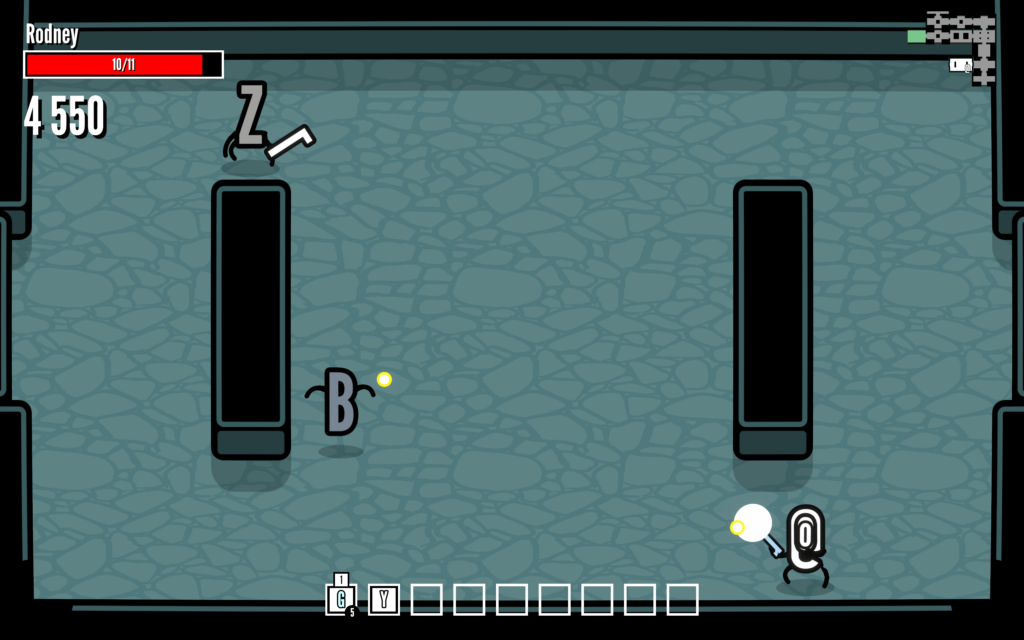
It is easily possible to play this game, in some ways a pretty standard random dungeon shooting action game that relies heavily on its loot system, without even encountering the feature referred to by its title. If you never interact with the titular totem in the first room, it’ll look a lot like the kind of game that’s been made since at least Binding of Isaac, which came out in 2011, and with a quirky art style where all of the characters and items are @-signs and letters, an unusual choice for an action game.
And I mean, that’s okay. It’s the Seven Day Roguelike challenge! No one expects greatness in seven days. The fun of Totem of Seeding comes from the fact that it’s one of those few Rogue-inspired games to use its letters for something other than representation: the game expects you to spell words with them.
The best use of this idea of which I’m aware is roguelike design wizard Jeff Lait’s Letter Hunt. Jeff has made all kinds of brilliant roguelikes over the years, many of them for 7DRL. In addition to making the popular game POWDER, he made Jacob’s Matrix, a non-Euclidian roguelike that still amazes me, and it’s far from the only astonishing variation on the roguelike theme he’s made. But to talk too much about Jeff in a review of a different game, that is not his equal, sounds like I’m trying to tear down Totem of Seeding. It’s a perfectly fine game in itself.
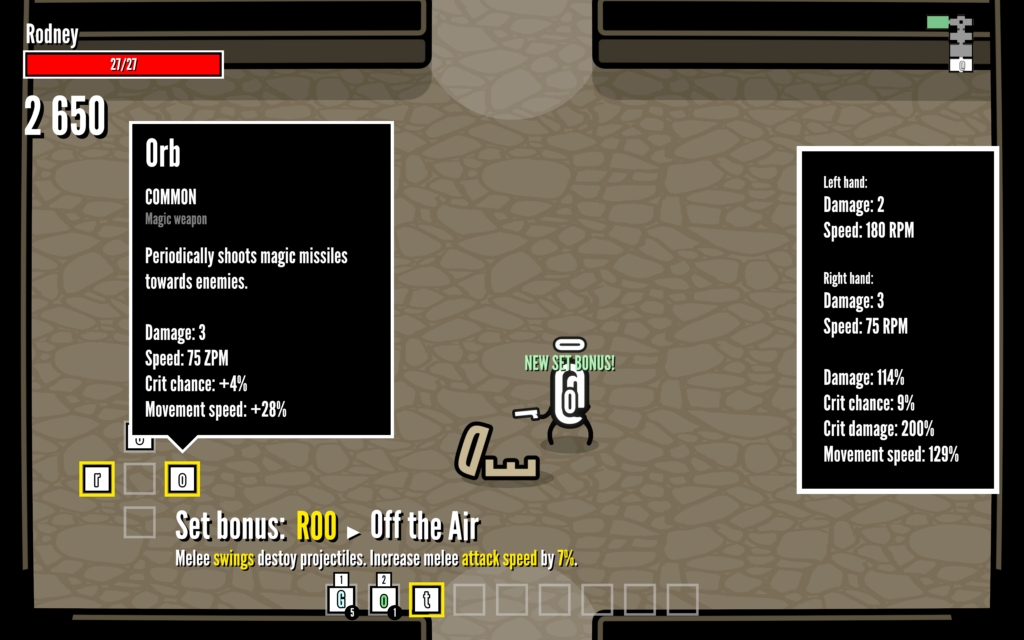
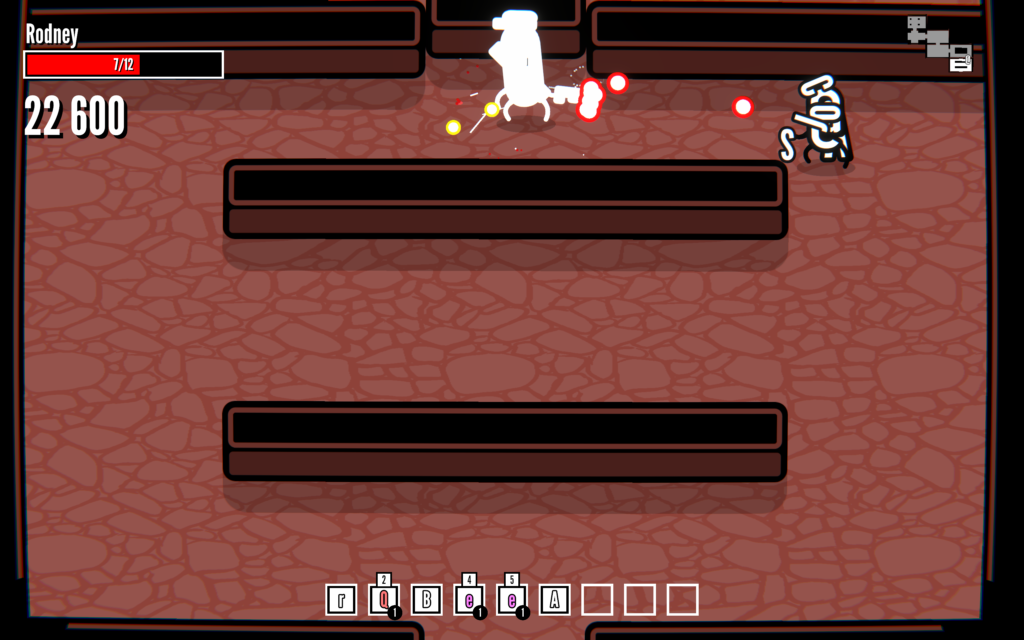
In overview, your character (an actual animated @-sign) explores a series of one-screen dungeon rooms, not unlike those from the original Legend of Zelda. They fight monsters with firearms, melee weapons and the odd magical item, most of which they find in treasure boxes in the dungeon. This is one of those games where your success is strongly tied to the items you find. It’s not a case where everything is good in some way or other: there are definitely some items that are better than others, and whether you have a good game or not depends on whether the roulette wheel lands on your numbers this time.
Good items? Shotguns, magic weapons, and anything that gives you a plus health or plus damage bonus. (Lots of things give you percentage bonuses, but as with a lot of games I’ve noticed, their effects are barely noticeable. You definitely want plus health bonuses, not percentage bonuses, the difference is huge.) Bad items? Most other things, but especially melee weapons, which for interface reasons only the enemies can make good use of.
Your camp is in the first room, where you can rest at the campfire to refill your health or visit the Totem. We’ll get back to the Totem, don’t forget about it.
There is an exit from the room, and when you go through it, you’ll be in the first room of a dungeon with a random, three-letter name. You can, at any time, go back to this first room and to your camp. That will end the dungeon run; the next time you go through the exit from the camp room, you’ll be in a different three-letter-named dungeon, with a different map, different enemies and different loot.
There will be times when it wil be best to abort a run and go rest at the campfire, but it’s important not to make too much use of this resource. Every time you start a new dungeon, the day number advances, and the higher the number, the harder the monsters will be. The game generates more monsters, they’ll have more health, and they’ll be more in each room. It also seems there will be fewer treasure chests. Day 1 is laughably easy, and Day 2 usually not too much of a bother, but they get much harder from there.
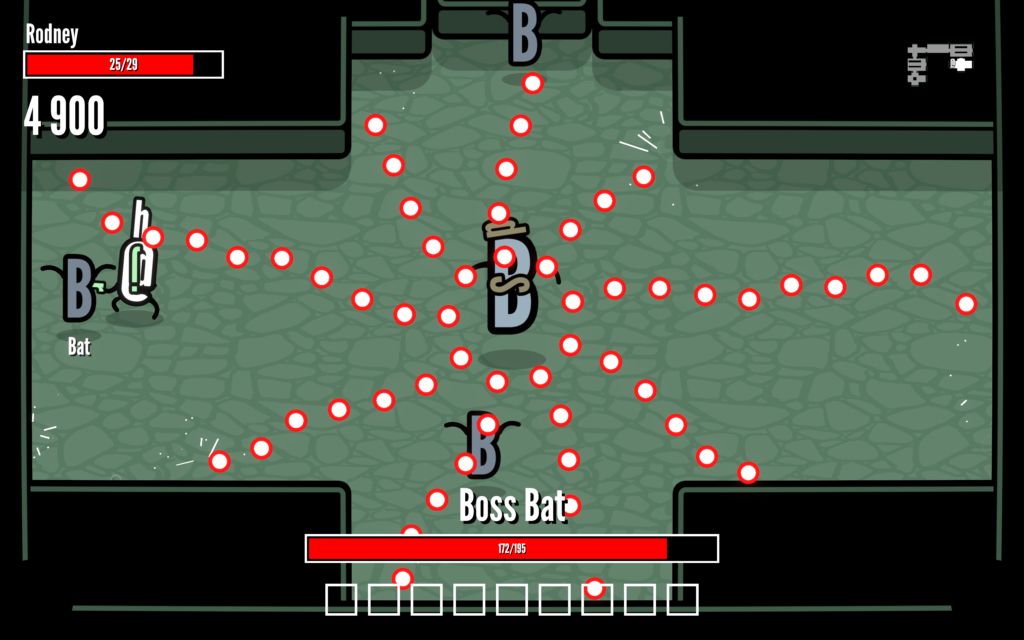
Before too many days the enemies will severely outclass the items you probably have, turning into damage sponges. Totem of Seeding calls itself a bullethellish roguelike, and while it’s only a few enemies that force you to dodge to that extent, you’ll run into them pretty soon, and much more often as the days advance.
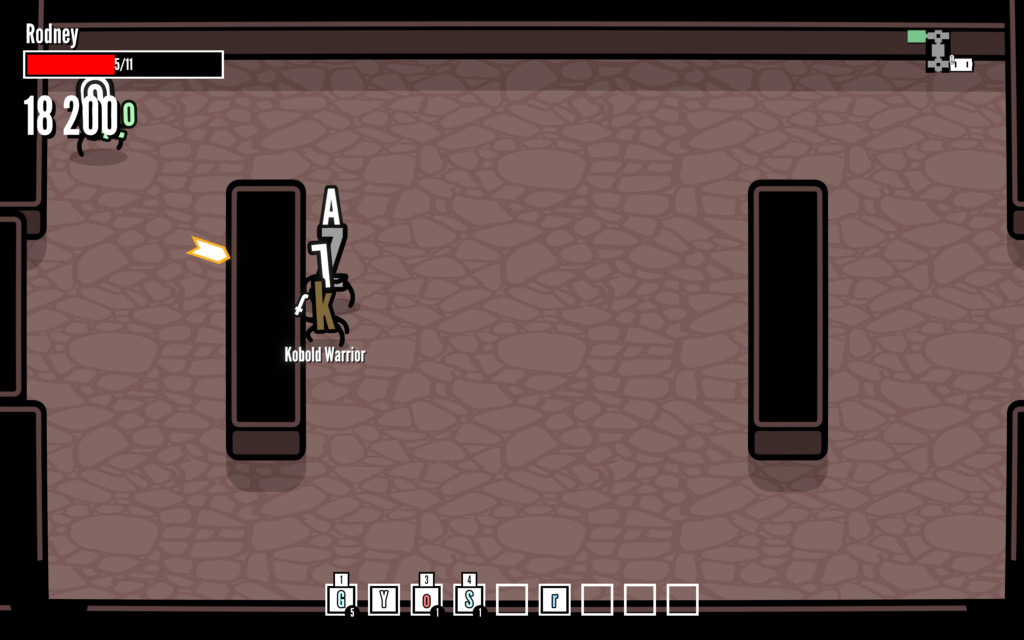
The worst enemies are Skeletons, who have guns of their own; Orcs, who not only have guns but fire lots of shots; and Kobold Warriors, who often dual-wield melee weapons and rush you as soon as you enter the room. The room generator sometimes puts enemies right next to you as you enter, and there’s times when a Kobold Warrior will be right in striking distance as you walk in. This usually ends your run immediately. The play balance could use a little more work, is what I’m saying.
Sometimes you’ll find traders, NPCs who will offer to give you a randomly-chosen item if you give them a different randomly-chosen item, that you’re probably not carrying. Sometimes you’ll find blacksmith NPCs, who will offer to improve a randomly-chosen item you’re currently carrying. Because of this, you’ll often find yourself wielding an upgraded version of the pitiful Pistol you start with. Blacksmiths, in practice, never improve an item in a way that’s noticeable. Once, for me, it made an item much worse, in that it replaced a plus-health bonus it had with a different bonus. Way to help, @-person.
When you explore the last room in a dungeon (the game helpfully provides a map, viewable with the Tab key and with a portion shown in the upper-right corner) you’re told about it, and it tells you then to go back to camp. You still have to walk all the way back for some reason, through the deserted halls. Fortunately travel is pretty quick, and dungeons tend not to be very large.
That’s the shell of the game, a kind of game that’s been iterated upon by many people over 12 years. Now we come back to that Totem.
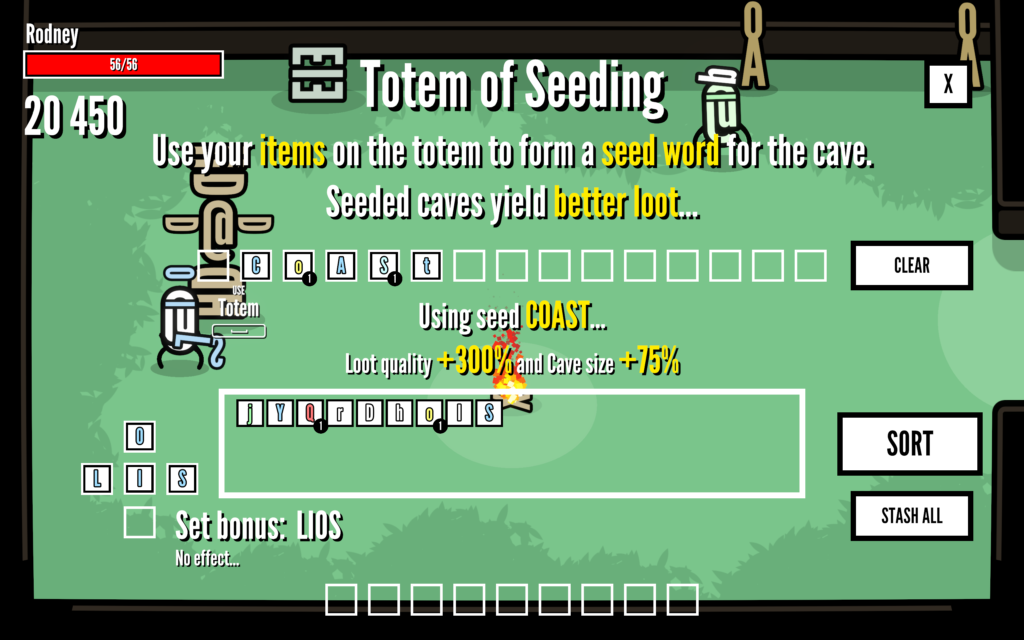
By interacting with the Totem, back at camp, you can pick a seed for the next dungeon you explore. This is the standard kind of random number generator seed that many other randomized games use to let you decide what dungeon you’ll explore. This has been going on since at least Dreamforge’s Dungeon Hack, back on DOS.
There are two complications to the way Totem of Seeding works. First, you can’t use just any numbers or letters in your seed value. You have to use the letters representing the items you’ve found in the dungeon so far the current play. This means your first day of exploration will always be a random dungeon. That three-letter dungeon name I mentioned above, that the game gives to each dungeon you explore, is a freebie seed the game gives you. And using the items for their letters consumes the items. Fortunately, as said before, the game gives you lots of useless items.
The second complication is rather unusual: the dungeon seed you enter must be an actual word. The game doesn’t let you enter just any sequence of characters, even though to an RNG’s stomach they all taste just the same. The game enforces the real-world word requirement regardless.
To encourage players to make longer words, the game’s generator artificially juices the generator the more letters you use in the seed. Seeds must be a minimum of three letters long; if you can’t make a word of that least that length, you’ll have to settle for the standard, anemic generator you’d usually get. You’ll get some items out of it, but unless you’re still on the first couple of days, they’ll probably be useful only for collecting letters for later seeds.
Each additional letter in the seed has a great effect on the next dungeon. A four-letter word gets you rather better items. A five-letter seed got me some items that increased my health to nearly ten times the pitiful 10 health I began with! Longer seeds also generate longer dungeons, so, a better chance you’ll find items with the features you want, and more letters to use in seeds on later days.
One issue with this system is that it makes vowels very important! And as far as item gen goes, not all items are lettered equal. Apples, frequently-appearing consumables that give you a paltry 3 HP when eaten, are the letter ‘o’. The common English vowels ‘e’ and ‘a’, conversely, are not common letters in the dungeon chests.
Because of the way the game monkeys with the loot generation when you seed with longer words, it drives home the fact that the loot generator is being used against you. Its favors are only bestowed on those who appease it with the proper lexical sacrifice. If you don’t feed it good words, it won’t feed you the tools you need to survive. And yet it was that loot generator itself that gave you the letters you have to work with. Due to this fact, some games you’ll just be screwed over. Sometimes you don’t find any vowels in the first dungeon, or not even three letters. A deficit like that will cause your power level to fall behind the advancing difficulty, and it’s unlikely you’ll catch up.
This is a definite flaw. The game could use a little more balancing in its item generation to account for it. But it’s the kind of flaw that I’d find, typically, in a big game, something I’d find on Steam. For a 7DRL, to make too much of a problem like this is grossly uncharitable. It’s a game made in seven days. And by a single person too! Treat it for what it is and you’ll still have a decent amount of fun with it, more than you’d have thought possible under such a design constraint. I look forward to seeing what its developer does with the idea from here.
Each indie showcase highlights the many indie games we play here on the channel. If you would like to submit a game for a future showcase, please reach out.
Owner of Game Wisdom with more than a decade of experience writing and talking about game design and the industry. I’m also the author of the “Game Design Deep Dive” series and “20 Essential Games to Study”