Sundry Sunday is our weekly feature of fun gaming culture finds and videos, from across the years and even decades.
To recap. Ten years ago, Disney hired the Brothers Chaps, creators of seminal Flash series Homestar Runner, to make for them a series of Flash shorts for Youtube and (I think?) broadcast as bumpers, called Two More Eggs.
At that time Matt and Mike Chapman already had a working relationship with Disney working on their shows Gravity Falls and Wander Over Yonder, and it was an opportunity to return to their roots making little shorts in Flash. The Two More Shorts are generally brilliant, and one subseries of them that fortuitously strays just inside the borders of our mandated focus is Eggpo, about two Goomba-like minion characters within a video game. We’ve covered five of the seven episodes so far; check out the Eggpo tag for all of them.
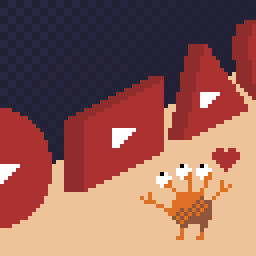
In Eggpo #6: Speedrun (2¼ minutes), our underling friends get invested in the success of a speedrunner blazing through their game.
Blippo+ is a game because it’s presented as a game, it was originally presented on the Playdate, and these days games are defined so maximally that anything could be a game. But there is no gameplay in Blippo+, unless you count the random times the signal drifts, a purely artificial event, and you have to adjust various sliders to make the picture clear again.
Blippo+ is more of a unique means of telling a story than a game. I’m brought to mind of Portal, not Valve’s 2007 weird kinetic puzzle-action game, but Activison’s 1986 even weirder storytelling experience, about exploring a planet-wide information system to discover what happened to its missing inhabitants. In both Blippo+ and (older) Portal, all the “gameplay” is in a system of presenting information to the viewer/reader.
There is a story that progresses through a series of updates. On the Playdate it was timelocked, so it was like it was passing in real time. In the new Steam and Switch versions, the story unfolds more at your own pace; after you’ve seen most of one set you can “download” the next “packette” of shows, but also go to previous packettes whenever you feel like it.
I said shows, because Blippo+ presents itself as the television of a distant planet. I have avoided calling it an alien planet, because it’s really a lot like Earth, and while there’s definitely some unexpected elements (a scientist talks to long-dead inhabitants who are brains in jars) most of it you wouldn’t have been surprised to have seen on Earth TV in the early 90s. There’s a self-centered teen show, an exercise program, an entertainment news show that feels like it’s from the MTV of old, a show with a character much like Max Headroom, and many other callbacks to cable television of three decades past. There’s even a scrambled porn channel, although there’s really no porn behind it, other than “Tantric Computing,” which is but video clips of a lady’s hand lovingly fondling old-style computer mice and monitors.
There’s a show about two space-faring cowboys. A claymation kids show. The “Fighting Trillions” series of action movies, of which we only ever see trailers, narrated by a virtual soundlike of the late, great Gary Owens. (All of the shows have really great voice acting!) A D&D-themed trivia gameshow. The weird Julia Child-like cooking show Snacks Come Alive. And more. One of the shows is just different kinds of static. Another is info cards for local programming. The “Tips” channel is, wonderfully, just a sequence of error messages.
It’s all rounded off with a Preview Guide-style program listing channel, and a Ceefax-like information presentation service that’s somehow one of the most affecting parts of the whole package.
Each show, of about 20 in all, is only two minutes long. It’s easy to load it up and watch the entire contents of one or two of the channels, either intently or as background to other things.
It really needs to be experienced to get the idea across. This collection of first week clips on Youtube (11 minutes) that should demonstrate to you what it’s like.
The Legend of Zelda: Ocarina of Time has a reputation of being one of the “best” games ever made. Professor Brigands of VG101 recently spent around twelve hours making a video walkthrough of the whole thing, even finding every Heart Piece, and even every Gold Skulltula, despite the fact, as they say frequently, that the reward is in no way worth it. Each video is approximately three hours long; maybe you can have it playing in the background while doing other things.
First video (beginning to the end of the second dungeon + extras):
Second video (Jabu-Jabu’s Belly through to the end of the Forest Temple):
Third video (the Fire Temple, the Water Temple and the fetch quest to get Biggoron’s Sword):
Fourth video (The Shadow and Spirit Temples and the end):
Is that not enough? Rival channel U Can Beat Video Games has been churning through all of Final Fantasy VI (a.k.a. III, it’s complicated), having done five videos so far with one left to go, with videos ranging in length between 3⅓ to 4 hours: Part One – Part Two – Part Three – Part Four – Part Five.
Switchaboo on Youtube had a look at video gamethings Nintendo made in the era before people habitually left the spaces out from between words. (14 minutes)
I didn’t know that Nintendo’s first foray into consoles was making a custom controller for the Odyssey (not the Odyssey 2, the Odyssey), and distributed it in Japan. But I do know that Nintendo’s history extends far back before video games, to making Hanafuda and traditional playing cards, and still makes them to this day, along with Mah Jong, Shogi and Go equipment.
The field of electronic entertainment, our self-selected area of exploration, is vast. On one end you have visceral creations that we don’t even bother with, games that are mostly about pointing at people in a virtual world and shooting them. On the other, we have esoteric creations of pure mathematics like Conway’s Game of Life.
How well-known would you consider Conway’s Life to be? By one measure it’s incredibly obscure, in that if you ask a random person on the street if they know about it they’ll probably at best think you’re talking about Hasbro’sGame of Life, a simple board game where players pilot colored pegs riding in a tiny plastic car down a winding road from birth to retirement, a buffet of unexamined assumptions with a long history which itself may be worthy of exploration here itself some day.
But by another yardstick, few games are more well-known than Conway’s Life. It was created 55 years ago, in 1970, by British mathematician John Horton Conway, meaning it’s Older than Pong. It’s not technically just a computer game, but its explorations have grown so huge that practically everyone who cares simulates it on a computer.
When I say it’s a creation of pure mathematics, please don’t be scared off, because it’s really simple to understand. It was a popular subject of Martin Gardner’s Mathematical Recreations columns in Scientific American.
Imagine an infinite grid, a pocket universe that’s like an Excel spreadsheet that goes on forever. Each cell can contain a counter, which is considered “alive,” or nothing, which is considered “dead,” or just empty. From there, you use a simple process to simulate this universe.
You don’t have to worry about physics or gravity or free will. Instead, every counter on the grid with less than two neighbors dies (is removed) due to loneliness; every counter with more than three dies due to overcrowding; and on every empty space with exactly three neighbors is birthed a new counter. By “neighbors,” I mean on one of the eight spaces around it. By “birthed,” I note that reproduction in the world of Life is genderless and trinary.
So that’s how to do it. But why would you? It’s because despite its simplicity, Life patterns grow by unexpected and interesting processes. It’s a case of emergent complexity; like how DNA molecules ultimately produce living creatures in our world, simple origins create hugely complex results. That similarity of complexity to our universe is why it’s called a “game of life.”
A better introduction can be found at this page at Cornell University. It’s a type of cellular automation, a wider field with many game design implications. You could consider classical roguelikes to be a type of cellular automation, although not nearly as simple, or as elegant. Within the world of Conway’s Life there are Gliders, Oscillators, Wicks, Puffers, Guns, Methuselahs, Spaceships and more. While there aren’t physics as we consider them, there is a “speed of light.”
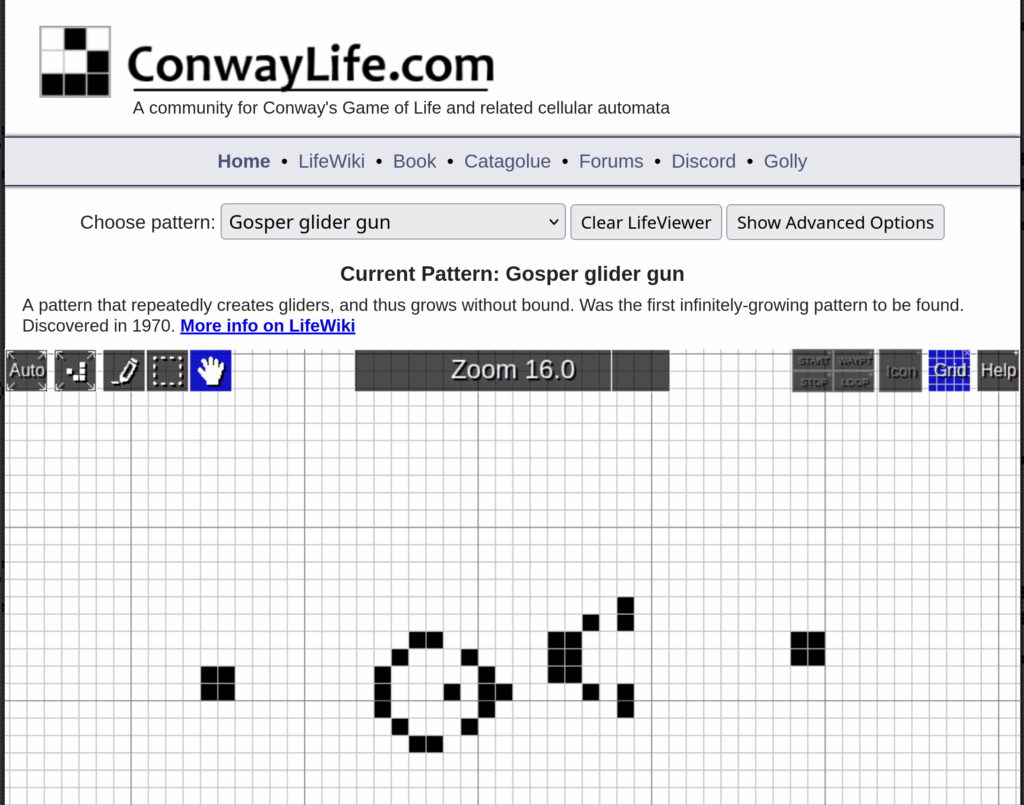
The website ConwayLife.com, created probably some time in 2009, is one of those many websites out there that invisibly hosts active communities that big media sites routinely ignore, the kind of thing that Set Side B carries both a banner and a deep affection for. There was a time where sites like this were a major focus of the World Wide Web, and it still is, even if the wider world fails to notice it. ConwayLife.com hosts a simulator on its homepage, a wiki of concepts, an active forum, a well-populated list of links, and even a Discord.
Please, those of you who read this, try to move your interest in the direction of exploring this strange but fascinating phenomena. Maybe it’ll bounce off of you, but maybe it won’t.
If you know where to look, there are many arcade machine restoration videos on Youtube, whole channels devoted to them. This Halloween-themed video from Electric Starship Arcade is only one of them. It’s mostly about the process of fixing up the cabinet and has very little gameplay, but it does end with a fun sequence where they dress up someone as a vampire and, driven in a hearse, bring him out in a coffin to introduce it! (40 minutes) And if you watch it, it’ll haunt your view history, and influence Youtube into recommending more restoration videos to you, in a suitably spooky fashion. Ooooooo!
Owner of Game Wisdom with more than a decade of experience writing and talking about game design and the industry. I’m also the author of the “Game Design Deep Dive” series and “20 Essential Games to Study”
Soon after release hopes were high for Bubsy. Games like Sonic the Hedgehog and… well… Sonic the Hedgehog 2 had the world convinced that edgy animal mascot platformers were golden, and characters like Aero the Acrobat and Awesome Possum invested our consoles like wisecracking vermin. Bubsy was just one of them.
Robin from 8-Bit Show-And-Tell has mentioned Loadstar, the magazine that I am trying to help preserve with the itch.io version of Loadstar Compleat. I say that just to mention anything that might even be slightly considered to be conflict of interest. There, done. All of this said, this post has nothing to do with any of that!
Before Tiger’s line of cheap handheld mechanical electonic games in the 80s and 90s, there were cheap handheld mechanical wide-up games in the 70s and 80s! These are basically forgotten by most people today, but kids of that age might vaguely remember them, made by companies like Tomy.
There used to be more websites dedicated to uncovering and preserving them. One that remains to this day is the Handheld Museum, which has an extensive listing of Tomy’s titles.
Another place you might be able to learn about them, with demonstrations, is Robin’s video on them. (29 minutes)
Robin shows off a variety of them, including a variety of electric (as opposed to electronic) games. Some weren’t even battery powered, instead having to be wound up via a dial on the back, but all but the last of the games in this video run on batteries. One had to be repaired on camera. The first game is the earliest, a solitaire version of poker, dating to 1971; for context, Pong, the first commercially successful video game, was made in 1972.
It just goes to show that personal gaming was something that existed even before video games. It was something in the air at the time, and even if Pong hadn’t happened (or the earlier Computer Space, or the Odyssey, or even prior games made at universities and laboratories), it seems evident that it would have happened shortly anyway. It was an idea that was bound to happen eventually, and probably sooner rather than later.
This is everything that’s at least half-off in the eShop’s Black Friday promotion this year.
Black Friday has slowly been creeping out over the entirety of Thanksgiving Week, and in its stupidly-named “Cyber Monday” incarnation the week after too. Nintendo’s eShop has begun its Black Friday sale early. Here’s a recap of the items being sold that are at least 50% off. As always, no one is paying for this placement; it’s being offered as a service to our readers. Most of these discounts are set to last about four more days.
Many faces, many sizes
Persona 5 Royal $21 (65% off) https://www.nintendo.com/us/store/products/persona-5-royal-switch/
Star Wars Grand Collection Contains: Jedi Knight II: Jedi Outcast, Jedi Knight: Jedi Academy, Bounty Hunter, Knights of the Old Republic I & II, Episode I: Jedi Power Battles, Episode I Racer, Force Unleashed, Republic Commando $56 (60% off)
And here are a few more notable games at at least an 80% discount. These are not part of the Black Friday/Cyber Monday promotion and may expire sooner.
If it’s not the holidays, it certainly is a holiday, at least for those of us in the US. We’re preparing to load up on turkey, or maybe a vegetarian equivalent. We’re occupied with various other things, so please enjoy this report on some games we’ve been playing.
Of course, Kirby Air Riders has been the main thing for me. I just finished the “true ending” of its story mode, Road Trip, a few minutes ago. It’s bombastic and loud, true, but it was nice to see O², Nightmare and Marx as bosses again, and Galactic Nova, from way back in Kirby Super Star, make a return as part of Kirby’s weird lore. For a series originally about beating up a penguin with royal pretensions because he took everyone’s food, Kirby’s certainly killed a lot of Cthulhus.
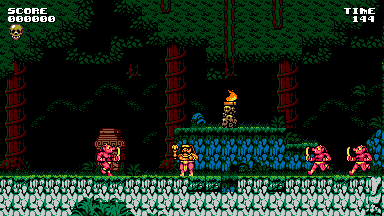
Rakshasa from UFO 50, screenshot borrowed (because of laziness) from syltefar.com.
Now that my excuse to talk about that again is out of the way, I’ve been playing more of Party House and Rakshasa in UFO 50. I’ve already said enough about Party House, and I’m working on a revision of my strategy guide; Rakshasa is also something that should have some things said about it, a very short, very hard take on Ghosts & Goblins with a spicy Indian flavor. It’s a game that revels in randomness, and it’s easy to get overwhemed if you don’t stay on your toes at all times. I actually think its big gimmick, that you don’t have lives, but instead must complete a minigame when you perish, of escalating difficulty each time, to be one of the less interesting things about it.
Besides that, I’ve been working my way through Dragon Quest III 2D-HD, which has some quite major design differences from the Famicom/NES game from 1988. Lots to say about that too—just, later. (BTW, if you think using em dashes means something is written by an “AI,” well, I won’t have much kind to say to you about that belief. Please read better writers.)
And then there’s Blippo+. (trailer above, 1¾ minutes) Published by Panic, who also published Untitled Goose Game and Thank Goodness You’re Here!, and first released for Panic’s little portable system that could, the Playdate, Blippo is simply a pitch-perfect rememberance of 90s TV, although as experienced on another planet. It has weird indulgent kids TV (“The Boredome”), classic MTV-style news programming (“The Rubber Report”), D&D-themed fantasy gameshows like from the UK (“Quizzard”) and even a scrambled porn channel, not real porn, but with a sexy lady’s hand caressing mice and monitors (“Tantric Computing”). It’s wrapped up in presentation that kind of looks like adjusting a satellite receiver, and all the shows are like one minute long. It’s weird, unexpected and fun, like everything else Panic makes.
Statue’s most recent focus has been Mechabellum, because as they told me, “I like games that trick me into doing math.” I think one could say that all turn-based strategy games are doing math in one form or another. Math is weird that way.
In addition to all the games they play to review on their Youtube channel Game Wisdom, GWBycer has been playing strategy game Phoenix Point, and its mod Terror From the Void. I didn’t know anything about it until I saw his message about it. Lot of strategy floating around in the air, with Air Riders thrown in to cut it with pure chaos.
File this under blasphemous acts of hackery, reported on by Video Game Esoterica (Youtube, 10 minutes) and Time Extension, a super-deluxe techno-nuts person going by malucard is trying to port Super Mario 64 to the original Playstation. They have a GitHub repo containing their efforts so far.
The growing number of fan-made decompilations of classic games is what make these hilarious affronts to the very idea of console exclusivity possible. But while ports of such games to PC platforms allow for much greater visual clarity and the resolution of long-standing deficiencies, this is almost a celebration of the idea of technical limitations—and I, for one, am all in favor. But you have to understand, I’ve given serious thought to the idea of picking up an old CP/M machine and coding on it in assembly. I’m crazy pants, is what I’m saying, and on things of this nature you probably shouldn’t be listening to me.
Just look at the footage in that video, and how it’s more glitch than game. It seems impossible that it’ll ever run like the N64 original, but we can dream, can’t we?