The Final Fantasy IV Door Stack Glitch

The Final Fantasy series is loaded with bugs throughout. A full recounting would be much more than a longpost’s worth, but here is a quick description of one specific example, from Final Fantasy IV (originally II in the US, but most people now will probably think of it by the Japanese numbering anyway).
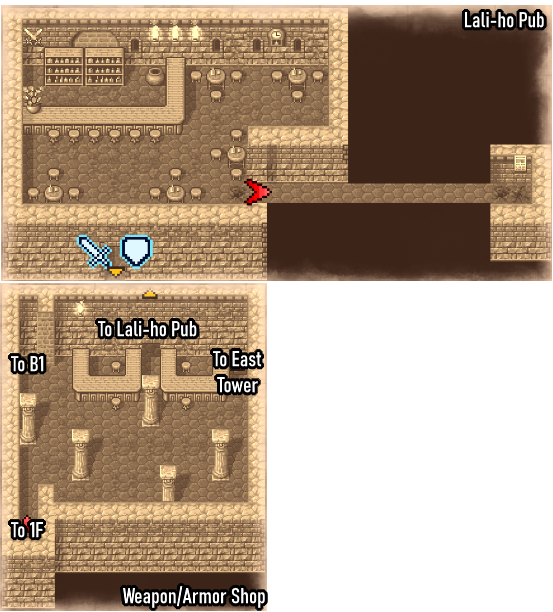
The door to the pub is push-type, potentially causing Problems.
Image from mynockx’s guide on GameFAQs.

Some RPGs, instead of coding area transitions all as a sequence of doors and destinations, instead use a form of stack to record where the player was when they entered the door. “Stack” here is a term from computer science, a data structure consisting of a region of memory and a pointed within it. Data can be “pushed” onto the stack, which means putting some number of bytes onto it and advancing the stack pointed by that number. Stacks can “grow” either up or down, meaning when the pointer advances, it’ll go in that direction. When the data is needed again, it’s read off the top of the stack, then the pointer is pulled back to its original position.

So how the door stack works is, when a player enters a location, say enters a town from the overworld, their location before entering is “pushed” onto the stack and they are then moved into the town’s entrance. When they exit the town, their old location is “pulled” from the stack, leaving it empty. (Actually, the data is still there, but because the stack pointer has been decremented, it’ll be overwritten the next time the player enters an area.)

Why use a stack? Well mostly it’s a convenience thing for the programmers. A door’s location can either be “into” an area, or “out of” it. “In” doors have to know where they’re going, but “out” doors just have to know they’re going outside. But it helps in one particular instance; if a game has a spell or item like “Exit,” “Outside,” or “Warp,” it can work simply by pulling every location off the stack until it gets to the last one. This means the programmers don’t have to have every location “know” where a given area is on the World Map. Just rewind the door stack until you get to the last location on it, that must be it.

Well there’s a subtle bug in some locations in Final Fantasy IV where some transitions that push when they should pull. One such transition is the one to the pub in the Dwarven Castle. When you enter the pub, the way in is pushed onto the stack; when you exit, instead of pulling that location off, the way out is pushed onto the stack.

There’s only so much memory reserved in a stack, which for old games is usually implemented as a single page (256 bytes) of memory. The pointer into it is thus one byte long, and so if the stack fills up, it wraps around. If you find such a door, and go through it enough times, you can cause it to overflow on purpose, with unexpected results.

This can be taken advantage of in Final Fantasy IV by overflowing the stack, then going through a pull-door, which causes the game state to be read from unexpected memory. Speedrunners (you just knew they’d be involved) use this to flip rapidly to the end of the game. Most players will never notice this very subtle bug, since when you return to the world map the game knows enough to completely clear the stack.

Something I’ve noticed about the 8- and 16-bit Final Fantasy games is, if there is a potential for an obscure bug somewhere, there is almost certainly going to be an example of that bug somewhere in that code. A lot of these bugs are only visible to a player with obsessive observation or repetition. This results in spells with unexpected effects, stats with no function, features that don’t operate, and item duplication bugs. Truly, it was an age before unit testing.

Final Fantasy Wiki: 64 Door Hierarchy Glitch

1,000 Blank White Cards and Dvorak

We’re getting into some weird elements of electronic gaming here, in the form of games that are not actually electronic, but spread amongst the World Wide Web. These are two similar games that became semi-popular-ish, relatively speaking, in the naughts.

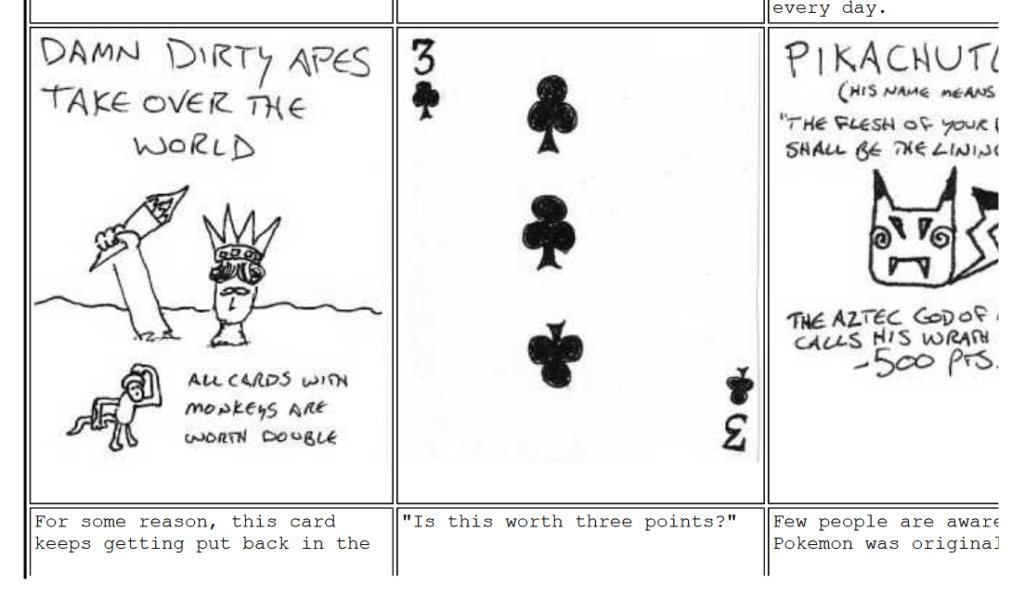
Sadly, Pikachulu’s (?) card is cut off in this archived version. Nice rendition of a playing card though.

To play either, you need a deck of blank index cards, practically-speaking at least two available friends (the more the better), writing implements for everyone, and some quantity of alcohol also helps. It technically can be played by only two people, but they’re both party games, and two people makes for a rather poor party.

1,000 Blank White Cards was one of the victims of the shutdown of Geocities (R.I.P. 1994-2009), that bastion of early web culture, or whatever substituted for it. These days Neocities is a useful replacement for it, and really deserves its own post, but that’s neither here nor at a spot roughly 30 feet from me that I’m going to call “there.”

An archive of the site in PDF form was saved by someone in academia and can be found here. Warning: contains edgy early-internet comedy. Content warning for mentions of tentacle rape, ass thorns, Hitler as a car mechanic, and a crude drawing of someone simultaneously experiencing diarrhea and vomiting. You had to have been there, but in retrospect, you’re better off for not being there. None of it is intended seriously at all. It’s exactly the kind of vibe Cards Against Humanity goes for, for whatever that’s worth, although crucially you don’t actually have to play it that way, and index cards tend to be cheaper.

The point of both 1,000 Blank White Cards and Dvorak is that you customize the game as you play, building a deck for your group that grows larger the more times you play one of them.

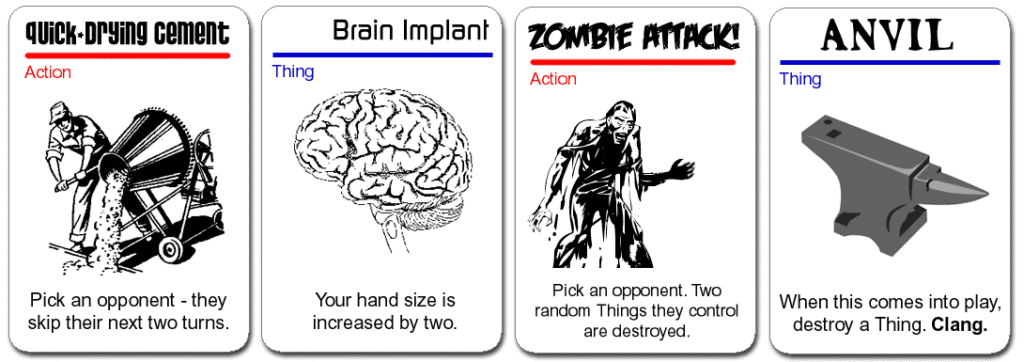
Dvorak example cards, from the website.

Both games involve people drawing upon their inner Magic: The Gathering designer, and both making up and illustrating cards. 1KBWC is the sillier of the two, but Dvorak seems only slightly more serious. Both games lend themselves to cross-referential cards, like the one in the first image that refers to other monkey cards. It’s possible to get really complex with cards (“All cards with an L in the name have all the numbers written on them effectively doubles for the rest of the game, if it’s a weekday.”) but that seems like it’s going against the spirit of the play. If a particular kind of card in the Permanent Deck turns out to be really powerful, it’s just begging for someone to take it down with a later card, so games like these tend to be self-correcting over time.

1,000 Blank White Cards (PDF archive) – Wayback Link – Surviving Mirror

Dvorak Wiki: Rules

Sundry Sunday: Crash Bandicoot In Japan

It’s Sunday! Time to electrocute your brain with more game-related video weirdness. Electrodes at the ready!

In Japan, it seems, Crash Bandicoot has a completely different, and extremely earwormy, theme song. Well in the Japanese release of Crash Bandicoot 2: Cortex Strikes Back, if you hold Left, Circle, L1, and L2 when the Playstation logo appears, you get this entertainingly bizarre karaoke video showing off a long version of the theme, featuring Crash doing a signature dance move, cavorting with ladies in nightgowns and bikinis, and getting blown up by a jetpack, all right and proper activities to be had by an anthropomorphic marsupial.

The song also featured in commercials for the games in Japan. As an extra, here is a (very badly compressed) compilation:

There’s a more video weirdness concerning Japanese Crash Bandicoot, but let’s save that for later….

Find The Spam

Find The Spam is an internet legend at this point, like zombo.com and Homestar Runner, although it’s much less well-known. It is a game, sort of. It is fun to play, for a couple of seconds at least. I won’t spoil any more, go see it now.

You could see it as a riff on hidden object games, although it predates them by two decades. While the Wayback Machine‘s earliest archive of the site is from 2001, it already had over 1.3 million views by that point. My own recollection is of seeing the site on a Windows 3.1 installation, meaning it may go as far back as 1994.

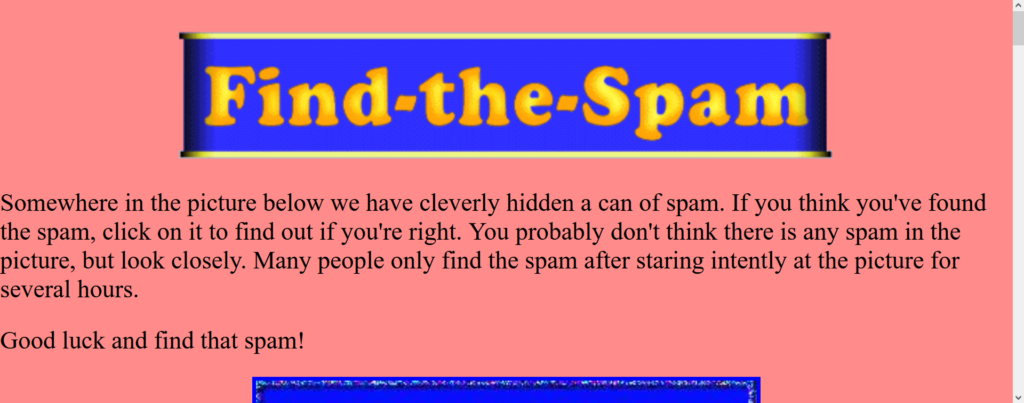
A recreation showing how the site would have been presented at the time.

The joke is slightly ruined on current machines. Viewed on older graphics cards (with resolutions of 800×600 or even less) the user would have to scroll down a little to see the image, and so would have time to read the intro text before it is revealed. Weirdly, on my Samsung tablet even more of the page is visible on first load, the screen seems positively anxious to spoil the joke for me.

By the way, can you tell I’ve been on an early web binge lately? You can expect more old-timey game sites in the near future….

Find The Spam

Zelda Classic & ZQuest

It’s hard to believe that Legend of Zelda fangame construction system Zelda Classic and ZQuest is 23 years old. Many such systems have fallen by the wayside during that time, but Zelda Classic continues on. Its first versions were made for DOS, but it continues to see improvements to this day.

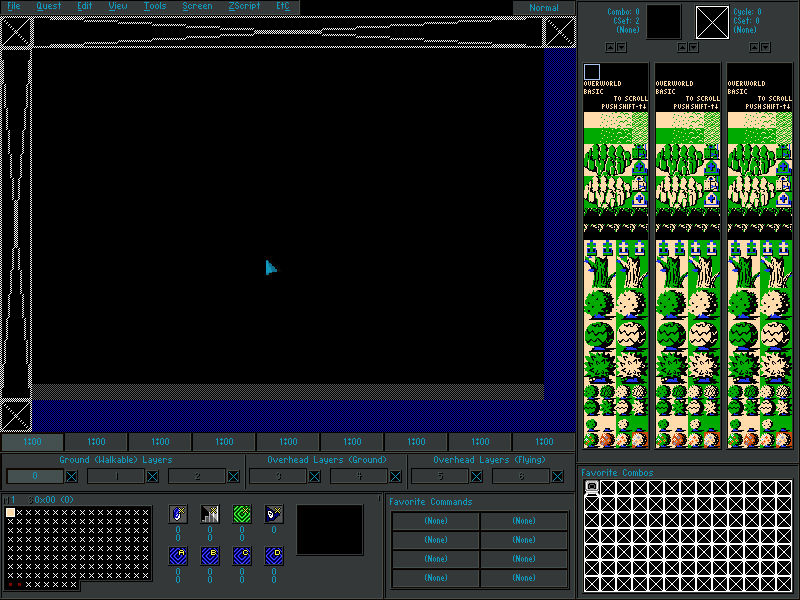
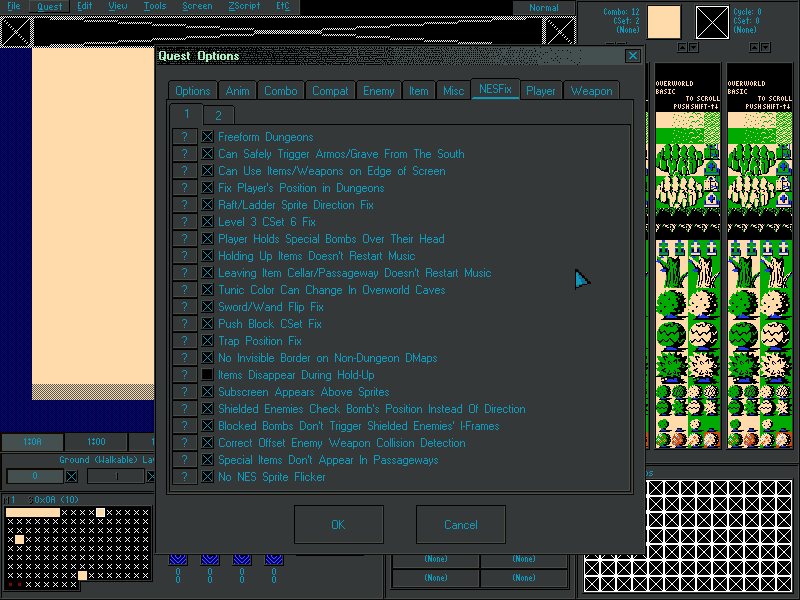
ZQuest has this weird interface where they rolled their own controls for everything. The dev system seems to be rendered in Allegro.

Zelda Classic and ZQuest are made specifically to make overhead view action-adventures in the Legend of Zelda style, to the extent that it has graphic sets taken directly from the games and many items that work like their console counterparts.

It even simulates many of the quirks from the various Zelda series titles. And yet, it doesn’t require you to abide by them. Pretty much every technical or creative limitation of the 2D Zelda series has an option to disable it if you like, but if for some reason you consider it intrinsic to the experience you can keep it too.

The graphics can be completely changed out. With it, you can make a game that doesn’t look anything like a Zelda title, which I suspect is why it’s been able to survive 23 years in a legal landscape overseen by a Nintendo increasingly draconian in its approach to guarding its intellectual property. Still, it’s pretty heavily aimed at making Zelda fangames, right down to having pages and pages of checkboxes for every known quirk of Zelda engine behavior.

Look at that gloriously pedantic list of quirks! The ZQuest developers are awesome.

While it does offer a scripting facility (which it’s difficult to find documentation for), ZQuest is mostly a construction set type of program. You place tiles and enemies, lay out overworlds and dungeons, decide what items to include, and go. The program itself has little in the way of documentation but the site has a tutorial that should help one get started. I strongly suggest, if you are interested in creating for this system, that you read it.

Fan projects going on for this long suggests a kind of mania, but the ZQuest people are serious. They even forked Allegro to fix bugs and adapt it for their purposes. May they keep it going for another 23 years and beyond.

Zelda Classic & ZQuest

News: 8/8/22: All Hail Raytheon

“We scour the Earth web for indie, retro, and niche gaming news so you don’t have to, drebnar!” – your faithful reporter

At NintendoLife, Alana Hauges notes a dispute between Corecell, developers of AeternoBlade II, and publisher PQube. It’s all a bit tl;dr, and that isn’t helped by the decision to put PQube’s lengthy response up front, undercutting Corecell’s arguments before we can even read them. In summary, Corecell claims PQube didn’t pay them for milestones, and PQube claims Corecell was unresponsive to their requests for fixes and offered to return rights. I mean, it’s rather they-said/those-others-said, but I note that PQube’s bring up the game’s poor sales, an irrelevant issue at best, is bad form. But we’re all busy blobbies and hey, here’s the next article.

“Here at Raytheon, this guy looks thoughtfully at this small bottle, no doubt full of some radioactive isotope or deadly poison. Notice our ‘Social Impact’ submenu, see we’re not evil!”

Even more depressing news, PC Gamer’s Ted Litchfield tells us that Girls Who Code, a non-profit dedicated to helping women get careers in the tech industry (good) was participating in a mentorship program set up by US arms manufacturer Raytheon Technologies (awful).

In more entertaining news, Vikki Blake at GameRadar mentions that Halo Infinite players have managed to discover a way to force a split-screen multiplayer for that game.

Isaiah Colbert writing for Kotaku informs us that Nintendo’s ending the gacha elements in their mobile game Mario Kart Tour. I’m glad to see this scourge of gaming slowly wane. Instead, players will purchase unlockables directly instead of hoping for lucky draws.

From Konami, resting on their late 80s/early 90s laurels for literally decades now!

Bryan at NintendoEverything has an interview with Chris Kohler of Digital Eclipse and Konami producer Charles Murakami about DE’s collection of 13 classic Teenage Mutant Ninja Turtles games. Digital Eclipse consistently does such good work these days and it’s a good recounting of the highs of the package and the work involved in bringing it to us.

“This guy is helping us put a tiny portion of our tremendous military profits into these boxes to feed to poor people. We’re actually good!”

Masahiro Sakurai’s Game Design Series

Sakurai’s fifth video, on frame rates.

A lot of the gaming web has been fawning over Kirby and Smash Bros. creator Masahiro Sakurai’s design videos. I haven’t had the chance to look at them yet, but they look interesting at least. They’ve been coming out at a good clip, like one every two days.

Sakurai’s star is so high right now, that it’s worth noting that (going by memory) he left Nintendo with a bit of a cloud over his head, after Kirby Air Ride was seen as something of a failure. Nowadays KAR (nice acronym!) is seen as an underrated classic, and I have put many hours into its City Trial mode, which is terrific, a tiny open-world high-speed racing/party game. More people should have the chance to play it; it is unique, which is something I can’t say about many other games. While the 3DS version of Smash Bros. has a mode inspired by it, in versus mode human players cannot interact with each other during the exploratory portion of the game, which harms it somewhat.

At the height of his abilities, Sakurai can make really interesting and new kinds of games, like Smash Bros. was, and like Kirby Air Ride and (the sadly neglected these days) Meteos are. It’s a shame that Smash is so popular, one of Nintendo’s biggest tentpoles, enough to crowd out his other work. I’m really interested to see what the next crazy idea he comes up with will be!

Sakurai’s Game Design Videos, on YouTube

RenoProject.org: Documenting Habitat and its descendants

Long, long ago, three full ages before Zuckerberg’s doomed Metaverse, there was Lucasarts, formerly Lucasfilm Games, and Maniac Mansion, and the SCUMM engine.

Lucasarts went on to have a long legacy of adventure games, and while it’s gone now and most of its progeny is owned by some mouse creature, it survives in a number of forms, like the upcoming Monkey Island re-revival.

Another legacy of Lucasarts and SCUMM is what is possibly the first graphical MUD, called Habitat.

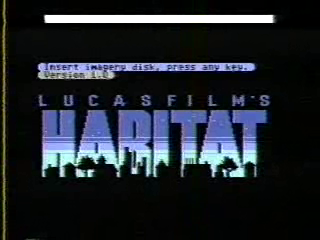
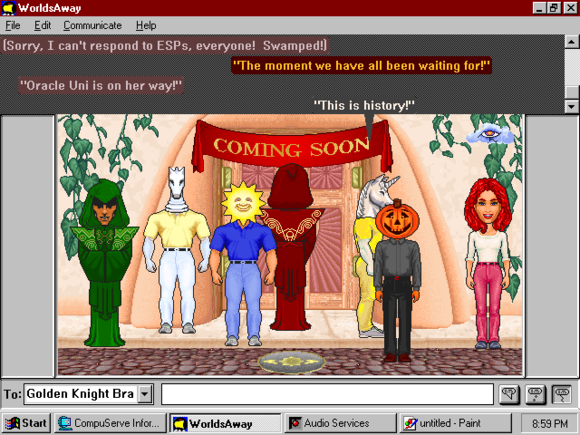
Even though it’s blurry, it deserves the head spot on a blog post, just one more time.

What? You don’t know what a MUD is, or a MOO or a MUCK? A lot of knowledge is in danger of being lost, but we don’t have time to remind you of rudiments here.

Habitat was an early experiment in online communities, a server-based virtual world whose clients were Commodore 64s. In appearance it looks a whole lot like a multiplayer version of Maniac Mansion.

It never went public, but did eventually become a paid feature, in modified form. on the C64 online service QuantumLink under the name Club Caribe. Then, with the wane of the Commodore 64 as a viable platform, QuantumLink closed their servers and rebranded as America On-Line, a.k.a. AOL. And that is not only history at this point, but ancient history. Read more about it here.

While there was still competition in the dial-up online service space, two creators of Habitat, Randy Farmer and Chip Morningstar, partnered with Fujitsu to have another go at a Habitat-style service, this time called WorldsAway. They partnered with AOL competitor CompuServe, and didn’t do badly for a while.

There’s all kinds of things to talk about here, and I have rather more knowledge than most because I was involved with this, I was volunteer staff at the flagship WorldsAway world, called Dreamscape. I was a participant in the CompuServe forum before the main service even opened, I spend an entire night on the phone as a teen, our old 486DX running Windows 3.11 downloading the client software.

WorldsAway was basically my life for a few years. It could be incredibly addicting, and spirits were high in the early days. There was a feeling of being at the forefront of something. The Internet was just starting to become really big. Who knew what it would become?

What happened to WorldsAway is a story, one that I’m probably not qualified to tell. I know there were problems with business management even from the start. The world staff was constantly said to be fighting with higher-ups, who wanted to cheapen or diminish the project. In size, certainly, the initial world Dreamscape never got anywhere as large as what we hoped for. Even compared to the size of its Commodore 64 predecessor Club Caribe, it was pretty small.

It’s said that they were a west coast operation, and many of their staffers were queer. One of the eventual spinoff worlds that WorldsAway would spawn was explicitly queer-friendly. Given the successes and continued struggles of queer-friendly media on the internet today, I feel like WA’s acceptance of alternate lifestyles should probably be better known.

I still have a couple of friends from those days. Others I’ve sadly lost touch with. A few friends from that time, notably Tiggles, Esme, and Rosaleah, have departed our physical world as well. Maybe some comfort could be had in the idea that maybe they’re users in some higher-order reality, who may have logged-off of our world, but are still out there in a more profound form. If they’re out there and somehow seeing this: please spare a thought for me. I’ll be back out there some day.

The Reno Project is a website devoted to preserving as much of those early projects, those ancient times, as possible. You could immerse yourself in the screenshots there, and dream of a past era that barely was. One of its competitors at the time, which is a bit better known today, is The Palace. One other service that still exists that competed with it is There, although good luck making an account (I tried). And Second Life of course continues to chug along. All of these things seem to me like more worthy projects than Zuckerberg’s latest progeny.

VGDensetsu: The Work of Yōichi Kotabe

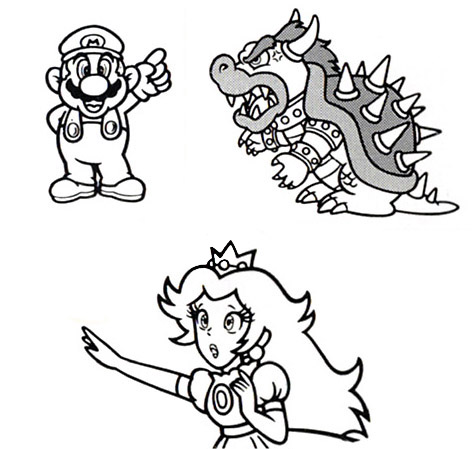
VGDensetsu hasn’t appeared in these pages yet and it’s high time we remedied that. This particular link is to a five-part series about an animator who switched careers to doing illustration for Nintendo, and played a major role in determining the look of many of their most popular characters, including Mario and Link.

Mario characters influenced by the work of Yōichi Kotabe
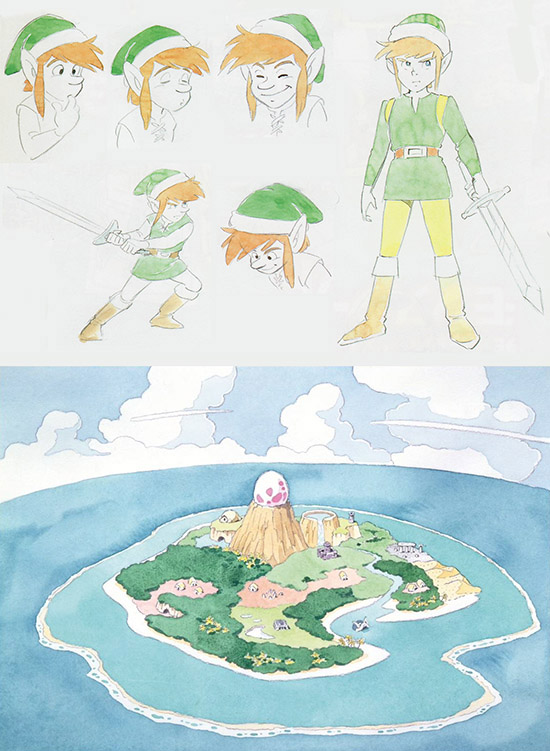
While often at the time illustrators went uncredited, it’s considered likely that Yōichi Kotabe did these illustrations of Link from Zelda II, and the island of Koholint from Link’s Awakening.

VGDesetsu: Yōichi Kotabe — 60 Years of Animation and Video Games
1. The Toei Era – 2. From One Studio to Another – 3. From Animation to Nintendo – 4. Diversification and Transmission – 5. Towards New Horizons

Sundry Sunday: The Adam West Cutscenes in the Golden Nugget PS1 Game

Its Sunday! Another week in the books! You made it. So, here’s a weird video something you may enjoy.

On the original Playstation there were a lot of games release, some good, some bad, and some rather strange. Since games were released on CD, there was a lot of space for full-motion video, and sometimes that allowed developers to build in some silly extras.

That’s what happened with the Golden Nugget game, a fairly standard gambling sim that was elevated to sublime levels of wackiness by its video clips. It’s a fairly standard shoehorned-in story, about a computer chip that allows one to win games of chance somehow, but then Adam West shows up, as “Mr Swayne,” starts Adam West-ing, and suddenly, you’re watching comedy gold.

There’s a lot of other-character-acting to wade through to get to Adam, so you’ll want to skip forward to 8:10 to see his first bit.