It’s true. It’s meant for things like WiFi login pages and displaying online manuals, but it doesn’t have a field for entering URLs yourself.
Seems unfair to me, but I suppose they thought everyone has a smartphone these days. (Until recently, I didn’t!) And I understand the web browser was a persistent security hole for the Wii-U. So while they include a web browser in the Switch for those reasons, it’s locked-off from the users. It’s still a security risk, mind you.
Now, a weird thing about the Switch is it’s multitasking system. The OS reserves a large portion of its memory for an “applet.” This is one of a number of system programs intended to provide a number of services to the user and running game software. Each of the round button options on the Home menu starts up an applet. The eShop is an applet. The system keyboard is an applet. And the web browser is an applet.
One thing about the applets is only one can run at a time! Games can actually run in the background while the Home menu and an applet are open, but if a game calls upon the system keyboard to enter text, then you go to the Home menu and open something else, the keyboard will stop. When you return to the game, it’ll have to be restarted.
Sundry Sunday is our weekly feature of fun gaming culture finds and videos, from across the years and even decades.
It’s a little old, but we do claim here that sometimes we’ll post things that are decades old. This one’s only five years of age.
It’s an animation of audio from a (adjusts glasses) “Kirby drama CD.” I don’t want to image what the rest of it is like, but this part at least is funny and adorable and pretty much keeping in Kirby’s character of being enthusiastic about everything. It’s only 45 seconds long:
Who set up Popstar’s phone service? This seems to be a land line! Did Waddle Dees build it? Did they contract it out to Magolor, who has set up a network of satellites Starlink-style? Did King Dedede pay for it? Is it a naturally occurring phone system? Who the heck knows, poyo!
Games From Scratch is a prolific Youtube channel dedicated to helping solo and small team gamedevs with tutorials and tools. They really do post frequently, so if I linked to everything they made it’d overwhelm the blog, but it’s been a while since I referred to them, and they just made a nice omnibus video of free tools. There is a sponsored section in it, but if that kind of thing bothers you I suggest using the browser extension SponsorBlock, which shows time-wasting sections on the Youtube timeline in different colors.
Well, there’s been another Nintendo Direct, yesterday it was. And while there wasn’t much news on the Switch 2, one of the announcements was that there will be another Nintendo Direct on April 2, in just five days, about it.
The presenter this time was (check Wikipedia) Senior Managing Executive and Corporate Director Shinya Takahashi. He has some charisma, but we’re still a long way from the days where Shigeru Miyamoto, Reggis Fils-Amie and Satoru Iwata would co-host, one time as puppets.
Sometimes I take one of these videos and I riff on the games revealed, and the specifics of their revelation. To remind: the narrator’s delivery style gives me a rash, so I’ll try not to bring that up for literally every trailer. Operation 2025 Snark Go (37 minutes)!
Cold Open: Dragon Quest I & II HD-2D Remake
After DQIII, these couldn’t be far behind, but it looks like substantial new content has been added, including a new character? The mainline series has been dropping references to the old Erdrick (a.k.a. Loto) games, maybe this connects to that?
Nintendo Direct for Switch 2 coming April 2
We already explained about this. I don’t know why they didn’t just pile it all into a single video, but it isn’t like people are going to miss out on the news.
No Sleep For Kaname Date – From AI: THE SOMNIUM FILES, from Spike Chunsoft
It’s a visual novel style mystery adventure from the people who brought us the Mystery Dungeon series. Of course, they’ve made lots of visual novels, but in my view that distracts from them making more Mystery Dungeon games. I’m a bit upset by the news that Shiren 6 sold like one-tenth what it has in Japan. What gives, y’all? Show them some love!
RAIDOU Remastered: The Mystery of the Soulless Army, from Atlus, out June 19
Atlus’s turn to make a Very Japanese Game. This one is a remake of a Playstation 2 entry in the Megami Tensei series. It stars a mystery-solving apprentice detective who can also summon devils to help him in turn-based battles. If he can summon devils, one is given to wonder, what does he need the trainee detective gig for? I guess consorting with the Underworld doesn’t put food on the table.
Shadow Labyrinth, from Bandai Namco
Those two games are fine, not my usual thing but I recognize their merits. But this one, I don’t know….
I feel like, for the most part, Bandai Namco doesn’t really know what to do with Pac-Man. Well, I can tell them what to do: make more Pac-Man Championship Edition! It’s that easy, oh and also police their high score tables much better for hacked plays, Pac-Man CE 2’s scoreboards are overloaded with impossible scores. Or else, maybe more Pac-Man World games? Getting their ducks in a row with GCC and getting back the rights to Ms. Pac-Man? Instead we have one of the least necessary games we’ve seen in many a generation: the dark and gritty reboot to Pac-Man.
“With your memories gone, you have been summoned to a strange, unfamiliar world… where you’re greeted by a yellow orb known as PUCK.” Oh brudder, ignoring that we’re talking about Pac-Fucking-Man, that’s three hoary game trailer clichés in one sentence!
“But who is this spherical stranger?” ITS PAC-MAN. ITS OBVIOUSLY PAC-MAN. EVEN IF IT ISN’T PAC-MAN FOR LORE REASONS, IT’S PAC-MAN.
“Moored in a mysterious, maze-like world…” AUGH “…your battle for survival begins.” The narrator is giving me a rash again.
“Experience a dark twist on the iconic Pac-Man…” JUST GIVE US PAC-MAN CE 3. THAT’S ALL YOU HAVE TO DO NAMCO. Sincerely, someone who’s gotten in dozens of hours of every previous Pac-Man CE game.
Patapon 1+2 Replay, from Bandai Namco
Ah, this actually looks interesting! But wasn’t Patapon a Sony thing?
You guide a tribe of primitive shapes with big eyes through a rhythm-based battle game. You give orders to your troops by tapping different buttons in the right rhythm, and their attack power comes from your timing. The original Patas-pon were PSP games, and the Switch is kind of like a PSP in its way. I’m still surprised this isn’t on a Sony platform though.
Story of Seasons: Grand Bazaar, from Marvelous
Another Harvest Moon, this one for the Nintendo DS, given a trademark-unencumbered remake on the Switch. Predictably, you play as a young farmer trying to make a place for themself in a new town, growing their suspiciously large vegetables and milking their hippo-like cows. Eventually they can hook up with one of several eligible spouses, giving it the veneer of a dating sim.
It’s a formula that Stardew Valley more-or-less perfected, and Harvest Moon went to the well so many times that I wonder if the features are just permuted in different ways now, but the series has a lot of fans and they’re pretty amiable.
Metroid Prime 4: Beyond, from Retro Studios and Nintendo, some time in 2025
A lot of people are looking forward to this one, and we finally have some substantive information on it. In this one Samus gains yet another new suit, what is it five by now (how does she pee in those things?), and psychic abilities. Samus is already a super-powerful cyborg wearing a power suit with a half-dozen kinds of deadly beams, can inexplicably roll up into a ball, and can basically fly in some games. Now she can move things WITH HER MIND too? When she inevitably loses her power suit at some point during this game, will she get to keep her mind powers?
The problem with the Metroid series is, the most intersting thing about them is Samus, but the title is “Metroid,” so Metroids have to be in every game. Samus could carry a game that doesn’t have anything to do with Metroids! I mean, the main antagonists are called, just, “space pirates.” They don’t even have a name as a race! There’s been hints that the main series will stop featuring them, although what it’ll be called in the future isn’t clear. Anyway, there’s a creature like a Metroid in this one, so I guess they’ll have at least one last hurrah.
Disney Villains Cursed Café, from Disney Games, out now
My eyes are nearly rolling out of my head. It’s another attempt by Disney to take some trend and wring lucre out of it using their IP. This time it’s a small business sim, where you serve Disney villains “potions.” You’re a “potionista.” Since it’s an excuse to throw together characters from vastly different properties it has some crossover comedy potential. Ursula and Maleficent hang out around with the likes of Captain Hook and Cruella DeVille. You get many different kinds of evil all thrown together as if they were the same thing.
You buy your ingredients from Yzma, from The Emperor’s New Groove, which I think is kind of unfair. While later elaborations upon its milieu make her more of a villain, in the original movie she’s more of an anti-hero? Kuzco, as an uncaring emperor trying to tear down Pasha’s village, was the real villain, and Yzma’s plotting against him was arguably in service of the Inca kingdom.
Gaston is your assistant in the game, which raises the question… how evil are you? Are you planning on taking over the Disney world? Or maybe, Disneyworld?
Witchbrook, from Chucklefish, available Holiday 2025
Chucklefish, a publisher that consciously adopts pixel art as a theme, has a number of successful games, including Starbound and Wargroove, but their best-known game is one they no longer publish: Stardew Valley. Witchbrook looks like it has similarities, although it applies its grid-based aesthetic to a pseudo-Harry Potter setting. But it’s got the romancin’, and the four-player co-op’n. And given how J.K. Rowling has succumbed to Internet Poisoning lately, a game in that kind of universe that isn’t so tainted with anti-trans rhetoric will probably be welcome, if the very idea hasn’t been ruined by its association with her.
The Eternal Life of Goldman, THQ Nordic
The always-breathless narrator explains: “Action, adventure and arcade games await!” Arcades figure not at all in this title though, which is mostly a platformer with a hand-drawn look. “Set off on a fantastical mission to eliminate a mysterious deity in this hand-drawn platforming adventure you’re explore an expansive archipelago where nightmares and wonder collide!” You’re describing a video game, that’s like half of them! Other than the admittedly charming artwork, we just don’t know much about this one.
Gradius Origins, from Konami, August 7
ARGH the narrator pronounces it “gray-dius!” It’s “grah-dius,” I continue to insist! GRAH-DIUS!! I can accept a short A, but never a long one! The included games are the arcade versions of Gradius, Salamander, Life Force, Gradius II, Gradius III (oh frog) and Salamander 2. Shown off is the fact that Gradius III has multiple versions, which is welcome news since the original arcade release is infamous for its length and difficulty. The whole series also has terrific music; hopefully there will be a jukebox mode for players who can’t take G3’s infuriating gameplay.
The collection also includes a new game, Salamander 3! Okay, I have to get this now.
Rift of the NecroDancer, from Brace Yourself Games, out now
A more traditional kind of rhythm game than its roguelike predecessor. They appear to be approaching other indie games with great music for paid DLC packs. A Celeste music pack DLC is available immediately, and notably, Peppino from Pizza Tower was shown off in the trailer as an upcoming expansion. Pizza Tower had some of the best music in all of video gaming, so it’s worth looking forward to.
Tamagotchi Plaza, from Bandai Namco, June 27
Tamagotchi’s logo still has the egg virtual pet device in it. Do they even still make those things? I haven’t seen one in a store in the States in decades. Tamagotchi games are sometimes better than you’d expect, especially from a property that’s now two decades past its best-by date. As always, it looks like a meltdown of the Sanrio characters, and has that kind of feel to it.
Pokemon Legends Z-A, from Nintendo/Creatures/GAME FREAK, late 2025
I guess the various companies involved decided they weren’t getting enough billions of dollars lately. “You’ll begin your adventure by choosing one of three partner Pokémon!” Literally everyone who’s watching this already knows that! (By the way, all the many accent-Es in this piece are brought to you courtesy of the Compose Key.)
“To make it easier for humans and Pokémon to co-exist, a company called Quazartico Inc. is carrying out an urban redevelopment plan!” I wonder who the villains will be, hmm.
“If you’re spotted, they’ll challenge you to battle!” Has anyone in any Pokémon been able to resist accepting a Pokémon fight, even if their last ‘mon is down to Struggling? JUST SAY NO TO TURN-BASED SANITIZED COCKFIGHTING. And it’s still nearly the same battle system as shown way back in Pokémon Red and Blue! Haven’t they exhausted its strategic possibilities three times over by now?
Mega-Evolutions are returning. I guess it shows dedication to something to bring back a previously-used gimmick rather than coining another one.
One of the trainers challenging the protagonist in this one is Zach. Zach opens up saying: “Well, I won’t make it easy for you, because this taxi driver has a taxi dream! I’m going to reach Rank A and abolish all forms of transit in Lumiose—except taxis!” That’s like picking your mayor by whoever has the meanest dog!
Rhythm Heaven Groove, from Nintendo, 2026
This is one I can get excited over. Finally, Rhythm Heaven comes to Switch, and it seems to have a lot of new minigames. Don’t sleep on this one, itsmanyminigamesarehilarious.
News: Virtual Game Cards, coming late April
A way to play Switch games on more than one system. Basically, you can de-authorize a card on one system to play it on another system you own. An internet connection is required, but only when authorizing (“loading”) or deauthorizing (“ejecting”).
BUT. It only works on up to two systems without a family Switch Online account, which potentially expands the count by 8 more systems. Local wireless seems to be required, so far-flung families may have problems. And only one game can be lent to a given person at a time, and only for up to two weeks at a time. Seems like a whole lot of catches and exceptions. The system is confirmed to support the Switch 2
Quick previews:
High on Life, from Squanch Games, May 6
Star Overdrive, from Dear Villagers, April 10
The Wandering Village, from Stray Fawn Studio, July 17
King of Meat, from Glowmade, sometime in 2025
Lou’s Lagoon, from Megabit Publishing
Fantasy Life i: The Girl Who Steals Time, from Level5, May 21
Saga Frontier 2 Remastered, from Square-Enix, out now
Monument Valley 1 & 2, ustwo games, April 15
Monument Valley 3 coming Summer
Everybody’s Golf: Hot Shots, Bandai
Marvel Cosmic Invasion, from Dotemu and Tribute, Holiday 2025
And:
Tomodachi Life: Living the Dream, Nintendo, 2026
Oooh, the prestigous last announcement this time goes to a series that hasn’t had a great amount of luck lately? It’s felt like Miis have been on the outs for a while. Tomodachi Life was last seen back on the 3DS, Miitomo on mobile lasted mere months, and Miitopia, while cool, didn’t build a lot of buzz. I’m glad Nintendo is giving both Miis and Tomodachi Life another chance, though it’s disappointing that it’s being announced so far in advance.
Nintendo Today app
Introduced by Shigeru Miyamoto himself, this is a smart device app that functions as a calendar, and presents daily Nintendo news and content. Huh, that sounds a bit familiar… ahem! It’s available for download now, and news on the Switch 2 will be presented through it as well as in the next Nintendo Direct, in five days.
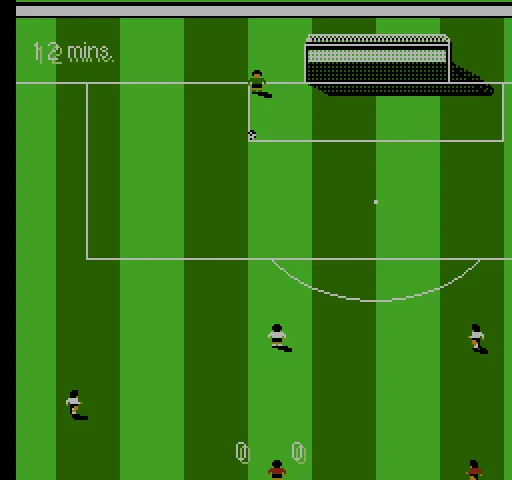
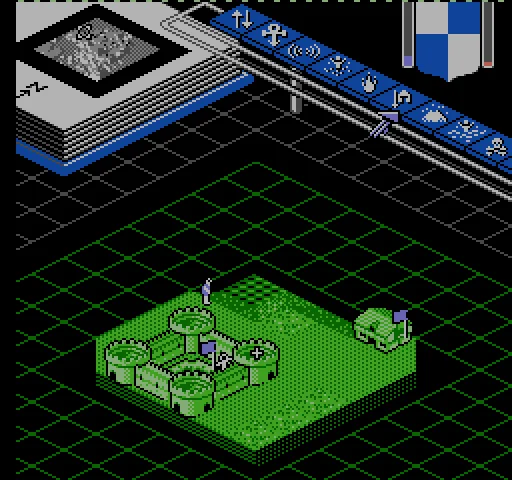
They’re not quite romhacks today, in fact they’re both nearly fully developed games that just never saw release. They’re also both ports of UK-made Amiga software of some renown. Sensible Soccer is a legendary soccer simulation that still sees the occasional new release, and Populous was the original “God game,” helmed by Peter Molyneux, where players take the role of a god trying to lead their followers to conquer a series of hundreds of worlds.
NES Sensible Soccer, screenshot from Games That Weren’t
Sensible Soccer’s claim to fame is a mixture of statistical depth and arcade-like gameplay that might bring players to mind of Tecmo Bowl. Wikipedia’s page on it, in fact, suggests that a Tecmo arcade game may have been an inspiration. Populous did see console releases for both the Mega Drive/Genesis and the SNES. The SNES version included content from an expansion pack, and has a number of additional terrains, as well as over a thousand levels to play. How did it do it? It created its maps procedural, natch, and you got to skip a number of levels depending on how well you did on the last map.
NES Populous, screenshot from Games That Weren’t
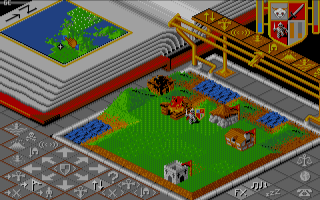
Looking at the tiny view onto the game world the NES version allows, it isn’t surprising to me that it never saw release. Compare to a screen from the Amiga version (screenshot from Wikipedia):
As can be seen, even the Amiga version only shows a small portion of the playfield, but it still gives you more to see than the NES version, although I think the number of visible tiles, 64, is in fact the same. The NES’s color limitations are also a problem, and what you don’t see in the screenshot is that moving the display around isn’t instant. The NES can’t change many background tiles in a single frame without blanking the screen, so what Populous does, on that platform, is do an animated vertical wipe when the display scrolls. It takes about half a second to change views, so when moving tile by tile across a large area the delays accumulate and slow down the game. That may also be why it doesn’t use larger tiles, it’d compound the delay in scrolling the viewport.
Despite that though, it’s great to see the game finally greet the world after so long, and even though it’s rumored to have a couple of bugs, Sensible Soccer looks like it might be a keeper.
“We scour the Earth web for indie, retro, and niche gaming news so you don’t have to, drebnar!” – your faithful reporter
There’s lots of things that have disappeared from the world in the 35 years the internet’s been around, and very few of them ever come back. Anyone remember Happy Puppy? Midway Games? GameSetWatch?
One of those dead properties was Game Informer, a long-time video game publication that got its start as an official organ of the used game chain FuncoLand, whose ads used to be ever-present in other game mags. When they merged with Babbages to form GameStop, Game Informer went with them. In recent years you could get issues of Game Informer for free from GameStop stores.
Then, I assume as a cost-cutting measure, GameStop shut it down last year. Despite its status as a store giveaway, the publication was pretty slick, and wasn’t without its fans. And lo, it seems they are back! Not just their website but a print magazine too! The new incarnation of Game Informer is unconnected to GameStop, it having been sold to an outside group. According to the company, its entire staff returned to work on the new publication. It seems too much to ask that it be free again, but maybe it won’t be too expensive.
I will admit that I wasn’t a huge fan of GI while they were owned by GameStop. Its focus was solidly on the AAA market that we mostly steer clear of. But it’s good when people working in media get their jobs back, and we wish the staff of the resurrected company well. They’ve even kept up with their reviews, on their first day back they posted 29 reviews of games released during their absence. (It includes Echoes of Wisdom, but no sign of Balatro.) It may be worth following their Youtube channel, which continues on from their GameStop days.
Owner of Game Wisdom with more than a decade of experience writing and talking about game design and the industry. I’m also the author of the “Game Design Deep Dive” series and “20 Essential Games to Study”
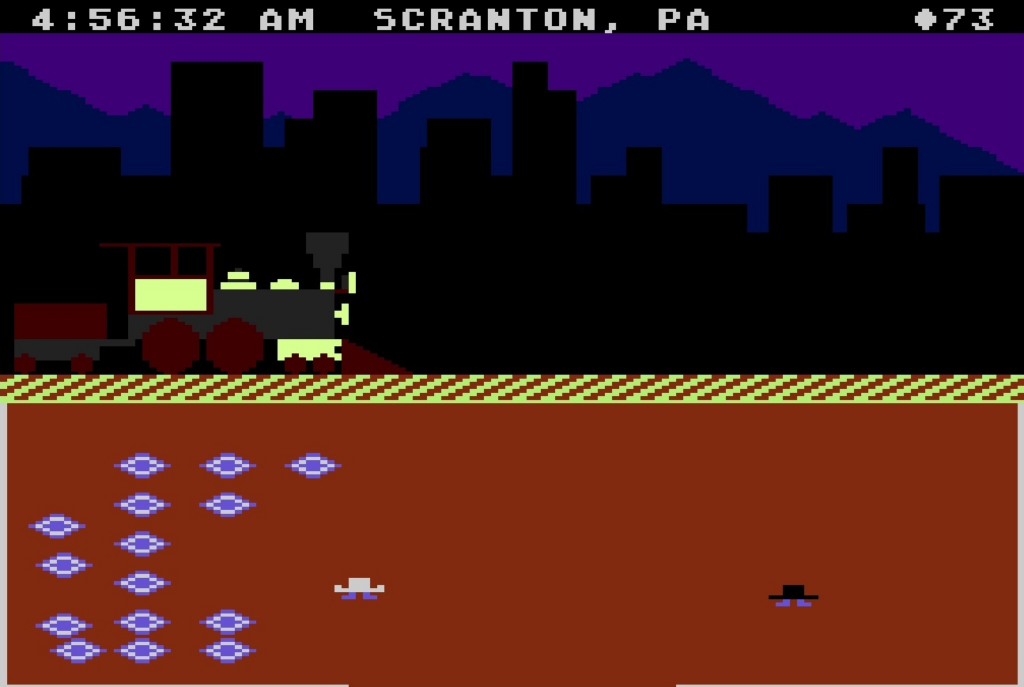
There’s a whole genre of computer game that’s almost extinct these days, the inventive educational semi-simulation. Some examples include the beloved M.U.L.E. and Where in the World is Carmen Sandiego, and another one is Scholastic and Tom Snyder Productions’ Agent USA. Chris Gallagher on Hardcore Gaming 101 tells us all about it. (Note about HG101: it seems only http links work there at the moment. Visiting the site right now over https brings up an error.)
The educational aspect, as with the best of these games, is not the foremost aspect of gameplay, it teaches by having the taught information be useful to the gameplay rather than its entire point. You’re Agent USA, a white hat with legs trenchcoat, and you’re trying to save the United States from the “FuzzBomb,” a device that spreads a kind of zombieism by contact with people (black hats with legs).
Your only weapon, and defense, against the “FuzzBodies” are crystals. You can drop them on the ground and, while they’re there, they’ll slowly grow, making more crystals around them. Bystanders love to pick crystals up off the ground, so you have to keep pushing them away, but FuzzBodies that touch crystals turn back to normal.
Winning is accomplished by collecting 100 crystals and touching the FuzzBomb, but you have to avoid touching FuzzBodies as you approach it. If you get touched, you lose half of your crystals, and if you run out you get Fuzzed youself, and are forced to watch your character walk around randomly until it happens to touch a crystal, which could be nearly immediate or take quite a long time.
The educational aspects come from geography, knowing the names of towns to visit, and learning state capitals, which have a special significance to the game. Capitals are the only cities with info booths, which supply various pieces of info as well as the location of the FuzzBomb. There’s also an aspect of time management: trains depart on strict schedules, and you may end up having to wait a bit after getting your ticket.
I have vague memories of reading about Agent USA when it was new, and always wondered about how it worked. Another game from the same publisher and developer, and from around the same time, was In Search Of The Most Amazing Thing.
Sundry Sunday is our weekly feature of fun gaming culture finds and videos, from across the years and even decades.
Its from Dorkly, a gamer content channel on Youtube. I usually try to keep the finds we present here to one-person operations or similar. But the animation (2 ½ minutes) is entertaining, and it addresses the experience of those people standing to the side watching others beat the crap out of each other. I’m surprised they don’t take an accidental Hadoken from time to time. Doesn’t seem very safe to be at ringside for a Psycho Crusher.
Owner of Game Wisdom with more than a decade of experience writing and talking about game design and the industry. I’m also the author of the “Game Design Deep Dive” series and “20 Essential Games to Study”
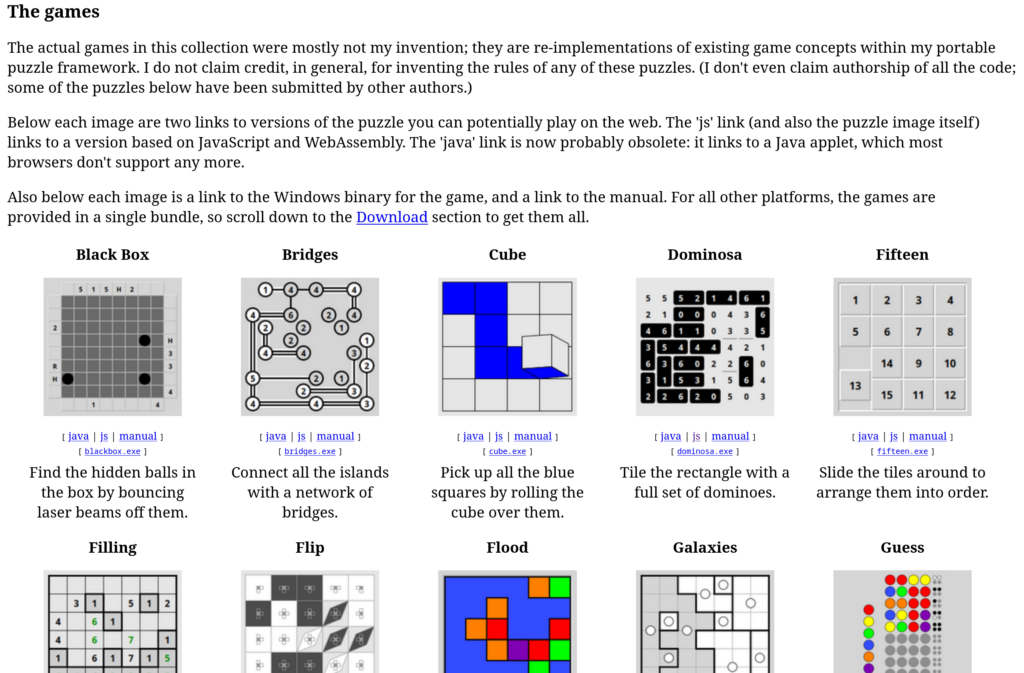
I’ve brought upSimon Tatham’s Puzzle Collection here before. It was then, and still is now, one of the great wonders of the World Wide Web, a completely, utterly free, in both beer and libre, collection of randomly-generated puzzles of 40 different styles and counting, available for pretty much every platform. Not currently for Mac, because Simon’s Mac stopped working, but you’re free to compile it yourself if you can.
Let’s delineate the platforms: Windows, Linux, Mac (with the above caveat), Android, iOS, Java and even Javascript. You should be able to field one of those options, right? And which puzzles are provided? Black Box, Bridges, Cube, Dominosa, Fifteen, Filling, Flip, Flood, Galaxies, Guess (Mastermind without the trademarked name), Inertia, Keen, Light Up, Loopy, Magnets, Map, Mines(weeper), Mosaic, Net, Netslide, Palisade, Pattern (a.k.a. Nonograms, or Picross), Pearl, Pegs, Range, Rectangles, Same Game, Signpost, Singles, Sixteen, Slant, Solo (genericized Sokoban), Tents, Towers, Tracks, Twiddle, Undead, Unequal, Unruly and Untangle. Not only will the software generate an endless of stream of puzzles for you to solve, often with a user-selected difficulty, but some platforms will even print out books of these generated puzzles for you to solve, along with an answer key.
The puzzles I’ve boldfaced are what I call Nikoli-style puzzles. Nikoli is a popular Japanese puzzle magazine, the original home of Sudoku, and has a particular kind of logic puzzle that’s really satisfying to play. They usually have simple rules, but with profound implications, and with some thought you can deduce processes to help you solve them. Sudoku aficionados will immediately know what I’m talking about. The main subject of this post is about one of these Nikoli-style puzzles, Dominosa.
Nikoli specializes in human-created puzzles, and Simon Tatham’s Puzzle Collection creates its puzzles by computerized process. These kinds of puzzles really are better when set by hand. But that doesn’t mean the automatically-generated kind doesn’t have its place.
Also, Simon Tatham’s puzzles are completely free, don’t track you, and don’t have ads, making them a real rarity in this money-desperate age. If you need any proof that the app stores of Apple and Google are rigged against you, then consider that the Puzzles have been available on both their platforms for over a decade, but their discovery algorithms never seem to surface them. (Here’s some help in finding them: Google Play, Apple App Store.)
To give you idea of what kind of puzzles these are, and to get you on your way to solving one kind of them, here are my observations about Dominosa. The rest of this post is pretty long, so this is your chance to check out if you don’t want basic tips on how to solve it.
Dominosa, KDE version
Dominosa presents you with a grid of numbers, usually from 0 to 6 (you can choose to solve larger puzzles). The numbers represent the values on a field of dominoes, but the edges between them have been removed, leaving only the numbers of pips that would be on their two sides. Your job is to place dominoes on the field, over the numbers, to reconstruct where they were originally. The puzzle is solved when every number is accounted for, filling the board with exactly one domino of each pair of values, with no contradictions.
I’ll present a series of images representing working out one of these puzzles at a basic level of difficulty. Not all of them are as simple as this.
A Dominosa puzzle, from the Android version of Simon Tatham’s Puzzles.
The way I solve these, I first look through for pairs of numbers. If you’re on a version of the Puzzles with keyboard support, you can press a number to highlight all of its values throughout the board. If you don’t have a keyboard, there will usually be number buttons onscreen that fill the same purpose. There may also be Undo/Redo buttons; if there aren’t, you can use Ctrl-Z/Ctrl-R for that.
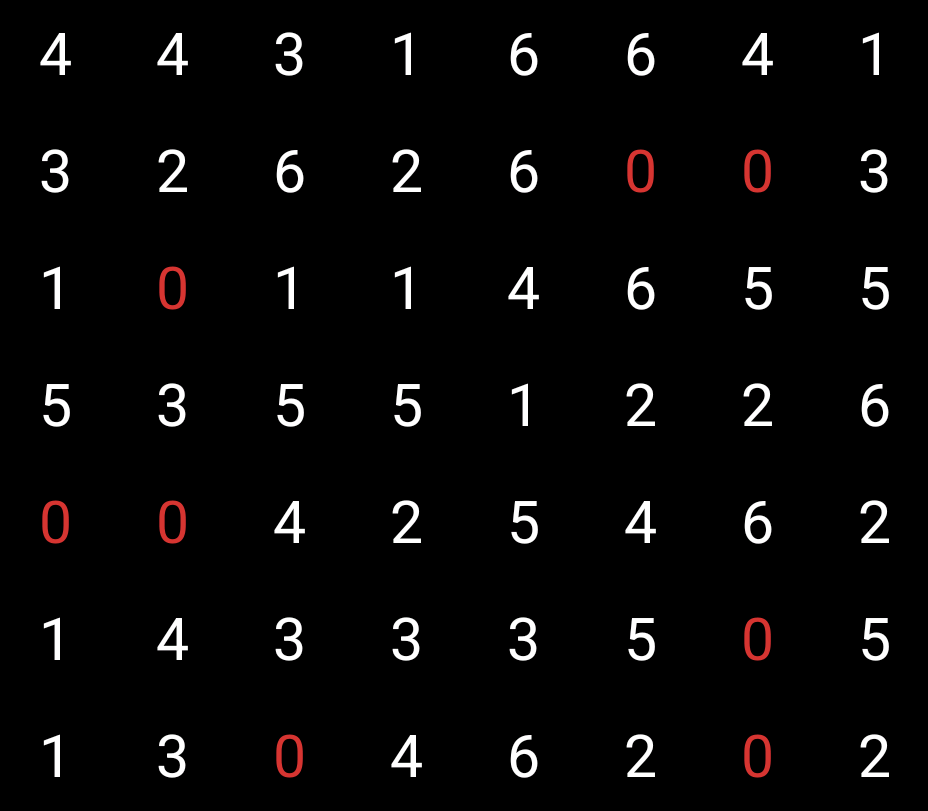
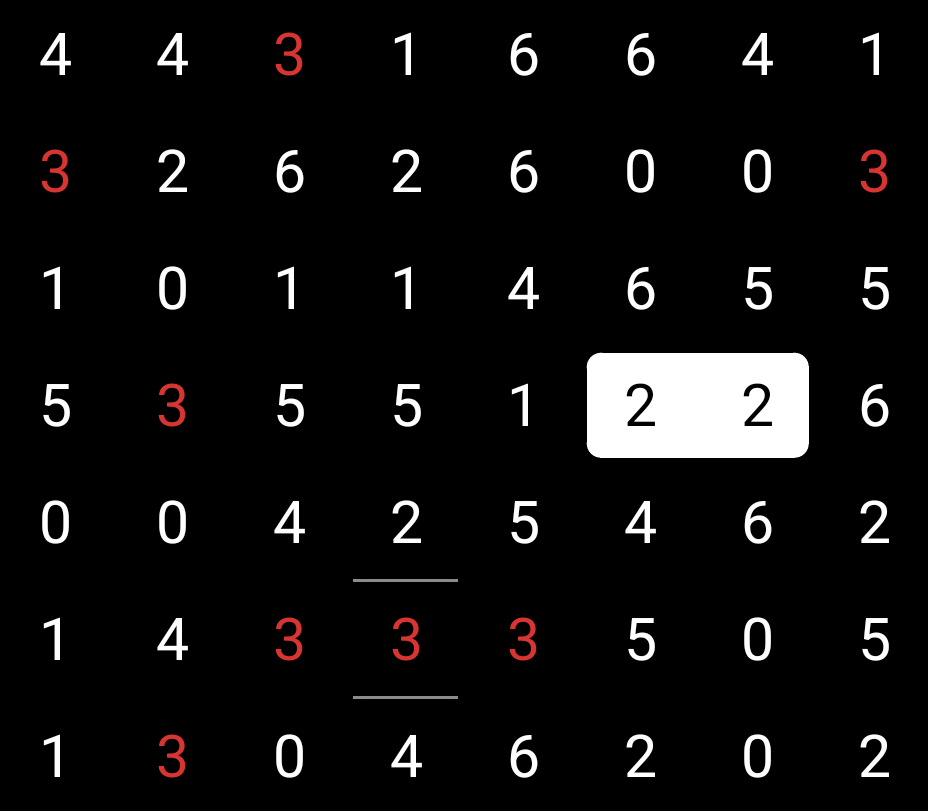
I start out by looking for all the zeroes. Here they are:
In a double-six puzzle like this one, there will always be eight of each digit. What I’m hoping to find is exactly one isolated pair of one of the numbers. There’s only one domino with each pair, from 0-0 through to 6-6, so a single pair means that a domino must be there.
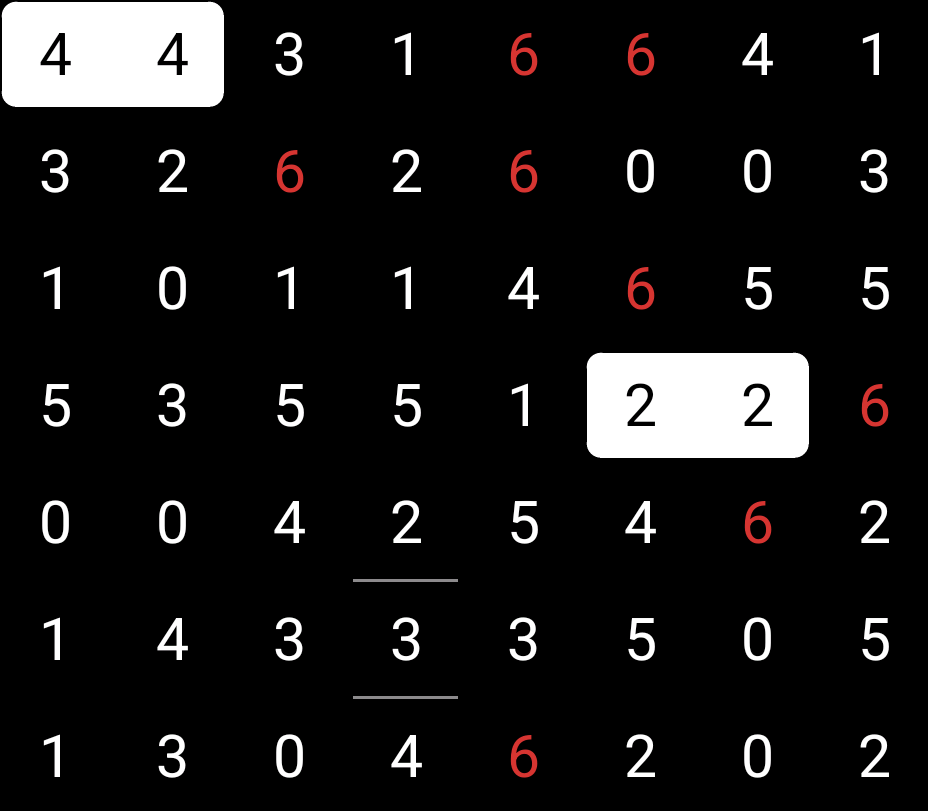
No luck with Double-Zero, so I keep going, checking each number in turn. (You can only have up to two digits highlighted at once; pressing a number again turns off its highlighting.)
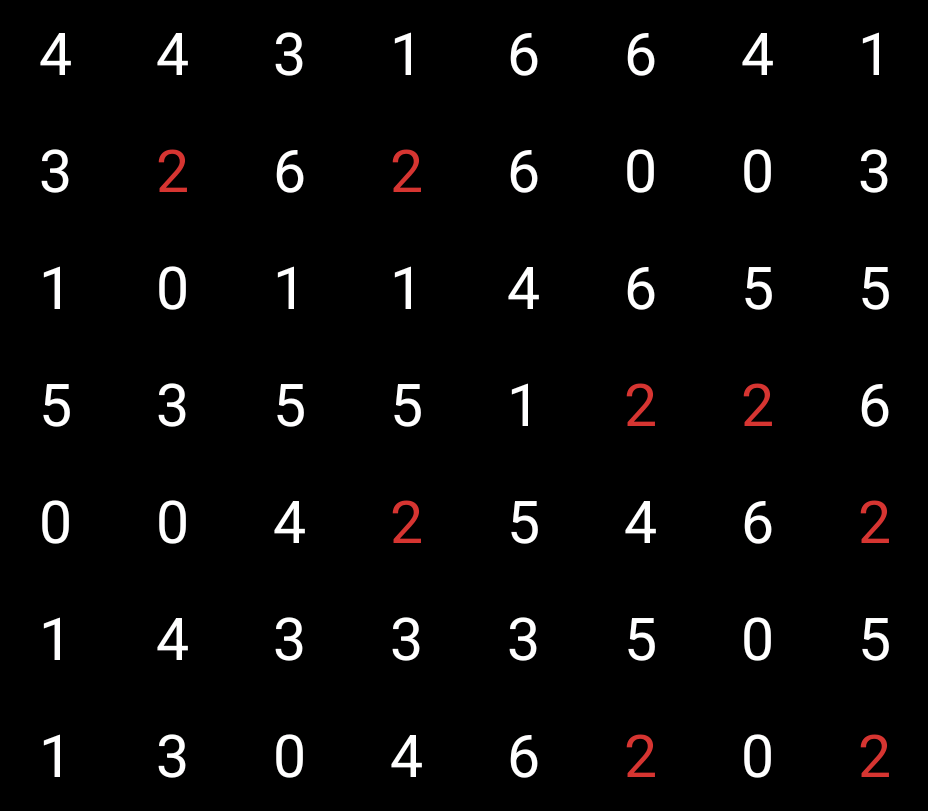
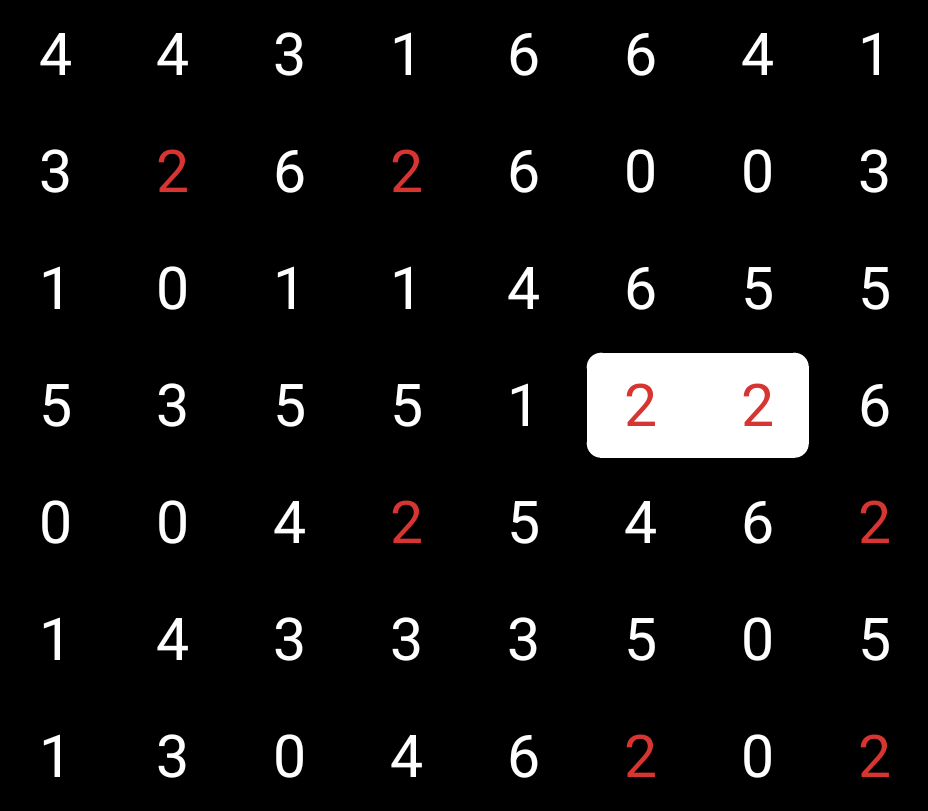
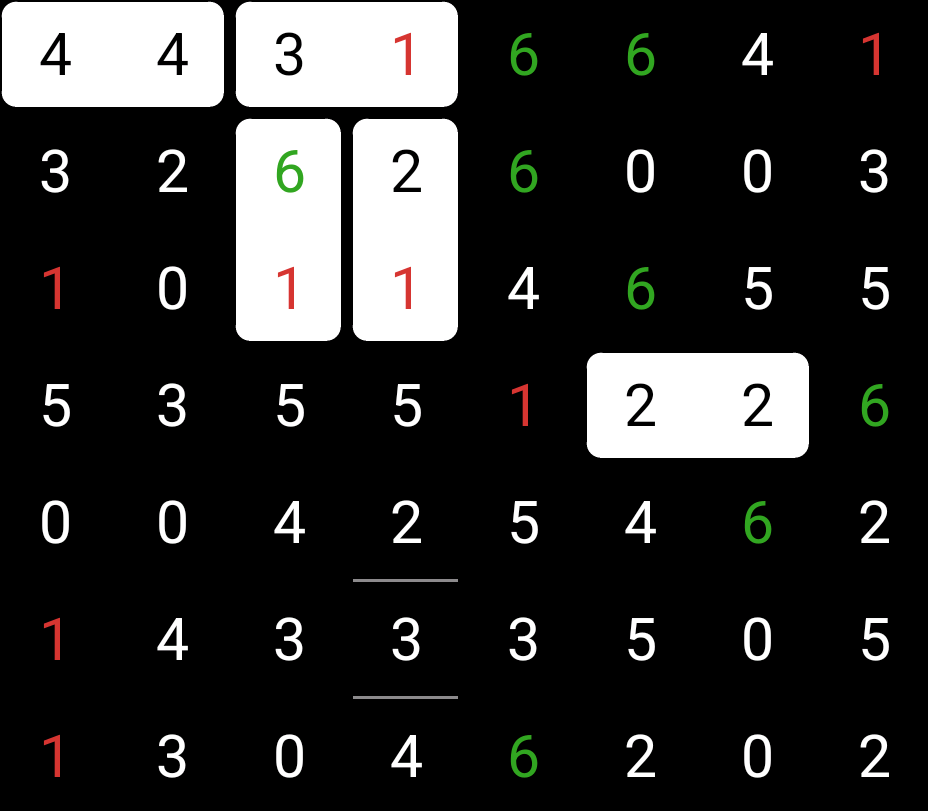
I have better luck with the 2s: there’s only one adjacent pair. So I click on the space between them to place a domino, as so:
In Nikoli-style puzzles, as you correctly fill out each little bit of the puzzle, it makes the rest of it slightly easier. When you make progress in solving it correctly, the puzzle seems almost to knit together, until the whole grid is complete.
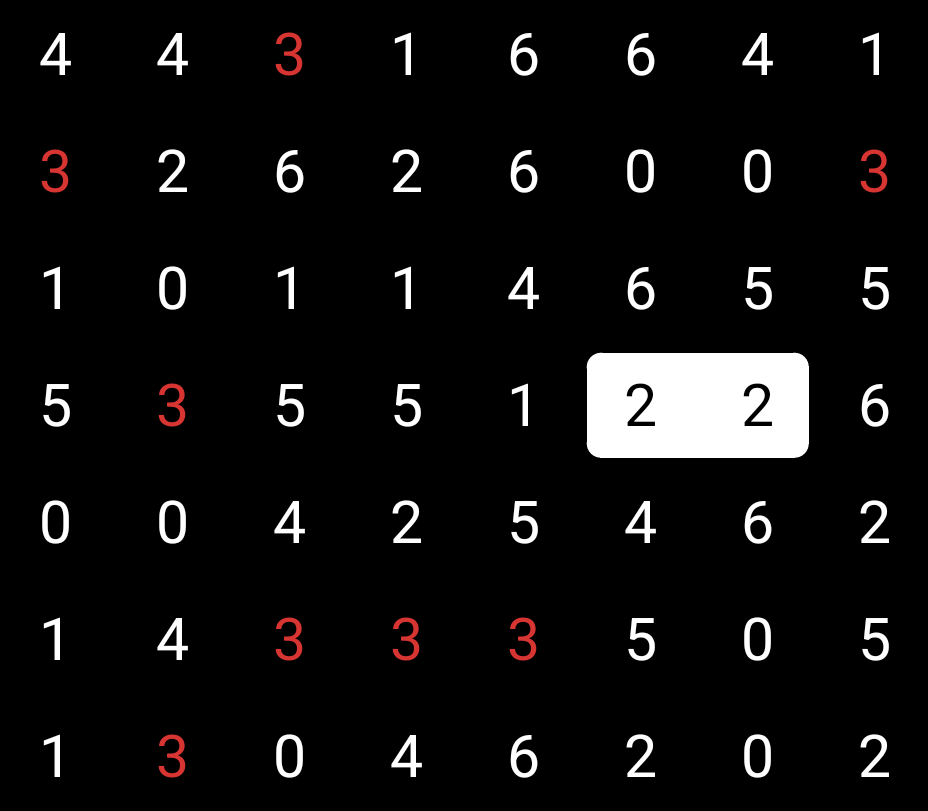
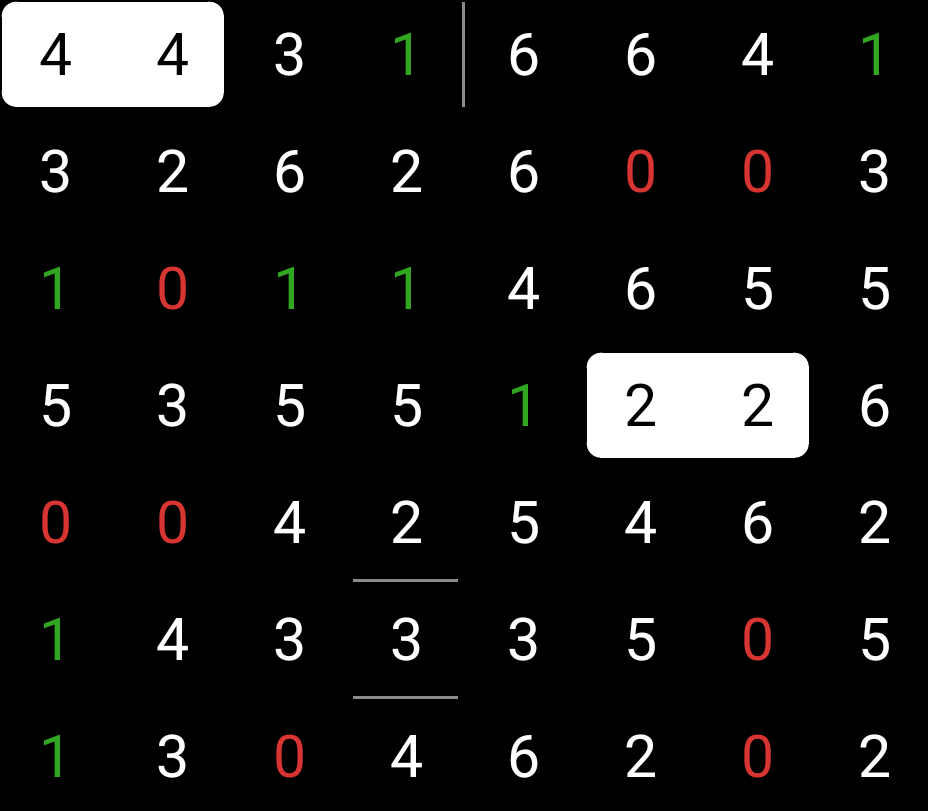
It’s not just single pairs that are useful though. Sometimes you’ll find single triples, either in a straight line as here, or in an L-shape. So long as there aren’t any other adjacent digits of that value in the puzzle, then you know that one of the two possible pairs must be the correct one.
How is that useful? In the below case, there are borders between the digits that the two possible placements have in common. Since one or the other must be correct, the two domino edges that the possibilities share must be edges in the solution. We can mark edges in Dominosa with the right mouse button, or on mobile platforms with a long press:
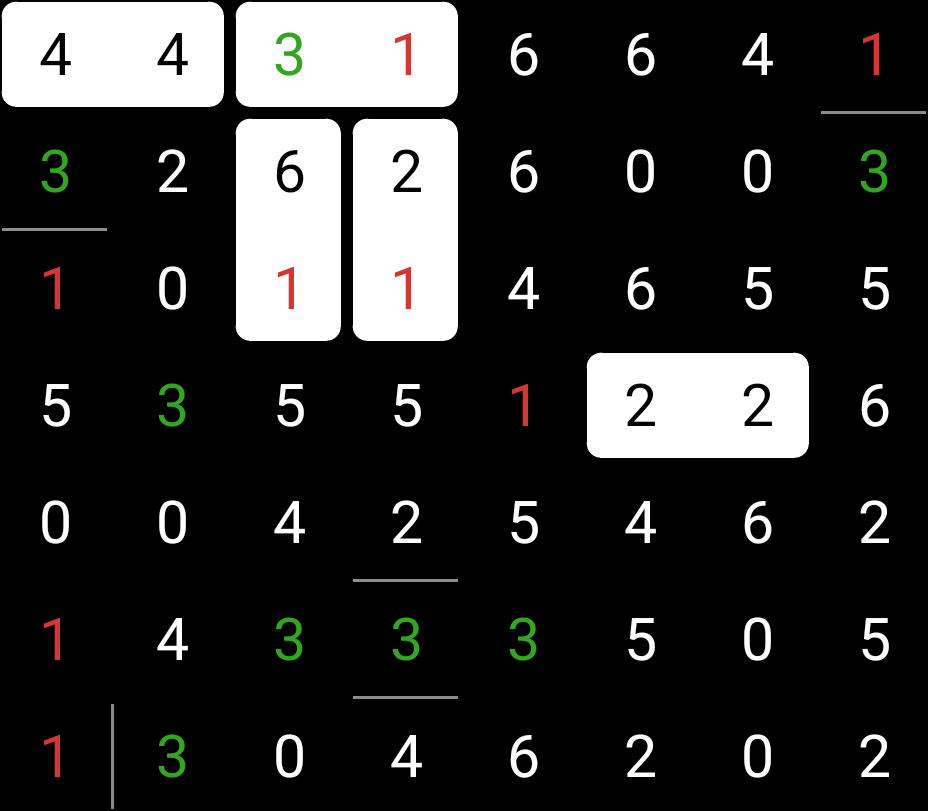
Above I’ve placed the horizontal edges that the two possible Double-Three locations have in common.
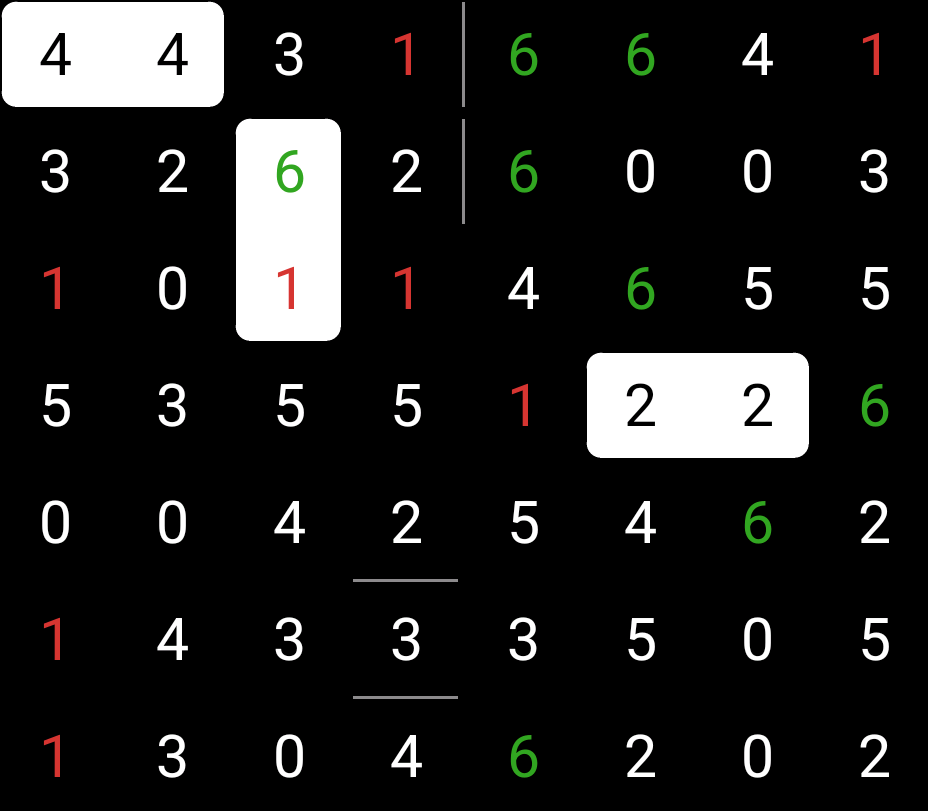
Moving on. There’s a single pair of 4s, so I’ve marked that domino. And there’s an L-shaped arrangement of three 6s. It’s on the outside of the puzzle, so there’s really just one edge to place, like so:
I’ve also started on the second step of the puzzle, looking for non-identical domino pairs. This is where the ability to highlight two different numbers becomes useful.
Now we’re looking for each possible 0-1 combo. There’s three possibilities here, which isn’t helpful.
The process I use is to check for the dominoes with one zero: 0-1, 0-2, 0-3, 0-4, 0-5 and 0-6. After that, the remaining pairs beginning with 1: 1-2, 1-3, 1-4, 1-5 and 1-6. When I move to the next digit, there’s fewer to check, because we’ve already done some: 2-3, 2-4, 2-5, 2-6; then 3-4, 3-5 and 3-6; then 4-5, 4-6, and finally 5-6.
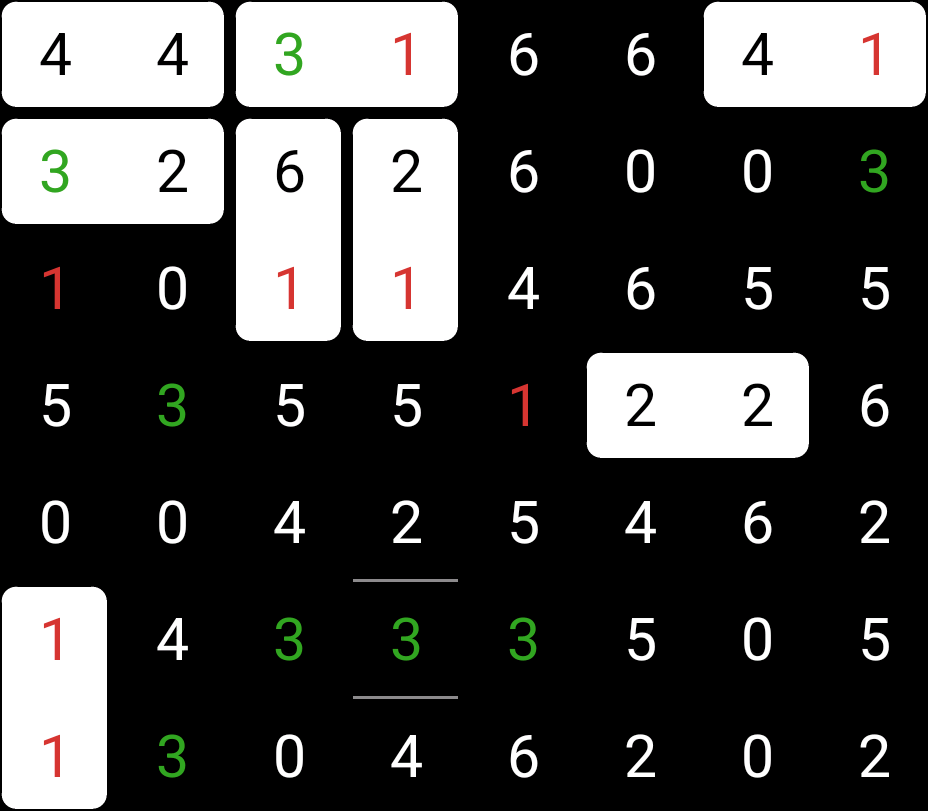
Of the 1-2 domino, there’s only two places where it could be, so I can place edges alongside them. Also, there are two 1-6 pairs. But because we’ve ruled out one of them, when we tried the Double-Sixes, there’s only one pair left that could possibly be the domino.
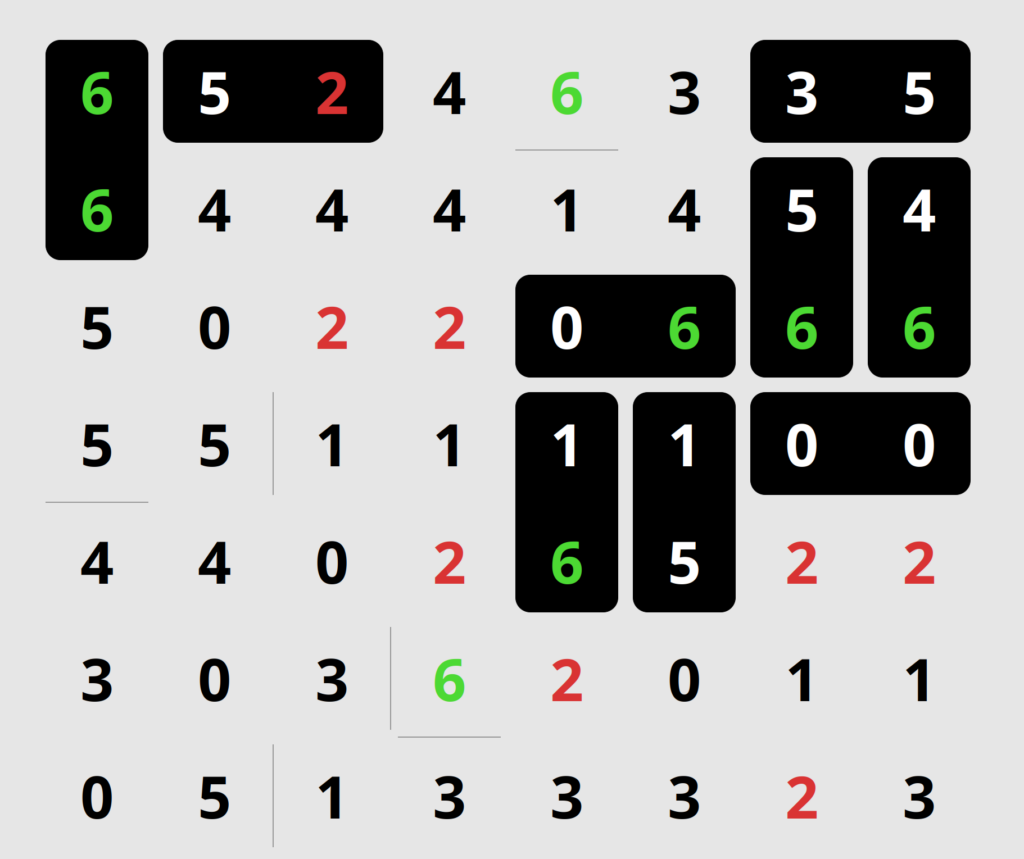
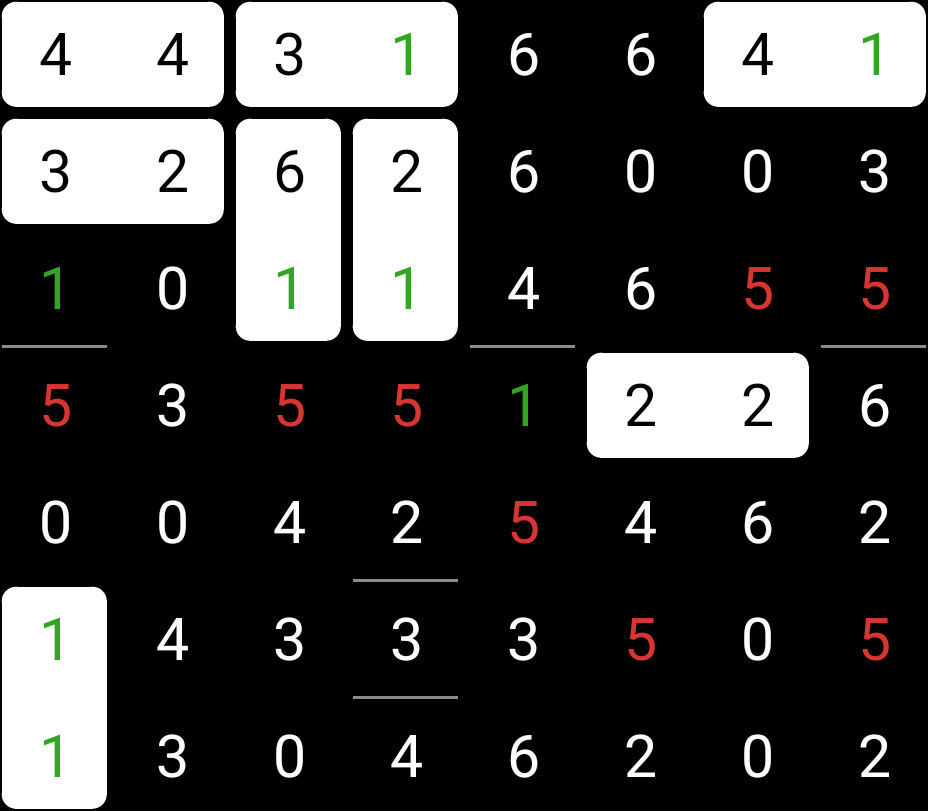
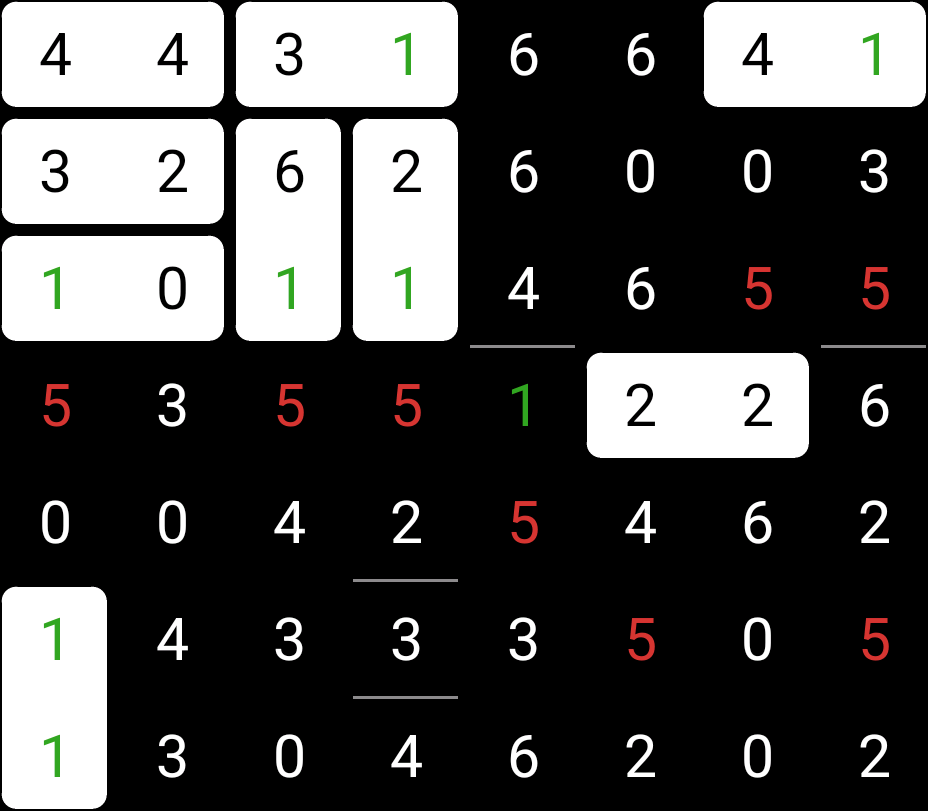
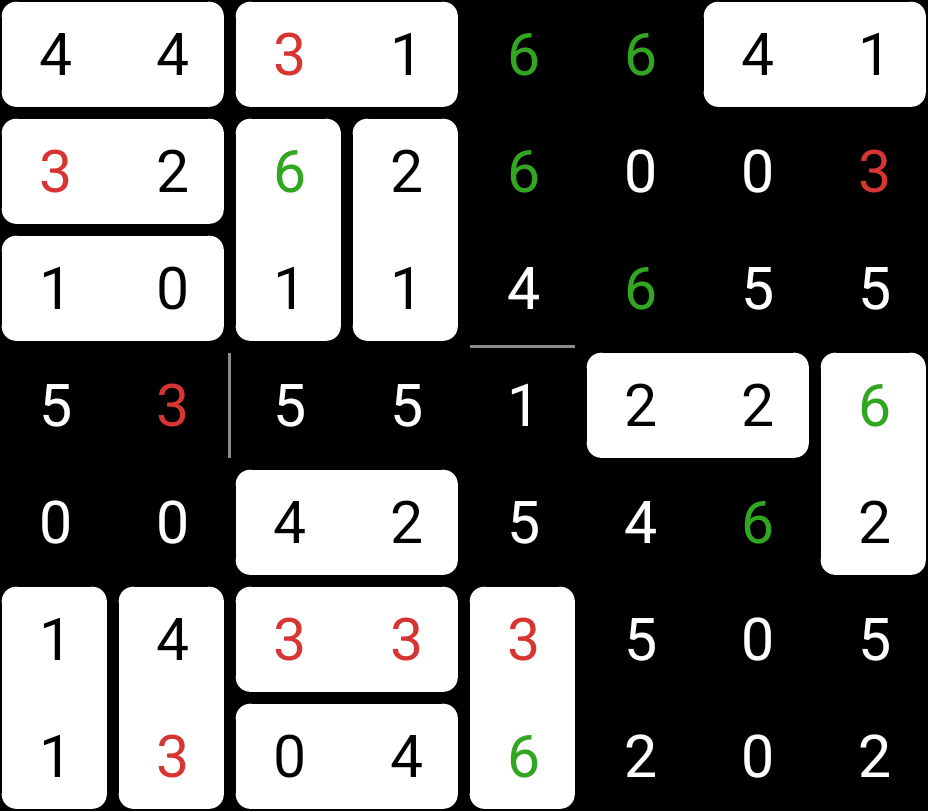
Ah. Now we have one of the best things we can find: a dead-end. A place with a cul-de-sac, where a domino has to go regardless of its digits. Every digit in the puzzle must connect in one direction, and the 3 to the right of the 4-4 has only one way to go, so that must be where the 3-1 goes. And because of the two edges nearby, the 1-2 also has a location where it has to go.
The great thing about these placements is, they weren’t narrowed down from the lack of other pairs of digits. Since the 3-1 has to go there regardless, all the other 1s by 3s on the board can’t be options, so we can place edges between those numbers.
We’re lucky again; each of these edges produces mandatory domino placements, in the same way!
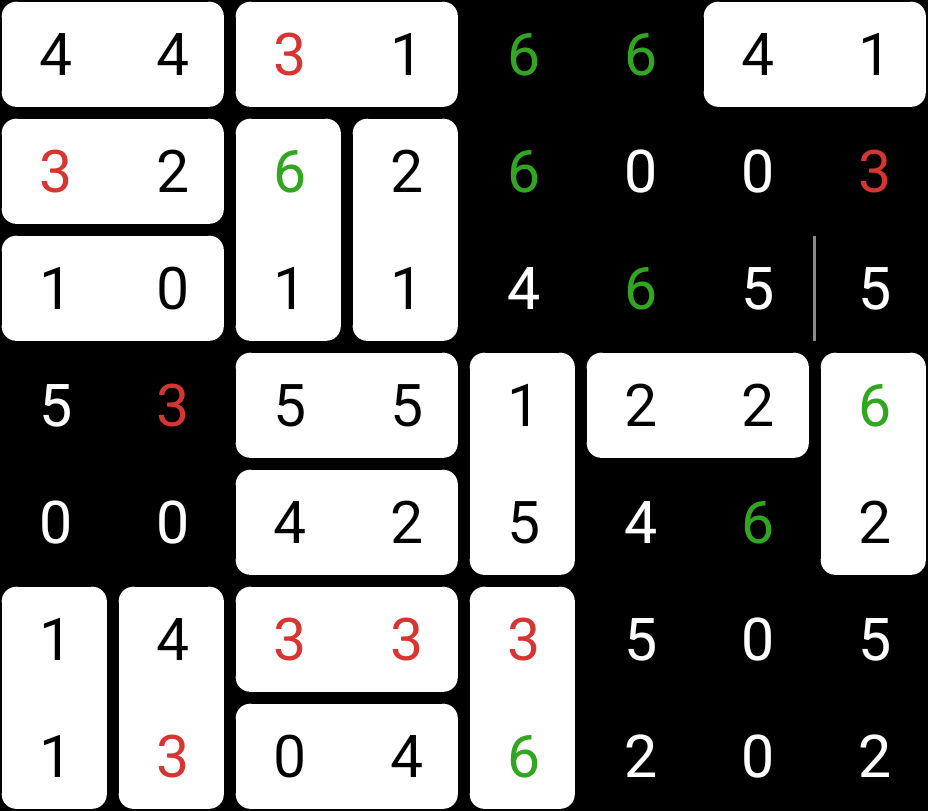
These, in turn, allow us to place another domino, a 1-4, and to block an edge between another 1 & 4. It results in an unfilled region of the puzzle with only one entrance. Dominoes have exactly two ends, so any region containing an odd number of digits is impossible. This lets us place a useful edge, between a 5 and a 6, because if the edge were below the 6 instead, the region would have 11 digits in it.
Continuing with checking for pairs, there’s a triple, a 1-5-1 with no alternatives around them. Since each puzzle must have exactly one 1-5, it has to be one of these two places, so all the other 1-5s in the puzzle must have edges between them.
And that means a mandatory placement for the 1-0.
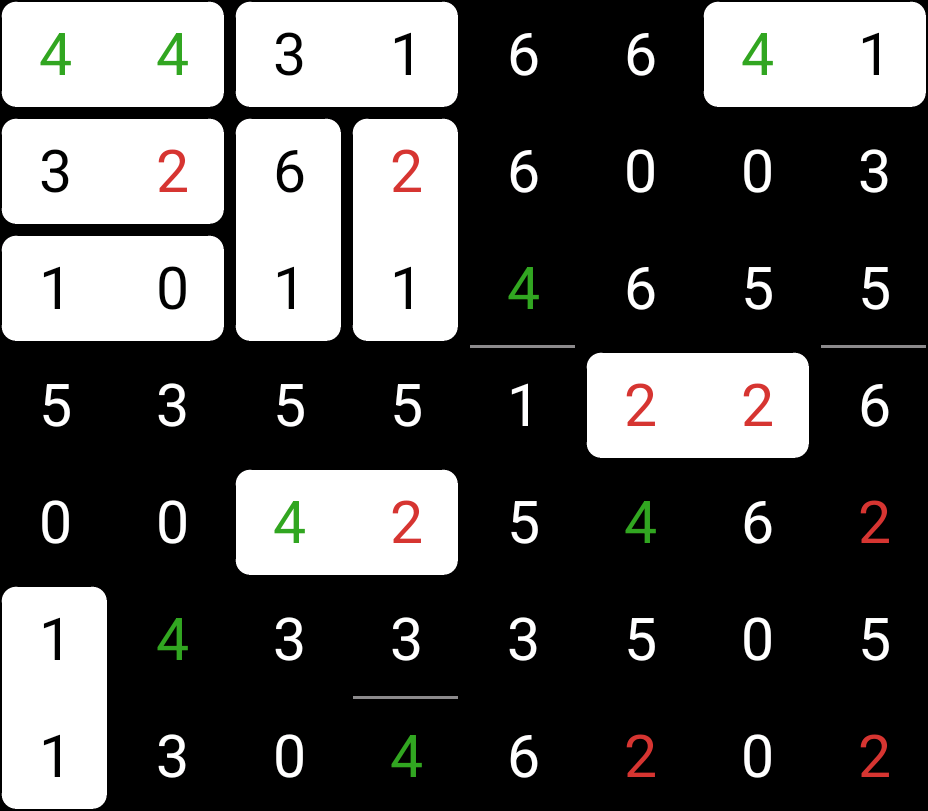
Hah, I neglected the mandatory 6-2 at the right side of the puzzle! But I did find a single remaining instance of a 2-4, which I filled in.
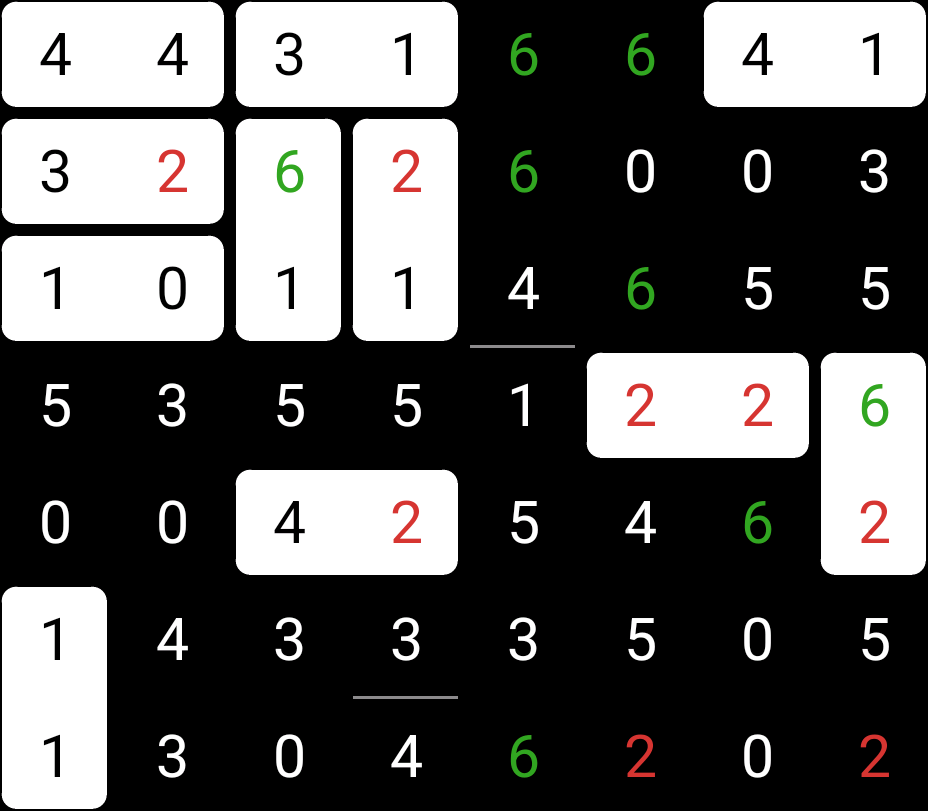
And then I noticed the 6-2:
We’ve done about half the puzzle now, but really we don’t have much left to do. The 6-2 we place means we can place edges between the 2 and 6 at the bottom of the puzzle, as so:
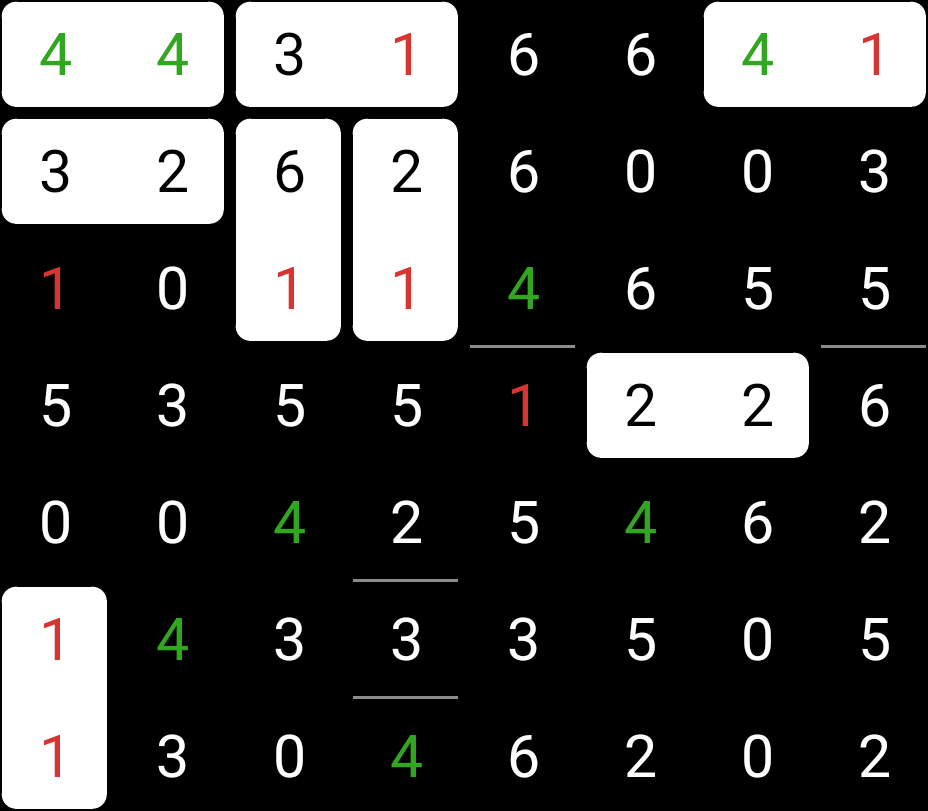
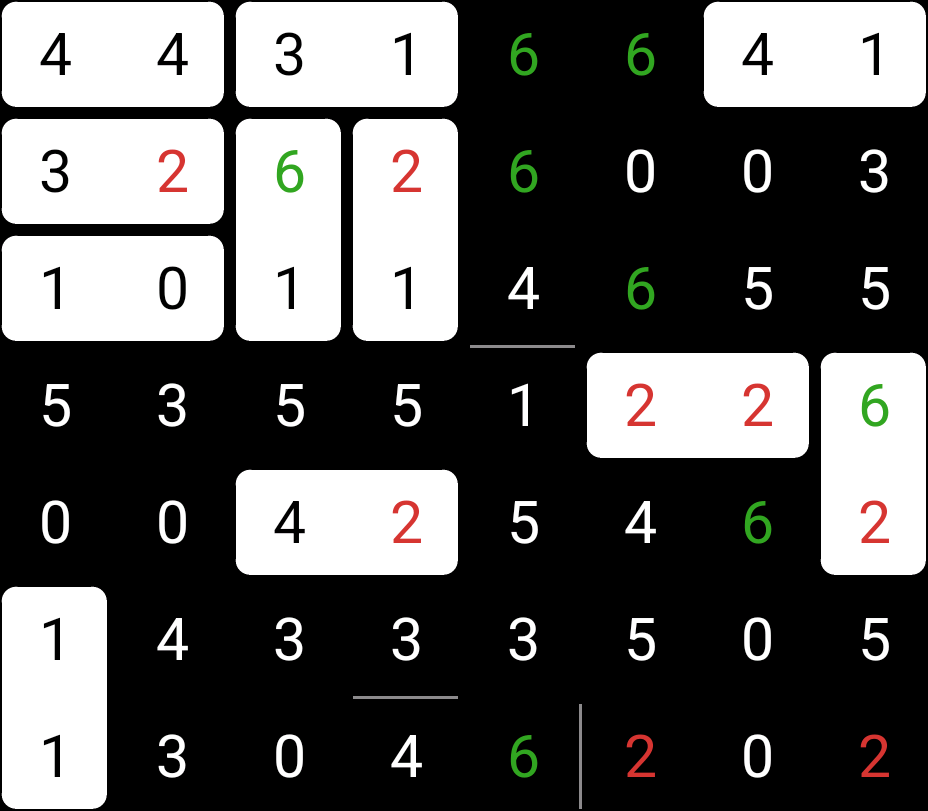
We can hurry through the rest of the puzzle. There’s a single triple of 3-4-3, so we can place an edge above its 4:
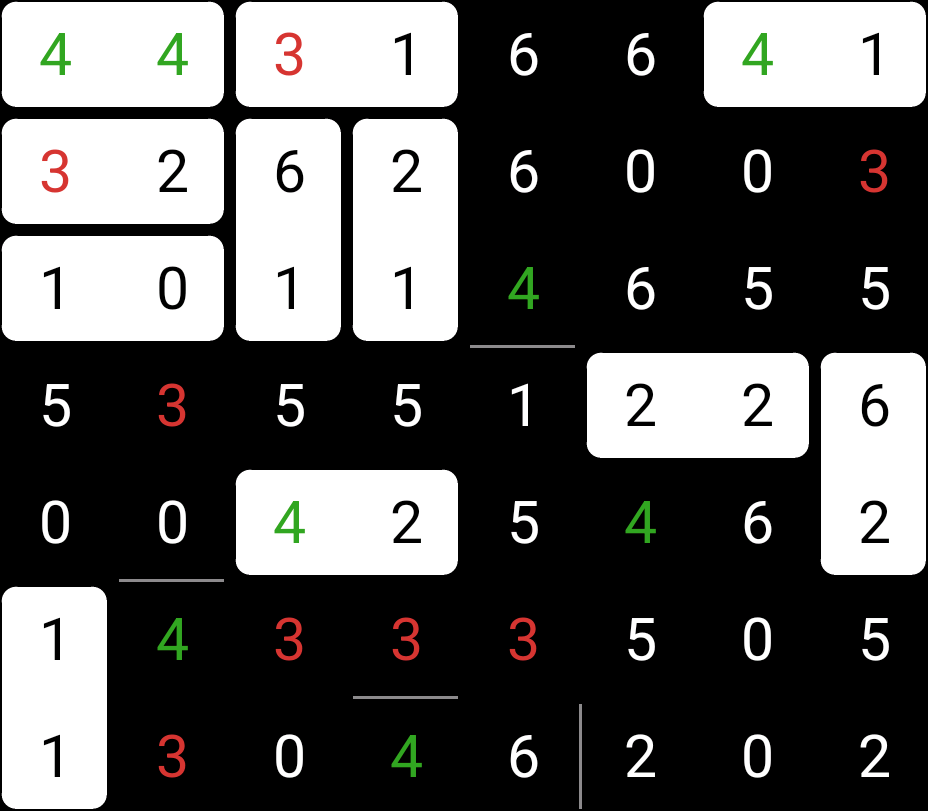
There’s a single 3-6:
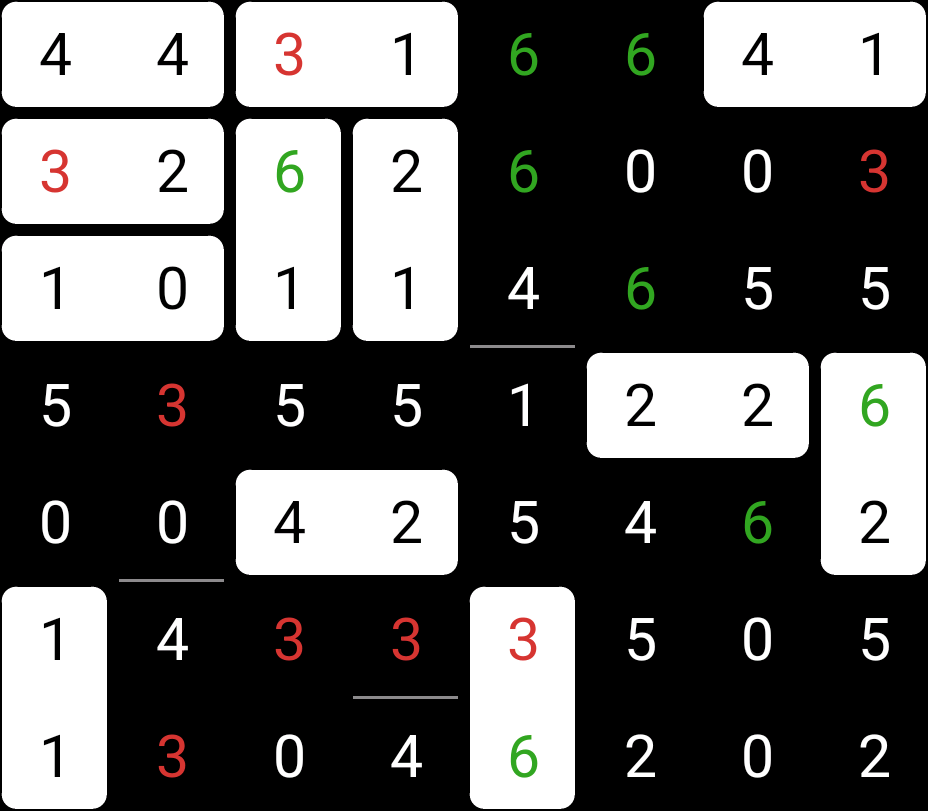
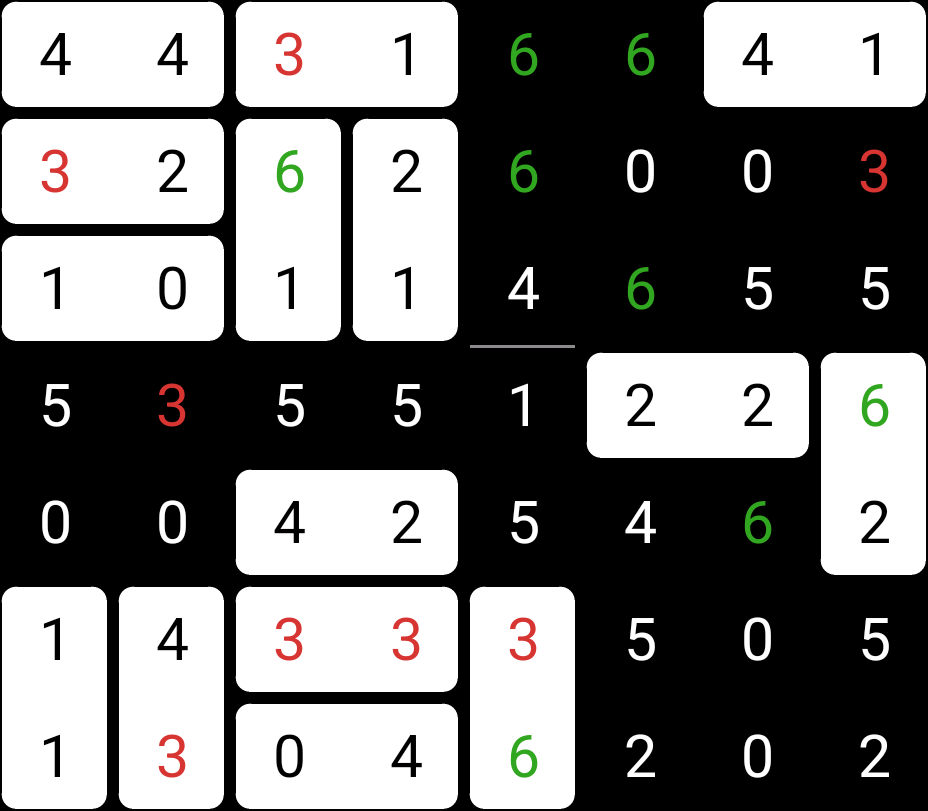
That creates two dead-ends, a Double-3 and 0-4, and then a 4-3:
From here, most of the rest of it can be worked out with the same principles. When we get to small areas like this, often figuring out where to place one domino, or even edge, makes the rest of its region obvious. There’s a small region with a single path into it, so the fact that regions can only have an even number of digits comes into play again.
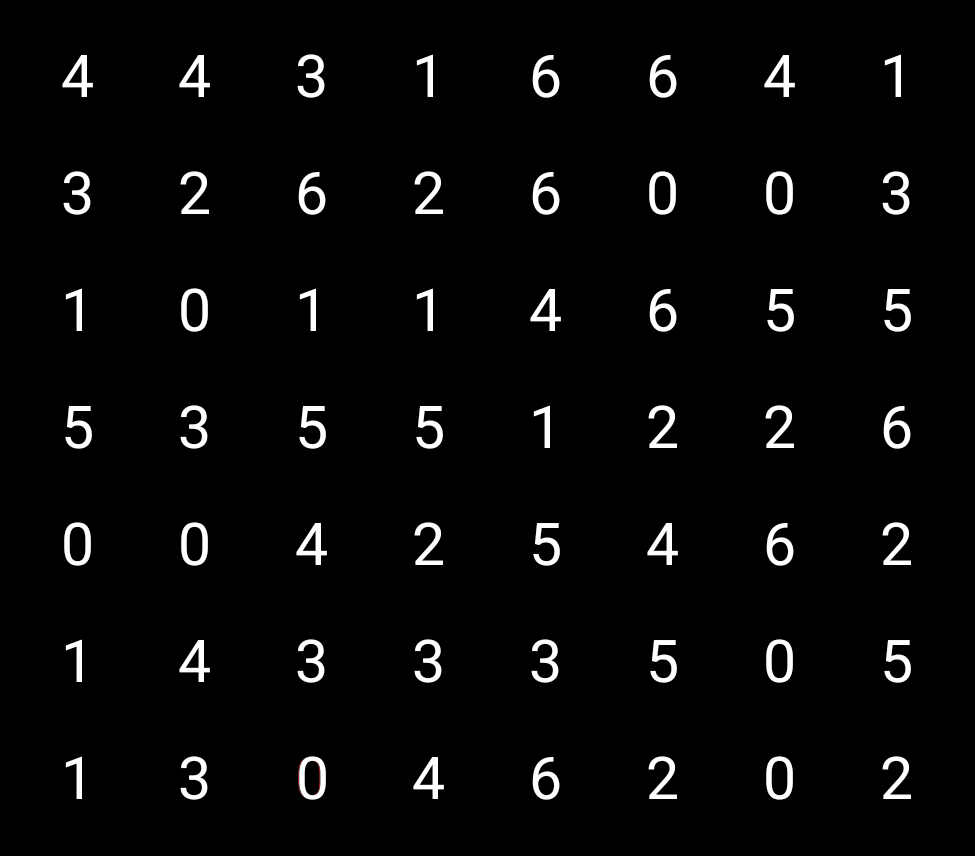
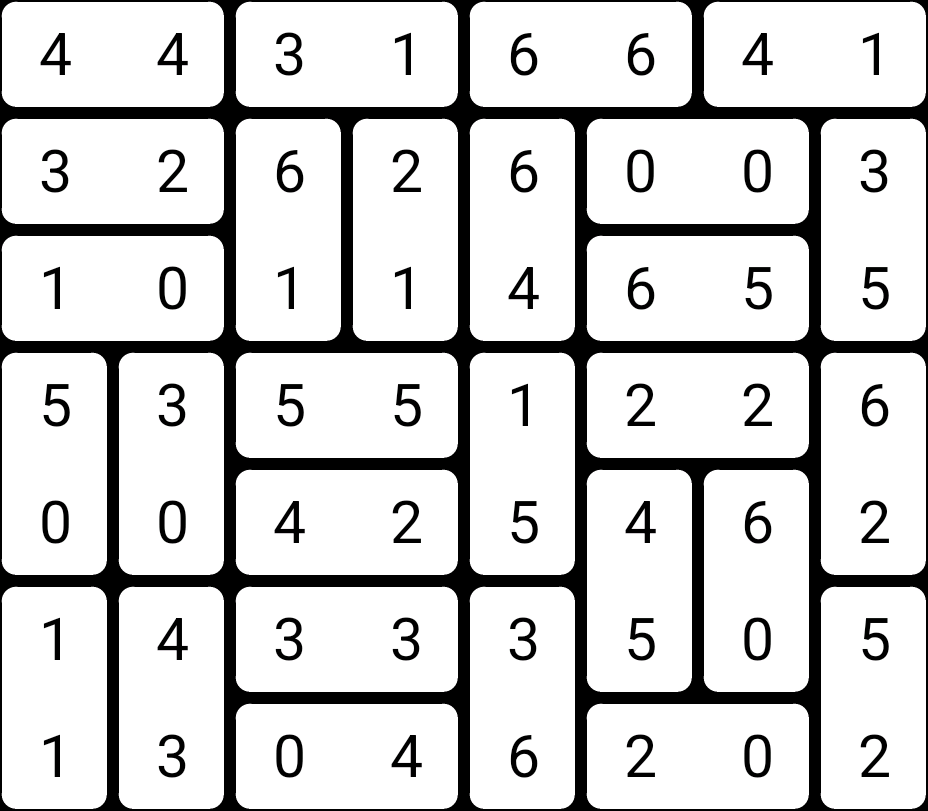
This puzzle is almost solved, so let’s just jump straight to the solution:
As noted before, most puzzles aren’t this easy. Often after you’ve been through all the possible pairs of digits, you still have a significant amount of puzzle left to do. Usually, if you look carefully at the puzzle, you can figure out placements that, if made, will result in contradictions to the rules of the puzzle. If you find one of those, you can then place an edge between its numbers.
There’s a couple more tricks I know of, but they start getting harder to explain easily here. I’m by no means an expert: I’m sure that experienced Dominosa solvers know tricks I have yet to figure out. I also don’t want to explain too much about how to solve these puzzles, as I got a lot of entertainment in figuring out my solving process, and I’d hate to deny that to you. Most of the processes I’ve mentioned so far are pretty obvious implications of the rules. Revealing the less obvious tricks feels a bit like a spoiler.
One great advantage you have in solving Nikoli-style puzzles on a computer is the Undo feature. Like doing Sudoku by hand, if you reach a point where tricks fail you and solving algorithms leave you stranded, you can progress by making assertions, basically guesses, then working them through until you reach a contradiction. There’s a whole strategy to this: you want to make a single binary, this-or-that guess, and to pick an unlikely guess, one that will prove itself incorrect quickly. Then you can erase the marks you made following your guess, and then mark its opposite.
On a computer, you can undo until the point where you made the guess, with Ctrl-Z. On paper, you’d not only have to remember all the marks you’d made since the guess, but you’d have to erase them all, which makes a huge mess. If you undo too far, you can press Ctrl-R to redo the removed moves. It’s really a tremendous aid!
Give Dominosa a try, and see what you can deduce. If you want to try some of the other Nikoli-style puzzles, that feel similar but have a different process, I recommend Loopy, Slant and Bridges.
It’s been a difficult time here for the moment, so I’m doing low-effort posts at the moment. I have ideas for several more long-form posts, but if the posts be long, so is the time to write them properly. So, in the meantime, here’s yet another Youtube video on a random piece of video game hyper-esoterica.
It’s a good one this time though! A 25-minute video on using all kinds of glitches and tricks to avoid beating bosses in a game where every level ends with a boss!
Super Mario 2, USA version, isn’t a game that I don’t think of when it comes to glitches, and I’d wager it doesn’t for many of you either, so it’s a bit reassuring to know that it’s got as many weird ways to bend the game’s rules as do games like Super Mario Bros. and Ocarina of Time. The video’s from Retro Game Mechanics Explained, which, along with Displaced Gamers, are among my favorite channels for digging deeply into the actually assembly code of games, and figuring out exactly why they do, or don’t do, what they could/should. Along the way you’ll get a basic understanding of how SMB2USA handles connections between areas.
If you’re as obsessed with understanding how these games were put together as I am, it’ll be like sugar candy to you! If you aren’t, well, maybe you’ll find it interesting anyway.