The World Wide Web is now over thirty years old. In that time, more content has vanished from it than remains now, but some of it can still be dredged up from the shadowy archives of the Wayback Machine. This is the latest chapter in our never-ending search to find the cool gaming stuff that time forgot….
It used to be that the internet was full of thousands of tiny sites. Many of them might only have gotten a few visits a year, if that, but they were there, quietly and earnestly providing a resource for people who might be looking for it.
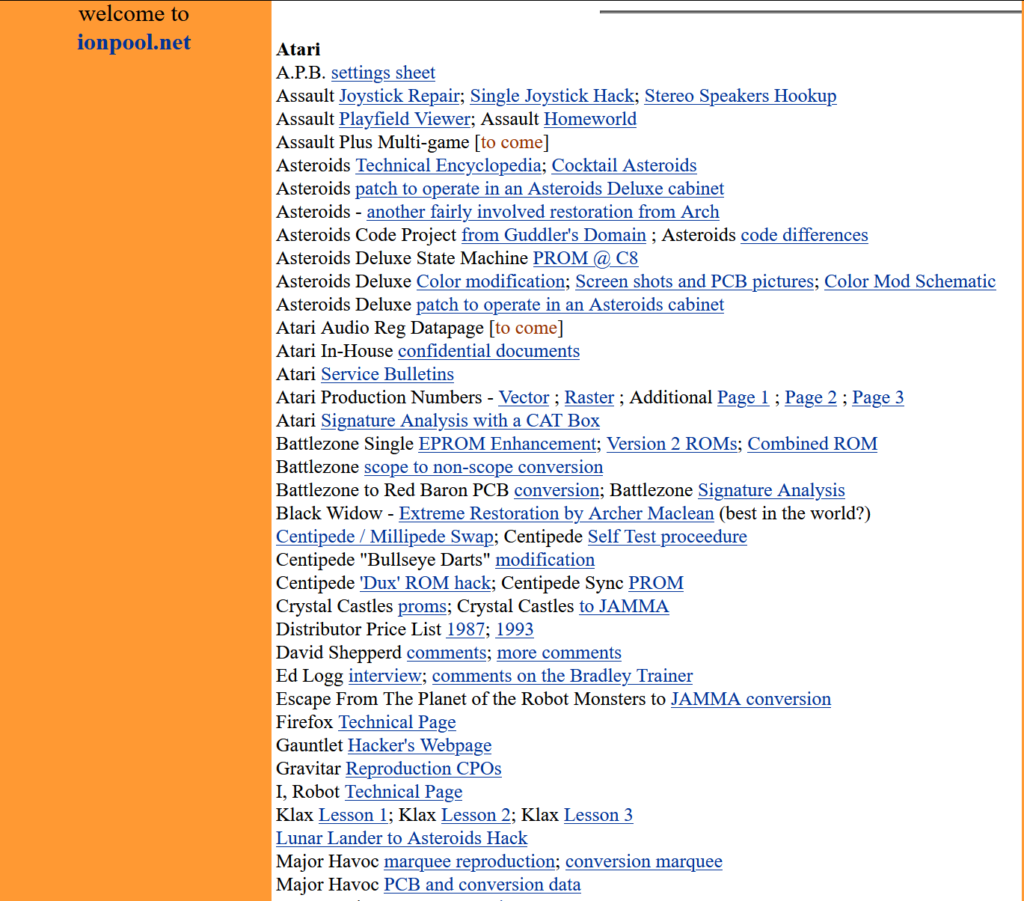
One of these sites was ionpool.net, which used to host a listing of classic gaming information. Here it is from its last archived version on the Wayback Machine from December 29, 2020. There’s a lot of links there, and the nature of the Wayback is, unless I check every one of those links, I can’t be sure if any of them will work. The few I’ve tried do, which is something at least.
ionpool.net in 2013, this is just the beginning of the list
There’s a lot of interesting documents there, presented in the classic List Of Tiny Links format. There’s far more there than I can summarize in a simple throwaway daily blog post like this one, but I particular point out to KLAX In Three Lessons, a series of Usenet posts written by Lyle Rains of Atari Games himself. In fact, those posts are so interesting that I might call them out in a later post….
Back to ionpool.net. The thing that saddens me is that the site still exists, but instead of providing the information that it helpfully offered back in 2013, now it’s just a black page with a graphic reading “END OF LINE.” This:
I can understand that even the slight resources necessary to preserve a website can, over time, become onerous. But I’d think it would be an equivalent cost to host an image like that, instead of leaving the old content up indefinitely. It was largely text files anyway.
Ah well. There is still the Wayback Machine, after all, slow and incomplete as it might be and difficult to sort through like it is. I can’t help but think that we should have more alternatives, though. The Internet Archive is not forever either.
7DRL, the 7-Day RogueLike challenge, is one of the oldest still-going gamejams out there, and still among the most interesting. Every year a number of surprisingly interesting games come out of it. One year, back when @Play was on GameSetWatch, I took it upon myself to look at every game that succeeded at the challenge that year. I think it was 2011? Even though it took weeks, enough time that I vowed I’d never review every game again, even some of the lesser ones had some interesting aspect to them.
This year will undoubtedly add yet more game to that backlog, hooray! That was a sarcastic hooray, I won’t deny it. But it was also, in a sense, an honest one too. More interesting and unique games mean more fun for everyone, fun that doesn’t cost $60 + DLC prices. And making them means more experienced gamedevs making things they like, things that don’t rely on multi-hundred dollar triple-A outlays of cash to realize, and that helps us, very slightly yet perceptibly, reclaim gaming culture from the wash of monotonous big-money content with which we’re all inundated.
It all starts March 2nd, so if you’re interested in participating, get ready to make! And it all ends, mostly, on March 11th, so get ready to play! (I say mostly because technically the challenge isn’t absolutely time-locked. But it’s a good period to aim for and build hype around.)
This tab has been open on my browser for literally months, so I’m finally excising it from the bar….
A while back the site HackADay did a teardown of the NES, going through how to take it apart and reassemble it, and going through some of the elements of its assembly. It doesn’t go into a lot of detail, but that lets it be fairly short, at only nine minutes.
Sundry Sunday is our weekly feature of fun gaming culture finds and videos, from across the years and even decades.
A really recent one this time! BitFinity, a.k.a. Matthew Taranto, who made Brawl in the Family and a fair amount of Waluigi music, animated and wrote this terrific little song about item hording in Final Fantasy VI, sung by Taylor Robinson.
I think, when you find a blog that’s been around since 2009, and is still being updated somewhat in 2024, that itself is worthy of celebration, and that is the case with brainscraps.net. It’s maintained by May Kasahara, a member of the venerable community webblog Metafilter (where I can also be found posting and commenting as JHarris).
Blogs come and go. Bloggers come and go too; sometimes they lose interest, but sometimes they pass away, such might be the case with oneswellfoop, a.k.a. Craig Wittier. There was a recent Talk post there about the many members who have passed away.
This is not a Metafilter focused blog. I mention all this to say that people’s blogs, and being around to blog, that’s precious, people’s writing is important, it’s a part of them, and I’m happy whenever I encounter it, whether the blog gets 10 readers or a million of them. But it’s nice when people go by there and read them, and I hope that you’ll be inspired to read Brainscripts, and other blogs, and if you don’t already, that you’ll learn to cherish that they exist. They won’t always, their bloggers won’t exist always either. Neither will I, and neither will you. So let’s all enjoy what time we have here left!
Are you surprised by that title? It isn’t obvious that there even is one, but Youtuber 2CPhoenix makes a strong case that there is, that’s (mostly) consistent across the game’s signage! Here’s their video on it (9 1/2 minutes):
These kinds of ciphers aren’t to common in games, but they’re not unheard-of either. The Legend of Zelda: The Wind Waker uses one for the Hylian language, which it even translates for you if you play through the game a second time, and there’s at least one other such language that’s used in Breath of the Wild for Shiekah artifacts. And of course, working out a cipher that’s used in many locations is a major late-game puzzle in Fez.
The “language” of what are possibly the Noki in Sunshine Mario Sunshine is one of those things where, like Bubble Bobble’s Bubble Alphabet, the letters are actually heavily stylized versions of our familiar Latin alphabet, meaning, if you kind of take your brain off the hook slightly and just try to read the glyphs like they were words, you can get a bit of a sense of what they’re saying. Or at least I can. A little.
It’s enough to make one want to take a second look at the fakey-letters in some other Nintendo games, such as the Splatoon and Pokemon series….
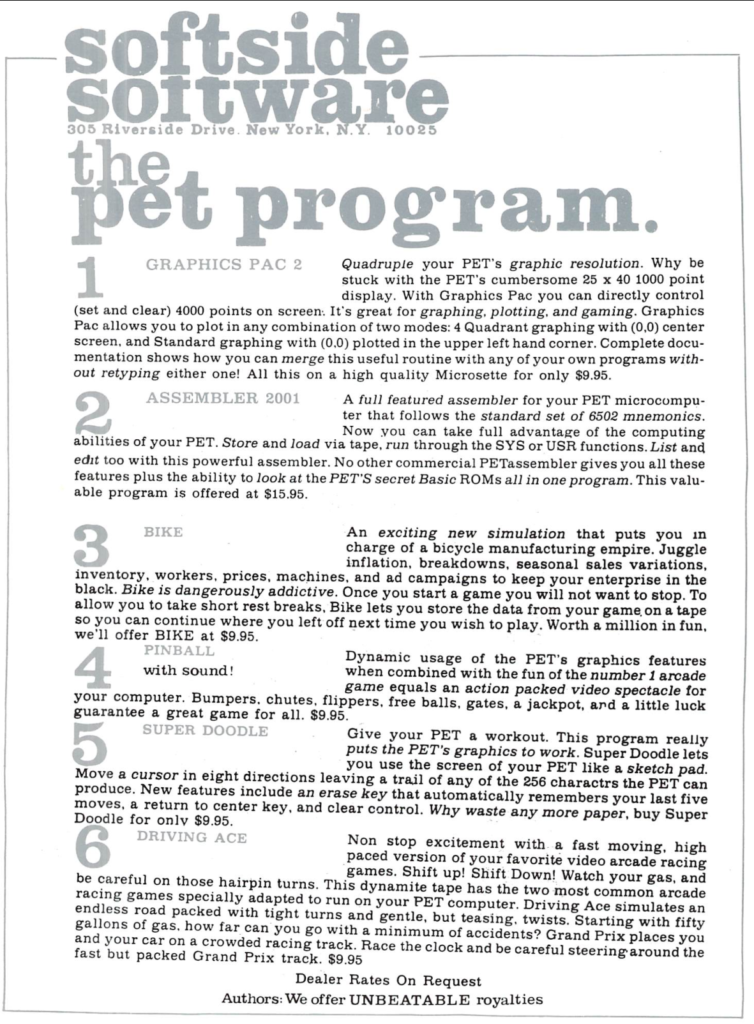
This is an ad, on the first page of the first issue of Compute Magazine, for “the pet program” from “softside software,” names all in lowercase. I have no idea if any copies of these programs remains in existence in our universe, but two places to look would be zimmers.net’s FTP archive and the Silicon PET Archive, and even in this era of the internet there are a fair number of PET software archives remaining.
Softside was far from the only company to put out its hopeful shingle through the pages of early computer magazines. At the time, magazine publishing worked with a lead time of several months. It is possible that Softside Software had gone under even by the time this ad saw print, but then again maybe not. A forum thread on AtariAge mentions several BASIC games sold by a “SoftSide,” apparently an Atari 8-bit magazine-on-disk, but they were based in New Hampshire, and the Softside of the ad was in New York.
Notes on the programs proffered:
Graphics Pac 2: I’m not sure what they mean, as the reference I’ve found claims the PET didn’t have a bitmapped display, but there were several models, and further add-on cards that added bitmapped displays, an 80-column mode, and even (gasp) color. A simple “Microsette” itself would not be enough. We are near the end of the PET’s reign as Commdore’s core product though.
Assembler 2001: It is easy to laugh this off nowadays when assemblers are mostly free software (and thank frog for that), but this was before that, and before the internet. $16 is a great price for an assembler from that time.
Bike. Apparently it was a Hammurabi/Lemonade Stand style game, where you made business decisions through simple menus and entering figures. Maybe someday someone will write such a game about running Commodore. You might scoff at the warning that “Bike is dangerously addictive,” but standards were lower then. It was 1979; Wizardry wouldn’t be published until 1981. “Worth a million in fun, we’ll offer Bike at $9.95.” I admire their chutzpah.
Pinball. “Dynamic usage of the PET’s graphics features” would have meant using its hardcoded, unchangable ROM graphics character set, with no sprites. “With sound!” That would mean its simple piezoelectric speaker. Don’t expect Raul Julia’s voice, or even Gorgar’s, to talk to you from the machine.
Super Doodle. Certainly of no relation to Omni Software’s popular Commodore paint program. Super Doodle lets you use any number of colors so long as they’re black or green, and a resolution of 40×25 characters. “Why waste any more paper.” Well probably because loading your notes off of tape would take too long.
Driving Ace. Offers two games for $9.95. The description doesn’t give a good sense of what they were like, but there are essentially only three kinds of racing game: scrolling in one direction (Monaco GP style), one screen or scrolling all around (Sprint style), and 3D (Pole Position through to Ridge Racer to F-Zero). I presume one of these is like Sprint and the other is like Monaco GP; I don’t think the PET was capable of even a slight approximation of 3D, but then, Pole Position’s hardware shouldn’t have been capable of what it could do either.
The ad is from Compute Magazine, most often stylized as COMPUTE! with an exclamation point, grew out of The PET Gazette in 1979. That former publication centered around the computing devices from Commodore International’s subsidiary, Commodore Business Machines. CBM had been around for over two decades up to that point as a maker of typewriters, adding machines and calculators, but in a maverick move by its co-founder and president Jack Tramiel, they bought MOS Technologies, which had just startled the nascent computing world by creating an ultra low cost microprocessor, the 6502. Tramiel had learned from a bit of a bastard move by Texas Instruments, who used their ownership of much of their supply chain to release a line of calculators that sold for less than Commodore’s production costs. Now, Tramiel owned the company that produced the chip that would soon launch the personal computing revolution, and could make other chips too, and Commodore was set to soon pull off Texas Instruments’ trick on the home computer industry with the VIC-20 and Commodore 64.
But until then they made other computers. They made the KIM-1 “single board computer,” and the PET 2001 and other machines with the PET branding. The PET Gazette’s audience was originally those machines, but burgeoning success convinced them to publish a more generalized 6502-focused magazine, and that magazine was Compute.
I have more to come on Compute, which in many ways was the archetypal type-in program magazine. It was far from the only one; other magazines offering type-in software at the time, names now even more obscure than Compute’s, were Creative Computing, Family Computing, and Commodore’s own publications Commodore Magazine and Power Play. Compute would for a while languish somewhat in the shadow of its own sister publication, borrowing part of its name from its predecessor, Compute’s Gazette, which focused on Commodore’s computers, the VIC-20, the Commodore 64, and later the Commodore 128.
The PET Gazette was founded by Small System Services Inc., and was published out of a shop, the Corner Computer Store, in Greensboro, North Carolina. Presumably that changed as the subscription rolls increased. Eventually Compute would be sold to ABC Publishing, a subsidiary of the broadcast network, and it would continue happily for several years. When its fortunes began to wane it was sold, first to Penthouse Publishing (really!), where its logo was redone to resemble that of its own publication Omni, then later to Ziff-Davis, who only wanted its subscriber list anyway; I don’t think they ever published an issue. As it became clearer that the future would be MS-DOS and Mac, its focus shifted, but they kept up their small systems focus for surprisingly long. I don’t think the Penthouse era provided any coverage that wasn’t DOS, Windows or Mac, but it would take time to check. Corrections later, if necessary.
A few days we linked to Cosmic Collapse, a Pico-8 Suika Game clone that, I claim, is better than the original, or its many many other clones. Its graphics are less cloying, its music is much better, its physics are livelier which adds a greater element of skill, and it has missiles awarded at different score levels that can be used to destroy individual planets.
Cosmic Collapse’s bin is slightly smaller than Suika Game’s, and to compensate a bit for that its “winning” “planet,” The Sun, is only the 10th item in the game, unlike of Suika Game’s Watermelon, which is the 11th of its orbular objects. Nether game really ends at that point, it’s the kind of game that continues until you lose, but it serves as a thematic success point.
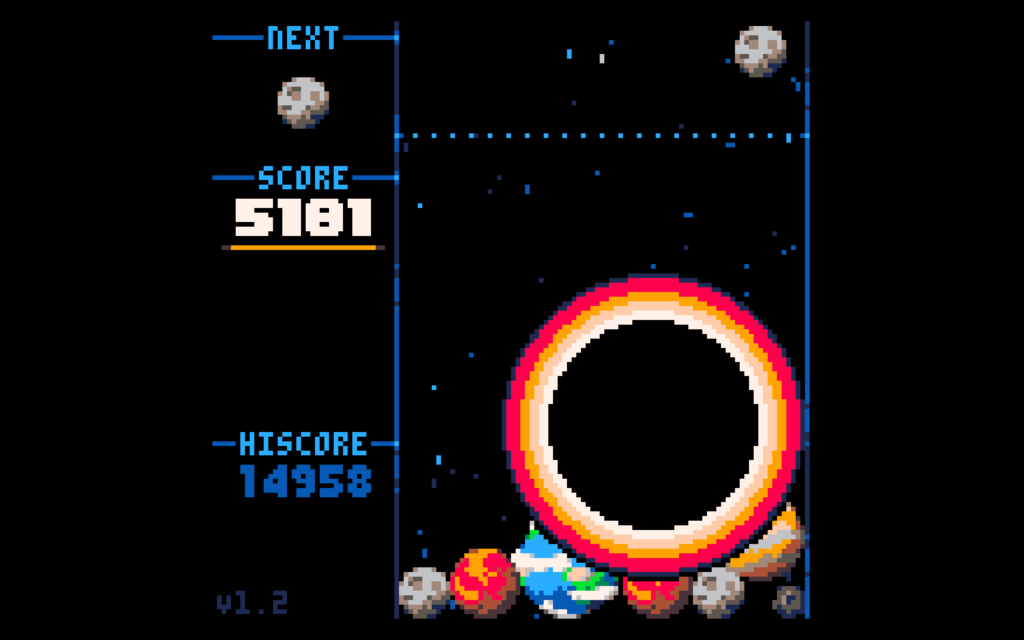
But as it turns out, as revealed by a comment by creator Johan Peltz on its itch.io page, Cosmic Collapse has two levels beyond sun. The first is a rather striking animated Black Hole object! After a lot of playing I finally managed to get to it. Here is a screenshot:
Pretty neat! The comment from the game’s creator mentions that there is a level past it, but that they don’t think it’s possible to reach. I don’t think it is either: to get to the Black Hole you have to have two Suns, and to get to that you have to have one Sun plus one Jupiter, Saturn, Neptune, Uranus, Earth, Mars, Mercury and Pluto. (I think it’s Pluto. What would it be if it wasn’t Pluto? Ceres?)
So, to get to the last object, you’d have to have a Black Hole plus a Sun, Jupiter, Saturn, Neptune, Uranus, Earth, Mars, Mercury and assumed-Pluto, which probably won’t all fit in one bin. My guess is it’s a guest appearance by some galaxy or something. Maybe someone can look at the game’s resources and find out what.
In addition to playing to get to Sun/Black Hole/Whatever Follows, it’s also possible to play Cosmic Collapse for score. The best way I’ve found to do that is to use missiles to destroy the largest objects when it becomes evident that you can’t do anything more with them. My highest score is nearly 15K. Indefinite play doesn’t seem quite possible, as missile awards come less frequently at higher scores, but it’s still fun to see how high one can get. (That’s not meant as a drug-inspired euphemism. Or a Donkey Kong-inspired one, either.)
Addendum: After writing this, I managed to get to Black Hole again, and got video of what it looks like in motion, which is pretty cool:
Sundry Sunday is our weekly feature of fun gaming culture finds and videos, from across the years and even decades.
I’ve always been a little ambivalent about Metal Slug. Not about its gameplay, which is excellent, but about its theme. It’s been said that it is impossible to depict warfare without glorifying it in some way. I think there is some truth to that, and there is no question that the Metal Slug games depict the hell out of it.
I think the Metal Slug makers recognize a bit of that, because of how humanely the enemy soldiers are depicted. They’re all trying to kill you, but they’re far from snarling villains. When not actively trying to bring about the end of Marco and Tarma (and Fio and Eri)’s lives, they’re chatting with each other, having a meal, sunning themselves on the deck of a ship, using the toilet or just hanging out. When they spot the invading players, they often react in terror. Sometimes you don’t want to shoot them, even when they’re climbing on your Slug and trying to throw a grenade in the hatch. Even their leader, General Morden, is not the typical villain. His backstory says that dissatisfaction with corruption in the Regular Army’s ranks, along with the loss of his wife and daughter due to an act of terrorism, was what caused him to launch his rebellion, and his solders admire his leadership.
It’s almost enough to make one want to overlook the questionable aspects of his army’s symbology, for which I can only thank my lucky frog the usual suspects haven’t latched onto. Morden is rehabilitated a bit in the endings of Metal Slugs 2 and 3, where he’s betrayed by the Martians he joined forces with, and helps the player’s commandos defeat, but its true that he’s always the antagonist at the start of each later game. Metal Slug, for all its sci-fi, zombie, magic and other trappings, is still a game about depicting conventional warfare, no matter how one-sided and improbable it may be.
Ah, as is often my habit, I used the subject of the post to write a short essay on some aspect of gaming. I hope you don’t mind. Here is the video, a stop-motion recreation of a typical Metal Slug scene, made by official entities to promote a mobile game. It seems appropriate to the subject.
There is a subtle flaw in SNES art creation tool Mario Paint. It has 32K of Save RAM, which is not technically enough to save an entire project, normal and animation canvases included. The program uses data compression to get everything to fit, and the compression is good enough that most of the time everything can be squeezed in, but such is the nature of data compression that it is not guaranteed to work on all possible data.
What happens when Mario Paint can’t fit everything into its save file? This:
A comment on the video gives purpose to the numbers the robot displays as it counts down. 100-25 is compressing the image; 25-12 is erasing the save RAM, and 12-0 is copying the data into save RAM.
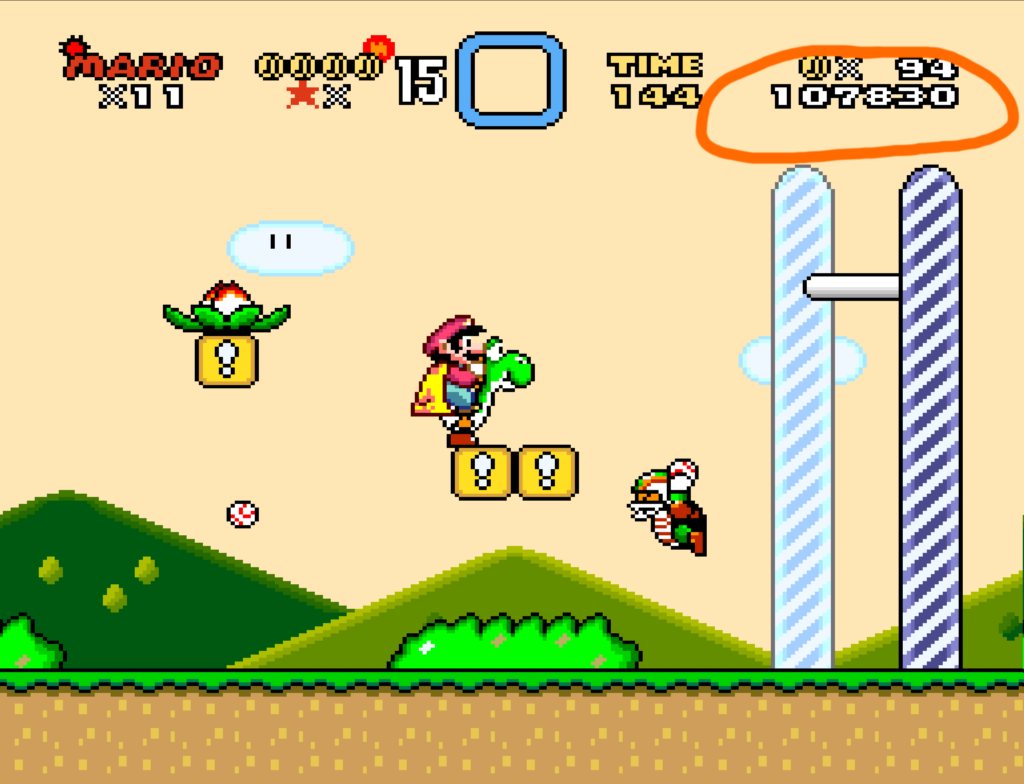
Awesome Mario trivia blog Supper Mario Broth noted on Mastodon that Super Mario World is extremely inefficient in displaying Mario’s score.
There is more information on SWMspeedruns.com, but in brief, SMW stores the player’s score as a 24-bit value as hexadecimal digits, and converts that value to decimal when it’s time to display it. There is no good way to do that that doesn’t involve figuring out the entire arithmetic, but Super Mario World does it particularly slowly: it starts with a copy of the score, then sees if it’s over 1,000,000. If it is, it increases the millions digit of the displayed score by 1, subtracts a million from the work value, then repeats. When it runs out of millions it repeats with the hundred-thousands, and repeats until it finishes with the tens. At least it doesn’t try it with the 1s, seeing as how nothing in the game awards single points!
In a worse-case scenario, with a score of 9,999,990, the code goes through this whole process every frame, consuming up to 8% of the time available for game logic.
What could the game have done to accomplish this better? It could have found out how many of each digit there was once instead of looping and incrementing. It could only figure out the score when the value changes. Or it could save the value as the digits themselves in decimal, just increment them by the right values when its needed, and then copy that figure to the screen. That’s largely what 8-bit games would do.
Even worse, if Luigi is the active character, the game does this twice: it figures out and prints Mario’s score, then it does it again for Luigi’s score, placing it onscreen in the same place.
While printing the score is just one thing the game does each frame, the effect is great enough that complex scores can lag the game, enough that speedrunners take the score into account to avoid it.
This adds to the evidence that Super Mario World development was rushed. It’s already known that a lot of the code in SMW is buggy, allowing for some truly heroic exploits like programming a text editor in SRAM purely by manipulating objects in an early level.